

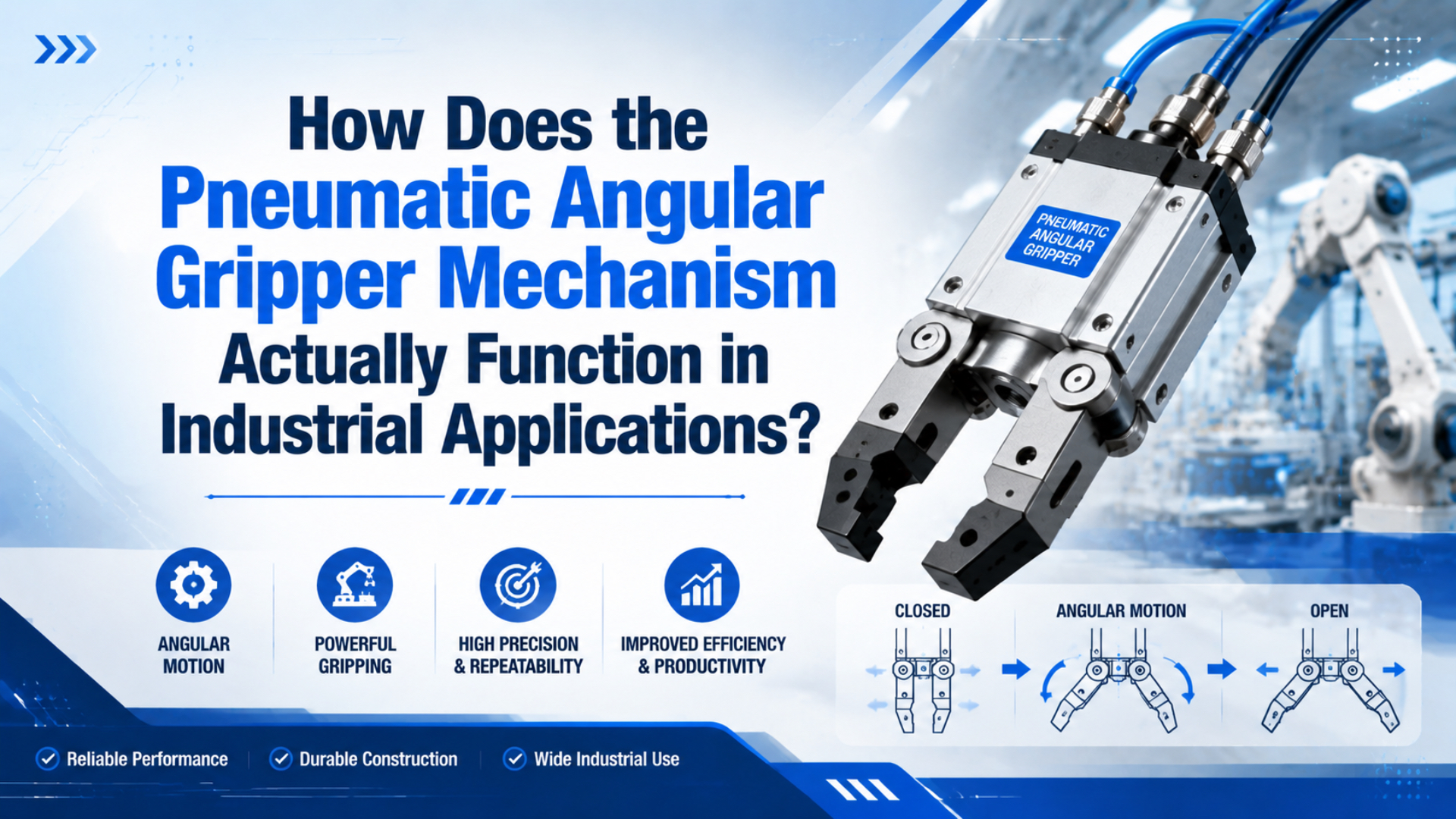
A pneumatic angular gripper is a compressed-air end effector that moves a piston, transfers that linear motion through a rack-and-pinion, lever, cam, or toggle mechanism, and rotates two synchronized jaws around fixed pivots. The attached fingers follow arcs rather than straight lines. As a result, the contact radius, finger angle, clearance envelope, and available force at the part can all change during opening and closing. The valve determines piston direction, but the internal mechanism determines jaw motion. Usable grip performance must therefore come from the selected model’s force or moment curves, not from a universal wedge multiplier.
Key Takeaways
- Angular gripper fingers rotate through an arc; they don’t remain parallel through the stroke.
- SMC lists 0.10 to 1.36 N·m effective gripping moment at 0.5 MPa across four MHC2 sizes.
- Check force at the real contact radius, allowable finger loads, backlash, sensing, and the depressurized state separately.
For broader type selection, compare this mechanism guide with the pneumatic gripper types overview and the dedicated parallel versus angular gripper comparison. This article stays with what happens inside an angular gripper and what that motion means at the fingertips.
From Pneumatic Piston Travel to Jaw Rotation
An angular gripper can complete the air-to-jaw motion chain in a compact body. SMC’s MHC2 catalog lists a 30° to -10° total opening and closing range, while its four standard bore sizes produce 0.10 to 1.36 N·m effective gripping moment at 0.5 MPa (SMC, accessed 2026).
The sequence starts when a directional valve connects one chamber to supply air and the other to exhaust. The pressure difference acts on the piston area and creates linear thrust. In a double-acting gripper, reversing the valve reverses piston travel. In a single-acting version, air drives one direction and a spring defines the return direction.
The piston then drives the transmission. Gears, links, cam faces, or toggle links convert its translation into rotation at the two jaw pivots. A positive-drive arrangement synchronizes the base jaws; equal pressure alone does not. Custom fingers attach to those jaws and establish the real contact points.
This distinction matters when diagnosing motion. A valve can shift correctly while a finger collides with the fixture. A piston can reach its end position while the part is absent. The chain is pneumatic at the input, mechanical through the middle, and geometric at the workpiece.
For the straight-line alternative, see how a pneumatic parallel gripper synchronizes opposing jaws.
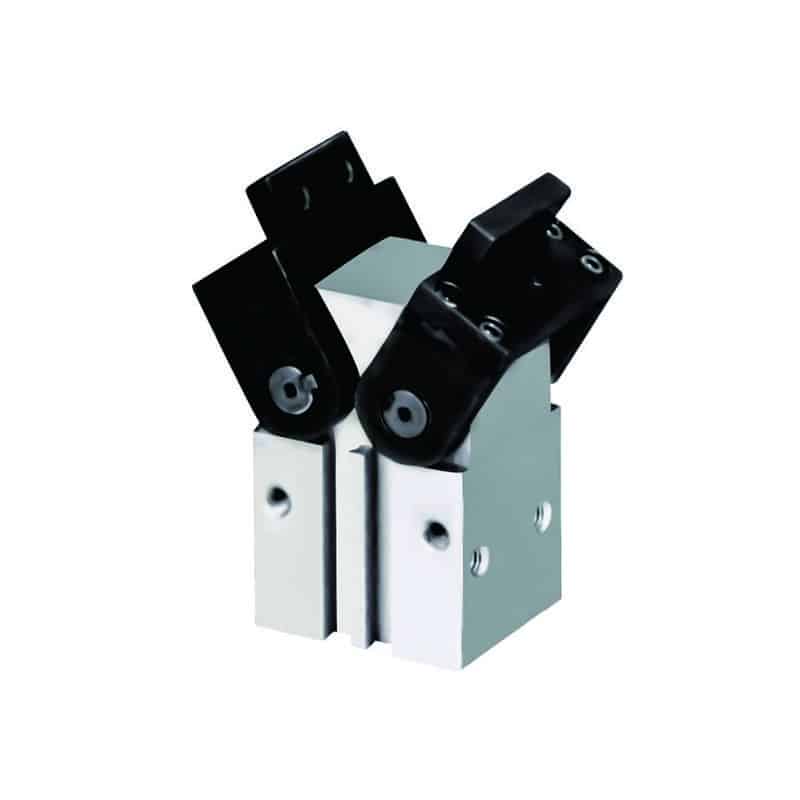
Which Mechanisms Actually Drive Angular Jaws?
There isn’t one universal angular-gripper transmission. Festo specifies a rack-and-pinion design for the HGWC, while Zimmer’s GG1000 uses a positively driven lever mechanism to synchronize its jaws. SCHUNK identifies a lever-gear drive and spring reset in the SGB 50 (Festo, 2016; Zimmer, accessed 2026; SCHUNK, accessed 2026).
These mechanisms solve the same conversion problem in different ways:
| Mechanism | Motion conversion | Engineering consequence |
|---|---|---|
| Rack and pinion | Piston-driven rack rotates a pinion connected to the jaws | Positive angular synchronization; gear clearance contributes to backlash |
| Lever gear or linkage | Piston thrust acts through pivoted links or gears | Compact package; output moment varies with linkage geometry |
| Cam and follower | A shaped drive surface moves a follower connected to each jaw | The profile controls displacement and mechanical advantage through the stroke |
| Toggle | Links approach a near-straight condition at closure | High holding capability near the designed end position; release behavior is model-specific |
The product name alone doesn’t reveal the complete load path. Two grippers can have the same opening angle and different piston arrangements, pivot spacing, bearing support, spring direction, or force curves. An exploded drawing and manufacturer force data are more useful than assigning every product to a broad “cam” or “wedge” stereotype.
The best mechanism question is not, “Which transmission multiplies force the most?” Ask where the mechanism has usable moment, how much clearance appears at the finger tip, and whether the production contact occurs inside the published curve. High theoretical mechanical advantage outside the intended jaw position has little value.
Why Does the Fingertip Follow an Arc?
Angular motion places every fingertip point on a circular path around its jaw pivot. Festo offers HGWC variants with 30° or 80° maximum opening angle, so the swept envelope can differ considerably in size even within one product family (Festo, 2016).
If a fingertip lies at radius r from the pivot and rotates through angle θ, its travel can be resolved as:
Horizontal change = r x (cos θ1 - cos θ2)
Vertical change   = r x (sin θ2 - sin θ1)
Arc length        = r x |θ2 - θ1|, with angle in radians
These equations describe motion, not grip force. They help determine whether the finger clears a nest wall, whether its pad rolls across the part, and whether an open jaw can strike guarding. Double the finger radius and the arc length doubles for the same angular change.
What happens at contact? Unless the pad is shaped to compensate, its surface orientation rotates with the jaw. A flat pad may touch an edge first, then increase its contact area as the jaw closes. A contoured finger can instead capture a shoulder or cylindrical feature. Angular jaws do not automatically center every irregular part.
Create the swept envelope in CAD using the maximum permitted finger length, full opening angle, manufacturing tolerance, and mounting error. Include hoses, sensor cables, fasteners, nearby tooling, and the path used to remove the part. The body outline alone is not enough.
How Should You Read Gripping Moment and Finger Force?
Manufacturers may publish moment, finger force, or both. For example, SCHUNK lists 4.95 N·m closing moment, 825 N closing force at zero finger length, and 50 mm maximum finger length for the SGB 50 at its stated conditions (SCHUNK, accessed 2026).
Gripping moment is rotational output at the jaw system. A first geometric approximation relates moment and tangential force:
Tangential force at one contact = applicable jaw moment / contact radiusDo not use that expression until the catalog definition is clear. SCHUNK defines the SGB closing moment as the arithmetic sum of the moments at the individual jaws. Another manufacturer may publish effective force per finger at a specified gripping point. Dividing a total two-jaw moment by one radius without checking the definition can double the expected contact force.
For a friction grip, estimate the required force per jaw before checking the product curve:
Required force per jaw = m x (g + a) x S / (μ x n)Here, m is workpiece mass, a is acceleration in the possible slip direction, S is the chosen safety factor, μ is a conservative friction coefficient, and n is the number of jaws sharing the load. The pneumatic gripper force calculator can run this preliminary friction calculation.
Suppose a 1.5 kg part accelerates upward at 4 m/s², with two jaws, μ = 0.25, and S = 2. The estimate is 82.9 N per jaw. That is required contact force. It is not permission to select any gripper whose bore could theoretically produce 82.9 N. Confirm available force at the actual pressure, jaw angle, contact radius, and finger projection.
Force margin and jaw-load margin are different. A gripper may create enough tangential force to prevent slip while an offset finger exceeds the permitted moment on the base jaw. Check the holding calculation and the allowable Mx, My, Mz, and axial loads independently.
Why Doesn’t Wedge Angle Alone Prove Self-Locking?
SMC’s MHT2 is explicitly a toggle gripper: the manufacturer states that its toggle mechanism gives stable force and holds the workpiece when air is shut down. That product-specific feature cannot be inferred from a generic wedge angle or transferred to every angular gripper (SMC MHT2, accessed 2026).
Ideal inclined-plane equations omit friction direction, link compliance, tolerances, wear, impact, and the actual back-driving path. They can illustrate a geometric tradeoff, but they do not certify a gripper as self-locking. Even the word “hold” needs context: does the mechanism retain nominal force, prevent immediate opening, or safely carry a suspended part after leakage and vibration?
A spring-closed gripper, a toggle mechanism, and a pilot-operated check valve solve different problems. The spring stores mechanical energy. The toggle resists reverse motion near a designed position. The check valve traps pneumatic pressure, which can still decay through seals, fittings, tubing, or the valve itself.
Treat air-loss behavior as a machine safety function. Verify the exact model, finger geometry, payload orientation, valve center condition, exhaust path, residual pressure, restart sequence, and foreseeable leakage. ISO 4414 provides general pneumatic-system safety requirements, but the complete machine risk assessment must decide whether releasing or retaining the part creates the lower risk (ISO 4414, 2010).
What Changes With Finger Length and Jaw Angle?
Finger length changes both the contact path and the load on the gripper. SCHUNK limits the SGB 50 to 50 mm maximum finger length and plots gripping force against finger length, while its closing-moment curve varies with opening angle (SCHUNK, accessed 2026).
Longer fingers increase the contact radius. For the same jaw moment, tangential force generally falls as radius increases. The larger projection also amplifies bending moments from part weight, acceleration, off-center contact, and impacts. Meanwhile, the fingertip travels farther for each degree of jaw rotation.
Jaw angle changes the direction of the contact force relative to the part. On a flat workpiece, the pad may slide or roll while closing. On a shaped pocket, force can resolve into a locating component and a clamping component. Friction, finger stiffness, and part tolerance then determine how the load is shared.
Do you need a stronger gripper or a better finger? A form-fit finger that captures a shoulder can reduce dependence on friction, but it introduces dimensional and release-clearance requirements. A larger soft pad may protect a delicate surface, yet its compliance can reduce positioning accuracy. Finger design is part of the mechanism, not an accessory added after sizing.
Check at least these four positions in CAD and in the manufacturer curves: fully open, first possible contact, nominal production contact, and fully closed without a part. The no-part position matters because sensors can report “closed” even when the workpiece was never gripped.
How Do Sensors, Springs, and the Depressurized State Interact?
Position sensing and force retention are separate functions. Festo lists proximity-sensor position detection for the HGWC and repeatability of 0.05 mm or better, while Zimmer’s GG1000 uses a permanent magnet for piston sensing and can include a spring energy store for grip-force safety (Festo, 2016; Zimmer, accessed 2026).
A body-mounted magnetic sensor usually detects piston or drive position, not contact force. An “open” sensor can confirm the mechanism returned to its reference region. A “closed” sensor can indicate that the piston passed a switch point. Neither proves that the part is present, seated correctly, or held with enough force.
For part confirmation, combine signals according to the risk: two jaw-position windows, an external presence sensor, pressure monitoring, a robot position check, or a dedicated grip-detection device. The choice depends on part variation and the consequence of a missed pick.
The spring direction also matters. A normally open single-acting gripper releases when pressure falls; a normally closed arrangement applies spring force. A double-acting model may remain where friction leaves it, move under external load, or release as trapped pressure decays. Never derive the safe state from “single acting” or “double acting” alone.
The circuit should define what happens during emergency stop, valve de-energization, hose rupture, slow pressure decay, manual exhaust, and restart. For the pneumatic side of that sequence, review how a solenoid valve routes compressed air and how pressure drop changes actuator performance.
How Do You Diagnose Backlash, Sticking, and Uneven Contact?
Accuracy terms describe different errors. Festo specifies HGWC repetition accuracy of 0.05 mm or better, jaw backlash up to 0.1 mm, angular jaw backlash up to 0.5°, and interchangeability up to 0.2 mm. One number cannot substitute for the others (Festo, 2016).
Start with the symptom and move through the air-to-contact chain:
| Symptom | First checks | Likely area to isolate |
|---|---|---|
| Both jaws are slow in both directions | Dynamic pressure, valve flow, speed controls, exhaust restriction, tube size | Air supply or valve circuit |
| Jaws move but the part slips | Pressure during contact, pad friction, acceleration, contact radius, finger flex | Sizing or finger geometry |
| One jaw appears to lead | Loose finger, collision, pivot play, gear or linkage clearance | Tooling or transmission |
| Motion is jerky near one angle | External interference, contamination, damaged contact surface, side load | Finger path, bearing, cam, or linkage |
| Sensor changes state without a part | Switch location, empty-close position, sensor logic | Detection strategy |
| Jaws open after air isolation | Spring direction, trapped-volume leakage, external load, retention feature | Circuit and safe-state design |
Measure pressure while the gripper cycles and again while it contacts the part. Static regulator pressure can remain correct while point-of-use pressure collapses during simultaneous demand. If both jaws slow together, check the common air path before dismantling the mechanical drive.
If only one side behaves differently, remove energy safely and inspect both custom fingers first. A bent finger, loose fastener, uneven pad, or fixture collision can imitate internal backlash. Long fingers make small pivot clearances more visible at the contact point.
Maintenance intervals must come from the selected manual. SMC lists the referenced MHC2 as non-lube, while Zimmer states up to 10 million maintenance-free cycles for the GG1000 series (SMC, accessed 2026; Zimmer, accessed 2026). Neither statement supports a universal relubrication schedule.
A changing fingertip position is not automatically poor repeatability. It may be the expected amplification of angular backlash at a long radius. Measure at the base-jaw reference and the real contact point, then compare each result with the correct catalog definition.
FAQ
Angular gripper specifications vary enough that model data should replace rules of thumb. Across the examples in this guide, opening ranges include 8°, 30°, and 80°, while repeatability spans 0.01 to 0.1 mm depending on the model and manufacturer’s definition (SMC, accessed 2026; Festo, 2016; SCHUNK, accessed 2026).
Do pneumatic angular grippers naturally center irregular parts?
No. Their jaws rotate symmetrically when the mechanism positively synchronizes them, but the part centers only if finger geometry, contact surfaces, friction, and fixture freedom create a centering load path. Irregular parts may contact one finger first or shift as the pad angle changes. Validate centering with the finished fingers and production tolerances.
Is gripping force constant through the opening angle?
Not necessarily. Linkage geometry, cam profile, pressure, friction, and contact radius can change the usable force or moment through the stroke. Some products are designed for nearly constant output, while others publish angle-dependent curves. Read the manufacturer’s curve at the planned contact angle and finger length rather than applying one nominal force everywhere.
Can a wedge-style angular gripper hold a part after air loss?
Only if the manufacturer documents a suitable holding or locking function for that exact model and position. Wedge angle alone doesn’t prove safe retention. A toggle gripper such as SMC’s MHT2 is specifically designed to hold after air shutoff, but payload, fingers, valve state, leakage, vibration, and the machine risk assessment still require verification.
How do I calculate force for an angular gripper?
First estimate the contact force needed from mass, acceleration, friction, jaw count, and a justified safety factor. Then use the manufacturer’s gripping-moment or finger-force curve at the actual pressure, jaw angle, and contact radius. Finally, check permitted finger length, jaw moments, surface pressure, part deformation, and the depressurized state.
What is the difference between repeatability and backlash?
Repeatability describes how closely the mechanism returns to a previous end position under stated conditions. Backlash is lost motion from clearance when load or direction changes. A gripper can repeat well from one approach direction yet show noticeable fingertip movement under reversing load, especially when long fingers amplify angular play.
Sources
The six primary references below cover four distinct mechanisms and three documented opening-angle values: 8°, 30°, and 80°. They are manufacturer catalogs or standards pages, so model numbers, conditions, and definitions should travel with every extracted specification rather than being presented as universal angular-gripper limits (SMC, accessed 2026).
- SMC, “Angular Type Air Gripper MHC2,” accessed 2026: https://www.smcworld.com/catalog/en/rotary_airchuck/MHC2-E/7-6-3-p0807-0815-MHC2_en/data/7-6-3-p0807-0815-MHC2_en.pdf
- SMC, “Toggle Type Air Gripper MHT2,” accessed 2026: https://www.smcworld.com/webcatalog/en-my/rotary-actuators-air-grippers/angular-type-air-grippers/MHT2-Z-E
- Festo, “Angle Grippers HGWC,” 2016: https://ftp.festo.com/Public/PNEUMATIC/SOFTWARE_SERVICE/Documentation/2016/US/HGWC_ENUS.PDF
- SCHUNK, “SGB 50 Angular Gripper,” accessed 2026: https://schunk.com/us/en/gripping-systems/angular/radial-gripper/sgb/sgb-50/p/000000000000305201
- Zimmer Group, “Series GG1000 2-Jaw Angular Grippers,” accessed 2026: https://www.zimmer-group.com/en/products/components/handling-technology/2-jaw-angular-grippers/series-gg1000
- ISO, “ISO 4414:2010 Pneumatic Fluid Power,” 2010: https://www.iso.org/standard/44790.html