


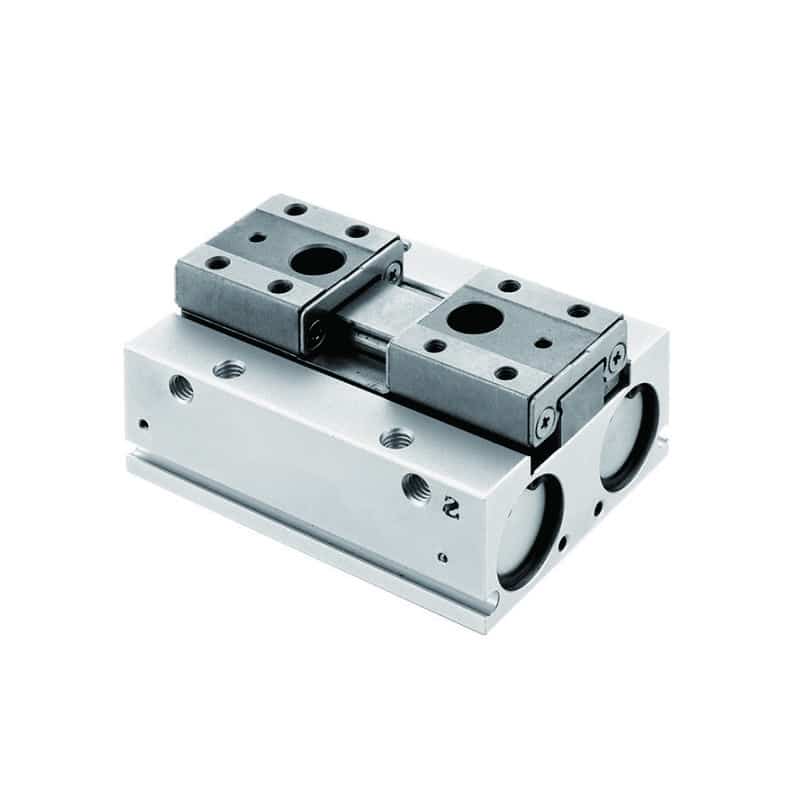
Pneumatic parallel grippers use compressed air to move a piston, then a mechanical transmission converts that piston motion into equal and opposite travel at two guided base jaws. The attached fingers contact the workpiece. A valve controls opening and closing, while sensors report jaw position and an optional spring or pressure-retention device can define what happens if air is lost. Pressure alone can’t synchronize the jaws. The wedge, rack-and-pinion set, inclined plane, or another positive-drive mechanism creates that relationship throughout their travel. Piston force is therefore not the same as usable grip force at the part. Finger projection, contact position, friction, acceleration, and jaw loading all sit between those two numbers.
Key Takeaways
- Pressure drives the piston; the transmission synchronizes the two jaws.
- SMC reports effective force per finger at a defined pressure and gripping-point distance, not as one universal body-force value for every finger arrangement.
- Check repeatability, backlash, finger projection, moment load, sensor state, and air-loss behavior as separate specifications.
For a comparison of parallel, angular, centering, and wide-opening designs, start with this pneumatic gripper types guide. This article stays with the internal motion chain and the engineering checks that follow from it.
From Valve Signal to Parallel Jaw Motion
A modern 2-jaw parallel gripper can turn one pneumatic command into synchronized linear motion through four functional stages. Zimmer’s 2026 GPP5000 instructions identify a double-acting pneumatic drive, a piston, a wedge-hook transmission, and two opposing guide rails (Zimmer Group, 2026).
The command usually begins at a directional valve. When the PLC energizes one valve state, supply air enters one gripper chamber while the opposite chamber exhausts. The pressure difference moves the piston. Switching the valve reverses the pressure path and piston direction. A single-acting version uses air for one direction and a spring for the other, so its normal state is defined by the spring arrangement.
The piston doesn’t normally touch the workpiece. It pushes or rotates an internal transmission. That transmission drives the two base jaws in opposite directions, while the guides constrain them to linear travel. Custom fingers bolt to those jaws and establish the actual contact geometry.
Why separate base jaws from fingers? The catalog’s stroke, repeatability, and load ratings usually describe the gripper body or base-jaw reference. The application-specific fingers add length, mass, contact pads, offsets, and moments that the body must carry.
SCHUNK also notes that published opening and closing times describe base-jaw movement only. Valve switching time, hose filling, and PLC reaction time are outside that number (SCHUNK MPG-plus 32, accessed 2026). For full station timing, use the separate pick-and-place cycle-time guide and review how the solenoid valve controls airflow.
Which Transmission Mechanism Keeps Both Jaws Synchronized?
Jaw synchronization is mechanical, not a result of equal air pressure at two separate jaws. Zimmer’s 2026 instructions state that piston force passes through one wedge-hook mechanism to move both jaws together, while the SMC MHL2 parts list shows two pistons connected through racks and a pinion (Zimmer Group, 2026; SMC, accessed 2026).
Several mechanisms can produce parallel motion. They solve the same kinematic problem in different packages:
| Transmission | How it moves the jaws | Design consequence |
|---|---|---|
| Wedge hook | Axial piston travel pushes angled surfaces connected to both jaws | Compact force transfer; guide and wedge condition affect backlash |
| Rack and pinion | Opposed racks engage one pinion so one jaw mirrors the other | Positive synchronization; gear clearance contributes to lost motion |
| Inclined plane | Piston movement acts across angled drive faces | Short package; opening and closing force can differ |
| Dual guided slide with linkage | One drive element connects two guided jaw carriers | Wide stroke is possible, but linkage and guide loads require attention |
The mechanism also explains why opening force and closing force may differ. A current Festo HGPM-12 datasheet lists 27 N per jaw while opening and 13.5 N while closing at 6 bar for that particular single-acting model (Festo, 2026). Those values belong to one design, not every parallel gripper.
The useful selection question is therefore not simply, “Are both jaws powered?” Ask whether the transmission positively couples the jaws, how its clearance appears at the finger tips, and whether the catalog force curve covers internal gripping, external gripping, or both. That distinction is more diagnostic than counting pistons from an exploded view.
Why Is Grip Force Not Simply Pressure Times Piston Area?
Piston area times pressure estimates theoretical actuator force, but it doesn’t state the usable force at the part. SCHUNK’s MPG-plus 32 lists 80 N closing force, 70 N opening force, 4 mm stroke per jaw, and a 40 mm maximum finger length as separate specifications (SCHUNK, accessed 2026).
The basic piston relationship is still useful inside the gripper:
Theoretical piston force = gauge pressure x effective piston areaAfter that point, the transmission ratio, seal friction, guide friction, and geometry determine base-jaw force. The attached fingers then move the contact point away from the jaw face. That projection creates a moment on the guide and can reduce the allowed operating envelope even when the nominal grip-force number looks adequate.
There are three different forces to keep straight:
- Piston force is the pressure-area result inside the pneumatic drive.
- Base-jaw force is the output after the internal transmission and friction.
- Contact force is the force available at the real finger position and part surface.
Which one belongs in a selection calculation? Use the manufacturer’s effective grip-force curve at the actual pressure and gripping-point distance. Then compare that available per-finger force with the force required to prevent slip, while also checking the jaw’s permitted axial force and moments.
This is why raising pressure isn’t a universal cure. Higher pressure can increase drive force, but it doesn’t remove excessive finger projection, a low-friction pad, an off-center part, or an overloaded guide. The product’s maximum pressure and load curves still apply.
What Determines the Actual Force at Each Finger?
SMC defines the MHL2 effective gripping force as the thrust of one finger when all fingers and attachments contact the work. Its worked example obtains 73 N at a 70 mm gripping point and 0.5 MPa, showing why pressure, contact distance, and per-finger force must be read together (SMC, accessed 2026).
For a symmetric friction grip, a useful preliminary estimate is:
Required force per jaw = m x (g + a) x S / (mu x n)Where m is part mass, a is acceleration in the slip direction, S is the safety factor, mu is the conservative friction coefficient, and n is the number of load-sharing jaws. This equation assumes the fingers squeeze the part by friction. A form-fit finger that captures a shoulder or pocket needs a different load-path review.
Consider a 2 kg part accelerated upward at 3 m/s², with two jaws, mu = 0.30, and a safety factor of 2. The estimate is 85.4 N per jaw. That is required contact force, not a catalog body size. The selected gripper must provide at least that force at the real finger length and working pressure, with acceptable moments.
A force margin can still be unsafe if the contact pressure damages the part. Soft packaging, thin-walled components, glass, and coated surfaces may need larger pads or form-fit fingers instead of more pneumatic force. The holding calculation and the surface-pressure check answer different questions.
What Do Repeatability, Backlash, and Jaw Play Really Mean?
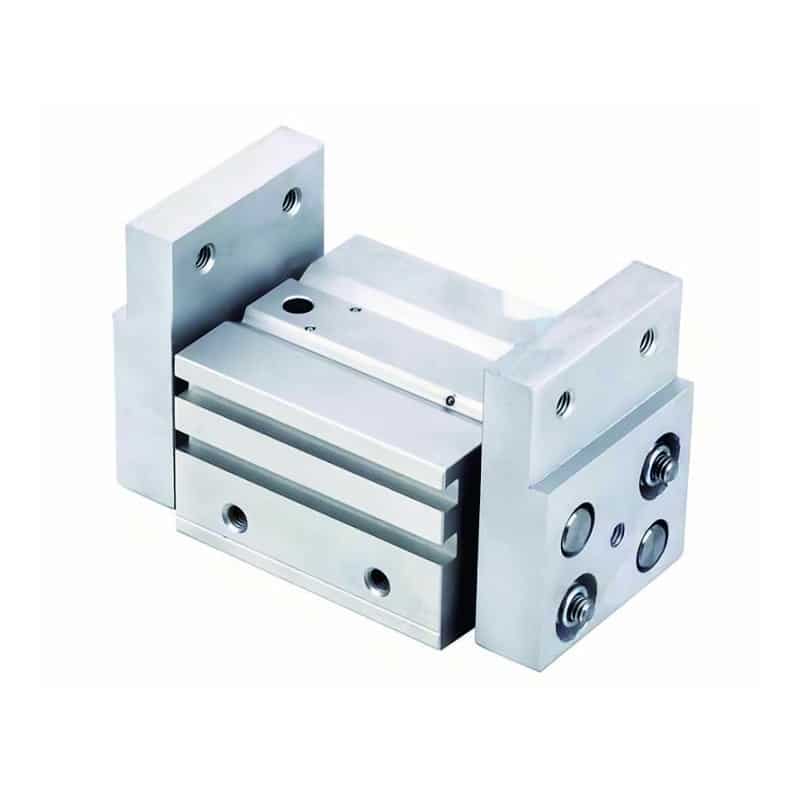
One current Festo HGPM-12 sheet separates repetition accuracy of 0.05 mm or better, jaw backlash below 0.03 mm, and maximum interchangeability of 0.2 mm. These three numbers describe different errors, so none should be relabeled as jaw parallelism throughout the stroke (Festo, 2026).
Repeatability describes how closely the jaw returns to a previous position over repeated cycles under defined conditions. SCHUNK derives it from 100 end positions. It doesn’t prove absolute dimensional accuracy, nor does it guarantee where a new gripper body will sit after replacement.
Backlash is lost motion caused by clearance in the drive and guide system. Direction reversal exposes that clearance. At long finger tips, a small angular or linear clearance can create a larger contact-position change.
Jaw play can be linear or angular freedom at the base jaw. Interchangeability instead describes unit-to-unit variation, while centering accuracy describes how closely opposed jaws locate a nominal center. Parallelism is the geometric alignment between relevant jaw or finger surfaces. Some values may be absent.
| Specification | What it helps predict | What it does not prove |
|---|---|---|
| Repeatability | Return to a previous jaw position | Absolute part position or jaw parallelism |
| Backlash | Lost motion after direction reversal | Load capacity at long finger projection |
| Interchangeability | Shift when one unit replaces another | Repeatability of one installed unit |
| Centering accuracy | Location of the gripped center | Surface damage or holding force |
| Permitted jaw loads | Axial force and moment capacity | Whether the part will slip between pads |
For a precision station, measure the finished fingers at the actual contact location. Body repeatability can be excellent while thin fingers flex, fast acceleration moves the part inside the pads, or fixture tolerance dominates the final position.
How Do Sensors, Spring Retention, and the Safe State Work?
Zimmer’s 2026 GPP5000 instructions allow sensors to detect jaw positions and describe spring-equipped variants whose spring acts as a grip-force safety device. That feature changes the depressurized state, but it doesn’t by itself prove that a suspended part will remain safely retained (Zimmer Group, 2026).
Position sensing usually starts with a magnet connected to the piston or drive and one or more magnetic field sensors in the body. Depending on the design, the system can report open, closed, or an intermediate jaw position. An external part-present sensor may still be needed because a “closed” signal can mean the fingers reached the end stop without touching a part.
A spring-assisted gripper can be configured to open or close when air is removed. Mechanical grip-force maintenance and pneumatic pressure-retention valves are other options. Each has limits. A spring provides finite force, trapped pressure can leak away, and a non-return valve doesn’t eliminate hose, fitting, or seal leakage downstream.
Before selecting the fail state, ask what the mechanism should do during emergency stop, power loss, valve de-energization, and gradual pressure decay. Would dropping the part create a greater hazard than continuing to clamp it? That decision belongs in the machine risk assessment, not in a generic “normally open” preference.
The pneumatic circuit also matters. Confirm the valve’s normal and de-energized states, exhaust path, residual pressure, manual override behavior, and restart sequence. The single-acting versus double-acting guide helps explain the actuator behavior, but the complete safe state must be verified on the assembled machine.
ISO 4414 provides general rules and safety requirements for pneumatic systems and components (ISO 4414, 2010). Apply it together with the gripper manual, the machine’s safeguarding design, and the applicable local regulations.
How Do You Diagnose Uneven Motion and Lost Grip?
Maintenance intervals are model-specific: Zimmer’s 2026 instructions state up to 30 million maintenance-free cycles for GPP5000/GPD5000 and up to 15 million for the AL variants. Those figures cannot justify a universal daily, weekly, or monthly schedule for every pneumatic gripper (Zimmer Group, 2026).
Start diagnosis at the symptom and follow the motion chain instead of replacing seals by habit:
| Symptom | First checks | Likely mechanism to isolate |
|---|---|---|
| Both jaws are slow in both directions | Dynamic pressure at the valve, flow controls, exhaust restriction, tube size | Air supply or valve flow |
| Force falls but speed seems normal | Pressure during contact, leaks, regulator behavior, contact-point distance | Supply pressure, seals, or sizing margin |
| One jaw leads or sticks | Finger collision, guide contamination, loose tooling, drive backlash | Guide or synchronization mechanism |
| Position signal changes but the part is missing | Sensor location, closed-without-part end stop, finger wear | Sensing logic or finger geometry |
| Jaws move when air is isolated | Trapped pressure, spring direction, valve leakage, residual energy | Circuit and defined safe state |
Measure pressure while the machine cycles. Static regulator pressure can look correct while point-of-use pressure falls during simultaneous demand. The pressure-drop troubleshooting guide covers that distinction.
Air quality requirements must come from the selected product. ISO 8573-1 classifies particles, water, and oil; it doesn’t assign one purity class to all grippers (ISO 8573-1, 2010). For example, SCHUNK specifies [7:4:4] for the referenced MPG-plus model. If moisture is suspected, review pressure dew point at the machine rather than assuming every sticky jaw needs lubrication.
Uneven jaws are not automatically proof of unequal pneumatic force. A positive-drive transmission mechanically couples the jaws, so asymmetric motion often points to an external finger collision, guide contamination, loose tooling, or internal clearance. Disconnect energy safely before checking any moving interface.
FAQ
The five answers below separate common catalog values from universal rules. For context, the referenced SCHUNK MPG-plus 32 lists 2 to 8 bar operating pressure, 4 mm stroke per jaw, and 0.02 mm repeat accuracy, but another gripper can have different limits (SCHUNK, accessed 2026).
Do pneumatic parallel gripper jaws move independently?
Normally, no. In a positive-drive design, one wedge, rack-and-pinion set, or linkage mechanically synchronizes the two base jaws. Zimmer’s 2026 GPP5000 instructions describe one wedge-hook mechanism moving both jaws. Separate fingers can still appear uneven if tooling is loose, a guide binds, or one finger contacts the fixture first.
Is pneumatic gripper force equal to pressure times piston area?
No. Pressure times effective piston area estimates theoretical piston force. The usable value is the manufacturer’s effective gripping force at the actual pressure, opening or closing direction, and finger position. SMC defines its MHL2 force per finger and provides curves from 0.1 to 0.6 MPa across different gripping-point distances.
How much safety factor should a gripper use?
There is no universal factor for every part and motion. SCHUNK’s published workpiece estimate for the referenced MPG-plus assumes a friction coefficient of 0.1 and a safety factor of 2 under gravity. Real selection must also cover machine acceleration, impact, finger projection, surface variation, orientation, and the consequences of a dropped part.
Does 0.02 mm repeatability mean the jaws stay parallel within 0.02 mm?
No. SCHUNK defines repeat accuracy using 100 consecutive end positions, while Festo lists repeatability, backlash, and interchangeability separately. Parallelism is a geometric specification. Measure or obtain the specific parallelism tolerance if part alignment depends on it, and include deflection from the finished fingers and applied jaw moments.
Will a spring-close gripper always hold the part after air loss?
No. A spring-equipped design can provide a defined closing force when pressure disappears, but retention still depends on spring force, finger geometry, friction, orientation, acceleration, and part tolerances. Zimmer identifies the spring as a grip-force safety device in certain variants; the complete machine still needs an air-loss and emergency-stop risk assessment.
Sources and Retrieval Notes
The engineering guidance above uses six primary manufacturer or standards sources, including Zimmer’s 2026 operating instructions, all retrieved on 2026-07-17. Model values are treated as examples, while the 2 ISO pages define general requirements without prescribing one gripper size, pressure, filtration class, or maintenance interval.
- Zimmer Group, “Installation and operation instructions: GPP5000, GPP5000AL, GPD5000, GPD5000AL,” dated 2026-01-26: https://www.zimmer-group.com/fileadmin/pim/SOM/DOK/MON/SOM_DOK_MON_DDOC00196-GPP-GPD5000__SALL__APD__V16.pdf
- SMC, “Parallel Type Air Gripper: Wide Type, MHL2 Series,” retrieved 2026-07-17: https://www.smcworld.com/catalog/en/rotary_airchuck/MHL2-E/6-3-p0497-0513-mhl2_en/data/6-3-p0497-0513-mhl2_en.pdf
- Festo, “Parallel gripper HGPM-12-EO-G9,” generated 2026-04-17: https://www.festo.com/modules/fox/bff/occ/v2/fox_us/articles/197567/datasheet/?lang=en_US
- SCHUNK, “MPG-plus 32 pneumatic gripper,” retrieved 2026-07-17: https://schunk.com/us/en/gripping-systems/parallel-gripper/mpg-plus/mpg-plus-32/p/000000000000305511
- ISO, “ISO 8573-1:2010 Compressed air, contaminants and purity classes,” retrieved 2026-07-17: https://www.iso.org/standard/46418.html
- ISO, “ISO 4414:2010 Pneumatic fluid power, general rules and safety requirements,” retrieved 2026-07-17: https://www.iso.org/standard/44790.html