

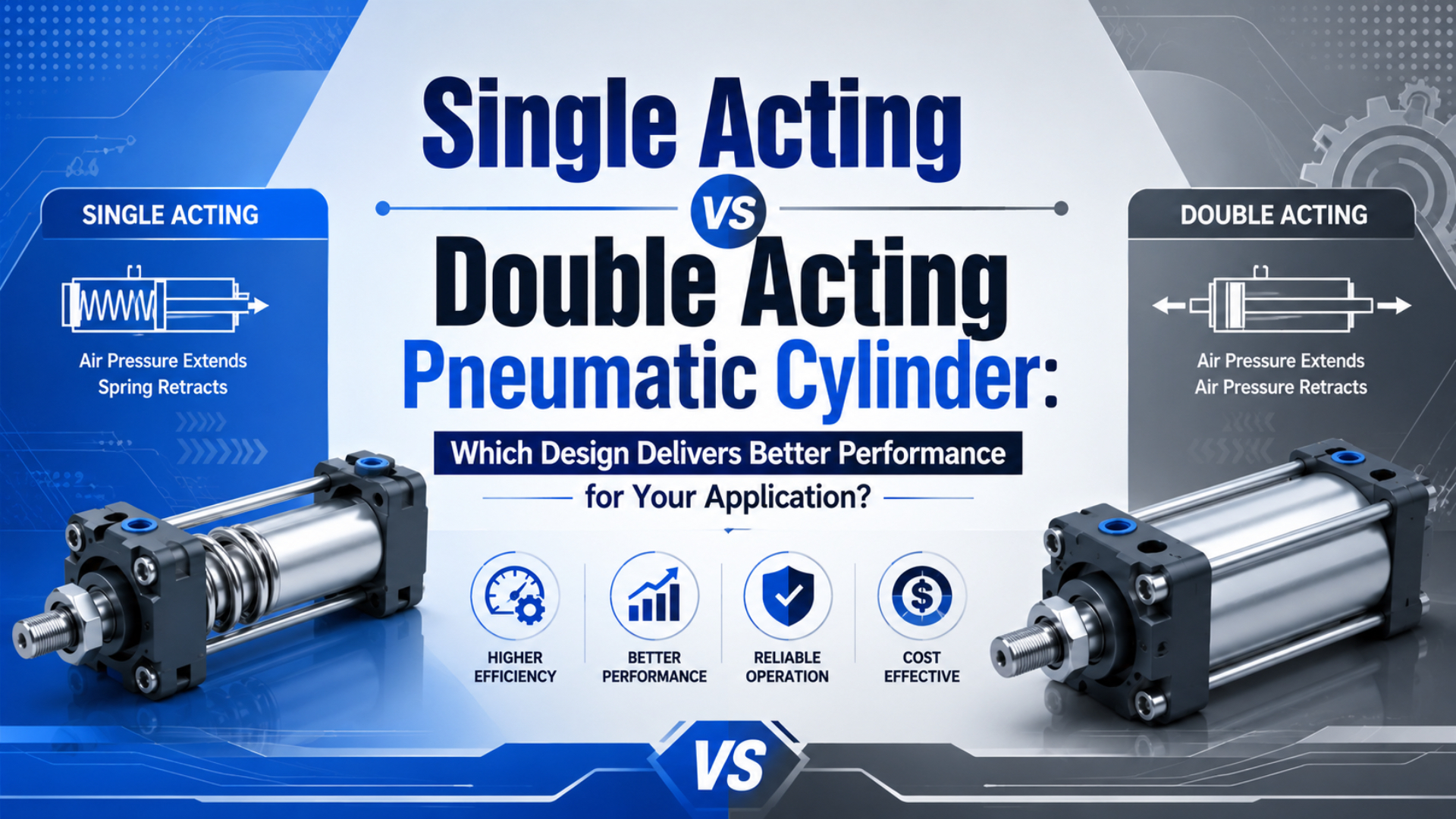
Single-acting cylinders perform best when one powered stroke is enough and a spring, gravity, or the process load can return the actuator safely. Double-acting cylinders perform better when the machine needs powered motion in both directions, repeatable speed control, retract force, or stable behavior under changing load.
That is the real answer. It is not “single acting is cheaper” or “double acting is stronger.” The better design is the one that matches the required return force, valve circuit, lost-air behavior, cycle rate, and air consumption.
Key Takeaways
- AutomationDirect describes single-acting cylinders as one-port actuators with spring or gravity return, while double-acting cylinders use separate ports for extension and retraction.
- CAGI recommends no more than 10% pressure drop from compressor discharge to point of use.
- Check return force, valve type, and measured port pressure before choosing.
The Short Answer: Choose by Return Force, Control, and Fail Position
AutomationDirect defines single-acting air cylinders as one-port designs returned by spring or gravity, while double-acting cylinders use separate ports for both directions (AutomationDirect, 2026). If the return stroke must move a load, hold speed, or resist gravity, start with a double-acting cylinder.
The selection logic is plain once you separate the working stroke from the return stroke. A single-acting cylinder can push, clamp, lift, eject, or release in one direction with a simple valve circuit. The return is handled by spring force, gravity, or the process.
A double-acting cylinder uses compressed air on both sides of the piston. That gives you controlled extension and controlled retraction. It also lets the PLC tune both directions with flow controls, cushions, sensors, and valve timing.
In our experience, the bad selection usually starts with the phrase “it only needs to move back.” Move back how? Against what load? In how much time? If the return stroke has a real force, timing, or safety requirement, it is not a secondary stroke.
Use the companion overview on how pneumatic cylinders work in automation when you need the full air-path sequence. This article stays focused on the single-acting versus double-acting decision.
How Do Single-Acting and Double-Acting Cylinders Differ Mechanically?
LibreTexts defines a single-acting cylinder as fluid power in one direction with spring, gravity, or external-load return (LibreTexts, 2025). AutomationDirect defines double-acting cylinders as two-port actuators that alternate high-pressure air for extension and retraction (AutomationDirect, 2026).
A single-acting cylinder normally has one pressure port, one working air chamber, and a return mechanism. In many short-stroke designs, that return mechanism is an internal spring. In vertical or assisted applications, the machine load or gravity may also provide the return force.
A double-acting cylinder has two pressure ports and two usable chambers. During extension, pressure fills the cap end and the rod end exhausts. During retraction, pressure fills the rod end and the cap end exhausts. The valve changes direction by changing which chamber receives supply air.
| Selection point | Single-acting cylinder | Double-acting cylinder | Engineering consequence |
|---|---|---|---|
| Air ports | One working port | Two working ports | Double acting needs a second air line and valve work port. |
| Return method | Spring, gravity, or external load | Compressed air | Single acting return force changes with spring travel. |
| Speed control | Best on powered stroke | Both directions | Double acting gives a cleaner path for meter-out control. |
| Lost-air behavior | Can return to spring state | Depends on valve center and load | Fail position must be designed, not assumed. |
If the article topic overlaps with your basic terminology research, read the basic concept of a pneumatic cylinder first. This page assumes the reader already knows the piston, rod, bore, stroke, and valve vocabulary.
Which Valve Circuit Fits Each Cylinder Type?
Festo explains that a 3/2 valve has one working output, so it fills one chamber and needs mechanical return; a 5/2 valve gives two working ports for pneumatic motion (Festo, 2026). Valve choice is therefore part of cylinder choice.
A single-acting cylinder usually pairs with a 3/2 directional valve. Supply air moves the piston for the powered stroke. When the valve shifts back, the working chamber exhausts and the spring or external force returns the actuator.
A double-acting cylinder usually pairs with a 5/2 or 5/3 directional valve. One work port feeds the cap end. The other feeds the rod end. Exhaust ports release the inactive side. This is why double-acting cylinders are easier to tune for repeatable machine timing.
Do not choose the cylinder and then treat the valve as an afterthought. A solenoid valve with the wrong function can make a good cylinder act weak, unpredictable, or unsafe.
Force and Retraction: What Changes in the Real Machine?
AutomationDirect gives a clear force example: a 4-inch bore at 100 psi can supply about 1,257 lbf on extension, but with a 1-inch rod the retracting effective area gives about 1,178 lbf (AutomationDirect, 2026). Rod-side force is lower because rod area is missing.
For extension force, both single-acting and double-acting cylinders use the same basic relationship:
Force = pressure x effective area
For a single-rod double-acting cylinder, retract force uses annulus area:
Retract force = pressure x (piston area - rod area)
This matters when the cylinder pulls a fixture, retracts a loaded slide, lifts through a linkage, or backs out of a clamped part. A single-acting spring return may not have enough return force. A double-acting cylinder may have enough return force, but it still needs rod-side area, actual pressure, and exhaust flow checked.
When we review failed replacements, the force mistake is usually on the return stroke. The extend stroke looked fine on paper. Then the machine asked the return stroke to pull product, lift tooling, overcome seal friction, or move against a guide that was already binding.
For the detailed equations, use the cylinder formula guide. If the question is only bore versus pressure, the force calculator above is the faster check.
Air Use, Speed, and Pressure Drop
SMC’s NCM catalog gives a 10-cylinder, 5-cycle/min example totaling 30 l/min (ANR) after cylinder and tube consumption are multiplied by cycle rate and cylinder count (SMC, 2026). Double acting usually uses more air because both directions are powered.
A single-acting cylinder normally consumes air on the powered stroke only. That can reduce demand in simple ejection, release, or light clamping tasks. The catch is that the spring return may limit return speed, and holding a spring-loaded position can still waste air if the valve circuit is poorly chosen.
A double-acting cylinder consumes air on extension and retraction. That sounds worse, but it buys controllable return motion. On high-speed automation, the productivity gain may matter more than the extra air. On a low-duty safety latch, the extra circuit may be unnecessary.
CAGI adds another useful guardrail: every 2 psig of excess operating pressure can raise compressor power by about 1%, and a well-designed system should stay within 10% pressure drop from compressor discharge to point of use (CAGI, 2026). That means cylinder selection is tied to tubing, fittings, valve Cv, mufflers, and FRL size.
For deeper pressure strategy, compare this article with working pressure optimization. Raising regulator pressure to fix a slow return is often masking a flow restriction.
When Should You Choose Single-Acting?
LibreTexts notes that single-acting cylinders can be simpler and more economical because pressure acts in one direction and return comes from spring, gravity, or external load (LibreTexts, 2025). Choose single acting only when that return method is designed, not assumed.
Single acting is a good fit when the task is simple and one-way. Think short-stroke ejection, light clamping, mechanical release, reject pins, small gates, or a fixture that only needs powered motion in one direction.
It can also be the right answer for fail-return behavior. If loss of air should move the actuator to a safe position, a spring-return design may be easier to reason about than a double-acting cylinder with a valve center condition that must be selected and validated.
Use a single-acting cylinder when these statements are true:
- The return stroke does not move a significant external load.
- The return time can vary slightly without hurting the machine sequence.
- A spring-return or gravity-return state is desirable during air loss.
- The stroke is short enough that spring packaging and spring force are practical.
- The control circuit benefits from a simple 3/2 valve.
Avoid it when the return stroke carries parts, clears a jam-prone area, controls product position, or must hit a tight timing window. That is where simple hardware can quietly become expensive downtime.
When Is Double-Acting the Better Choice?
AutomationDirect says double-acting cylinders move the piston forward and back by alternating the port receiving high-pressure air (AutomationDirect, 2026). Choose double acting when the machine needs controlled motion, force, or timing in both directions.
Double acting is the default for pushers, transfer stops, guided slides, clamps that must release predictably, packaging stations, pick-and-place axes, and most rodless cylinders. It also fits applications where mounting orientation changes the load on the return stroke.
Double acting does not make the cylinder “precision” by itself. It gives the control system something to work with. Flow controls, cushions, pressure regulation, sensors, stop hardware, and valve timing still decide how repeatable the motion feels on the machine.
For long strokes, look at rodless cylinder selection. Rodless designs are usually double acting because a spring return over a long stroke is bulky, inconsistent, and hard to package.
Choose double acting when these conditions show up:
- The retract stroke pulls a load or must overcome friction.
- Stroke time matters in both directions.
- The load can change by product, fixture, orientation, or tooling wear.
- The process needs meter-out speed control in both directions.
- The machine must hold, stop, or recover predictably during a cycle.
A useful rule is to score the return stroke as if it were a separate actuator. If you would not trust a spring or gravity to do that job alone, the application is already asking for double acting.
Cost, Maintenance, and RFQ Decision Matrix
AutomationDirect’s cylinder sizing page shows why force and rod-side area must be checked before cost: at the same 100 psi, a 4-inch bore example drops from about 1,257 lbf on extension to 1,178 lbf on retraction with a 1-inch rod (AutomationDirect, 2026). Wrong sizing costs more than the valve difference.
Single-acting hardware can cost less because the cylinder has fewer air connections and the circuit may use a simpler valve. That does not mean the installed system is always cheaper. If the spring return causes slow cycles, inconsistent release, or manual clearing, the cost moves from the purchase order into production.
Double-acting hardware often costs more in valves, tubing, fittings, and setup time. The payback is not a made-up percentage. It comes from fewer missed returns, faster controlled cycling, lower scrap, easier troubleshooting, and a cleaner path to sensor-based machine control.
| Question before buying | Prefer single acting when | Prefer double acting when |
|---|---|---|
| What happens when air is lost? | Spring return is the desired safe state. | The safe state depends on valve center, brake, lock, or PLC logic. |
| Does the return stroke do work? | Return is unloaded or gravity-assisted. | Return pulls, lifts, clears, or positions a load. |
| How tight is the cycle time? | Return time can vary. | Both stroke times must be tuned. |
| How much air capacity exists? | Air demand must stay low and speed is modest. | Extra air use is acceptable for controlled motion. |
| What data should go into the RFQ? | Stroke, load, return state, spring direction, valve function. | Bore, rod, stroke, pressure, speed, valve, tube, sensors, load direction. |
Before sending an RFQ, include bore, stroke, available pressure at the actuator during motion, load direction, required return force, valve type, tube size, mounting orientation, cycle rate, and fail-position requirement. For replacement work, add photos and the old model code through the contact page.
FAQs About Single Acting vs Double Acting Pneumatic Cylinders
The FAQ should answer selection questions without repeating a basic cylinder glossary. Festo’s 3/2 versus 5/2 valve explanation and CAGI’s 10% pressure-drop guardrail are the two checks that keep these answers practical rather than generic (Festo, 2026; CAGI, 2026).
Which is better, single acting or double acting?
Neither is always better. Single acting is better when one powered stroke and spring or gravity return meet the force, timing, and safety requirement. Double acting is better when both directions need powered control, especially where the return stroke pulls a load, controls speed, or must behave consistently.
Does a double-acting cylinder always produce equal force both ways?
No. A single-rod double-acting cylinder usually has less retract force because the rod reduces the effective rod-side area. AutomationDirect’s 4-inch bore, 1-inch rod example at 100 psi shows lower retract force than extension force. Double-rod cylinders are different because rod area can be balanced.
Does single acting always use less compressed air?
Single acting usually uses air on one powered stroke, so air use can be lower. The full system still depends on holding logic, leaks, cycle rate, spring return time, and pressure drop. SMC’s air-consumption method includes cylinder volume, piping volume, cycles per minute, and cylinder count.
Which cylinder is safer during air loss?
A spring-return single-acting cylinder can move toward a predictable position when air is removed. That can help fail-safe design. A double-acting cylinder can also be safe, but the valve center, load direction, exhaust behavior, locks, brakes, and risk assessment must define what happens during pressure loss.
What should I measure before replacing one type with the other?
Measure the load, stroke, required return force, available pressure at the cylinder during motion, target stroke time, valve function, tube size, mounting orientation, and lost-air state. If the old cylinder failed, record whether the symptom was weak extension, weak return, slow speed, leakage, impact, or inconsistent release.
Sources
- AutomationDirect: Pneumatic Air Cylinders, single-acting and double-acting cylinder definitions, porting, and available cylinder families. Retrieved 2026-06-04.
- AutomationDirect: Cylinder Sizing, force examples for extension and retraction, including rod-side effective-area reduction. Retrieved 2026-06-04.
- Festo: Pneumatic Valves, 3/2 and 5/2 valve functions for pneumatic actuator circuits. Retrieved 2026-06-04.
- CAGI: Working With Compressed Air, 10% pressure-drop guidance and excess-pressure energy penalty. Retrieved 2026-06-04.
- SMC: NCM Air Cylinder Catalog, air consumption and required air volume method for cylinders and piping. Retrieved 2026-06-04.
- LibreTexts: Function of a Single-Acting Cylinder, construction, return mechanism, and common applications. Retrieved 2026-06-04.
- AutomationDirect Video: How to Select a Pneumatic Cylinder, cylinder selection video used for the embedded video reference. Retrieved 2026-06-04.