

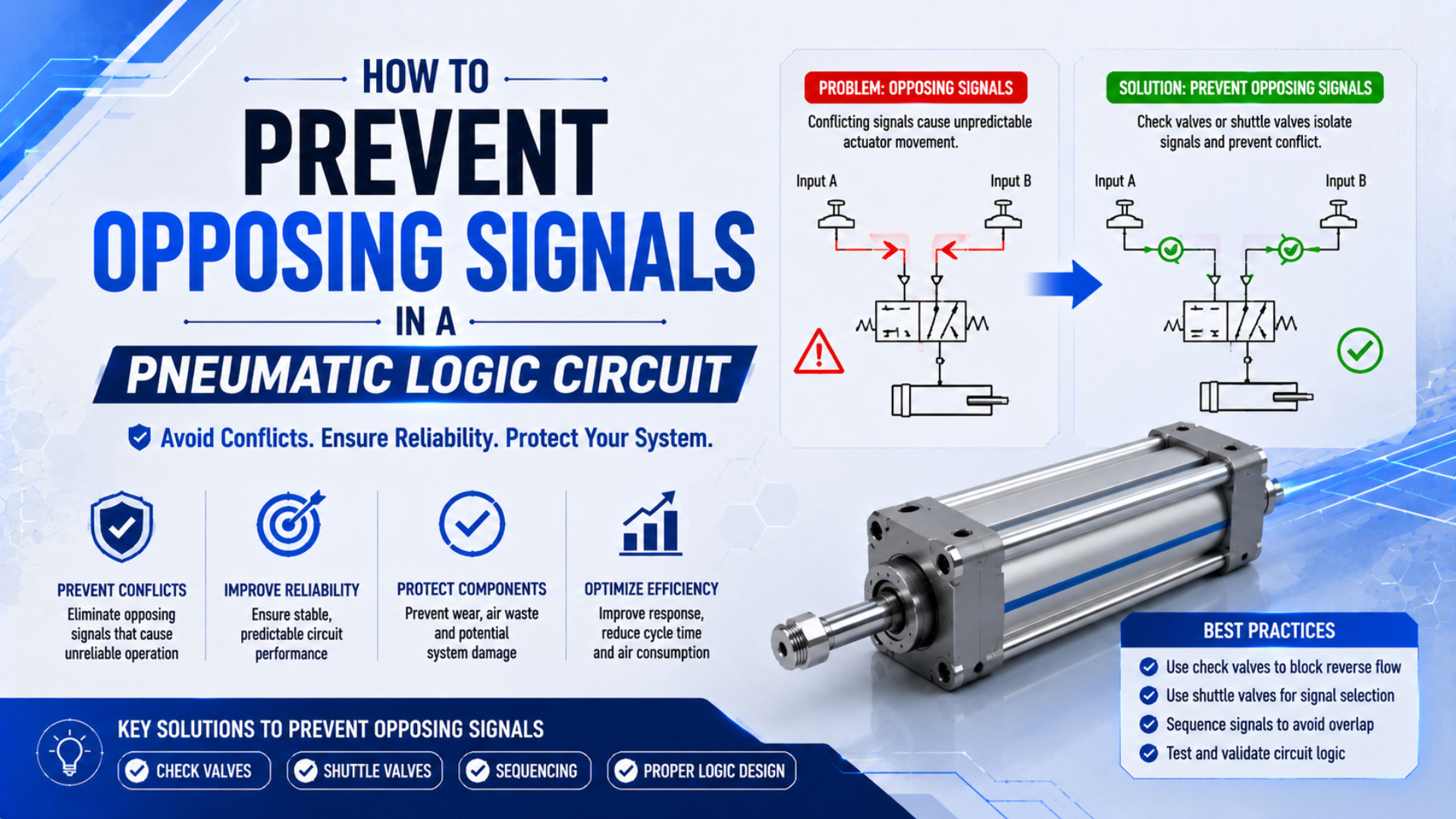
Prevent opposing signals by making one control state the sole owner of each directional-valve command. In electrical control, use mutually exclusive outputs and fault detection. In an air-only sequence, use cascade groups or another state element that exhausts the inactive command path before enabling its opposite. Shuttle hardware alone doesn’t provide this protection.
An opposing pneumatic signal is an extend or retract command that remains valid while its opposite command is also active. Its origin may be electrical, pneumatic, or mechanical. Check PLC logic, relay wiring, overlapping mechanical valves, trapped pilot pressure, restricted exhausts, and duplicate memory elements.
Key Takeaways: Treat both commands active as a fault, never a permitted operating state. Give each actuator command one state owner, then prove the inactive electrical or pneumatic path is off. A shuttle valve performs OR logic; it doesn’t arbitrate extend versus retract. Test normal, conflicting, loss-of-energy, and restart states before release.
What Is an Opposing Signal, and What Actually Happens at the Valve?
One Parker direct-solenoid valve catalogue explicitly says its two coils should not be energized simultaneously, but that particular instruction is model-specific (Parker Catalog 0640-E, retrieved 2026). An opposing command is therefore a control fault whose physical result must be checked against the selected valve’s construction.
For a double-solenoid or double-piloted directional valve, define two Boolean commands: E requests extension, and R requests retraction.
Three command states are permitted. E = 0, R = 0 is the uncommanded state, whose result depends on whether the valve is monostable, bistable, or spring-centered. E = 1, R = 0 commands extension. E = 0, R = 1 commands retraction. The fourth combination, E = 1, R = 1, must enter a fault response rather than become another operating mode.
Extend command E |
Retract command R |
Logic status | Required design response |
|---|---|---|---|
| 0 | 0 | permitted | apply the documented de-energized or retained state |
| 1 | 0 | permitted | command extension and monitor completion |
| 0 | 1 | permitted | command retraction and monitor completion |
| 1 | 1 | conflict | inhibit both or execute the validated fault response |
Don’t infer the actuator response from coil voltage alone. A single spool can’t occupy two fully shifted positions at once, but simultaneous forces can produce delayed shifting, last-state retention, coil heating, chatter, or a model-dependent dominant side. A bistable pneumatic latch can retain its last state, while a 5/3 spring-centered valve returns to its specified center when both commands are removed. The separate guide to 5-way, 3-position valve holding explains why even a closed center isn’t a guaranteed mechanical hold.
The most useful definition of “off” is physical, not logical. An inactive PLC bit doesn’t prove that a relay contact opened, a solenoid de-energized, a pilot tube exhausted, or the spool reached the intended state. A reliable circuit verifies the command at the last practical point before the directional valve.
Why Doesn’t a Shuttle Valve Resolve Extend and Retract Conflicts?
Festo rates one didactic shuttle valve for 1 to 10 bar and 500 L/min nominal flow, while defining it strictly as an OR gate (Festo Shuttle Valve 539771, 2015). It combines two alternative inputs into one output; it doesn’t make two opposite outputs mutually exclusive.
Shuttle valves are useful when either of two legitimate sources may request the same downstream function, including manual or automatic permission for one pilot line, two alternative start locations, or a backup pressure-signal source. If both inputs are present, the higher pressure reaches the outlet on the cited Festo unit. That’s pressure selection, not safety-rated priority logic. The original misconception comes from drawing “Input A” and “Input B” without naming their meanings. If A and B are two ways to request extension, OR logic is appropriate. If A requests extension and B requests retraction, combining them through one shuttle valve destroys the directional distinction. Installing separate shuttle valves on both pilots can still leave both pilot outputs active.
Use the pneumatic logic valve guide for the broader design of AND, OR, memory, timing, and inhibition functions. For this article, the selection rule is shorter:
| Control requirement | Appropriate method | Why |
|---|---|---|
| either source may request the same action | shuttle valve or validated OR logic | one common output is intended |
| two conditions must both be true | two-pressure valve or validated AND logic | output requires both permissions |
| extend and retract must never coexist | mutual exclusion, cascade grouping, or exclusive state machine | two different outputs must remain exclusive |
| one command must override another | specified priority architecture with a defined fault state | pressure magnitude alone is not enough |
SMC lists 0.05 to 1.0 MPa for one current shuttle and AND-valve family, a 20:1 operating-pressure span (SMC VR12, retrieved 2026). That span doesn’t prove downstream switching. Fittings, tubes, logic elements, leakage, and exhaust restriction still affect the pressure available at the valve.
Air-Only Mutual Exclusion: The Cascade Method
Festo’s 2025 industrial-pneumatics training scope treats signal overlap, motion diagrams, the cascade principle, and grouping as separate design topics (Festo Training Catalogue, 2025). In a pure pneumatic sequence, cascade grouping separates command states. One group remains enabled while the previous group exhausts before the next can become active.
Start from the required motion sequence, not from a box of valves. For the sequence A+ → B+ → B− → A−, cylinder B appears in opposite directions at the middle transition; split before B−, with Group 1 containing A+ → B+ and Group 2 containing B− → A−.
A cascade group is a consecutive set of movements in which one cylinder doesn’t appear with opposing directions. Only one group line should be pressurized at a time. The selector supplies the active group’s signal valves and vents the inactive group before the next group can generate its command. This is break-before-make behavior expressed pneumatically. The old command must fall below the receiving pilot’s reset threshold before the new command becomes effective. A blocked silencer, an incorrectly connected 3/2 signal valve, a long small-bore tube, or a leaking memory element can prevent that release even when the motion diagram is logically correct.
Treat the cascade group line as a state bus, not merely another air supply. If two group lines can be pressurized together during normal switching, manual override, or restart, the architecture has duplicate state ownership; fix that transition before tuning time delays or adding more logic valves.
The worked A+ → B+ → B− → A− design and its state table are covered in the guide to sequential cylinder circuit design. This article stays at the conflict boundary. Only one group can authorize either pilot of a directional valve at a time.
How Should PLC and Relay Logic Enforce Mutual Exclusion?
ISO 13849-1:2023 applies to safety-related control systems using electrical, hydraulic, pneumatic, and mechanical technologies, yet it doesn’t choose the safety function or required PLr for a machine (ISO 13849-1, 2023). For ordinary sequence control, mutual exclusion still needs deterministic logic, output feedback where justified, and a defined fault response.
Mutual exclusion is the rule that permits no more than one opposing output to be active. Create one state variable that owns the actuator command. Automatic sequence logic, manual jog logic, recovery code, and maintenance mode should request a state from one command arbiter instead of writing directly to the two physical outputs.
A practical output rule is:
| Requested state | Extend output | Retract output | Fault condition |
|---|---|---|---|
| neutral | 0 | 0 | neither command allowed |
| extend | 1 | 0 | retract request must be absent |
| retract | 0 | 1 | extend request must be absent |
| conflicting requests | 0 | 0 | latch diagnostic and execute the specified response |
Use both software and electrical separation when the consequence warrants it. PLC logic can inhibit the opposite output in the same scan. Interposing relays can add cross-wired normally closed contacts so one energized coil removes the other coil’s circuit. Output diagnostics or valve-position feedback can then detect a welded contact, shorted conductor, or spool that didn’t follow the command. Don’t hide mode transitions. When changing from automatic to manual, cancel the prior command, verify its output is off, and then accept the new mode’s request. On power restoration, rebuild state from qualified sensor and machine conditions rather than replaying a stale output image. A bistable valve can remember a physical state after the controller forgets it.
For a larger valve island, record command ownership, loss behavior, pilot source, and restart policy in the modular pneumatic circuit worksheet. That record blocks silent duplicate ownership. Such faults can otherwise appear after a PLC change or valve substitution.
Residual Pilot Pressure and Reset Races
SMC specifies a 0.05 MPa minimum operating pressure for its current VR12 shuttle and AND-valve family, but a directional valve’s minimum pilot pressure is a separate model-specific value (SMC, retrieved 2026). A command can be electrically off while trapped or slowly exhausting pilot pressure still influences the main spool.
Measure both pilot ports during the transition that fails. An electrical check at the PLC proves only that the output instruction changed. It doesn’t reveal a stuck relay, energized manual override, restricted pilot exhaust, cross-connected tube, leaking logic element, or pressure trapped by a check function.
Look for four different timing quantities:
| Timing quantity | What to measure |
|---|---|
| controller delay | state transition to output change |
| electrical release | coil or relay field removal to armature drop |
| pneumatic decay | inactive pilot line falling below its release threshold |
| valve shift | spool and downstream pressure paths reaching the new state |
Avoid solving a reset race with an undocumented timer. A delay can mask the symptom at one pressure and temperature while the root restriction remains. First provide a defined exhaust path, correct the tube routing, and confirm pressure decay. Add a timer only when the functional specification requires a deliberate dead time and the selected components support it. Pressure loss can create a different conflict: both logic paths look valid upstream, but neither provides enough pilot margin at the main valve during simultaneous demand. Measure dynamic pressure at the receiving pilot. The broader pressure-drop troubleshooting guide covers supply, tube, fitting, and exhaust restrictions that a static regulator gauge misses.
How Do You Commission an Opposing-Signal Interlock?
ISO 4414:2010 remains the current pneumatic-system safety standard after its 2021 confirmation and covers design, installation, adjustment, continuous operation, maintenance, reliability, and significant hazards (ISO 4414, 2010). Commissioning should therefore prove every command combination, loss condition, transition, and restart response instead of cycling the actuator once.
Begin with the four-state command table. Force each permitted state and confirm the electrical outputs, pilot pressures, spool indication if available, actuator direction, end feedback, and timeout response. Then force the prohibited state through a controlled test method. The circuit should inhibit or remove the commands and produce the documented diagnostic without creating an unreviewed motion.
Use this sequence:
- Verify the drawing against the installed hardware. Record the exact valve function, model, normal state, pilot source, coil or pilot identification, and every manual override before applying a test command.
- Confirm
E = 0, R = 0produces the documented physical outcome. - Test extend and retract separately while recording both command paths.
- Introduce simultaneous logical requests, then confirm the arbiter rejects them and records the fault without issuing a direction command.
- Check each pilot line at the directional valve, not only at the logic source.
- Restrict or disconnect one feedback path under controlled conditions. Verify the timeout, output removal, diagnostic record, and recovery requirement; repeat for each feedback channel whose failure could hide an unresolved command.
- Remove electrical power, main air, and pilot air in separate tests.
- Restore energy and verify the specified reset conditions before motion can resume.
Record the controller revision, valve part number and function, supply setting, measured pilot pressures, command timestamps, spool feedback, actuator result, and pass limit. Without those fields, a later replacement or software update can’t reproduce the acceptance test.
Where Does Control Interlocking Stop and Machine Safety Begin?
OSHA 29 CFR 1910.147 includes pneumatic energy and requires covered energy-control procedures to be inspected at least annually; it also says push buttons and selector switches aren’t energy-isolating devices (OSHA 1910.147, retrieved 2026). A command interlock can improve operation without becoming a maintenance lockout or validated safety function.
Separate three layers in the specification:
| Layer | Purpose | Evidence required |
|---|---|---|
| process mutual exclusion | prevent contradictory normal commands | state table, logic test, pilot measurements |
| safety-related control function | reduce risk when a defined hazardous event occurs | risk assessment, safety requirements, architecture, PLr, validation |
| hazardous-energy control | protect people during covered servicing and maintenance | isolating devices, stored-energy control, procedure, verification |
ISO 12100:2010 provides the machinery risk-assessment and risk-reduction method and remains current after confirmation in 2022 (ISO 12100, 2010). ISO 13849-1 then provides a method for safety-related control parts. Neither standard turns an ordinary relay contact, PLC bit, shuttle valve, or sequence valve into a safety component merely because it blocks one command.
Two-hand control illustrates the boundary. ISO 13851:2019 defines requirements for two-hand control devices and identifies three types, while leaving machine selection to the applicable standard or risk assessment (ISO 13851, 2019). A standard pneumatic AND valve can demonstrate two-input logic, but it doesn’t by itself prove simultaneity, anti-tie-down, fault tolerance, stopping performance, or required distance from the hazard. Venting is also machine-specific. Removing supply pressure may stop powered motion, release a clamp, or let gravity move a vertical load. The related guides to ISO 13849 pneumatic safety circuits and safety exhaust valve integration cover the broader safety-function boundary.
Write the process conflict response and safety response as separate rows even when both remove the same output. That separation protects validation. It prevents a future process-software change from being mistaken for a safety modification and keeps energy isolation independent of controller availability.
Pneumatic Opposing-Signal FAQs
The five answers below keep OR logic, mutual exclusion, and safety functions separate. Festo’s cited shuttle valve operates from 1 to 10 bar, while ISO 13849-1:2023 covers safety-related pneumatic control without selecting a machine’s required PLr (Festo; ISO).
Can a shuttle valve stop opposing extend and retract commands?
No. A shuttle valve performs OR logic by passing either input to one common output. It is suitable when two sources request the same action. Extend and retract are different outputs, so they need mutual exclusion through an exclusive state machine, relay interlock, cascade group, or another deliberately designed architecture.
What should happen if both PLC outputs turn on?
Treat the combination as a fault. The command arbiter should remove or inhibit both physical outputs and apply the machine-specific controlled response. Record the conflicting requests, active mode, feedback state, and output status; don’t let output order inside a PLC scan silently decide which actuator direction wins.
Does a bistable valve solve signal overlap?
No. A bistable valve retains its last shifted state until the opposite command changes it, but it doesn’t validate the command source. Simultaneous coils or pilots can still create model-dependent behavior. The controller must prevent overlap, and commissioning must confirm inactive pilot pressure decays before the opposite command takes effect.
Can a pneumatic AND valve make a safety interlock?
An AND valve can require two pneumatic inputs, but the Boolean relationship alone doesn’t establish a safety function; ISO 13851:2019 defines additional requirements for two-hand controls, and ISO 13849-1:2023 covers safety-related control design. The machine risk assessment must define the function, required performance, fault reaction, and validation.
How should an opposing-signal fault be tested?
Test all four command combinations, including the prohibited simultaneous state, using a controlled commissioning procedure; measure both electrical outputs and both pilot pressures at the directional valve. Then test power loss, air loss, feedback failure, manual override, mode change, and restart. Record the expected and observed response for each condition.
Sources and technical references
| Source | Scope used in this article |
|---|---|
| ISO 4414:2010 | pneumatic-system design and safety requirements; retrieved 2026-07-22 |
| ISO 12100:2010 | machinery risk assessment and risk reduction; retrieved 2026-07-22 |
| ISO 13849-1:2023 | safety-related parts of control systems; retrieved 2026-07-22 |
| ISO 13851:2019 | two-hand control devices; retrieved 2026-07-22 |
| OSHA 29 CFR 1910.147 | control of hazardous energy; retrieved 2026-07-22 |
| Festo pneumatic valves | monostable and bistable functions; retrieved 2026-07-22 |
| Festo Didactic shuttle valve | OR function and technical data; retrieved 2026-07-22 |
| Festo Training Catalogue 2025 | signal overlap and cascade grouping; retrieved 2026-07-22 |
| SMC VR12 | shuttle and AND-valve specifications; retrieved 2026-07-22 |
| Parker Catalog 0640-E | direct-solenoid valve operating note; retrieved 2026-07-22 |