Introduction
Picture this: your production line grinds to a halt because a custom pneumatic cylinder hasn’t arrived on time. Every hour of downtime costs thousands of dollars, your team is scrambling, and your client is losing patience. Poor lead time management doesn’t just delay projects—it destroys profitability and damages hard-earned reputations. 😰
Effective lead time management for custom pneumatic cylinders involves planning orders 4-8 weeks in advance, maintaining clear communication with suppliers about specifications, building strategic buffer inventory for critical components, and partnering with manufacturers like Bepto Pneumatics who offer expedited production and reliable delivery schedules.
I’ve seen this scenario play out countless times during my years at Bepto Pneumatics. Just last month, a packaging equipment manufacturer in Michigan called us in a panic—their OEM supplier quoted them 12 weeks for a custom rodless cylinder replacement. We delivered a compatible solution in 10 days, saving their entire production schedule.
Table of Contents
- What Factors Actually Determine Custom Cylinder Lead Times?
- How Can You Accurately Forecast Your Custom Cylinder Needs?
- What Communication Strategies Minimize Delays with Suppliers?
- Should You Build Safety Stock for Custom Pneumatic Components?
What Factors Actually Determine Custom Cylinder Lead Times?
Understanding what drives production timelines is the first step toward managing them effectively. 🎯
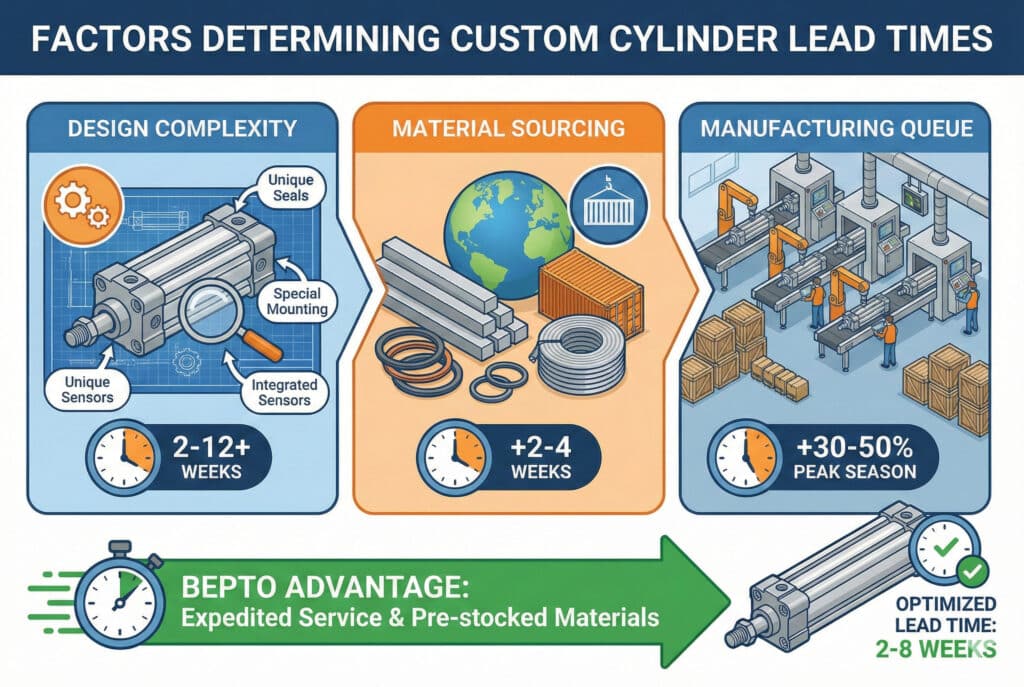
Custom pneumatic cylinder lead times typically range from 2-12 weeks depending on design complexity, material availability, manufacturing capacity, customization level, and shipping logistics1—with rodless cylinders generally requiring 3-6 weeks for standard customizations and 8-12 weeks for highly specialized designs.
Design Complexity and Engineering Requirements
The more unique your specifications, the longer the lead time. Standard bore sizes with common stroke lengths? We can often turn those around in 2-3 weeks. But if you need specialized seals, unique mounting configurations, or integrated sensors, expect 6-8 weeks minimum.
Material Sourcing and Supply Chain Variables
Even the best manufacturers can’t control global supply chains. Aluminum extrusions are usually readily available, but specialized steel alloys or particular seal materials might add 2-4 weeks to your timeline.
Manufacturing Queue and Capacity
Here’s what many buyers don’t realize: your order competes with others in the production queue. During peak seasons (typically Q1 and Q3 for industrial equipment), lead times can extend by 30-50%.
| Lead Time Factor | Typical Impact | Bepto Advantage |
|---|---|---|
| Standard customization | 3-6 weeks | 2-4 weeks with express service |
| Complex design | 8-12 weeks | 5-8 weeks with engineering support |
| Material constraints | +2-4 weeks | Pre-stocked common materials |
| Peak season delays | +30-50% | Dedicated capacity for partners |
How Can You Accurately Forecast Your Custom Cylinder Needs?
Reactive ordering is expensive ordering. Proactive planning saves both time and money. 📊
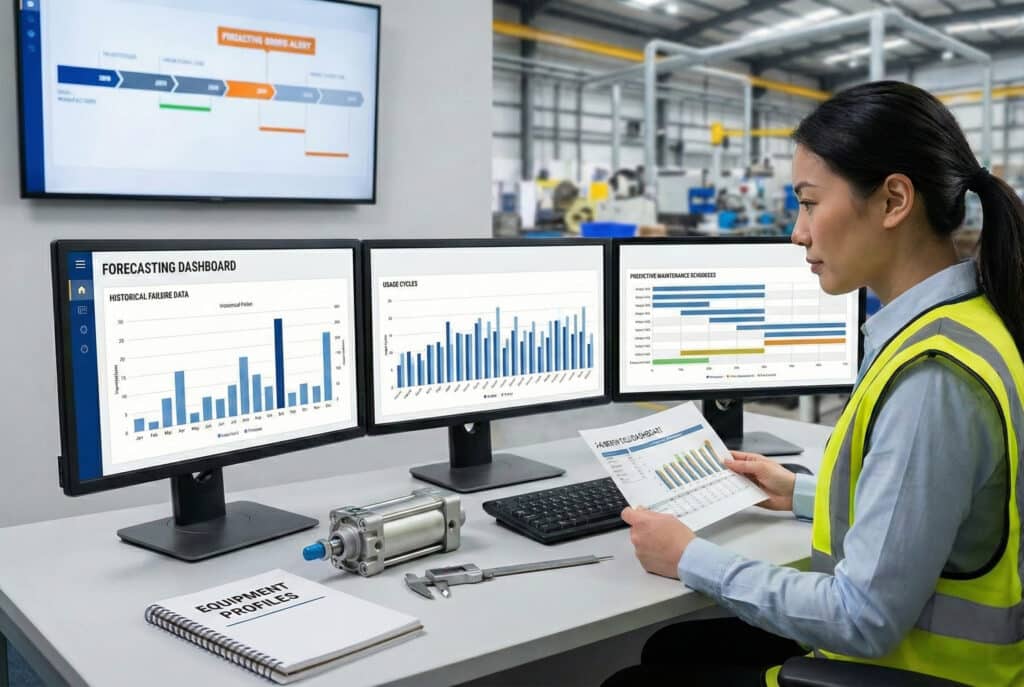
Accurate forecasting requires analyzing historical failure data, tracking equipment age and usage cycles, implementing predictive maintenance2 schedules, and maintaining 3-6 month rolling forecasts that account for both routine replacements and anticipated project demands.
Implement Usage-Based Tracking
I worked with Sarah, a maintenance manager at a automotive parts plant in Ontario, who was constantly firefighting cylinder failures. We helped her implement a simple tracking system that logged cycle counts and operating conditions. Within three months, she could predict failures within a two-week window and order replacements proactively.
Build Relationships with Your Engineering Team
Your engineers know what projects are in the pipeline. Monthly coordination meetings between purchasing, engineering, and maintenance can reveal upcoming custom cylinder needs months in advance—giving you plenty of runway for ordering.
Create Equipment Profiles
Document every pneumatic cylinder in your facility:
- Installation date
- Manufacturer and model
- Expected lifespan (typically 5-10 million cycles)
- Operating conditions
- Replacement lead time
This database becomes your forecasting goldmine. 💎
What Communication Strategies Minimize Delays with Suppliers?
Clear communication isn’t just helpful—it’s essential for managing lead times effectively.
Minimize delays by providing complete technical specifications upfront, requesting detailed production schedules with milestone dates, establishing single points of contact on both sides, scheduling weekly progress updates for complex orders, and documenting all specification changes immediately in writing.

The Complete Specification Checklist
Incomplete specs are the #1 cause of lead time extensions. Before placing any custom order, ensure you provide:
- Physical dimensions: Bore diameter, stroke length, overall dimensions
- Mounting style: Flange, foot, clevis, trunnion, or custom
- Port specifications: Thread type, size, and location
- Pressure requirements: Operating and maximum pressure ratings
- Environmental factors: Temperature range, exposure to chemicals/moisture
- Performance needs: Speed requirements, load capacity, duty cycle
Establish Communication Protocols
At Bepto Pneumatics, we assign each client a dedicated account manager. This eliminates the “telephone game” that happens when you’re bounced between sales, engineering, and production. One contact, one source of truth. 📞
Use Visual Documentation
A picture truly is worth a thousand words. Send photos of existing installations, marked-up drawings, or even videos of the cylinder in operation. This reduces misunderstandings that can add weeks to your timeline.
Should You Build Safety Stock for Custom Pneumatic Components?
Strategic inventory isn’t wasteful—it’s insurance against costly downtime.
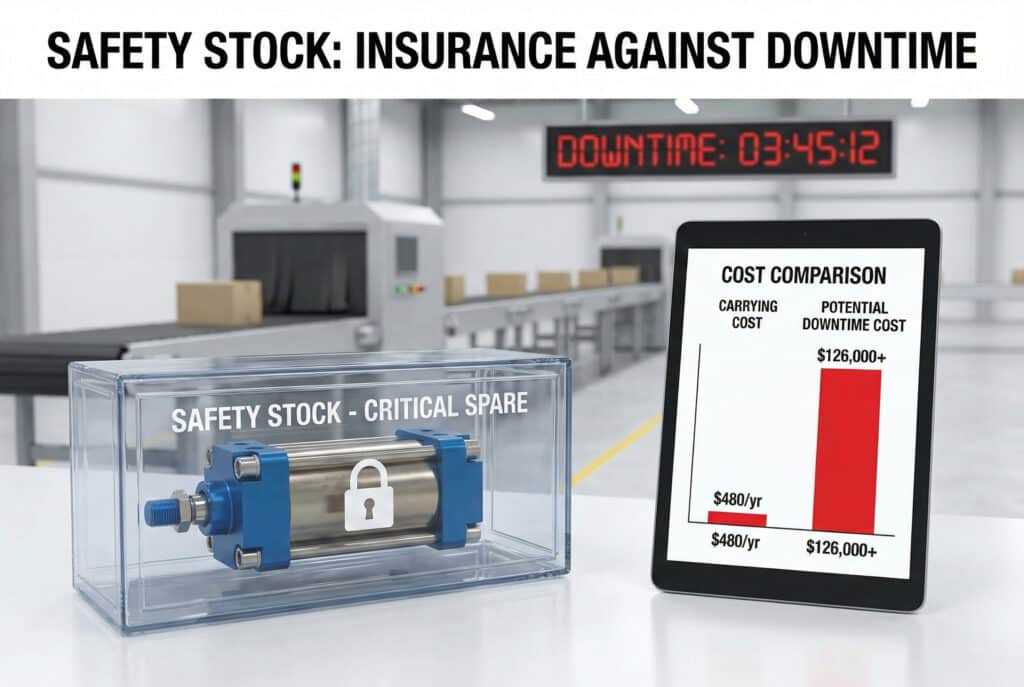
Building 1-2 units of safety stock3 for critical custom cylinders is financially justified when downtime costs exceed $5,000 per day, lead times exceed 6 weeks, or the component supports single-point-of-failure applications—with total carrying costs4 typically representing just 2-5% of potential downtime losses.
Calculate Your Downtime Cost
Let me share a story about Marcus, a production director at a beverage bottling facility in Texas. His main filling line used four custom rodless cylinders. When one failed, the entire line stopped—costing $18,000 per day in lost production.
He initially resisted keeping spares, citing the $3,200 cost per cylinder. I walked him through the math:
- Spare cylinder cost: $3,200
- Annual carrying cost (15%): $480
- OEM replacement lead time: 10 weeks
- Potential downtime cost: $126,000 (7 days × $18,000)
After one failure that cost him $54,000 in downtime, Marcus now keeps two spares on hand. Best $6,400 he ever spent. 💰
Strategic Stocking Criteria
Consider safety stock for cylinders that are:
- Mission-critical: Single points of failure in your process
- Long lead time: 6+ weeks for replacement
- High failure risk: Operating in harsh environments or high-cycle applications
- Expensive downtime: Where hourly losses exceed $1,000
The Bepto Partnership Model
We work with many clients on consignment inventory5 programs. We keep your critical spares in stock at our facility, you only pay when you need them, and we ship same-day. It’s safety stock without the carrying costs.
Conclusion
Effective lead time management isn’t about hoping for the best—it’s about planning for success through accurate forecasting, clear communication, strategic partnerships, and smart inventory decisions. 🎯
FAQs About Custom Pneumatic Cylinder Lead Times
What’s the typical lead time for a custom rodless cylinder?
Standard custom rodless cylinders typically require 3-6 weeks, while highly specialized designs may take 8-12 weeks. At Bepto Pneumatics, we offer expedited 2-4 week service for many common customizations, and our engineering team can often suggest design modifications that maintain your performance requirements while reducing lead time.
How much should I budget for expedited production?
Expedited production typically adds 15-30% to the base cylinder cost but can reduce lead time by 40-60%. The real question is whether that premium is less than your potential downtime costs—in most cases, it’s a bargain. We’re transparent about expedite fees and help you make informed decisions.
Can I modify specifications after placing an order?
Specification changes are possible but impact lead time depending on production stage—before manufacturing begins, changes add 3-5 days; after production starts, they may require restarting the entire process. This is why we emphasize thorough specification review before order confirmation. Our engineering team conducts a detailed review call for every custom order.
What information do I need to get an accurate lead time quote?
Provide complete specifications including bore size, stroke length, mounting style, port configuration, pressure requirements, and quantity needed. Also mention your target delivery date and whether you have flexibility. The more context we have, the more accurately we can commit to a timeline—and the better we can suggest alternatives if your timeline is tight.
How can Bepto Pneumatics help reduce my lead times compared to OEM suppliers?
Bepto maintains pre-stocked raw materials for common configurations, operates dedicated production lines for replacement cylinders, and focuses exclusively on pneumatic components—allowing us to deliver custom rodless cylinders 40-60% faster than typical OEM channels. We’ve built our entire business model around being the fast, reliable alternative when OEM lead times threaten your operations. Give us a call, and let’s discuss your specific needs. 🚀
-
Understand the broader scope of supply chain logistics and how it impacts manufacturing lead times. ↩
-
Learn how predictive maintenance strategies can forecast equipment failures before they cause downtime. ↩
-
Explore the formulas and methodologies for calculating the optimal safety stock levels for critical components. ↩
-
Understand the financial components that make up inventory carrying costs to make better stocking decisions. ↩
-
Read about how consignment inventory models work to reduce upfront costs while ensuring part availability. ↩