

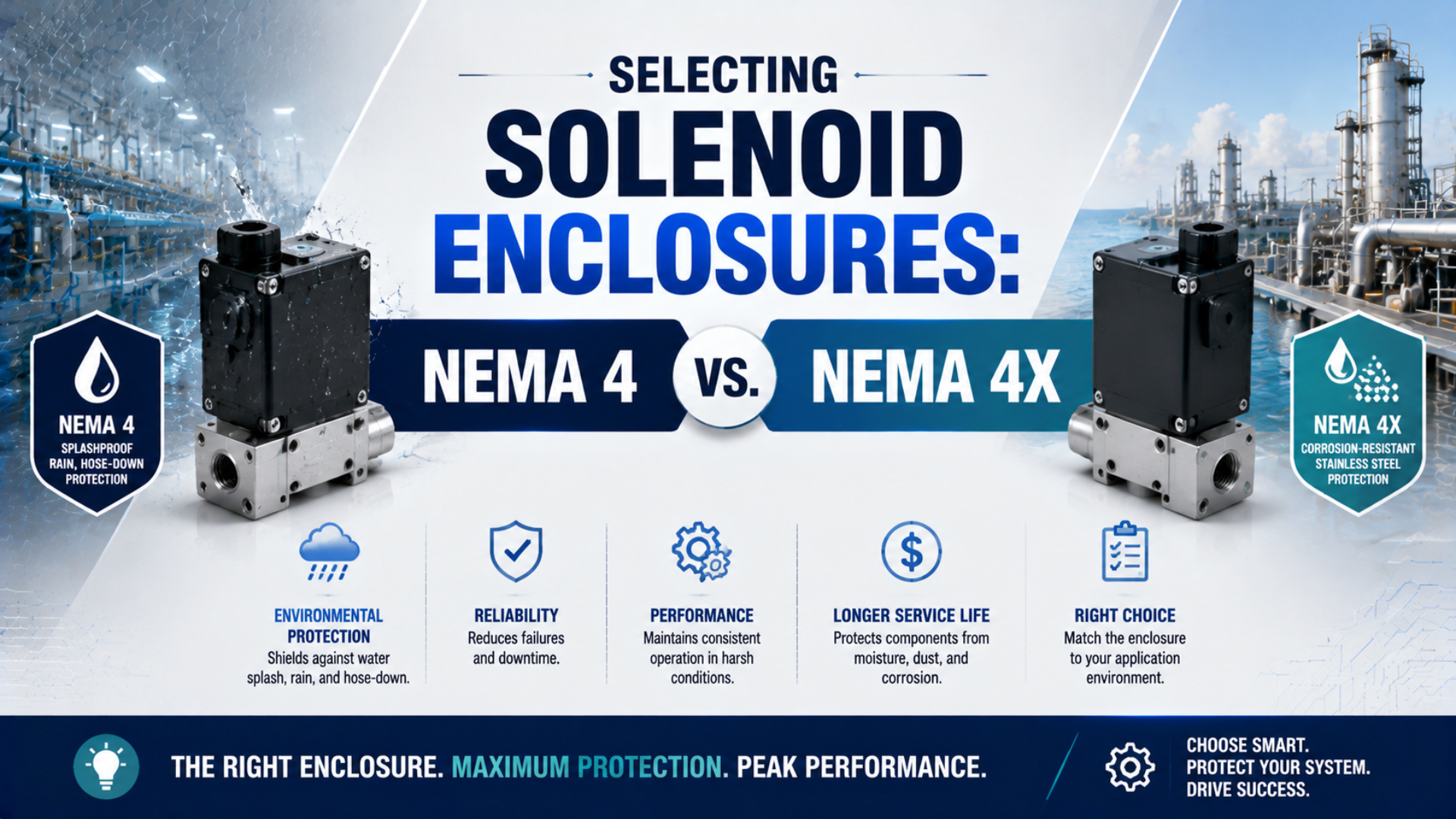
Choose NEMA Type 4 when the installed solenoid assembly needs protection from windblown dust, rain, sleet, snow, splashing water, hose-directed water, and external ice, but does not need the additional corrosion performance of Type 4X. Choose Type 4X when the documented atmosphere, wash chemistry, salt exposure, or equipment specification requires that additional corrosion resistance.
That answer is only the starting point. A Type rating is a performance classification for the evaluated enclosure or equipment, not a universal chemical-compatibility certificate and not a synonym for stainless steel. The complete installed path matters: operator housing, connector, gasket, cable gland, conduit fitting, fasteners, field openings, mounting orientation, and maintenance condition.
Key Takeaways
- NEMA tests outdoor enclosures for 600 hours; Type 4X receives an additional 200-hour corrosion comparison.
- Type 4 and 4X can meet or exceed IP65 and IP66, but IP ratings cannot be converted back to NEMA Types.
- The lowest-rated installed component limits the assembly.
- Confirm material compatibility and rating evidence by exact model.
NEMA Type 4 is an indoor-or-outdoor enclosure classification that covers access to hazardous parts, windblown dust, specified water exposure, and external ice formation.
NEMA Type 4X provides the Type 4 protections plus an additional level of corrosion resistance. It does not specify one required construction material.
What Do NEMA Type 4 and Type 4X Actually Protect?
NEMA defines both Type 4 and 4X for indoor or outdoor use. Both address four main exposure groups: access to hazardous parts, windblown dust, water from weather or hose-directed spray, and external ice formation. Type 4X adds corrosion protection (NEMA Enclosure Types).
The Type rating describes the degree of protection provided under the standard’s construction and test conditions. It does not mean that water can never enter under any imaginable jet, immersion, installation error, gasket damage, or field modification. Nor does it qualify the pneumatic valve’s pressure range, seal chemistry, flow capacity, coil voltage, or functional safety.
| Selection question | Type 4 | Type 4X |
|---|---|---|
| Indoor or outdoor use | Yes | Yes |
| Windblown dust | Included | Included |
| Rain, sleet, snow, splashing and hose-directed water | Included | Included |
| Undamaged by external ice formation | Included | Included |
| Additional corrosion resistance | No 4X-level claim | Included |
| One mandatory material | No | No |
| Chemical compatibility with every cleaner | No | No |
| Hazardous-location approval | Separate requirement | Separate requirement |
The phrase “watertight” is too vague for an engineering purchase specification. State the exact Type rating, installation orientation, cable-entry method, environmental exposure, and any separate approval. If a manifold also carries an IP rating, use the valve-manifold IP65, IP67, and IP69K guide to keep that rating system separate.
The buyer is not selecting a box in isolation. The real object being specified is an environmental protection boundary around energized parts. A Type 4X operator with an unrated plug, damaged gasket, or incorrect gland can leave the installed boundary below Type 4X even though the coil label still reads “4X.”
Does NEMA Type 4 Have No Corrosion Protection?
NEMA’s enclosure FAQ states that all outdoor enclosures and a G90 galvanized-steel reference specimen undergo 600 hours of salt-spray exposure. Type 4X enclosures then receive an additional 200-hour exposure and comparison with an AISI Type 304 stainless-steel specimen (NEMA Enclosure FAQ).
It is therefore inaccurate to describe Type 4 as having no defined corrosion provisions. The useful distinction is narrower: Type 4X provides the standard’s additional corrosion-resistance level beyond Type 4. The “X” does not mean that Type 4 receives no outdoor-corrosion consideration.
The public table of contents for ANSI/NEMA 250-2020 separates general corrosion protection, outdoor corrosion protection, and additional protection for Types 3X, 3RX, 3SX, 4X, and 6P. This structure also shows why the difference should not be reduced to “Type 4X equals one ASTM B117 test” (ANSI/NEMA 250-2020 contents and scope).
Do not turn the test duration into a lifetime multiplier. A 200-hour or 600-hour laboratory exposure does not mean 200 or 600 hours of field life, and it cannot justify an 8-to-12-year service claim. Field corrosion depends on chemical concentration, temperature, wet-dry cycling, deposits, crevices, surface finish, galvanic couples, gasket condition, cleaning practice, and mechanical damage.
Is NEMA 4X Equivalent to IP66?
NEMA’s 2023 technical bulletin shows that Type 4 and 4X enclosures meet or exceed both IP65 and IP66 ingress requirements. The same bulletin warns that the conversion is one-way because NEMA Types cover additional hazards and construction details beyond the two IP numerals (NEMA Bulletin No. 123).
The safe statement is:
- A properly rated NEMA Type 4 or 4X product can satisfy the referenced IP65/IP66 ingress levels.
- An IP66 product is not automatically NEMA Type 4 or 4X.
- IP66 does not communicate the additional Type 4X corrosion performance.
- The complete installed assembly remains limited by its least protective component.
IEC 60529 classifies access, solid-object ingress, and water ingress. ANSI/NEMA 250 also considers characteristics such as corrosion, icing, gasket aging, lubricant or coolant exposure for applicable Types, and ready-for-use installation details. That difference is why a procurement table should not place an equals sign between the systems.
If a customer specification asks for both Type 4X and IP66, quote and document both ratings for the exact configuration. Do not silently replace one with the other. International projects often need both because the equipment, local electrical rules, and buyer documentation use different rating systems.
When Should a Solenoid Enclosure Be Type 4X?
Type 4X adds one defined protection category beyond Type 4: the additional corrosion level. The selection question is therefore whether the installed atmosphere, deposits, cleaning process, specification, or maintenance history creates a corrosion requirement that Type 4 alone does not address (NEMA Enclosure Types).
Use Type 4X as a strong candidate when documented exposure includes:
- marine aerosols, salt spray, deicing salts, or chloride-bearing deposits
- acidic, alkaline, oxidizing, or solvent-containing cleaning agents
- corrosive process vapors, mist, condensation, or product residue
- repeated sanitation where damaged coatings, seams, or fasteners would be unacceptable
- a machine, facility, insurer, customer, or authority specification that explicitly requires Type 4X
- a replacement history showing corrosion at the operator, connector, gland, fastener, or enclosure seam
Do not convert those conditions into universal mandates. FDA guidance requires suitable, cleanable equipment and contamination control, while EU GMP Annex 1 requires exposed clean-area surfaces to be smooth, impervious, unbroken, and compatible with repeated cleaning and disinfection. Neither source universally names NEMA 4X for every solenoid (FDA equipment CGMP Q&A; EU GMP Annex 1).
The correct route is performance-based:
- list every chemical and its concentration
- record exposure temperature, duration, frequency, and rinse conditions
- identify direct spray, vapor, splash, condensation, deposits, and immersion separately
- check enclosure, gasket, cable, connector, valve body, fasteners, and labels against the actual agents
- confirm the required Type, IP, hygienic, and hazardous-location approvals independently
For the broader mechanical exposure problem, see protecting pneumatic cylinders in harsh washdown environments. Enclosure selection protects electrical parts; it does not qualify actuator rods, bearings, barrel finishes, or mounting hardware.
What Does the Type Rating Cover in a Complete Solenoid Assembly?
NEMA states that a field-installed assembly’s overall Type rating is limited by the least severe Type rating among its components. A Type 4X enclosure combined with a lower-rated fitting therefore produces a lower-rated installed boundary (NEMA Enclosure FAQ).
Check every penetration and interface:
- solenoid operator enclosure and coil encapsulation
- removable plug, DIN connector, M12 connector, junction box, or flying lead
- connector gasket and fastening screw
- cable gland, conduit hub, adapter, reducer, blanking plug, and drain
- field-drilled openings and the method used to seal them
- manual override, indicator window, external fasteners, and nameplate
- mounting orientation and any conditional marking such as “Type 4X only when closed”
- valve-to-operator joint, breather, pilot exhaust, and exhaust silencer
The Type rating protects the electrical enclosure boundary. It does not make the pneumatic internals chemically compatible. A Type 4X operator can sit on an aluminium valve body with an elastomer seal that is unsuitable for the process chemical. Conversely, a 316 stainless valve body can use an electrical connector that does not preserve Type 4X.
Direct-mount arrangements introduce another boundary. A NAMUR interface standardizes the pneumatic mounting pattern, not the environmental rating of the combined actuator, valve, connector, tubing, and exhaust system. Review the NAMUR solenoid valve guide separately.
Ask the supplier to draw the protection boundary on the assembly drawing. If the Type claim ends at the operator housing while the field cable connector, valve interface, or breather sits outside it, the RFQ should name those exposed components and their required ratings individually.
Which Enclosure Material Should You Choose?
nVent’s material guide describes Type 304 stainless as roughly 18% chromium and 8% nickel, while its Type 316 example adds about 2% molybdenum and uses a different chromium-nickel balance. The guide still warns that chemical suitability depends on the actual environment (nVent enclosure-material guide).
Start with the verified Type rating, then select material. Do not reverse that order.
Coated or painted steel
Coated steel can be suitable for a Type 4 product and may also appear in corrosion-resistant constructions when the evaluated design passes the applicable requirements. Its field performance depends on coating system, edge coverage, damage, fastener design, cleaning abrasion, and repair practice. A scratch or drilled opening can expose base metal even when the original enclosure passed its tests.
Type 304 stainless steel
Type 304 is widely available and may suit many washdown and outdoor applications, but it is not immune to chloride pitting, crevice corrosion, deposits, or aggressive cleaners. Confirm the exact grade, surface finish, weld treatment, external hardware, and chemical compatibility. “Stainless” alone is not an RFQ-grade material description.
Type 316 or 316L stainless steel
Schneider Electric notes that 316’s molybdenum content improves resistance to corrosive salts and chemicals relative to 304, making it a stronger candidate for coastal, deicing-salt, and selected industrial-chemical locations (Schneider Electric enclosure guidance). It still requires chemical-specific review and does not guarantee immunity.
Nonmetallic materials
Fiberglass, polyester, polycarbonate, and other polymers avoid conventional rust and can perform well with selected acids, alkalis, and salts. They differ in impact strength, UV resistance, temperature range, flame behavior, water absorption, static control, sealing, and chemical compatibility. nVent’s comparison explicitly directs users to chemical-resistance data for the specific agent (nVent nonmetallic enclosure guide).
Use a material compatibility table from the enclosure or valve manufacturer. Record chemical name, concentration, temperature, contact time, stress state, UV exposure, and rinse cycle. If the chemical is absent from the table, obtain a written application review or run a controlled material test rather than assigning suitability by industry name.
A Practical NEMA 4 vs. 4X Selection Workflow
ANSI/NEMA 250 separates Type designation, construction, marking, and design tests into four distinct control areas. A defensible selection must therefore connect the environmental requirement to an exact construction, marking, installation, and evidence package (ANSI/NEMA 250-2020 contents and scope).
- Define the pneumatic duty. Record valve function, pressure, medium, flow, voltage, power, switching frequency, temperature, safe state, pilot requirements, and exhaust arrangement.
- Map environmental exposures. Separate dust, weather, hose spray, immersion, cleaning chemicals, process chemicals, salt, condensation, UV, icing, impact, and hazardous atmosphere.
- Identify the required protection systems. State the NEMA Type, IP rating, hazardous-location approval, hygienic requirement, and customer standard independently.
- Select an exact evaluated configuration. Include operator, connector, gland, fittings, gasket, manual override, valve body, fasteners, cable, and mounting orientation.
- Choose material by chemistry. Compare actual agents and temperatures against supplier data for the enclosure, seals, labels, wire insulation, and valve body.
- Review field installation. Confirm openings, conduit, drains, adapters, torque, orientation, and maintenance preserve the required rating.
- Verify documents and samples. Match the nameplate, declaration or listing, datasheet, drawing, bill of materials, instructions, and received sample to one order code.
Do not use Type 4X as a substitute for a hazardous-location evaluation. Type 7, Type 9, Class/Division, Zone, ATEX, and IECEx address different hazards. A corrosive hazardous area may need multiple ratings on one exact product. See the ATEX solenoid valve guide for that separate decision.
Verification and RFQ Evidence
NEMA’s current FAQ distinguishes two conformity paths: ANSI/NEMA 250 can support a supplier’s declaration of conformity, while standards such as UL 50E are used by certification bodies for listed equipment. Third-party certification is available, but it is not inherent in every NEMA Type claim (NEMA Enclosure FAQ).
Request these items before approving a supplier:
- manufacturer and exact product or enclosure order code
- photograph or drawing of the permanent Type marking
- ANSI/NEMA 250 supplier declaration, UL/CSA/ETL listing, or other specified conformity evidence
- certification-directory record when a third-party mark is required
- conditional restrictions and installation instructions
- enclosure, fastener, gasket, connector, gland, valve-body, and seal materials
- permitted cable entries, plugs, field holes, adapters, drains, and mounting orientation
- chemical-resistance evidence for the named agents and temperatures
- coil voltage, wattage, duty, ambient range, and connector wiring
- separate hazardous-location and hygienic evidence when applicable
UL offers certification for enclosures and accessories with Type ratings including 4X, and provides searchable product databases. When the RFQ requires a UL mark, verify the exact product in the applicable certification record rather than accepting a generic brochure or an unrelated family certificate (UL enclosure certification).
Self-declaration is not permission to use the NEMA registered trademark as a certification mark. Equally, an impressive certificate is not useful if it covers another connector, material, coil, or enclosure. The evidence must resolve to the supplied configuration.
For supplier qualification beyond Type markings, use the branded-versus-unbranded pneumatics guide to structure sample inspection, traceability, drawing control, and change-notification questions.
How Should Lifecycle Cost Be Compared?
NEMA’s 600-hour outdoor corrosion framework and additional 200-hour 4X comparison are laboratory qualification elements, not service-life predictions. A credible lifecycle comparison must therefore use the buyer’s actual failure history, labor, downtime, cleaning exposure, and replacement policy rather than an invented 12-to-24-month payback (NEMA Enclosure FAQ).
Use a transparent cost boundary:
Here, is the cost for the chosen study period. The remaining terms are documented purchase, installation, inspection, maintenance, replacement, and downtime costs for the exact compared configurations. Use the same currency, study period, production assumptions, and failure definition for both options.
Keep regulatory or customer nonconformance separate unless the site has a documented method for valuing it. Do not insert an arbitrary “audit risk cost.” Instead, identify the required specification as a pass/fail condition. A cheaper product that does not meet the required Type, material, or listing is not a valid alternative in the cost comparison.
Useful evidence includes:
- work orders and photographed corrosion locations
- actual replacement intervals by model and location
- loaded labor rate and access time
- production records for confirmed downtime
- cleaning chemical, temperature, concentration, and frequency
- spare inventory and emergency freight costs
- inspection and gasket-replacement intervals
- supplier quotation tied to the full order code and evidence package
No current site calculator performs this enclosure-specific lifecycle analysis. The pneumatic-components landed-cost tool measures import and procurement costs, not corrosion exposure, Type-rating compliance, or field failure. It should not be used here.
Separate qualification from economics. First remove every option that fails the environmental and documentary requirements. Then compare lifecycle cost among the remaining compliant configurations. Mixing those stages lets a low initial price disguise a technical nonconformance.
Selection Rule
Type 4 and 4X both meet or exceed IP65 and IP66 ingress levels in NEMA’s published comparison, but only Type 4X includes the additional corrosion performance. This makes corrosion need, not water pressure alone, the main discriminator between the two Types (NEMA Bulletin No. 123).
Select Type 4 when the complete assembly satisfies the ingress, ice, installation, and local specification requirements without needing the 4X corrosion level. Select Type 4X when documented chemicals, salt, cleaning, corrosion history, or project requirements call for that additional protection.
In both cases, approve only the exact assembly and conformity route. Verify the connector, cable entry, field modifications, valve materials, coil conditions, and any hazardous-location approvals separately. Bepto Pneumatic can help convert that evidence list into an RFQ for a specific solenoid valve configuration.
NEMA 4 vs. 4X Solenoid Enclosure FAQs
NEMA’s published guidance distinguishes two conformity routes, two one-way IP comparisons for Type 4/4X, and a weakest-component rule for field assemblies. These five questions apply those boundaries to common solenoid-valve purchasing and installation decisions (NEMA Enclosure FAQ).
Can a NEMA Type 4 enclosure be upgraded to Type 4X with a field coating?
Not by coating alone. A field-applied finish may improve corrosion resistance, but it does not automatically establish that the modified enclosure meets Type 4X construction, marking, and test requirements. Follow the enclosure manufacturer’s approved modification method and obtain evidence for the resulting assembly before retaining or changing the Type claim.
Does a stainless-steel solenoid enclosure automatically qualify as Type 4X?
No. Stainless steel is a material, while Type 4X is a performance classification for an evaluated enclosure or product. The design must also address openings, gaskets, fasteners, water exposure, access, icing, marking, and corrosion requirements. Verify the exact product’s Type marking and conformity documentation.
Is IP66 the same as NEMA Type 4X?
No. NEMA states that Type 4 and 4X can meet or exceed IP65 and IP66, but an IP66 rating cannot be converted back into a NEMA Type. IP66 covers solid and water ingress, while Type 4X also includes the applicable NEMA construction, icing, and corrosion provisions.
Does every NEMA Type 4X claim require third-party certification?
No. ANSI/NEMA 250 may be used for a supplier’s declaration of conformity, while UL 50E and related standards support third-party certification and listing. The project specification, electrical code, authority having jurisdiction, and customer requirements determine which evidence is acceptable. Request documents for the exact supplied configuration.
Can a Type 4X solenoid be used in a hazardous location?
Only if the exact product also carries the required hazardous-location approval for the classified gas, dust, group, division or zone, temperature class, and wiring method. Type 4X addresses environmental enclosure protection and corrosion; it does not by itself provide explosion protection, intrinsic safety, or nonincendive approval.
Sources and technical references
- NEMA Enclosure Types.
- NEMA FAQs: Enclosures.
- ANSI/NEMA 250-2020 contents and scope.
- NEMA Bulletin No. 123: NEMA and IP Ratings.
- UL electrical enclosure and component certification.
- nVent enclosure-material selection guide.
- Schneider Electric Type 304 and 316 enclosure guidance.
- FDA equipment CGMP Q&A.
- European Commission EU GMP Annex 1.