

Introduction
Your pneumatic cylinders handle different loads throughout the production cycle—sometimes moving empty fixtures, sometimes carrying full product loads. With fixed cushioning, light loads decelerate too aggressively while heavy loads slam into end stops. You’re stuck choosing between over-cushioning light loads or under-cushioning heavy ones, and neither option delivers acceptable performance across your operating range. 🔄
Shock absorber damping coefficients determine deceleration force relative to velocity, with adjustable coefficients allowing optimization for variable loads ranging from 5-50kg on the same cylinder. Proper tuning matches damping force to kinetic energy across the load range, preventing both excessive bounce (over-damping light loads) and insufficient deceleration (under-damping heavy loads), with adjustment ranges typically spanning 3:1 to 10:1 force ratios depending on absorber design and quality.
Last month, I consulted with Sarah, a process engineer at a pharmaceutical packaging facility in North Carolina. Her filling line handled containers from 2kg to 18kg using the same rodless cylinder positioning system. With standard fixed cushioning, light containers bounced and oscillated for 0.5+ seconds, while heavy containers impacted hard enough to crack product. Her line efficiency suffered from extended settling times, and product damage exceeded 2% on heavy containers. She needed variable damping that could adapt to her 9:1 load range. 📊
Table of Contents
- What Are Damping Coefficients and How Do They Work?
- How Do You Calculate Required Damping for Different Loads?
- What Adjustment Methods Provide Variable Damping Control?
- How Do You Tune Damping for Optimal Performance Across Load Ranges?
- Conclusion
- FAQs About Shock Absorber Damping
What Are Damping Coefficients and How Do They Work?
Understanding damping physics reveals why coefficient adjustment is essential for variable-load applications. ⚙️
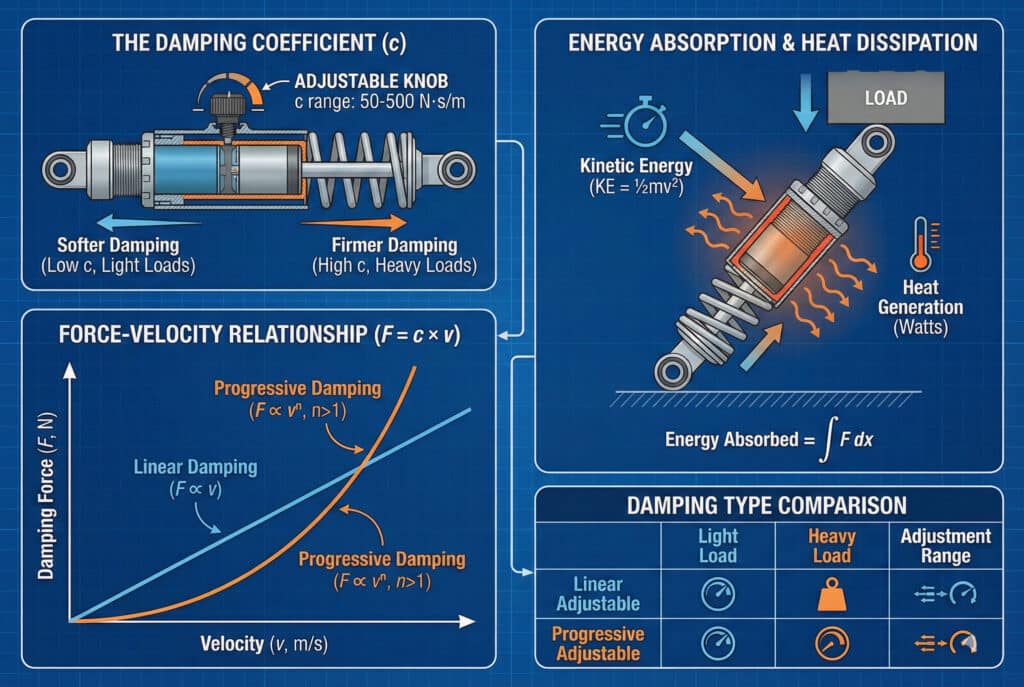
Damping coefficient (c) defines the relationship between damping force1 and velocity through F = c × v, where force increases proportionally with velocity for linear dampers or exponentially for progressive designs. Typical coefficients range from 50-500 N·s/m for pneumatic shock absorbers, with higher coefficients producing firmer damping that suits heavy loads, while lower coefficients provide softer damping for light loads. Adjustable absorbers allow coefficient changes of 3-10x to accommodate varying kinetic energies without component replacement.
The Damping Force Equation
Damping force follows fundamental physics principles:
$$
F_{damping} = c \times v
$$
Where:
- F = Damping force (Newtons)
- c = Damping coefficient (N·s/m)
- v = Velocity (m/s)
Example Calculation:
- Damping coefficient: 200 N·s/m
- Impact velocity: 1.5 m/s
- Damping force: 200 × 1.5 = 300N
This linear relationship means doubling velocity doubles damping force—providing natural adaptation to impact energy.
Linear vs. Progressive Damping
Different damping profiles suit different applications:
Linear Damping (F = c × v):
- Constant coefficient throughout stroke
- Predictable, consistent behavior
- Best for: Constant-load applications
- Force increases proportionally with velocity
Progressive Damping (F = c × v^n, where n > 1):
- Coefficient increases with compression
- Softer initial contact, firmer finish
- Best for: Variable-load applications
- Force increases exponentially with velocity
| Damping Type | Light Load Response | Heavy Load Response | Adjustment Range | Best Application |
|---|---|---|---|---|
| Linear fixed | Too firm | Too soft | None | Single load only |
| Linear adjustable | Tunable | Tunable | 3-5:1 | Moderate variation |
| Progressive fixed | Good | Good | None | 2-3:1 load range |
| Progressive adjustable | Excellent | Excellent | 5-10:1 | Wide load variation |
Energy Absorption Capacity
Damping coefficient determines total energy absorption:
$$
Energy_{absorbed}
= \int F \, dx
= \int (c \times v)\, dx
$$
For a given stroke length, higher damping coefficients absorb more energy but create higher peak forces. The art of tuning is matching coefficient to energy requirements without exceeding force limits.
Coefficient Selection Guidelines:
- Light loads (5-10kg): c = 50-150 N·s/m
- Medium loads (10-25kg): c = 150-300 N·s/m
- Heavy loads (25-50kg): c = 300-500 N·s/m
- Variable loads: Adjustable 100-400 N·s/m range
Damping Efficiency and Heat Dissipation
Energy absorption converts kinetic energy2 to heat:
Heat Generation Rate:
- Energy per cycle = ½mv²
- Cycles per minute = operating frequency
- Heat = Energy × Frequency
- High-frequency applications require heat dissipation consideration
For Sarah’s North Carolina application running 45 cycles/minute with 18kg loads at 1.2 m/s:
- Energy per cycle: ½ × 18 × 1.2² = 13 joules
- Heat generation: 13J × 45/min = 585 watts
- Significant heat requiring aluminum body for dissipation 🔥
How Do You Calculate Required Damping for Different Loads?
Proper damping calculation ensures optimal performance across your entire load range. 🔬
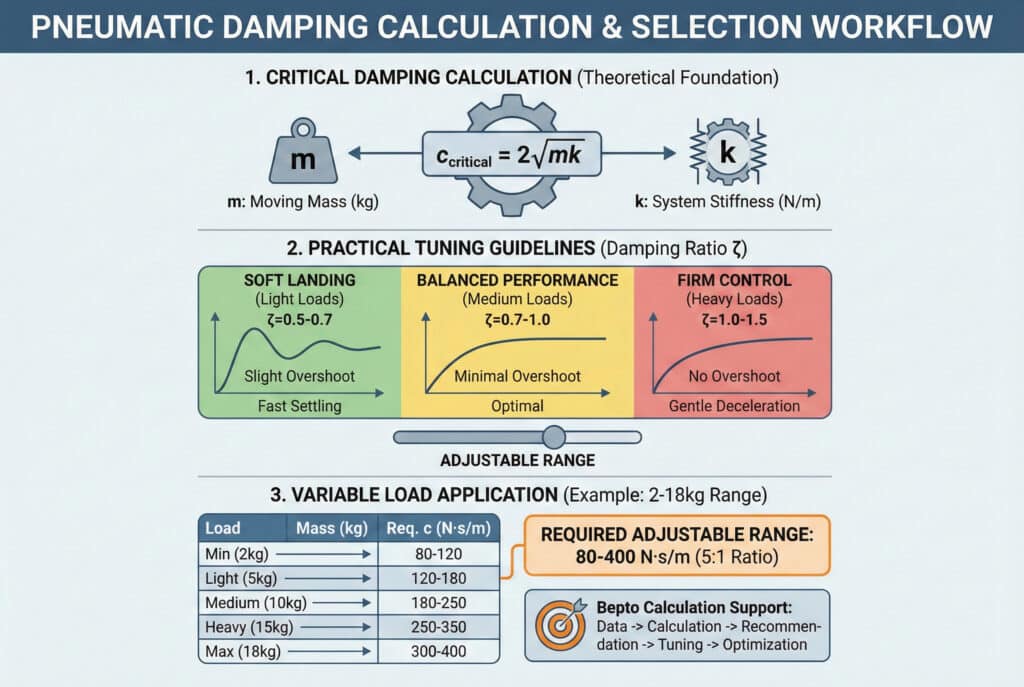
Calculate required damping coefficient using c = 2√(mk) for critical damping3, where m is moving mass and k is system stiffness, then adjust based on desired response: 50-70% of critical for soft landing (light loads), 80-100% for balanced performance (medium loads), or 120-150% for firm control (heavy loads). For variable-load systems, calculate coefficients for minimum and maximum loads, then select adjustable absorbers spanning that range with 20-30% margin.
Critical Damping Calculation
Critical damping provides fastest settling without oscillation:
$$
c_{critical} = 2 \sqrt{m k}
$$
Where:
- m = Moving mass (kg)
- k = System stiffness (N/m)
- c_critical = Critical damping coefficient (N·s/m)
Example – Light Load:
- Mass: 8 kg
- Stiffness: 50,000 N/m (typical for shock absorber)
- c_critical = 2√(8 × 50,000) = 2√400,000 = 2 × 632 = 1,264 N·s/m
For practical pneumatic applications, use 50-80% of critical damping to allow slight overshoot for faster settling.
Practical Damping Selection
Real-world applications require adjustment from theoretical values:
Damping Ratio4 (ζ) Guidelines:
- ζ = 0.3-0.5 (30-50% critical): Under-damped, fast but with overshoot
- ζ = 0.5-0.7 (50-70% critical): Slightly under-damped, good balance
- ζ = 0.7-1.0 (70-100% critical): Near-critical, minimal overshoot
- ζ = 1.0-1.5 (100-150% critical): Over-damped, slow but no overshoot
Selection Based on Application:
- High-speed packaging: ζ = 0.5-0.7 (fast settling)
- Precision positioning: ζ = 0.8-1.0 (minimal overshoot)
- Delicate products: ζ = 1.0-1.5 (gentle deceleration)
Variable Load Calculation Matrix
For Sarah’s pharmaceutical application with 2-18kg range:
| Load Condition | Mass (kg) | Velocity (m/s) | KE (J) | Required c (N·s/m) | Damping Ratio |
|---|---|---|---|---|---|
| Minimum load | 2 | 1.2 | 1.4 | 80-120 | 0.6-0.7 |
| Light load | 5 | 1.2 | 3.6 | 120-180 | 0.6-0.7 |
| Medium load | 10 | 1.2 | 7.2 | 180-250 | 0.6-0.7 |
| Heavy load | 15 | 1.2 | 10.8 | 250-350 | 0.6-0.7 |
| Maximum load | 18 | 1.2 | 13.0 | 300-400 | 0.6-0.7 |
Conclusion: Required adjustable range = 80-400 N·s/m (5:1 adjustment ratio)
Energy-Based Coefficient Estimation
Alternative approach using kinetic energy:
$$
c \approx \frac{2 \times KE}{v \times stroke}
$$
Where:
- KE = Kinetic energy (joules)
- v = Impact velocity (m/s)
- stroke = Absorber stroke length (m)
Example for 18kg load:
- KE = 13 joules
- Velocity = 1.2 m/s
- Stroke = 0.05m (50mm absorber)
- c ≈ (2 × 13) / (1.2 × 0.05) = 26 / 0.06 = 433 N·s/m
This simplified formula provides quick estimates for absorber selection. 📐
Bepto Calculation Support
At Bepto, we provide damping calculation services for customers:
Our Process:
- Collect application data (mass range, velocity, frequency)
- Calculate required coefficient range
- Recommend appropriate adjustable shock absorbers
- Provide initial tuning settings
- Support field optimization
We’ve developed calculation tools based on hundreds of successful installations, ensuring accurate recommendations for your specific application. 🎯
What Adjustment Methods Provide Variable Damping Control?
Different shock absorber designs offer varying levels of damping adjustment capability. 🔧
Variable damping control is achieved through three primary methods: manual needle valve adjustment (changes orifice size, 3-5:1 range, requires stopping for adjustment), rotary dial adjustment (external knob changes internal restriction, 5-8:1 range, adjustable during operation), or automatic load-sensing designs (self-adjusting based on impact force, 8-12:1 range, no manual intervention). Selection depends on load variation frequency, adjustment accessibility requirements, and budget constraints, with costs ranging from $80 for manual to $400+ for automatic systems.

Manual Needle Valve Adjustment
Traditional and most economical approach:
Design Features:
- Threaded needle valve controls oil flow restriction
- Typical adjustment: 10-20 turns from closed to open
- Requires hex key or screwdriver for adjustment
- Must stop operation to adjust
Adjustment Range:
- Minimum damping: Valve fully open
- Maximum damping: Valve nearly closed (never fully close)
- Typical range: 3-5:1 force ratio
- Precision: ±10-15% repeatability
Best For:
- Infrequent load changes (daily or weekly)
- Accessible mounting locations
- Budget-conscious applications
- Cost: $80-150 per absorber
Rotary Dial External Adjustment
More convenient for frequent changes:
Design Features:
- External knob directly controls damping
- Numbered scale (typically 1-10 or 1-20)
- Adjustable without tools
- Can adjust during operation (with caution)
Adjustment Range:
- Scale positions correspond to damping levels
- Typical range: 5-8:1 force ratio
- Precision: ±5-8% repeatability
- Faster adjustment than needle valve
Best For:
- Frequent load changes (hourly or per-shift)
- Operator-accessible locations
- Production flexibility requirements
- Cost: $150-280 per absorber
Automatic Load-Sensing Designs
Premium solution for highly variable loads:
| Feature | Hydraulic Auto-Adjust | Pneumatic Compensating | Servo-Controlled |
|---|---|---|---|
| Adjustment method | Pressure-responsive valve | Spring-loaded piston | Electronic actuator |
| Response time | Instantaneous | <0.1 seconds | 0.2-0.5 seconds |
| Adjustment range | 8-10:1 | 6-8:1 | 10-15:1 |
| Accuracy | ±5% | ±8% | ±2% |
| Cost | $280-400 | $200-320 | $500-800 |
| Maintenance | Low | Medium | Medium-high |
Best For:
- Continuous load variation (cycle-to-cycle)
- Unmanned operations
- Critical applications requiring optimization
- High-volume production justifying investment
Adjustment Mechanism Comparison
Practical considerations for selection:
Manual Needle Valve:
- ✅ Lowest cost
- ✅ Simple, reliable
- ✅ No external power required
- ❌ Requires stopping for adjustment
- ❌ Limited range
- ❌ Time-consuming tuning
Rotary Dial:
- ✅ Quick adjustment
- ✅ No tools required
- ✅ Good range
- ❌ Moderate cost
- ❌ External knob can be bumped
- ❌ Still requires manual intervention
Automatic:
- ✅ No manual adjustment needed
- ✅ Optimizes every cycle
- ✅ Maximum range
- ❌ Highest cost
- ❌ More complex
- ❌ Potential maintenance requirements
For Sarah’s pharmaceutical application with frequent container size changes (every 15-30 minutes), we recommended rotary dial adjustable absorbers—providing quick adjustment without stopping production, at reasonable cost. 💡
How Do You Tune Damping for Optimal Performance Across Load Ranges?
Systematic tuning methodology ensures optimal performance for all load conditions. 🎯
Tune damping by starting with calculated mid-range settings, then testing minimum and maximum loads while measuring settling time, bounce, and peak deceleration forces. Optimal tuning achieves settling times under 0.3 seconds, bounce amplitude less than 10% of stroke, and peak forces below structural limits (typically 500-1000N). For wide load ranges, create adjustment charts mapping load conditions to damping settings, enabling operators to quickly optimize for current production requirements without trial-and-error.
Initial Setup Procedure
Start with calculated baseline settings:
Step 1: Calculate Mid-Range Setting
- Determine average load: (Min + Max) / 2
- Calculate required coefficient for average load
- Set absorber to corresponding adjustment position
- For Sarah’s application: (2kg + 18kg) / 2 = 10kg baseline
Step 2: Test Minimum Load
- Run cylinder with lightest expected load
- Observe deceleration behavior
- Measure settling time and bounce
- If excessive bounce: Reduce damping 20-30%
Step 3: Test Maximum Load
- Run cylinder with heaviest expected load
- Observe deceleration behavior
- Check for hard impacts or insufficient deceleration
- If inadequate: Increase damping 20-30%
Step 4: Iterate
- Adjust settings incrementally
- Test intermediate loads
- Document optimal settings for each load range
Performance Measurement Criteria
Define success metrics for tuning:
| Performance Metric | Target Value | Measurement Method | Acceptable Range |
|---|---|---|---|
| Settling time5 | <0.3 seconds | Timer or high-speed camera | 0.2-0.4 seconds |
| Bounce amplitude | <5mm | Visual or proximity sensor | <10mm |
| Peak deceleration | 8-15 m/s² | Accelerometer | 5-20 m/s² |
| Noise level | <75 dB | Sound meter | <80 dB |
| Positioning accuracy | ±0.2mm | Measurement system | ±0.5mm |
Load-Based Adjustment Chart
Create operator reference for quick optimization:
Sarah’s Pharmaceutical Line – Damping Settings:
| Container Type | Total Mass | Damping Setting | Dial Position | Notes |
|---|---|---|---|---|
| Small vial | 2-4 kg | Minimum | Position 2-3 | Prevent bounce |
| Medium vial | 5-8 kg | Low-medium | Position 4-5 | Balanced |
| Large vial | 9-12 kg | Medium | Position 6-7 | Standard |
| Small bottle | 13-15 kg | Medium-high | Position 8-9 | Firm control |
| Large bottle | 16-18 kg | Maximum | Position 9-10 | Prevent impact |
This chart eliminated guesswork and reduced changeover time from 15 minutes to under 2 minutes. 📋
Fine-Tuning Techniques
Advanced optimization methods:
Technique 1: Settling Time Optimization
- Gradually increase damping until bounce disappears
- Then reduce 10-15% for fastest settling
- Slight underdamping (ζ = 0.6-0.7) settles faster than critical
Technique 2: Force Limit Verification
- Install force sensor or pressure gauge
- Measure peak deceleration force
- Ensure forces stay below structural limits
- Typical limit: 500-800N for standard cylinders
Technique 3: Energy Balance Check
- Calculate kinetic energy input
- Verify absorber stroke utilization (should use 70-90%)
- Under-utilization: Increase damping
- Over-utilization (bottoming out): Decrease damping or add absorber capacity
Automated Tuning Systems
For high-value applications, consider automated optimization:
Servo-Controlled Absorbers:
- Load sensors detect impact mass
- Controller calculates optimal damping
- Servo adjusts damping in real-time
- Cost: $500-800 per absorber
- ROI: 6-18 months in high-volume applications
Bepto Smart Damping Solution:
We’re developing intelligent shock absorbers with:
- Integrated load sensing
- Microcontroller-based optimization
- Self-learning algorithms
- Remote monitoring capability
- Target release: Q3 2026 🚀
Sarah’s Tuning Results
After systematic tuning of her North Carolina pharmaceutical line:
Performance Improvements:
- Settling time: Reduced from 0.5-0.8s to 0.15-0.25s (70% improvement)
- Bounce: Eliminated on all container sizes
- Product damage: Reduced from 2.1% to 0.3% (86% reduction)
- Changeover time: Reduced from 15 min to <2 min (87% reduction)
- Line efficiency: Increased 12% due to faster settling
Financial Impact:
- Product damage savings: $48,000/year
- Efficiency improvement value: $35,000/year
- Absorber investment: $4,200 (14 units × $300)
- Payback period: 18 days 💰
The key was systematic calculation, proper absorber selection, and methodical tuning across the full load range.
Conclusion
Shock absorber damping coefficients are the critical tuning parameter for variable-load pneumatic systems, determining whether your cylinders deliver consistent performance or struggle with bounce and impact across load variations. By calculating required coefficients for your load range, selecting appropriately adjustable absorbers, and systematically tuning for optimal performance, you can achieve fast, precise, and reliable operation regardless of load variations. At Bepto, we provide the technical expertise, calculation support, and quality adjustable shock absorbers to optimize your variable-load applications for maximum performance and reliability.
FAQs About Shock Absorber Damping
What’s the difference between damping coefficient and damping ratio?
Damping coefficient (c) is the absolute force per unit velocity measured in N·s/m, while damping ratio (ζ) is the dimensionless ratio of actual damping to critical damping, expressed as a percentage or decimal (ζ = c / c_critical). Coefficient is the physical property of the absorber, while ratio describes system behavior. For example, c = 200 N·s/m might represent ζ = 0.7 (70% of critical) for one mass but ζ = 0.4 for a different mass. Engineers use coefficient for absorber selection and ratio for predicting system response.
How much adjustment range do you need for variable-load applications?
Required adjustment range equals the ratio of maximum to minimum kinetic energy, typically 3-5:1 for moderate variation (2:1 mass range) or 8-12:1 for wide variation (4:1+ mass range). Calculate by determining KE for lightest and heaviest loads: if minimum KE = 3J and maximum KE = 27J, you need 9:1 adjustment range. Add 20-30% margin for velocity variations and component tolerances. Bepto offers adjustable absorbers with 5:1 (standard), 8:1 (enhanced), and 12:1 (premium) ranges to suit different applications.
Can you use multiple shock absorbers to increase capacity?
Yes, multiple absorbers in parallel multiply capacity while averaging damping coefficients—two identical absorbers provide 2x energy capacity with the same coefficient, or different settings can be used to create custom damping profiles. For example, combining soft (c=100) and firm (c=300) absorbers creates progressive damping: light loads compress only the soft absorber, while heavy loads engage both for combined c=400. This technique suits applications with extreme load variation. Ensure absorbers are properly aligned and synchronized for even loading.
How often should damping settings be adjusted for variable loads?
Adjustment frequency depends on load change frequency and performance requirements: adjust every changeover for optimal performance (2-5 minute task with rotary dial), or use compromise settings for similar loads if changeovers are very frequent. For loads varying within 2:1 range, single mid-range setting often provides acceptable performance. For loads varying beyond 3:1, adjustment significantly improves performance and reduces component wear. Automatic load-sensing absorbers eliminate manual adjustment for cycle-to-cycle variation.
What causes shock absorbers to lose damping force over time?
Damping force degradation results from seal wear allowing internal leakage (most common), contamination of damping fluid, wear of internal metering components, or loss of gas charge in gas-spring designs, typically occurring after 500,000-2,000,000 cycles depending on quality and loading severity. Symptoms include increased settling time, bounce reappearance, and reduced peak force. Quality absorbers like those from Bepto include replaceable seal kits ($25-60) extending service life, while economy absorbers require complete replacement ($80-150). Proper initial tuning (avoiding over-compression) extends life 2-3x by reducing internal stress.
-
Learn about the physics of viscous damping where force is proportional to velocity. ↩
-
Review the fundamental physics concept of energy possessed by an object due to its motion. ↩
-
Understand the specific damping level that returns a system to equilibrium in the shortest time without oscillation. ↩
-
Learn about the dimensionless parameter describing how oscillations in a system decay. ↩
-
Read about the time required for a system’s response to remain within a specified error band. ↩