

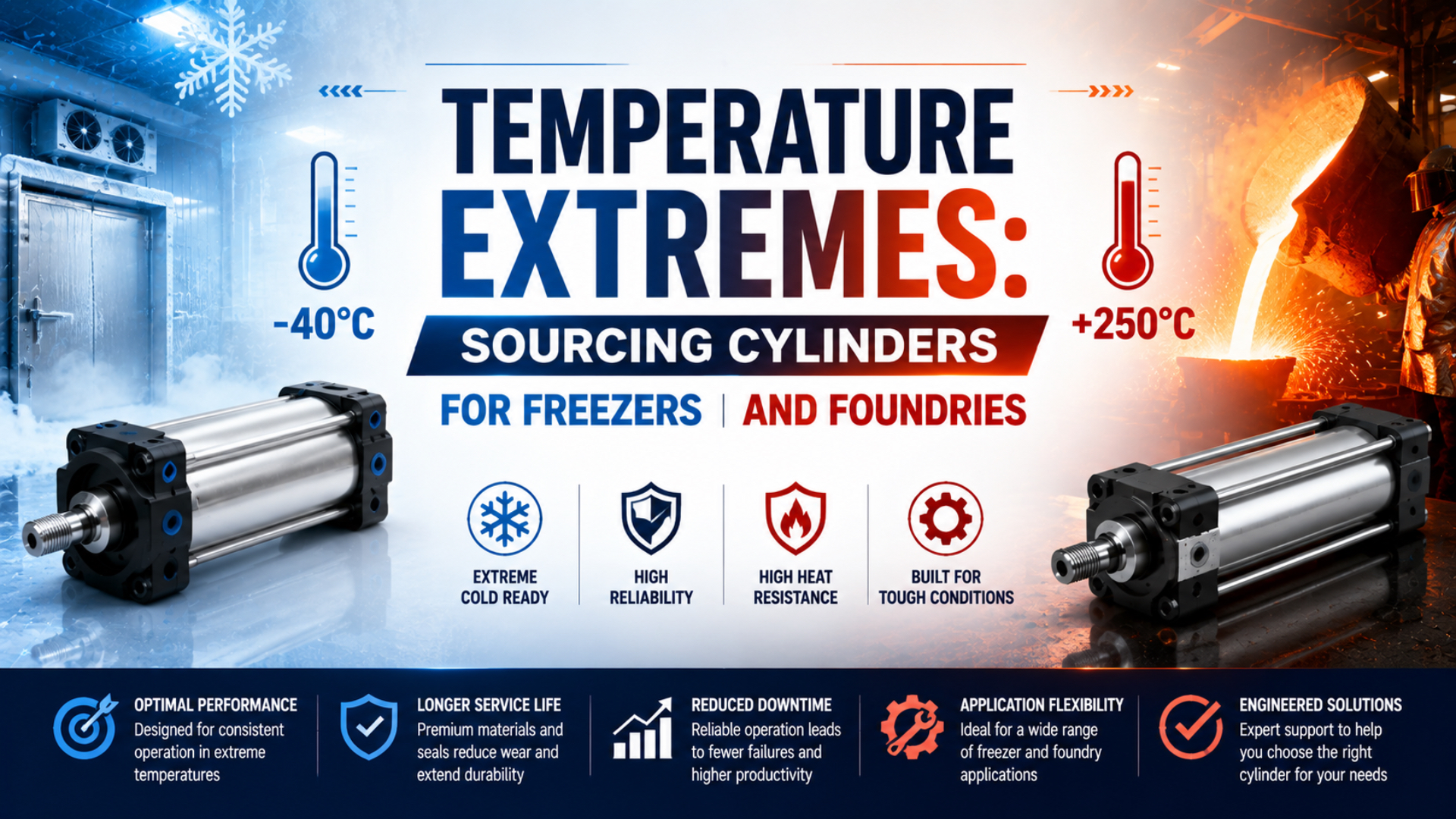
Source an extreme-temperature pneumatic cylinder as a documented configuration, not as a standard cylinder with a different seal kit. The controlling limit may belong to the grease, magnet, switch, cushion, tube, fitting, rod connection, or mounting arrangement. The RFQ must therefore describe the installed temperature profile and require evidence for every exposed component.
An extreme-temperature pneumatic cylinder is a complete, identified actuator configuration whose documented limits cover the installed ambient, media, surface, startup, duty, accessory, and maintenance conditions.
Current product catalogs show how large the configuration difference can be. SMC lists its -XB7 cold-resistant option at -40°C to 70°C. Its -XB6 heat-resistant option runs from -10°C to 150°C. Both options change seals and grease, and they restrict features such as switches or cushioning (SMC -XB7; SMC -XB6, accessed 2026-07-26).
Key Takeaways
- Specify the complete ordered cylinder, not a polymer family.
- Record eight temperature inputs before requesting a quote.
- Keep pressure dew point below the coldest compressed-air location.
- Measure cylinder surfaces near a furnace instead of quoting furnace temperature.
- Qualify switches, tubing, fittings, grease, mounts, and guarding with the actuator.
For detailed component behavior, use the separate guides to high-temperature pneumatic cylinders, sub-zero cylinder design, and cylinder seal temperature selection. This article concentrates on sourcing, RFQ evidence, and acceptance testing across both environments.
What Temperature Data Belongs in the RFQ?
Record at least eight temperature inputs before selecting a cylinder. SMC publishes option ranges of -40°C to 70°C and -10°C to 150°C. These are ambient ratings for identified configurations, not permission to expose any cylinder to those limits (SMC Web Catalog, accessed 2026-07-26).
The phrase “operates beside a furnace” is not a temperature specification. Neither is “used in a freezer.” Give the supplier the values below, their measurement locations, and how they were obtained.
| RFQ input | What to record | Why it changes selection |
|---|---|---|
| Minimum ambient | Coldest air surrounding the installed cylinder | Screens the body, seals, grease, switch, tube, and fitting |
| Maximum ambient | Hottest surrounding air during production | Separates general heat exposure from a local radiant source |
| Cylinder surface | Barrel, gland, end cap, rod, and switch temperatures | Shows what the actual assembly experiences |
| Compressed-air temperature | Temperature at the valve and cylinder inlet | Reveals a media condition that may differ from ambient |
| Cold-soak temperature | Body temperature after the longest shutdown | Defines the first-stroke condition |
| Continuous temperature | Stabilized value during normal cycling | Supports the continuous operating rating |
| Short peak and dwell | Peak value, location, duration, and frequency | Prevents a short material limit from becoming a continuous rating |
| Cycle profile | Heating, cooling, defrost, washdown, or door-opening sequence | Exposes thermal cycling and condensation paths |
Measure surface temperature after the machine reaches steady production and during the worst credible event. In a foundry, that may be an open furnace door or hot-part transfer. In a freezer, it may be the first command after a weekend shutdown or the warm, humid period immediately after defrost.
Treat temperature as a time history, not one minimum and one maximum. Two applications with the same peak can require different designs when one reaches it for ten seconds per shift and the other remains there continuously.
Freezer Selection: Moisture and Cold-Start Controls
The cold option must cover both temperature and water control. SMC specifies dry air for its -XB7 cylinder to prevent moisture from freezing, while ISO 8573-1 classifies compressed-air contamination by particles, water, and oil (SMC -XB7; ISO 8573-1, accessed 2026-07-26).
The useful air-quality value is pressure dew point at a stated pressure and measurement location. Atlas Copco advises reducing pressure dew point below the coldest point the compressed-air system can reach. It also notes that a typical refrigerated dryer delivering about 3°C pressure dew point does not prevent condensation when downstream air becomes colder (Atlas Copco, accessed 2026-07-26).
That means the freezer RFQ should include:
- Required pressure dew point and the lowest pipe, valve, and cylinder-port temperature.
- Dryer type, drain arrangement, filter grade, and dew-point monitoring location.
- Lowest body temperature before the first commanded stroke.
- Expected breakaway time, stroke time, and pressure at cold start.
- External condensation, ice, washdown, and defrost exposure.
- Exhaust location and the possibility of local icing or blocked silencers.
- Grease, seals, wipers, tubing, fittings, valves, and sensors approved for the exact minimum temperature.
A desiccant breather attached somewhere near the actuator does not dry the compressed air entering a double-acting cylinder. Control water upstream, remove liquid at drains and low points, and verify the pressure dew point at the relevant pressure. The pressure dew point guide explains why atmospheric dew point cannot be substituted directly.
Cold-start acceptance matters because grease viscosity and seal recovery can be most demanding after a long idle period. Do not warm the sample before the test unless the production machine will use the same controlled heater, thermostat, fault monitoring, and startup interlock.
Foundry Selection: Measure the Cylinder, Not the Furnace
A furnace rating is not a cylinder rating. Parker’s Series 2A/2AN catalog gives -23°C to 74°C for one standard seal class. Specific high-temperature arrangements reach 204°C and require construction changes (Parker Series 2A/2AN catalog, accessed 2026-07-26).
Measure the barrel, gland, rod, end caps, sensor, valve, tube, and fittings during the hottest operating sequence. Also record the heat path:
- Radiation: direct line of sight to a furnace, hot billet, mold, ladle, or oven opening.
- Convection: hot air surrounding the cylinder or moving through an enclosure.
- Conduction: heat entering through brackets, machine frames, rod ends, or fixtures.
- Internal media: compressed-air temperature at the valve and cylinder port.
- Contamination: scale, sand, weld spatter, abrasive dust, or hot process residue at the rod and wiper.
A shield can reduce radiant exposure. It does not create a new cylinder rating by itself. State the shield material, air gap, coverage, ventilation, and measured temperatures on both sides. If cooling air or water is proposed, specify flow monitoring, leak consequences, interlocks, and the safe state after cooling is lost.
Distance and relocation are often more reliable than exotic seal materials. Moving a valve, switch, or cylinder outside the hot zone may remove several weak links at once. A mechanical linkage, remote sensor, heat shield, or different actuator architecture should be considered when the cylinder surface cannot be kept inside a documented product range.
During servicing, heat is only one hazardous-energy source. OSHA notes that pneumatic, thermal, mechanical, hydraulic, chemical, and other stored energy must be controlled and dissipated or restrained before maintenance begins (OSHA, accessed 2026-07-26).
How Should Seals, Grease, and Accessories Be Qualified?
Approve a complete model and compound, not a generic material name. Parker assigns different limits and construction requirements to low-temperature nitrile, fluorocarbon, and energized PTFE seal classes. The stated ranges belong to those defined cylinder arrangements (Parker Series 2A/2AN catalog, accessed 2026-07-26).
Labels such as NBR, FKM, polyurethane, or PTFE are only screening terms. The final decision must identify:
| Item | Evidence to request | Common sourcing error |
|---|---|---|
| Dynamic seals | Compound code, profile, pressure, speed, surface, and temperature limits | Selecting by base polymer alone |
| Static seals | Exact O-ring or gasket compound and groove conditions | Upgrading only the rod seal |
| Energizer | Spring or elastomer material and temperature range | Treating PTFE as a complete seal system |
| Lubricant | Product name, quantity, compatibility, and replenishment rule | Adding a generic low-temperature oil or high-temperature grease |
| Rod and barrel surfaces | Material, finish, coating, hardness, and contamination exposure | Ignoring abrasive scale, ice, or washdown chemicals |
| Magnet and switch | Ordered option, temperature limit, cable, connector, and mounting | Assuming the standard switch remains available |
| Cushion or bumper | Availability and energy limit for the temperature option | Assuming the standard cushion is retained |
| Tube and fittings | Material, pressure, temperature, bend radius, and sealing method | Checking the cylinder but not the air line |
The restrictions can be substantial. SMC’s -XB7 sheet changes the seal material and grease. It does not accept an auto switch and has no cushion type. The -XB6 heat-resistant sheet directs buyers to a separate heat-resistant switch option and lists model-specific speed limits (SMC -XB7; SMC -XB6, accessed 2026-07-26).
The ordered suffix is part of the engineering evidence. A quotation that names only the base cylinder series can silently omit the seals, grease, switch restrictions, or cushion configuration that made the temperature rating possible.
How Should Thermal Expansion Be Screened?
Use thermal expansion to screen mounting and clearance risks, then ask the manufacturer to check the real geometry. NIST lists about for aluminum and for a short steel gauge block at 20°C (NIST, accessed 2026-07-26).
For a single unconstrained part, estimate length change with:
Here, is the change in length, is the material’s linear thermal-expansion coefficient, is the reference length, and is the temperature change. Keep units consistent.
For example, a 1,000 mm aluminum mounting member screened with over a 50°C rise gives:
That 1.2 mm result does not prove that a piston will bind or a seal will leak. It shows that brackets, couplers, guides, rod ends, sensor targets, and external alignment may move enough to require a detailed check.
For two connected materials, the useful screening quantity is differential growth:
Apply the equation to the actual constrained dimension. Radial bore clearance requires diameters, material temperatures, tolerances, coatings, piston construction, and seal geometry. Axial body growth cannot be converted automatically into piston-to-bore radial clearance.
Thermal growth belongs in the interface register. The cylinder, machine frame, guide, coupler, and sensor target can each move differently, so the supplier should review the assembled load path instead of returning only a barrel-material coefficient.
What Evidence Must the Supplier Return?
A temperature number without an ordering code is incomplete evidence. Parker lists separate P1P versions at -40°C to 80°C, -20°C to 80°C, and -10°C to 120°C, while SMC’s temperature options remove or alter some standard features (Parker P1P catalog; SMC -XB7, accessed 2026-07-26).
Require the quotation or technical submittal to return:
- Full manufacturer, series, ordering code, revision, bore, stroke, rod, ports, mounting, and function.
- Rated ambient and media temperatures, including continuous and permitted short-duration conditions.
- Seal compound codes, seal profiles, lubricant, wiper, wear-ring, magnet, switch, cable, connector, tube, fitting, and valve limits.
- Pressure, speed, side-load, cushion-energy, duty-cycle, and lubrication restrictions for the quoted temperature option.
- Drawing dimensions and any thermal-growth, alignment, shield, or standoff requirements.
- Test conditions supporting the rating, including soak duration, temperature measurement points, pressure, speed, and leakage criteria.
- Maintenance instructions, approved replacement kits, lubricant policy, and storage limits.
- A statement identifying exclusions, substitutions, and changes that require requalification.
Do not accept “high-temperature seals supplied” as proof that the assembled cylinder is suitable. A useful supplier response shows how the stated temperature changes the order code and which accessories remain valid.
How Should the Sample Cylinder Be Qualified?
Test the sample at the declared configuration and speed range. SMC specifies 50 to 500 mm/s for many -XB7 and -XB6 arrangements, but also publishes model-specific exclusions and lower limits for some hot-service configurations (SMC -XB7; SMC -XB6, accessed 2026-07-26).
Write the acceptance test before placing the sample order:
- Incoming inspection: verify the ordering code, materials, grease, seal kit, switch, ports, and drawing.
- Baseline test: record leakage, stroke time, port pressure, breakaway behavior, switch operation, and cushion setting at reference temperature.
- Temperature soak: hold the complete assembly until the required measurement points stabilize.
- First-stroke test: command the cylinder without undocumented preheating or manual assistance.
- Duty test: run the specified load, speed, pressure, orientation, cycle rate, and thermal sequence.
- Fault test: verify the safe response to loss of heating, cooling, air supply, sensing, or ventilation when those systems are part of the design.
- Post-test inspection: check leakage, rod and bore condition, seal damage, lubricant migration, fastener condition, alignment, switch drift, and dimensional change.
Acceptance limits should be numerical where the machine needs numerical performance. Define maximum stroke time, leakage, pressure variation, temperature, switch error, and allowed visible damage. “Operates normally” is too vague for a sourcing decision.
Lock out pneumatic, mechanical, electrical, and thermal energy before inspection or disassembly. If pressure or temperature must remain present for a diagnostic measurement, use a machine-specific risk assessment and a controlled test procedure instead of treating the test as ordinary maintenance.
Freezer vs. Foundry RFQ Matrix
One RFQ form can cover both environments when it separates the heat path and failure mechanism. ISO 8573-1 treats particles, water, and oil as separate compressed-air contaminants, while manufacturer catalogs attach temperature limits to specific cylinder configurations (ISO 8573-1; SMC Web Catalog, accessed 2026-07-26).
| RFQ field | Freezer emphasis | Foundry emphasis |
|---|---|---|
| Temperature record | Cold soak, air temperature, defrost, warm-door event | Surface temperature, radiant peak, hot-part dwell |
| Air quality | Pressure dew point, drains, low points, freeze protection | Lubricant stability, contamination, valve and tube exposure |
| Seal system | Cold recovery, breakaway friction, grease viscosity | Heat aging, compression set, energizer and static seals |
| Accessories | Cold-rated switch, cable, tube, connector | Remote switch, heat-rated cable, shielded tube and fittings |
| External contamination | Ice, condensation, washdown | Scale, sand, sparks, abrasive dust, hot residue |
| Installation | Drainage, insulation, controlled heater if required | Distance, shield, air gap, ventilation, remote actuation |
| Acceptance test | Cold-soak first stroke and icing inspection | Hot-cycle surface mapping and post-test leakage |
| Safety | Slips, frostbite, trapped entry, stored pneumatic energy | Burns, radiant heat, hot surfaces, stored pneumatic and thermal energy |
Use the ISO 8573-1 air-quality guide when the RFQ must define particles, water, and oil classes. The specification point and measurement point should be written beside the class.
Extreme-Temperature Pneumatic Cylinder FAQs: What Should Buyers Ask?
Current catalogs do not support one universal extreme-temperature cylinder. Published examples span -40°C low-temperature configurations, -10°C to 150°C heat-resistant configurations, and model-specific 204°C arrangements with construction changes (SMC; Parker, accessed 2026-07-26).
Can one cylinder cover both freezer and foundry service?
Only if the supplier documents the same complete configuration for both temperature profiles, including cycling between them. Many cold and hot options use different seals, grease, switches, cushions, and speed limits. Treat a wide polymer temperature range as screening data, not proof that one assembled cylinder covers both installations.
Is FKM always the best seal material for high-temperature cylinders?
No. FKM is a material family, not a complete cylinder specification. The finished compound, seal profile, static seals, lubricant, pressure, speed, surface finish, media, and temperature duration all matter. Some high-temperature designs use energized PTFE or other arrangements and require changes beyond the seals.
How dry must the compressed air be in a freezer?
Specify pressure dew point below the coldest location reached by the pressurized air system, with a project margin based on the applicable standard and risk. State the pressure and measurement location. Also remove liquid water through drains and piping design; a dryer outlet number alone does not prove conditions at the cylinder.
Does furnace temperature determine the required cylinder rating?
No. Record the temperatures of the cylinder barrel, gland, rod, end caps, switch, valve, tubing, and fittings during the hottest operating event. Furnace temperature describes the source. Distance, radiation, convection, conduction, shielding, ventilation, and duty determine the temperatures experienced by the installed components.
What should an extreme-temperature cylinder quotation include?
Ask for the complete ordering code, temperature limits, seal compounds, lubricant, accessory ratings, excluded options, speed and pressure restrictions, drawing, test conditions, maintenance instructions, replacement kits, and change-control statement. The quotation should connect every claimed limit to the exact configuration being supplied.
Sources and technical references
- SMC -XB7 Cold Resistant Cylinder, retrieved 2026-07-26.
- SMC -XB6 Heat Resistant Cylinder, retrieved 2026-07-26.
- SMC Heat Resistant/Cold Resistant Web Catalog, retrieved 2026-07-26.
- Parker P1P Compact Pneumatic ISO Cylinder Catalog, retrieved 2026-07-26.
- Parker Series 2A/2AN Heavy Duty Pneumatic Cylinder Catalog, retrieved 2026-07-26.
- ISO 8573-1:2010, Compressed Air Contaminants and Purity Classes, retrieved 2026-07-26.
- NIST Gauge Block Handbook, Thermal Expansion, retrieved 2026-07-26.
- Atlas Copco, Compressed Air Dew Point and Freezing, retrieved 2026-07-26.
- OSHA, Control of Multiple Hazardous Energy Sources, retrieved 2026-07-26.