

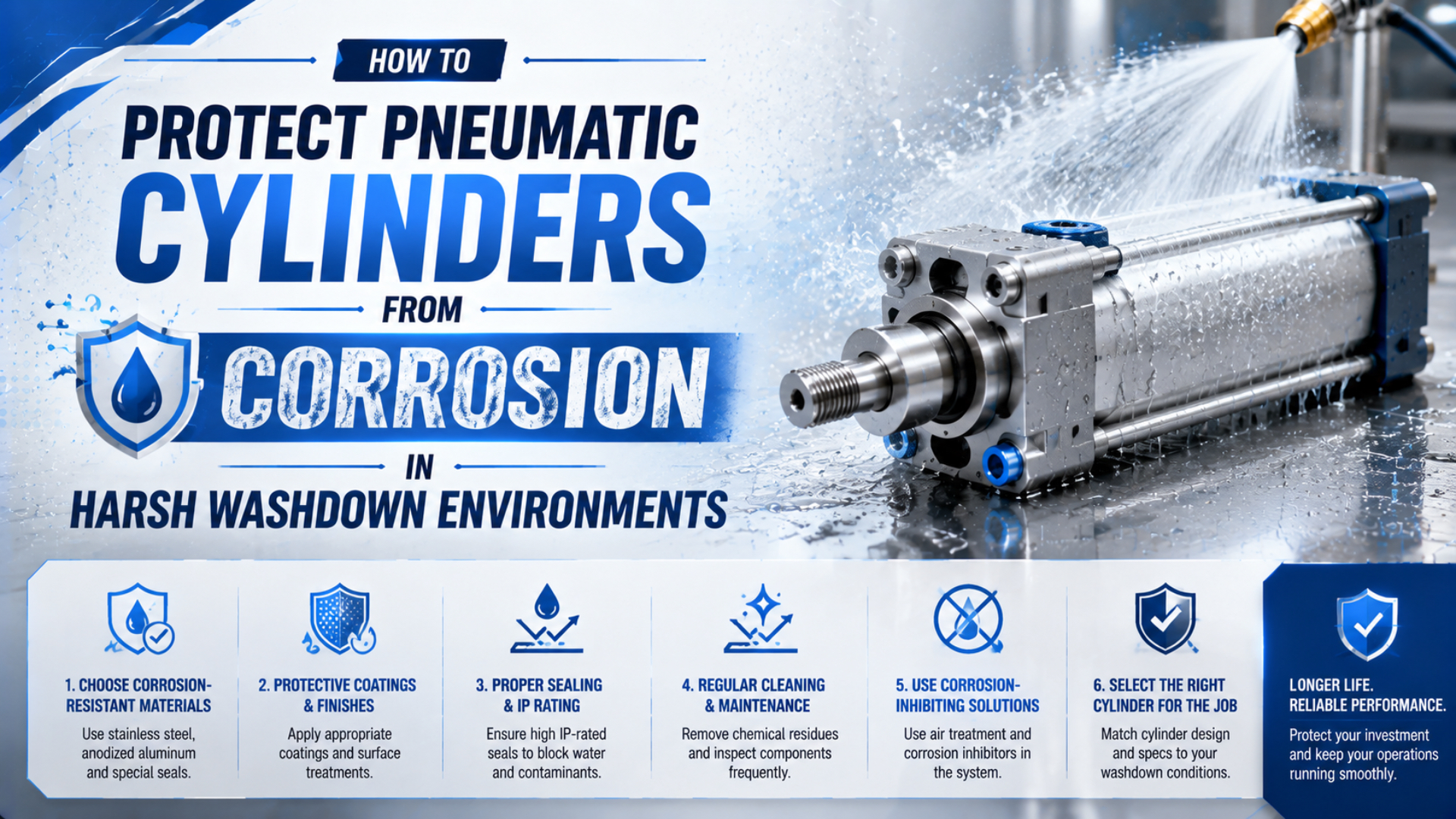
Protect a pneumatic cylinder from washdown corrosion by treating the cleaning procedure as an operating load case. Record the chemical, concentration, temperature, spray pressure, nozzle distance, contact time, frequency, rinse, and drainage. Then match every exposed part, not just the barrel, to that exact exposure.
Section 117.40 of the US food-manufacturing rules requires equipment to be adequately cleanable, installed for cleaning and maintenance, and able to withstand the cleaning compounds, sanitizers, and procedures of its intended use (eCFR 21 CFR 117.40, accessed July 2026). It does not prescribe one stainless grade or IP code for every washdown area.
Key Takeaways
- The cleaning recipe, hygiene zone, and drainage geometry define the corrosion load.
- 316L has a higher nominal PRE than 304L, but alloy alone does not guarantee service life.
- An IP test addresses water ingress under stated conditions, not chemical compatibility or hygiene.
- Diagnose external and internal corrosion paths separately before replacing hardware.
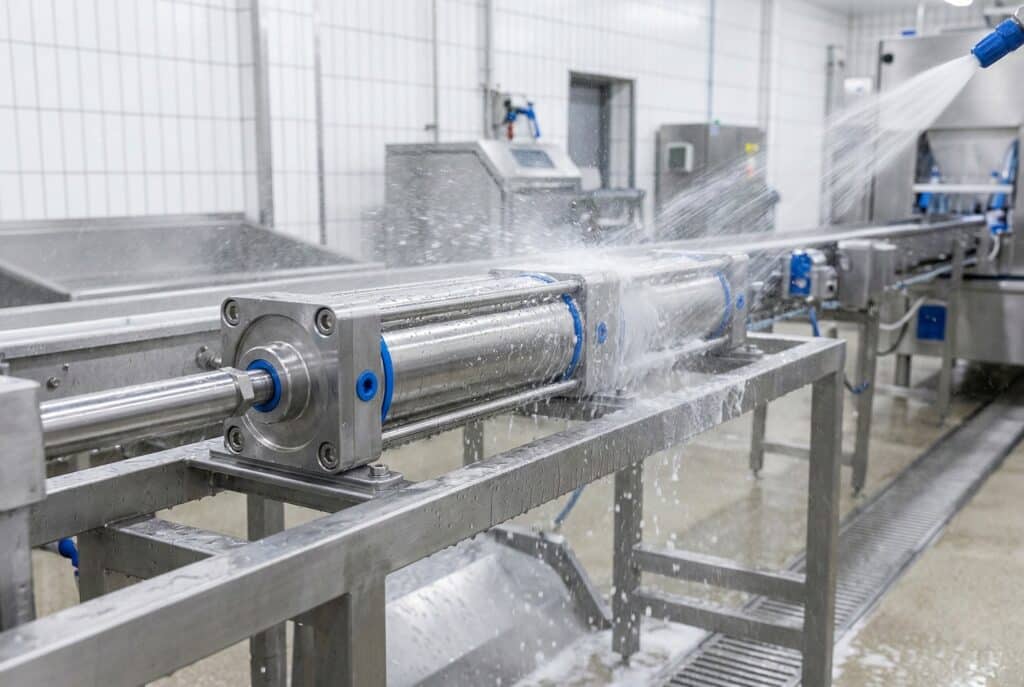
A washdown review includes the cylinder, mount, fasteners, switch, cable, fitting, tube, valve connection, and every surface where liquid can collect.
Washdown exposure is the complete chemical, thermal, hydraulic, geometric, and time-dependent load imposed by cleaning and sanitation. Ingress protection is evidence that a stated enclosure resisted defined solids or water tests; it is not a general certificate for chemical resistance, hygiene, or corrosion life.
What Washdown Exposure Must the Cylinder Survive?
Section 117.40 contains seven equipment requirements and explicitly includes pneumatic systems in the sanitary-design boundary (eCFR, accessed July 2026). Start by documenting the actual washdown cycle and hygiene zone; labels such as “food grade,” “stainless,” or “washdown rated” are not complete engineering requirements.
Create one exposure record for each machine state. Production spray, scheduled sanitation, maintenance cleaning, and shutdown condensation may reach different parts of the actuator.
| Exposure field | What to record | Why it changes the protection plan |
|---|---|---|
| Cleaning media | Product name, active chemistry, concentration, pH, chloride content | Screens metals, seals, coatings, grease, labels, and plastics |
| Temperature | Fluid temperature and component surface temperature | Changes reaction rate, elastomer behavior, and thermal expansion |
| Spray | Pressure, nozzle type, distance, angle, and duration | Defines direct impingement and likely ingress paths |
| Frequency | Cycles per shift, day, or week | Separates occasional rinsing from repeated chemical exposure |
| Rinse and dry | Rinse quality, drying method, and time wet | Residual cleaner can continue attacking after sanitation ends |
| Geometry | Mounting orientation, low points, crevices, and shields | Identifies areas where liquid and soil remain |
| Hygiene zone | Product contact, splash, washdown, or protected area | Sets cleanability, material, and documentation expectations |
Ask the sanitation team what reaches the rear mount, switch rail, rod end, clevis, port, and underside of the cylinder. The spray visible from the aisle may not be the worst location. A horizontal bracket can hold diluted sanitizer against a fastener for hours after the main surface looks dry.
The existing guide to stainless steel cylinders for food washdown covers procurement and hygiene-zone selection. This article focuses on protecting and diagnosing cylinders already exposed to a harsh cleaning process.
Treat washdown exposure like pressure or side load: define the peak condition, duration, repetition, and acceptance limit. “Daily cleaning” is no more useful to a cylinder supplier than “high pressure” without a number and measurement point.
Which Corrosion Path Is Damaging the Cylinder?
ISO 8573-1 classifies compressed-air purity through three principal contaminant groups: particles, water, and oil (ISO 8573-1, 2010). That structure helps separate moisture arriving through the air supply from external washdown liquid, crevice retention, galvanic contact, coating damage, or chemical attack at an exposed surface.
Do not assume every corroded cylinder leaked from the outside. Preserve evidence before wiping or disassembly:
- Photograph the first visible stain, blister, pit, rust line, or swollen seal.
- Record whether damage begins at a fastener, scratch, joint, label edge, port, wiper, bracket, or low point.
- Compare the exposed side with the guarded side.
- Inspect nearby fittings, switches, cables, and stainless frame members.
- Check condensate, drains, filters, and point-of-use air quality on the same branch.
- Record cleaning chemistry and recent changes in concentration or procedure.
- If the cylinder is opened, keep internal and external deposits separate.
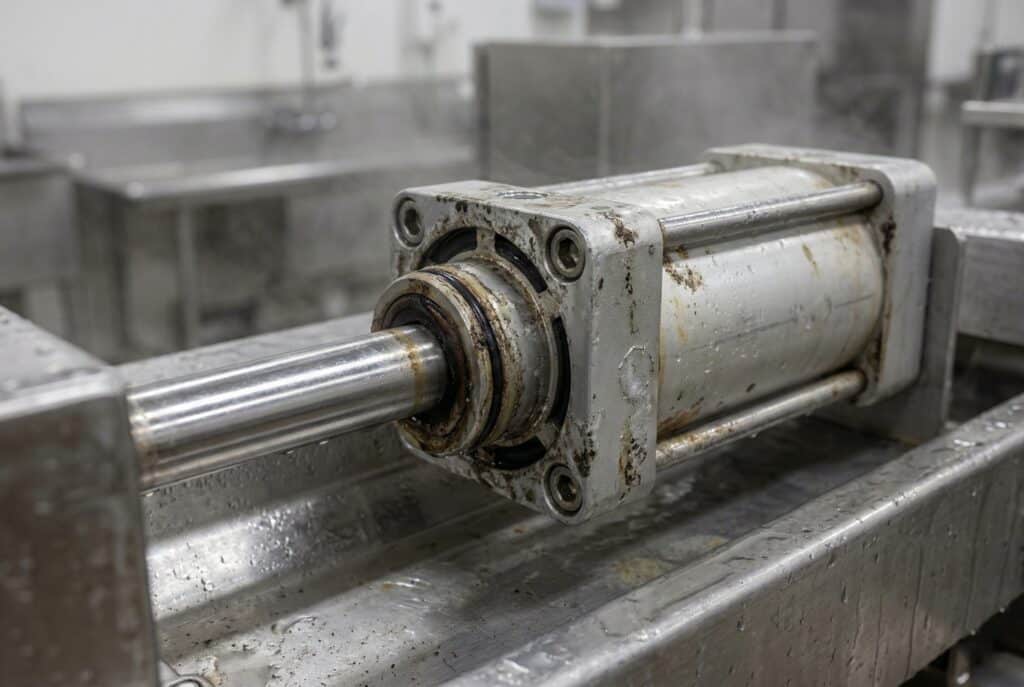
Damage concentrated around a joint or low point can indicate retained liquid, coating loss, or dissimilar-metal contact. It does not by itself prove which fluid crossed the pressure seal.
Use the failure pattern to choose the next check:
| Evidence pattern | Likely branch | Confirmation step |
|---|---|---|
| Pits beneath deposits or bracket overlaps | Crevice or under-deposit corrosion | Remove the overlap, document wet time, inspect the hidden surface |
| Attack begins at a scratch or coating edge | Barrier damage | Inspect coating thickness, adhesion, and repair history |
| Corrosion concentrates where two metals meet | Galvanic couple | Identify alloys, electrical contact, area ratio, and electrolyte path |
| Chloride-bearing residue and localized stainless pits | Pitting or crevice corrosion | Review chemistry, rinse, temperature, alloy, finish, and deposits |
| Water or rust appears inside several devices on one branch | Compressed-air contamination | Sample near the machine and inspect drains, dryer, filter, and piping |
| Seal softening, swelling, cracking, or loss of elasticity | Chemical or thermal incompatibility | Verify the exact compound against cleaner concentration and temperature |
For deeper mechanism reviews, use the guides to chloride stress-corrosion cracking and galvanic corrosion between cylinder components.
When Should You Use 304L, 316L, or a Coated Cylinder?
Outokumpu lists nominal pitting-resistance-equivalent values of 18 for 304L and 24 for 316L, with about 2.1% molybdenum in the cited 316L chemistry (Outokumpu Prodec datasheet, accessed July 2026). This makes 316L a stronger starting point for chloride exposure, not a universal lifetime guarantee.
Select the material after the exposure and geometry are known:
| Condition | Reasonable starting point | Evidence still required |
|---|---|---|
| Mild detergent, effective rinse, protected zone | Coated aluminum or 304 may be suitable | Coating system, scratch tolerance, seal chemistry, service history |
| Repeated direct water splash | Stainless exterior or a validated water-resistant model | Complete assembly materials, scraper, switches, fittings, drain paths |
| Chloride-bearing or acidic sanitation | 316L deserves stronger consideration | Cleaner concentration, temperature, wet time, deposits, crevices |
| Product-contact zone | Hygienic configuration tied to applicable declaration | Surface, geometry, grease, polymers, documentation, intended contact |
| Severe chemistry outside food processing | Alloy, coating, or remote actuation selected from compatibility data | Supplier test limits and installed acceptance plan |
SMC’s CG5-S is a useful counterexample to blanket 316L rules. Its external metal parts are 304 stainless, it is intended for water-splash environments, and the catalog states that the cited product cannot be used in the food zone (SMC CG5-S catalog, 2024).
The lesson is not that 304 is always sufficient. It is that application zone, design, materials, and declarations travel together. Festo documents a CRDSNU configuration suitable for direct food contact under Regulation (EC) No. 1935/2004, showing how the exact product configuration closes a different requirement (Festo CRDSNU product information, 2025).
Surface treatment matters too. Passivation can restore a clean passive surface after fabrication, while electropolishing can reduce surface peaks and improve cleanability. Neither process removes a bad crevice, mixed-metal fastener, trapped-liquid pocket, or incompatible seal.
Use the separate marine corrosion-resistant cylinder guide when salt spray or seawater, rather than sanitation chemistry, is the main load.
What Does an IP Rating Prove in a Washdown Application?
Siemens describes an IPX9 laboratory test at about 80°C and 80 bar, from four spray positions for 30 seconds each, with the nozzle about 125 mm from the device (Siemens SIRIUS ACT manual, 2025). An IP rating proves only the tested enclosure protection under the stated standard and conditions.
IEC 60529 classifies degrees of protection provided by enclosures for electrical equipment (IEC 60529, Edition 2.2). ISO 20653 applies a related IP-code framework to electrical equipment in road vehicles (ISO 20653, 2023). A quotation should therefore identify the exact standard, suffix, tested component, configuration, and report.
Do not treat these claims as interchangeable:
| Claim | What it can support | What it does not establish |
|---|---|---|
| IP67 | Defined dust and temporary-immersion protection for the rated enclosure | High-pressure hot spray, chemical resistance, hygienic geometry |
| IPX9 or IP69 | High-pressure, high-temperature water ingress test under IEC conditions | Sanitizer compatibility, corrosion life, food contact |
| IP69K | Test designation tied to a stated standard such as ISO 20653 | Universal industrial or food-washdown approval |
| IP-rated switch | Ingress evidence for that switch configuration | Cylinder barrel, rod seal, port, fitting, cable junction, or whole axis |
Ask four questions:
- What exact part number and assembly were tested?
- Which standard and edition defined the test?
- What pressure, temperature, distance, angle, duration, and acceptance criterion were used?
- Does the report cover the installed switch, connector, cable, fitting, and mounting orientation?
The answer may still be “use IPX9 equipment,” but now it is tied to evidence rather than a marketing badge.
How Do Geometry, Drainage, and Seals Prevent Recurrence?
The 3-A hygienic-design primer uses 32 microinches, or 0.8 µm Ra, as a common product-contact surface criterion and also requires freedom from pits and crevices, drainability, cleaning access, and suitability for the cleaning method (3-A SSI, accessed July 2026). Surface finish is only one layer.
Apply protection in this order:
- Move the cylinder or add a cleanable guard so direct spray and product fall do not strike vulnerable joints.
- Rotate or redesign brackets so liquid drains and rear surfaces remain inspectable.
- Eliminate exposed dissimilar-metal contacts or isolate them with a supplier-approved design.
- Choose alloy, coating, fasteners, rod finish, switches, fittings, tubing, and labels for the recorded chemistry.
- Match the exact elastomer compound and grease to concentration, temperature, pressure, motion, and contact requirements.
- Protect ports and electrical connections without creating a hidden pocket.
- Validate the complete installed assembly through the real cleaning cycle.
Seal labels need care. “EPDM,” “FKM,” or “NBR” names a polymer family, not the complete formulation. Request compatibility for the exact compound, cleaner, concentration, temperature, contact time, pressure, speed, lubricant, and approval boundary. The pneumatic seal compatibility guide provides the broader review method.
The weakest exposed accessory often sets the washdown limit. A stainless barrel cannot protect a plated fitting, damaged cable gland, recessed switch screw, mixed-metal clevis pin, or low cable loop that stays wet after the cylinder dries.
What Inspection and Maintenance Should Be Recorded?
SMC’s CG5-S catalog covers bore sizes from 10 to 100 mm and offers NBR or FKM according to the cited configuration, yet it still requires application-specific precautions (SMC CG5-S, 2024). Maintenance intervals must follow actual exposure, condition trends, manufacturer instructions, and failure consequence.
Begin with a conservative inspection interval, then adjust it from evidence. Do not promise a universal weekly, quarterly, or annual schedule.
| Inspection area | Record consistently | Escalation trigger |
|---|---|---|
| External metal | Stain location, pit count or mapped area, scratches, rust transfer | New pit, coating lift, spreading stain, damaged passive surface |
| Rod and wiper | Deposit, scoring direction, wiper edge, lubricant condition | Recurring deposit, new scratch, swelling, cracking, leakage |
| Joints and mounts | Wet pockets, crevice residue, fastener condition, movement marks | Liquid remains after dry time, loose mount, dissimilar-metal attack |
| Switch and cable | Lens, housing, seal, connector, routing, low points | Water behind connector, cracked jacket, intermittent signal |
| Fittings and tubing | Material, corrosion, leakage, strain, routing | Corroded body, loosened thread, damaged tube, trapped liquid |
| Motion | Stroke time, end position, dynamic pressure, cushioning, noise | Slower stroke, impact, incomplete travel, abnormal pressure |
| Air treatment | Drain operation, condensate, filter condition, purity result | Water carryover, rust, failed drain, repeated downstream contamination |
Before hands-on work, isolate energy and dissipate stored pneumatic pressure under the site’s approved procedure. Preserve the failure evidence first. After repair, repeat the loaded machine cycle and washdown exposure used for acceptance.
In our experience, the first useful inspection photograph is usually the one taken before the cylinder is wiped. Deposit direction, the edge of the wet area, and the first attacked joint can disappear during cleaning, leaving the replacement team with a damaged part but no reliable corrosion path.
A useful record includes:
- exact cylinder and accessory part numbers
- photograph location and orientation
- washdown batch, cleaner, concentration, temperature, and time
- production and sanitation machine state
- condition before cleaning, after cleaning, and after drying
- measured motion and leakage results
- corrective action, responsible person, and follow-up date
For isolation and trend fields beyond corrosion, use the complete pneumatic actuator maintenance checklist. If internal water is suspected, compare the branch against the ISO 8573-1 air-quality guide.
Should You Retrofit, Relocate, or Replace the Cylinder?
Parker’s standard OSP-P rodless cylinder uses an anodized-aluminum profile, aluminum end caps, NBR seals, and corrosion-resistant steel sealing bands; the catalog does not make it a universal all-stainless washdown solution (Parker OSP-P catalog, accessed July 2026). Actuator architecture alone cannot close a corrosion requirement.
Choose the action that removes the confirmed path:
| Finding | Preferred response |
|---|---|
| Direct spray reaches a vulnerable but healthy cylinder | Relocate, shield, or redirect the cleaning process |
| Liquid pools around a bracket or switch rail | Redesign the mount for drainage and inspection |
| Coating is locally damaged but the repair system is approved | Repair under the coating supplier’s preparation and inspection method |
| Fastener or bracket creates a galvanic couple | Change or electrically isolate the approved materials and remove the electrolyte trap |
| Seal compound is incompatible | Select a manufacturer-approved compound and confirm grease and temperature limits |
| Internal water originates in plant air | Correct drains, drying, filtration, and contaminated piping before replacing another cylinder |
| Required chemistry exceeds the current assembly’s documented limits | Replace with a fully documented configuration or move the actuator outside the exposure |
| Repeated damage remains unexplained | Stop substitution and perform a controlled failure analysis |
Rodless, compact, tie-rod, round-body, and guided cylinders can all work in a washdown machine when their exact materials, geometry, accessories, load, and test evidence fit the duty. None is protected by its family name.
When requesting a replacement, send:
- Cylinder type, bore, stroke, load, speed, cycle, cushioning, and mounting
- Washdown chemistry, concentration, temperature, pressure, distance, time, and frequency
- Hygiene zone and food-contact boundary
- Required alloys, coatings, seals, grease, fasteners, switches, fittings, and tubing
- Drainage, access, surface, and prohibited-crevice requirements
- Exact ingress standard and test-report expectations
- Material declarations, certificates, drawings, maintenance parts, and change control
- Installed acceptance checks under the approved cleaning cycle
The most valuable supplier response is a deviation list tied to one configuration. “Washdown rated” should become a table showing what was reviewed, what was tested, what remains outside the rating, and which cleaning limits apply.
A Defensible Washdown Protection Plan
Section 117.40 requires cleanable equipment and resistance to the intended cleaning procedure, while 3-A guidance combines surface finish with drainage, accessibility, and freedom from pits and crevices (eCFR; 3-A SSI). Effective protection therefore depends on the complete installed system, not one material or badge.
Use this sequence:
- Define the cleaning and operating load case.
- Preserve evidence and separate the corrosion paths.
- Reduce direct exposure and trapped liquid.
- Match every material and interface to the actual chemistry.
- Verify ingress claims against the exact standard and assembly.
- Inspect with repeatable fields and condition-based intervals.
- Validate the correction through the real washdown cycle.
This approach prevents two expensive mistakes: buying stainless hardware without fixing the exposure path, and replacing a cylinder damaged by contaminated compressed air with another cylinder that will see the same internal water.
Washdown Pneumatic Cylinder FAQs
The 3-A hygienic-design primer commonly uses 0.8 µm Ra for product-contact surfaces, but it also requires drainage, cleaning access, and surfaces free from pits and crevices (3-A SSI). Washdown protection decisions must therefore combine zone, chemistry, geometry, materials, ingress evidence, and inspection.
Is 316L stainless steel always required for a washdown cylinder?
No. 316L has stronger nominal pitting resistance than 304L in the cited Outokumpu comparison, but the correct grade depends on chloride exposure, acidity, temperature, wet time, drainage, crevices, food-contact zone, and service history. Coated aluminum or 304 may suit a milder protected area when the complete configuration is documented.
Does IP69K prove that a pneumatic cylinder is food safe?
No. An IP test addresses enclosure protection against water under a stated standard and laboratory procedure. It does not establish food-contact compliance, sanitizer compatibility, surface finish, drainage, grease suitability, or corrosion life. Verify the exact standard, tested component, configuration, test report, and intended-use declaration separately.
Can washdown water enter a pneumatic cylinder through the rod seal?
It can, but external ingress is only one branch. Moisture can also arrive through contaminated compressed air, service work, an exposed port, or damaged tubing. Preserve deposit location, inspect the wiper and rod, and compare other devices on the same air branch before assigning the cause.
How often should washdown cylinder seals be replaced?
There is no universal interval. Use the exact manufacturer’s instructions, cycle count, cleaning chemistry, temperature history, leakage trend, motion data, visual condition, and failure consequence. Begin with a conservative inspection plan, then adjust only from recorded evidence. Replace an incompatible or damaged seal rather than waiting for a calendar date.
Are rodless cylinders better for harsh washdown environments?
Not automatically. A magnetic rodless cylinder, a slotted band cylinder, and a rod cylinder have different exposure and sealing paths. The Parker OSP-P example uses an aluminum profile and steel sealing bands, so “rodless” does not mean all-stainless or IP69K. Compare exact materials, geometry, load, accessories, and test evidence.
Sources and technical references
- eCFR 21 CFR 117.40, Equipment and utensils
- IEC 60529, Degrees of protection provided by enclosures
- ISO 20653:2023, Road-vehicle electrical-equipment IP code
- ISO 8573-1:2010, Compressed-air purity classes
- 3-A SSI primer for hygienic design
- Outokumpu Prodec stainless-steel datasheet
- SMC CG5-S stainless-steel cylinder catalog
- Festo CRDSNU stainless-steel cylinder information
- Parker OSP-P rodless-cylinder catalog
- Siemens SIRIUS ACT IPX9 test description