

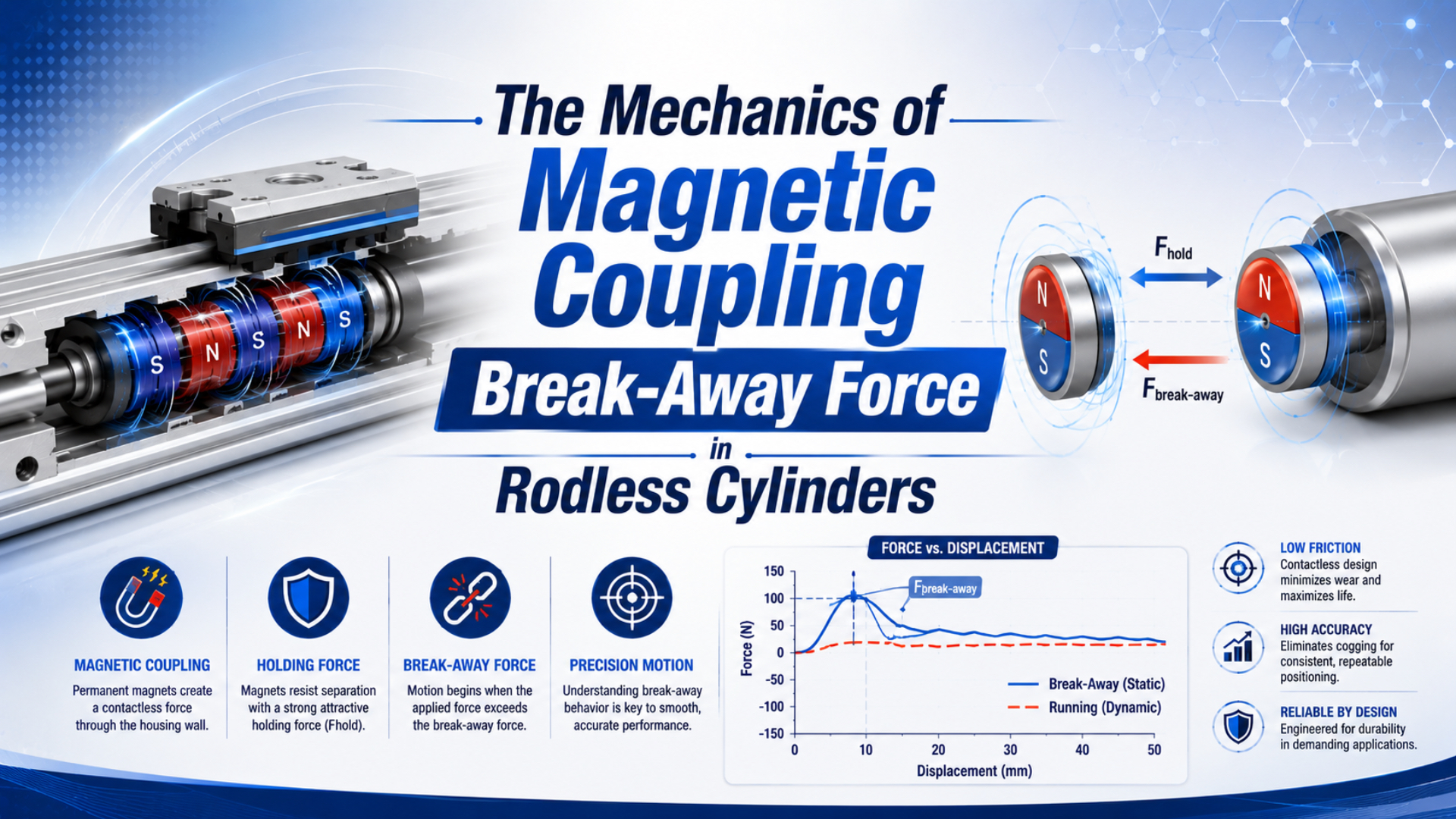
Magnetic coupling break-away force is the axial force at which the external carriage can no longer remain synchronized with the piston inside a magnetically coupled rodless cylinder. Parker calls this value magnetic pull-off force and lists 157 to 942 N for its five P1Z bore sizes. SMC uses the term magnet holding force and publishes 19.6 to 2,256 N across the nine CY3B/CY3R bore sizes.
These figures come from the manufacturers’ product data (Parker; SMC, retrieved 2026-07-23).
Those two ranges make the first sizing rule clear: break-away force is a product rating, not a universal property of all magnetic cylinders. The calculation must also cover the load’s axial resistance, acceleration, mounting direction, guide friction, load offset, operating pressure, speed, and stopping energy. A bore that produces enough pneumatic thrust can still be the wrong magnetic or guide configuration.
Key Takeaways
- Magnetic holding force limits axial force transfer; it is not the carriage’s side-load or moment rating.
- Calculate the demanded axial force, then apply the exact manufacturer’s allowable-driving-force and offset limits.
- Check pressure, speed, stopping energy, guidance, and recoupling safety separately.
What Does Magnetic Coupling Break-Away Force Actually Rate?
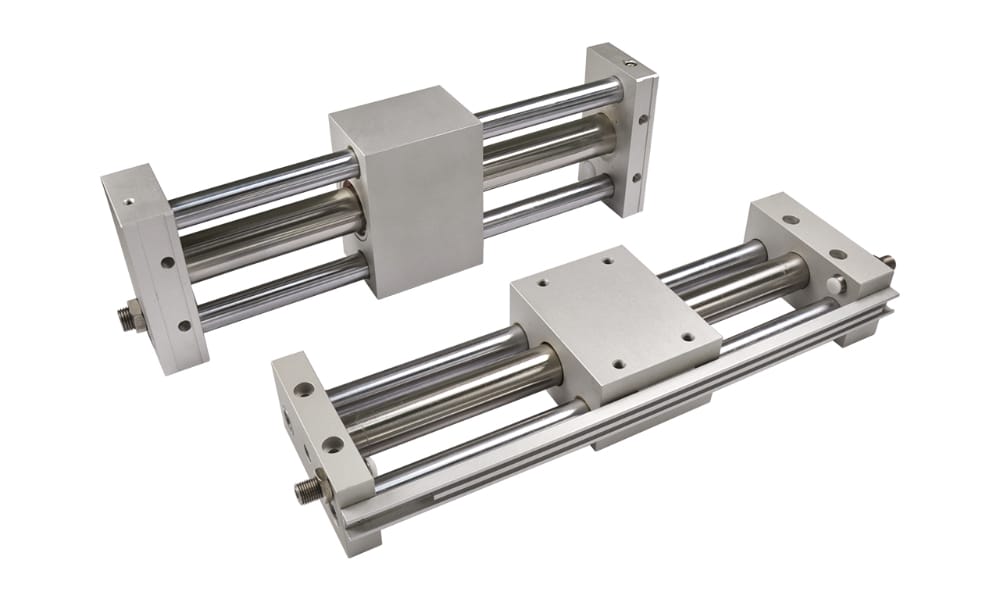
Parker publishes both theoretical force at 6 bar and maximum magnetic coupling force for the P1Z. On the 32 mm model, the values are 483 N and 703 N. The catalog therefore treats pneumatic thrust and magnetic axial transfer as separate engineering limits (Parker P1Z catalog, retrieved 2026-07-23).
Piston area creates the pneumatic thrust. The magnetic assembly limits how much of that axial force can cross the closed tube wall. The piston and carriage remain aligned while the coupling can transmit the carriage’s demand. If resistance rises beyond that limit, the piston can continue moving while the carriage stops or lags.
This meaning differs from breakaway force in a conventional rod cylinder. There, the term often means the force needed to overcome seal and bearing stiction at the start of motion. In a magnetic rodless cylinder, magnetic pull-off or separation is a different failure mode. Procurement documents should therefore use the manufacturer’s exact term and unit.
Magnetic holding force is the manufacturer’s axial separation threshold for the internal and external magnet stacks. Allowable driving force is the application limit read from the selected model’s force and load-offset data. Guide capacity is the permitted lateral force and moment for the carriage or external rail. These values aren’t interchangeable.
The rating also doesn’t prove that the carriage can carry a side load. Magnetic force transfers axial motion. A basic carriage, integrated slide bearing, ball guide, and separately guided payload can all have different allowable forces and moments even when the magnetic holding force is identical. The rodless-cylinder load mechanism guide explains that separate guide check.
Magnetic Force Is a Catalog Limit, Not an Inverse-Square Shortcut
SMC’s current CY3R data lists nine model-specific holding forces, ranging from 19.6 N for 6 mm bore to 2,256 N for 63 mm. Its selection procedure then applies allowable-driving-force curves based on axial resistance and the load’s force-application offset (SMC CY3B/CY3R catalog, retrieved 2026-07-23).
A simple inverse-square equation can’t reproduce that product behavior. The magnetic circuit includes multiple magnets, pole pieces, the nonmagnetic tube wall, radial clearances, and a changing axial offset as the two magnet stacks begin to separate. Magnet grade and temperature matter too, but their effects belong to the chosen assembly, not to a technology-wide percentage.
Contamination illustrates why this distinction matters. Debris on the exposed tube can increase sliding resistance, interfere with guide motion, or damage a surface. Ferrous debris may be attracted toward the carriage. None of those observations justifies assigning a universal 10%, 20%, or 50% loss of magnetic force. Measure the resulting resistance and inspect the assembly instead.
How Do You Build the Axial Force Budget?
SMC’s CY3B/CY3R model-selection inputs include load mass, connection-bracket mass, guide friction coefficient, operating pressure, speed, stroke, mounting direction, and load application distance. Its horizontal, inclined, and vertical workflows use different resistance calculations, so payload mass alone is not enough (SMC selection catalog, retrieved 2026-07-23).
For a preliminary machine-level check, define the demanded axial force as:
Here, is demanded axial force in newtons, is an opposing process force, is measured or conservatively estimated guide resistance, is total moving mass in kilograms, is axial acceleration in metres per second squared, is gravitational acceleration, and is the travel angle measured from horizontal.
For a simple sliding guide, a preliminary friction term may be written as:
The coefficient must represent the installed guide and its condition. Don’t borrow a generic value when preload, seals, cable carriers, misalignment, or process contact materially changes resistance. A force gauge or motorized pull test of the guided load, performed separately from the cylinder, is often more useful than a guessed coefficient.
The preliminary acceptance relationship is:
The right-hand side is not automatically the headline holding force. First, use the exact manufacturer’s allowable-driving-force curve or table for the selected model, load offset, mounting method, and duty. Next, make separate checks for direct carriage mass, force and moment ratings, operating pressure, piston speed, and stopping energy.
Worked Example: A Horizontal Guided Load
An 8.8 kg hypothetical assembly accelerating at 3.0 m/s², with 0.08 guide friction and a 10 N process force, creates 43.3 N of preliminary axial demand. SMC’s method still requires load offset and the model’s allowable-driving-force curve before a CY3B or CY3R bore can be approved (SMC, retrieved 2026-07-23).
Assume:
- Payload and connection hardware: 8.8 kg
- Horizontal travel:
- Axial acceleration: 3.0 m/s²
- Guide friction coefficient for the example: 0.08
- Opposing process force: 10 N
The estimated guide resistance is:
The demanded axial force is:
That result is a load-side requirement, not a selected cylinder. The next step is to plot against the model’s allowable driving force at the actual load offset. If the load is mounted directly on a basic CY3R carriage, SMC also limits direct load mass by bore. If an external guide carries the payload, the connection must accommodate cylinder deflection without binding.
What about pneumatic thrust? It must exceed the same load demand at the pressure actually available at the cylinder during motion. Use both port pressures when back pressure is significant. The cylinder force-loss guide covers that pressure-side check, and the Cylinder Force Calculator can provide an initial theoretical-force estimate.
A large gap between headline holding force and calculated axial demand doesn’t automatically create an equivalent safety margin. Load offset may reduce allowable driving force, direct carriage mass may fail, or a stopper event may exceed the permitted kinetic energy. Report each utilization separately instead of compressing unlike limits into one percentage.
Dynamic Stops, Pressure, and Speed Are Separate Constraints
SMC lists allowable intermediate-stop energies from 0.007 to 5.07 J across CY3B sizes, together with pressure limits. Parker states that dynamic forces must remain below the P1Z magnetic coupling force. A static holding-force comparison therefore cannot approve a fast axis or hard stop (SMC; Parker, retrieved 2026-07-23).
The moving kinetic energy before deceleration is:
Here, is kinetic energy in joules and is carriage speed in metres per second. Compare that energy with the exact cushion, bumper, shock absorber, or intermediate-stop limit. If the load strikes an external stopper while the piston is still pressurized, the piston force can act against a stationary carriage and separate the magnets.
Pressure doesn’t strengthen the permanent-magnet coupling. It changes the piston force applied to it. For this reason, some manufacturers restrict pressure for vertical operation or external intermediate stops even though the cylinder’s general maximum operating pressure is higher. Increasing regulator pressure to cure a stall can make a jam-related separation more likely.
Speed creates a similar trap. The force needed to accelerate the load depends on the motion profile, while end-of-stroke energy grows with the square of speed. Reduce acceleration, extend deceleration distance, tune cushioning, or use an appropriately sized external shock absorber rather than treating magnetic force as the only limit. See the external shock absorber sizing guide for the energy workflow.
Why a Previously Reliable Cylinder Can Decouple
Parker lists five P1Z pull-off-force values from 157 to 942 N and instructs users not to exceed them. If separation begins without a load change, investigate new resistance, alignment, guide wear, stopper contact, pressure, and carriage-to-piston synchronization before assuming the magnets have weakened (Parker P1Z instructions, retrieved 2026-07-23).
| Observation | What it can indicate | Check |
|---|---|---|
| Separation at one stroke position | Tube damage, debris, guide misalignment, local interference, or cable-carrier drag | Disconnect the drive safely and measure load resistance across the full stroke |
| Separation only during acceleration | Acceleration force or pressure ramp is too aggressive | Record motion profile and pressures at both ports |
| Separation at a stopper | Stop energy, residual piston force, or incorrect stroke adjustment | Compare speed, mass, pressure, and stopper method with the catalog |
| Gradually increasing drag | Guide wear, contamination, lubrication problem, seal drag, or mounting shift | Inspect guide play, surfaces, brackets, and cylinder deflection |
| Vertical load moves after separation | Gravity is not restrained by the magnetic coupling | Isolate the hazard and add an engineered load-holding measure |
Side load belongs in this investigation because it can raise guide resistance or change carriage alignment. It still shouldn’t be converted into a guessed magnetic-force reduction. Draw the load center, offsets, pitch, roll, and yaw moments, then compare them with the selected guide’s ratings.
Temperature must also be checked against the complete actuator specification. The current SMC CY3R range is rated from -10 to 60°C without freezing, while Parker’s P1Z instructions specify 0 to 60°C. Those are product operating limits, not generic neodymium-versus-ferrite derating tables.
Field Diagnosis and Controlled Recoupling
Parker’s P1Z instructions cover five bore sizes and warn that the piston and carriage can separate above the magnetic holding force. The document also identifies strong magnetic fields, crushing motion, and residual pressure after venting. Recoupling is therefore a controlled maintenance task, not a push on a live machine (Parker, retrieved 2026-07-23).
Use this diagnostic sequence:
- Stop the machine, isolate every energy source, secure suspended loads, and verify the pneumatic state according to the machine and cylinder instructions.
- Confirm that the internal piston and external carriage are actually out of synchronization. A damaged guide or loose load bracket can create a similar symptom.
- Remove the process load or disconnect the drive through the approved connection method. Measure the external guide’s resistance over the full stroke.
- Inspect the tube, carriage, guide, brackets, cable carrier, sensors, end stops, and surrounding ferrous debris.
- Follow the selected manufacturer’s procedure to move the piston and carriage into the specified recoupling position. Keep hands outside crush zones.
- Start with controlled pressure and low speed. Verify position sensing, full-stroke motion, cushioning, and load resistance before returning to automatic operation.
A handheld force gauge can be useful, but only with a defined fixture and test state. Pulling the carriage of an unpressurized assembled cylinder may move the piston with it, so the reading can include piston-seal friction rather than the magnetic separation threshold. Use the manufacturer’s test method or compare the complete unit with a documented baseline under identical conditions.
In our experience, a full-stroke resistance trace usually resolves the question faster than another catalog comparison. We record the force needed to move the disconnected payload, note where drag changes, and align that trace with pressure and motion data. This separates a coupling problem from a guide, bracket, cable-carrier, or stopper problem.
Selection and RFQ Checklist
SMC offers nine CY3B/CY3R bore sizes, but its selection flow requires more than bore and stroke. A defensible RFQ includes force, load offset, guide arrangement, mounting direction, pressure, speed, stopping method, environment, and failure response. Those inputs let the supplier apply the correct force and energy data (SMC, retrieved 2026-07-23).
| RFQ input | Why it matters |
|---|---|
| Current manufacturer, series, bore, stroke, and holding-force option | Identifies the applicable magnetic and dimensional data |
| Total moving mass, including tooling and connection hardware | Sets gravity and inertia terms |
| Load center and force-application offsets | Determines guide moments and allowable driving force |
| External guide type and measured or estimated resistance | Separates axial coupling demand from load support |
| Mounting direction and travel angle | Adds or removes the axial gravity component |
| Pressure at both cylinder ports during motion | Shows available net piston force and exhaust back pressure |
| Target speed, acceleration, deceleration, and cycle rate | Defines dynamic force, flow, heat, and stopping energy |
| Cushion, shock absorber, stopper, and intermediate-stop method | Determines how kinetic energy is dissipated |
| Temperature, washdown, dust, and ferrous-particle exposure | Checks environmental compatibility and maintenance access |
| Behavior after loss of air or magnetic separation | Defines guarding, sensing, and load-holding requirements |
For technology selection rather than force calculation, compare the failure modes in the magnetic-versus-mechanical rodless coupling guide. A magnetic design can provide a closed pressure tube and a non-destructive separation mode, but only when the machine treats separation as a detectable, controlled event.
Magnetic Coupling Break-Away Force FAQs
SMC publishes CY3R magnet holding forces from 19.6 to 2,256 N, while Parker publishes P1Z pull-off forces from 157 to 942 N. These ranges answer the most common question: there is no universal magnetic break-away force. The exact series, bore, guide, load offset, pressure, speed, and stopping method determine whether an application is acceptable.
Is magnetic holding force the same as pneumatic cylinder thrust?
No. Pneumatic thrust comes from pressure acting on piston area. Magnetic holding force limits how much axial force the internal piston can transmit to the external carriage. Parker publishes both values for the P1Z, which shows why they must be checked separately. Guide forces and moments require a third check.
Does higher air pressure increase magnetic coupling strength?
No. Higher pressure increases piston thrust, not the permanent magnet’s holding force. During a jam or external intermediate stop, that added piston force can push against a stationary carriage and separate the coupling. Follow the model-specific pressure limits for vertical operation and stopping conditions rather than using only the general pressure rating.
Can side load make a magnetic coupling separate?
Side load doesn’t translate into a universal magnetic-force loss percentage. It can increase guide friction, tilt the carriage, alter running clearance, or overload the guide. Any of those effects can raise axial demand until the coupling separates. Check the force and moment ratings of the selected guide and measure installed resistance.
How should a separated piston and carriage be reconnected?
Isolate pressure and machine energy, secure the load, confirm the piston and carriage positions, and follow the exact manufacturer’s recoupling procedure. Parker directs users to a defined piston-and-carriage connection process and warns about crushing motion, strong magnetic fields, and residual pressure. Never force the carriage into place on a live machine.
Can break-away force be measured with a handheld force gauge?
Only with a controlled fixture and defined test state. Pulling an assembled, unpressurized carriage may also move the internal piston, adding seal and bearing friction to the reading. Use the manufacturer’s test method, restrain the correct component, control residual pressure, and compare results under repeatable temperature and alignment conditions.
Sources and technical references
- SMC CY3B Magnetically Coupled Rodless Cylinder catalog, specifications, holding force, vertical-load limits, pressure limits, and intermediate-stop energy. Retrieved 2026-07-23.
- SMC CY3B/CY3R model-selection catalog, operating inputs, allowable-driving-force curves, load offset, deflection, direct load, and mounting guidance. Retrieved 2026-07-23.
- Parker P1Z operating instructions, magnetic pull-off forces, separation warning, commissioning, recoupling, residual pressure, and magnetic-field safety. Retrieved 2026-07-23.
- Parker P1Z product catalog, theoretical force, magnetic coupling force, stroke, pressure, speed, guidance, and cushioning data. Retrieved 2026-07-23.