Introduction
Every purchasing manager faces this dilemma: Your production line needs a replacement cylinder. The Festo branded option costs $1,850 with a 6-week lead time. An unbranded alternative promises the same specs for $520, available tomorrow. Your CFO demands cost cuts. Your plant manager can’t afford downtime. Your quality director warns against “cheap knockoffs.” Who’s right? 🤔
You can safely compromise on brand names for standard pneumatic components that meet ISO specifications1 and operate in non-critical applications, but should never compromise on material quality, dimensional accuracy, pressure ratings, or supplier documentation—the key is distinguishing between premium branding markup and genuine engineering value. Smart procurement means understanding which applications tolerate cost-optimized solutions and which demand premium reliability, regardless of price.
Last spring, I consulted with Jennifer, operations manager at a food packaging facility in Wisconsin. She was spending $94,000 annually on branded pneumatics—mostly Festo and SMC—for 23 packaging lines. After a comprehensive audit, we identified that 68% of her cylinders operated in low-criticality applications where unbranded alternatives would perform identically. By strategically mixing Bepto cylinders (premium unbranded) with her existing branded components, Jennifer cut costs by $41,000 annually while actually improving system reliability through faster parts availability. 💰
Table of Contents
- What Actually Differentiates Branded from Unbranded Pneumatic Components?
- Which Applications Can Safely Use Unbranded Pneumatics?
- Where Should You Never Compromise on Premium Brands?
- How Do You Evaluate Unbranded Supplier Quality?
- FAQs About Branded vs. Unbranded Pneumatic Components
What Actually Differentiates Branded from Unbranded Pneumatic Components?
Let’s cut through the marketing noise and examine what you’re actually paying for. 🔍
The primary differences are: brand recognition and marketing costs (20-35% of price), global distribution networks and inventory systems (15-25%), extensive product catalogs with custom options (10-15%), established technical support infrastructure (5-10%), and actual engineering/quality premiums (10-20%)—meaning 50-75% of branded pricing reflects business infrastructure rather than superior component performance. Understanding this breakdown helps you make rational decisions about where brand premium delivers value versus where it’s pure overhead.
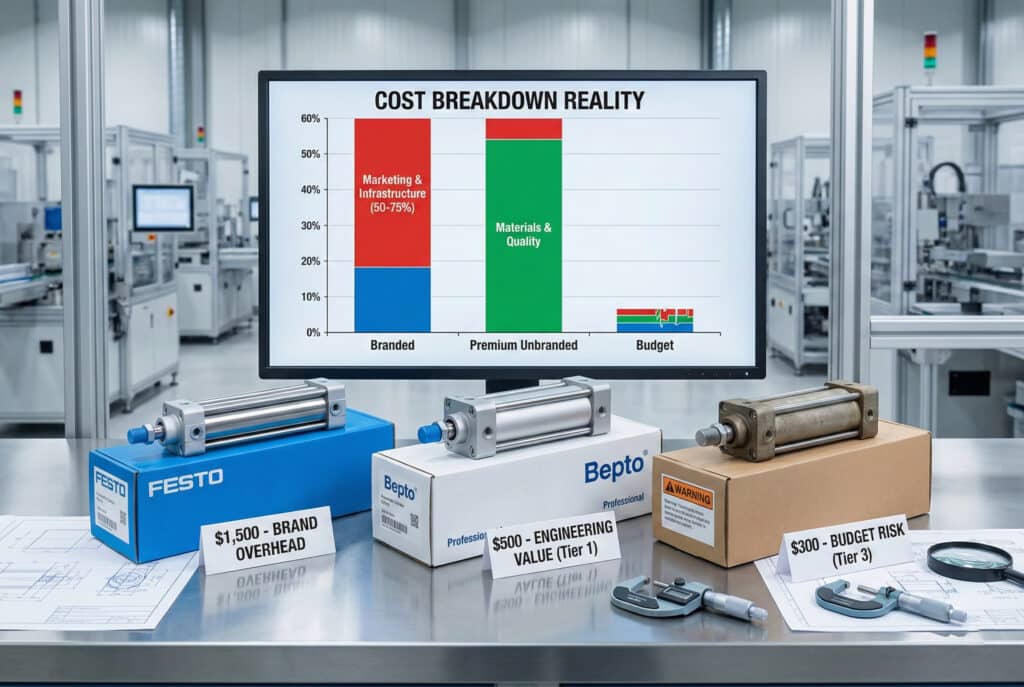
The Price Breakdown Reality
Let me show you where your money actually goes when you buy branded pneumatics:
| Cost Component | Branded (e.g., Festo) | Premium Unbranded (e.g., Bepto) | Budget Unbranded |
|---|---|---|---|
| Raw materials | 18% ($270) | 28% ($140) | 35% ($105) |
| Manufacturing | 12% ($180) | 22% ($110) | 30% ($90) |
| Quality control | 8% ($120) | 12% ($60) | 5% ($15) |
| Engineering/R&D | 7% ($105) | 8% ($40) | 2% ($6) |
| Marketing/branding | 25% ($375) | 3% ($15) | 1% ($3) |
| Distribution network | 18% ($270) | 12% ($60) | 10% ($30) |
| Technical support | 7% ($105) | 10% ($50) | 2% ($6) |
| Profit margin | 5% ($75) | 5% ($25) | 15% ($45) |
| Total Price | $1,500 | $500 | $300 |
This table reveals an uncomfortable truth: When you buy a $1,500 Festo cylinder, only about $675 (45%) goes toward actual manufacturing, materials, and quality—the rest funds brand infrastructure. 📊
Important distinction: I’m not suggesting branded components are overpriced scams. That infrastructure delivers real value: global availability, comprehensive catalogs, established reputation, and proven track records. The question is: Do you need to pay for all that infrastructure for this specific application?
What “Unbranded” Actually Means
The term “unbranded” creates confusion. Let me clarify the spectrum:
Tier 1 – Premium Unbranded (Bepto Model):
- ISO 90012 certified manufacturing
- Full technical documentation and support
- Material certifications and traceability
- Typically 60-70% of premium brand pricing
- Example: Bepto Pneumatics, established regional brands
Tier 2 – Generic/White Label:
- Contract manufacturers producing for multiple distributors
- Basic quality standards
- Limited documentation
- Variable consistency between batches
- Typically 40-50% of premium brand pricing
- Example: Generic Chinese/Taiwanese manufacturers
Tier 3 – Budget/Unknown Origin:
- Unclear manufacturing source
- Minimal quality control
- No certifications or documentation
- High variability and failure rates
- Typically 20-30% of premium brand pricing
- Example: Unmarked components from unknown suppliers ⚠️
Critical insight: When I advocate for “unbranded” alternatives, I’m referring exclusively to Tier 1 premium unbranded suppliers. Tier 3 budget components are false economy—they’ll cost you far more in downtime and failures than you save on purchase price.
Engineering Equivalence vs. Brand Perception
Here’s a case study that perfectly illustrates the brand-vs-performance disconnect:
Blind Testing Experiment – Michigan Manufacturing Plant
Carlos, a skeptical plant engineer, agreed to a blind comparison test. He installed three rodless cylinders3 on identical assembly stations:
- Station A: Festo rodless cylinder ($1,680)
- Station B: Bepto rodless cylinder ($695)
- Station C: Budget unbranded cylinder ($380)
His maintenance team didn’t know which brand was which—only “Cylinder 1, 2, and 3.”
After 6 months (approximately 180,000 cycles each):
| Metric | Festo | Bepto | Budget |
|---|---|---|---|
| Positioning accuracy | ±0.09mm | ±0.08mm | ±0.24mm |
| Cycle time consistency | 1.82s avg | 1.84s avg | 2.13s avg |
| Air consumption | 14.2 L/cycle | 14.5 L/cycle | 18.7 L/cycle |
| Maintenance events | 0 | 0 | 3 |
| Technician preference | Ranked #2 | Ranked #1 | Ranked #3 |
The results shocked Carlos: His team actually preferred the Bepto cylinder, rating it slightly smoother in operation. The Festo performed excellently (as expected), while the budget cylinder showed measurable performance degradation. 🎯
The lesson: Premium unbranded components (Tier 1) deliver performance indistinguishable from premium brands. Budget unbranded (Tier 3) components are legitimately inferior. The price difference between Tier 1 and Tier 3 ($315) is money well spent; the difference between branded and Tier 1 unbranded ($985) is often pure brand premium.
What You’re Actually Buying with Premium Brands
To be fair, premium brands do offer genuine advantages in specific contexts:
Legitimate Brand Value:
✅ Global availability: Need a replacement in Singapore, São Paulo, or Stuttgart? Premium brands have local stock
✅ Comprehensive catalogs: 10,000+ SKUs with every conceivable configuration
✅ Established reputation: Easier to justify to customers and auditors
✅ Long-term consistency: Same product available for 10-15 years
✅ Integration ecosystems: Valves, cylinders, controllers designed to work together
Overvalued Brand Premium:
❌ Marketing and advertising costs
❌ Sponsorships and trade show presence
❌ Extensive sales force overhead
❌ Premium office locations and facilities
❌ Brand prestige without performance difference
At Bepto Pneumatics, we’ve deliberately chosen to invest in engineering, quality, and customer service rather than marketing budgets and global distribution infrastructure. This allows us to deliver premium quality at 60-70% of branded pricing—a value proposition that resonates with cost-conscious customers who don’t need a cylinder available in 147 countries. 🌍
Which Applications Can Safely Use Unbranded Pneumatics?
This is where smart procurement separates from reckless cost-cutting. 💡
Safe applications for premium unbranded pneumatics include: non-customer-facing operations, redundant systems with backup capacity, applications with easy accessibility for maintenance, standard pressure/temperature environments (1-10 bar, 0-60°C), and processes where 2-4 hour replacement time is acceptable. These represent 60-75% of typical industrial pneumatic applications—a massive opportunity for cost optimization without risk.
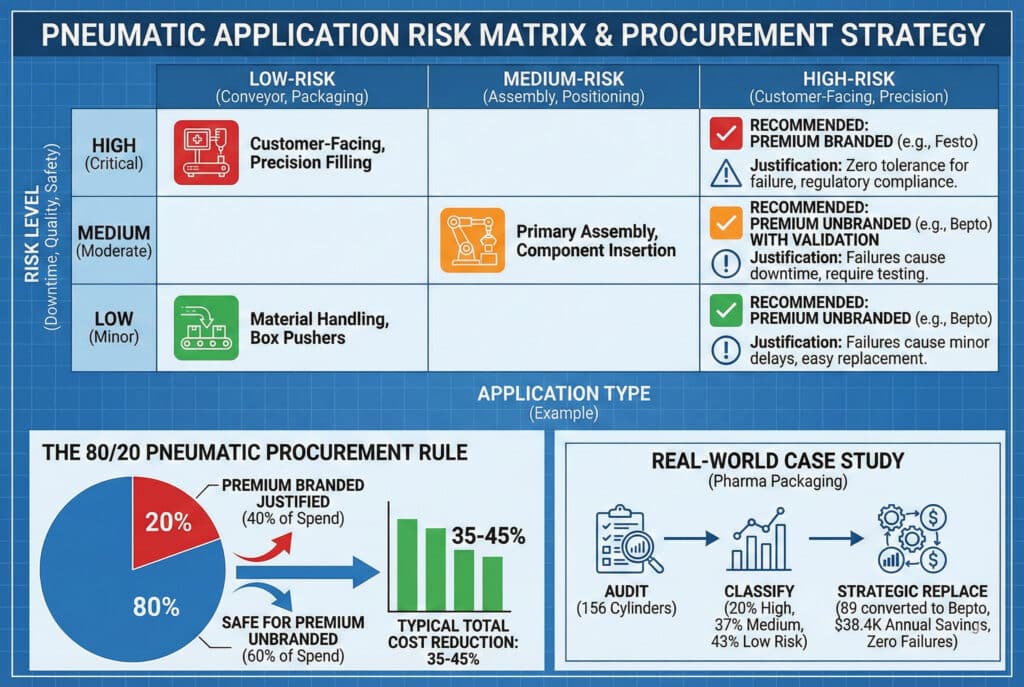
The Application Risk Matrix
I’ve developed this framework over 15 years of helping customers optimize pneumatic procurement:
Low-Risk Applications (Ideal for Unbranded)
Material Handling Systems:
- Conveyor gates and diverters
- Pallet positioning
- Box pushers and stoppers
- Lift tables (non-critical)
Why safe: Failures cause minor delays, not safety hazards or quality defects. Easy to access for quick replacement.
Example: A logistics center in Ohio replaced 47 SMC cylinders ($285 each = $13,395) controlling conveyor diverters with Bepto cylinders ($165 each = $7,755). Over 3 years, they’ve experienced identical reliability with $5,640 savings plus reduced lead times for replacements.
Secondary Operations:
- Parts orientation before assembly
- Labeling and marking stations
- Packaging and bundling
- Scrap removal
Why safe: These operations don’t directly affect product quality. Redundancy is often built into production flow.
Assembly Fixtures (Non-Critical):
- Work-holding for secondary operations
- Tool positioning (non-precision)
- Door and cover actuation
- Parts feeding
Why safe: Failures are immediately obvious and don’t create quality escapes. Replacement can often happen during shift changes.
Testing and Inspection Equipment:
- Sample positioning
- Fixture actuation
- Non-destructive test equipment
- Quality lab equipment
Why safe: These applications typically have lower cycle counts and controlled environments. Failures don’t affect production throughput.
Medium-Risk Applications (Premium Unbranded with Validation)
Primary Assembly Operations:
- Component insertion
- Press-fit operations
- Fastener installation
- Sub-assembly joining
Why moderate risk: Failures can stop production, but quality impacts are usually detectable. Requires validation testing but suitable for premium unbranded.
Example: Sarah, manufacturing engineer at an electronics assembly plant in California, uses Bepto rodless cylinders for PCB positioning during component placement. After 18 months and 2.4 million cycles, performance remains within specification. She validated thoroughly before deployment but now saves $28,000 annually versus Festo alternatives. ✅
Precision Positioning (±0.5mm or looser):
- Pick-and-place operations
- Vision system positioning
- Dispensing equipment
- Welding fixture positioning
Why moderate risk: Requires verification that unbranded cylinder meets positioning accuracy specs, but many premium unbranded options deliver ±0.1mm repeatability.
Machine Tool Loading:
- CNC machine loading/unloading
- Workpiece clamping (non-critical dimensions)
- Chip removal systems
- Coolant system actuation
Why moderate risk: Failures cause downtime but rarely damage expensive tooling or workpieces if properly designed with fail-safes.
Real-World Application Analysis
Let me walk through how a pharmaceutical packaging company made these decisions:
Company Profile:
- 8 packaging lines producing over-the-counter medications
- 156 pneumatic cylinders across all lines
- Previous 100% Festo specification
- Annual pneumatic spend: $87,000
Our Audit Process:
Step 1 – Application Categorization:
We classified every cylinder by criticality:
- High-risk: 31 cylinders (20%)
- Medium-risk: 58 cylinders (37%)
- Low-risk: 67 cylinders (43%)
Step 2 – Strategic Replacement Plan:
- High-risk: Maintain Festo (customer-facing, precision filling)
- Medium-risk: Bepto after validation (assembly operations)
- Low-risk: Immediate Bepto conversion (material handling, labeling)
Step 3 – Phased Implementation:
- Month 1-2: Replace 20 low-risk cylinders, monitor performance
- Month 3-6: Validate and replace 15 medium-risk cylinders
- Month 7-12: Expand to remaining low/medium-risk applications
- Ongoing: Maintain Festo for high-risk applications
Results after 18 months:
- 89 cylinders converted to Bepto (57%)
- 67 cylinders remain Festo (43%)
- Annual savings: $38,400 (44% reduction)
- Zero performance-related failures
- Actually improved parts availability (Bepto 8-day lead time vs. Festo 6-week)
This strategic approach delivered massive savings while maintaining quality and reliability where it mattered most. 📈
The 80/20 Rule for Pneumatic Procurement
Here’s a principle that’s served my customers well:
80% of your pneumatic applications can use premium unbranded components safely, but those applications typically represent only 60% of your total pneumatic spend. The remaining 20% of high-criticality applications account for 40% of spending—and often justify premium branded components.
This means you can typically achieve 35-45% total cost reduction by strategically deploying unbranded alternatives, while maintaining premium brands where they deliver genuine value.
Where Should You Never Compromise on Premium Brands?
Now let’s talk about where cost-cutting becomes dangerous—because not every application tolerates compromise. ⚠️
Never compromise on brand quality for: safety-critical applications (emergency stops, personnel protection), customer-specified components in OEM equipment, ultra-precision positioning (±0.05mm or tighter), extreme environments (>80°C, corrosive atmospheres, cleanroom Class 5 or better), or applications where failure creates hazardous conditions or expensive damage. These represent 15-25% of typical applications but deserve 100% of your quality focus.
High-Risk Applications Requiring Premium Brands
Safety-Critical Systems
Emergency Stop Mechanisms:
- Press brake safety systems
- Robot cell barriers
- Machine guarding actuation
- Emergency shutdown valves
Why no compromise: Human safety cannot have a price tag. Regulatory compliance (OSHA, CE marking) often requires documented component specifications. Liability exposure is catastrophic if failures cause injury.
Example: A metal stamping plant asked if they could use unbranded cylinders for press brake safety guards. My answer was unequivocal: “Absolutely not.” Safety systems demand premium components with complete traceability, established reliability data, and manufacturer liability backing. The $400 savings isn’t worth the million-dollar lawsuit or, more importantly, the injured worker. 🚫
Personnel Protection Equipment:
- Light curtain mounting and positioning
- Safety gate actuation
- Lockout/tagout mechanisms
- Fall protection systems
Medical and Pharmaceutical Production:
- Drug dispensing and filling
- Sterile product handling
- Critical process control
- Patient-contact equipment
Why no compromise: FDA validation requirements, patient safety, and regulatory compliance demand fully documented, traceable components from established manufacturers.
Customer-Specified Components
OEM Equipment with Specified Parts:
When your customer’s purchase order specifies “Festo DGPL-25-500” or similar, you have zero flexibility. Substitution violates contract terms and can void equipment warranties.
Why no compromise: Contractual obligation, customer satisfaction, and potential warranty implications.
Example: An automation integrator building custom machinery for an automotive customer learned this the hard way. They substituted unbranded cylinders to improve margins, and the customer rejected the entire machine during final inspection. The $4,200 they “saved” cost them $67,000 in rework, delayed delivery penalties, and damaged reputation. 😱
Established Service Agreements:
If you have a service contract requiring OEM parts, substitution may violate terms and void coverage.
Ultra-Precision Applications
Positioning Tolerance ±0.05mm or Tighter:
- Semiconductor manufacturing
- Precision optics assembly
- Medical device manufacturing
- High-precision dispensing
Why limited compromise: While some premium unbranded suppliers (including Bepto) can meet these tolerances, the validation burden is substantial. Premium brands offer established performance data and tighter statistical process control.
Nuanced view: Even here, premium unbranded isn’t automatically disqualified—but requires extensive validation including:
- Statistical capability studies (Cpk ≥1.67)
- Long-term repeatability testing (100,000+ cycles)
- Environmental stability testing
- Batch-to-batch consistency verification
At Bepto, we’ve successfully supplied cylinders for ±0.05mm applications, but I’m honest with customers: This requires rigorous validation that may not justify the cost savings for small quantities.
Extreme Environments
High Temperature (>80°C continuous):
- Oven and furnace automation
- Hot forming operations
- Thermal processing equipment
Why limited compromise: Requires specialized seals (Viton/FKM), high-temp lubricants, and validated thermal performance. Premium brands have extensive application data; unbranded suppliers may lack testing validation.
Corrosive Atmospheres:
- Chemical processing
- Marine environments
- Wastewater treatment
- Aggressive cleaning systems
Why limited compromise: Material compatibility is critical. Stainless steel construction, specialized coatings, and chemical-resistant seals require documented testing. Premium brands offer proven solutions; unbranded alternatives need thorough validation.
Cleanroom Class 5 or Better:
- Semiconductor fabrication
- Pharmaceutical production
- Biotechnology manufacturing
Why limited compromise: Requires special low-outgassing materials, particle generation testing, and cleanroom certifications. Few unbranded suppliers have the testing infrastructure to validate cleanroom compatibility.
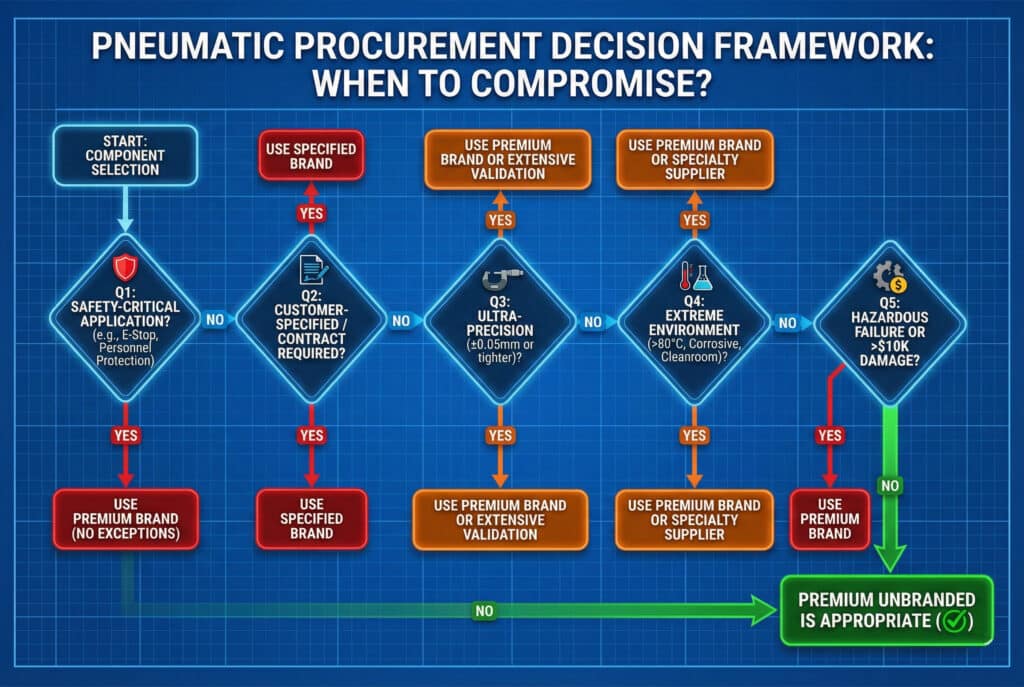
The Decision Framework
Here’s the simple flowchart I use with customers:
Question 1: Is this a safety-critical application?
- YES → Use premium brand, no exceptions
- NO → Continue to Question 2
Question 2: Is the component customer-specified or contract-required?
- YES → Use specified brand
- NO → Continue to Question 3
Question 3: Does it require positioning accuracy ±0.05mm or tighter?
- YES → Use premium brand or validate extensively
- NO → Continue to Question 4
Question 4: Does it operate in extreme environments (>80°C, corrosive, cleanroom)?
- YES → Use premium brand or validated specialty supplier
- NO → Continue to Question 5
Question 5: Would failure create hazardous conditions or >$10,000 damage?
- YES → Use premium brand
- NO → Premium unbranded is appropriate ✅
This framework has helped hundreds of customers make rational, risk-based decisions about where to deploy unbranded alternatives. 🎯
When Premium Brands Deliver Real Value
Let me be clear: I’m not anti-brand. Premium brands absolutely deliver value in specific contexts:
Genuine Premium Brand Advantages:
Extensive Application Engineering:
Premium brands employ application engineers who can help design complex systems, calculate flow requirements, and optimize performance. This expertise is valuable for novel or challenging applications.
Long-Term Product Availability:
Festo, SMC, and Parker maintain product lines for 15-20 years. If you’re building equipment with a 20-year service life, this consistency matters.
Global Service Networks:
If your equipment ships worldwide and needs local service support, premium brands’ global presence is genuinely valuable.
Comprehensive Testing Data:
Premium brands publish extensive performance data: cycle life testing, temperature curves, contamination resistance, etc. This data reduces your validation burden.
Integration Ecosystems:
If you’re building a complete pneumatic system with cylinders, valves, controllers, and sensors all communicating via IO-Link4 or fieldbus, single-brand ecosystems offer integration advantages.
At Bepto, we acknowledge these advantages. Our value proposition isn’t “we’re better than Festo”—it’s “for 60-75% of applications, you don’t need everything Festo offers, and you shouldn’t pay for capabilities you won’t use.” 💡
How Do You Evaluate Unbranded Supplier Quality?
This is the critical skill that separates successful cost optimization from expensive disasters. 🔍
Evaluate unbranded suppliers by: verifying ISO 9001 certification and manufacturing capabilities, requesting material certifications and test reports, conducting dimensional inspection of samples, checking references from similar industries, assessing technical support responsiveness, and reviewing warranty terms and failure policies. A reputable Tier 1 unbranded supplier will welcome this scrutiny; suppliers who resist documentation requests should be avoided.
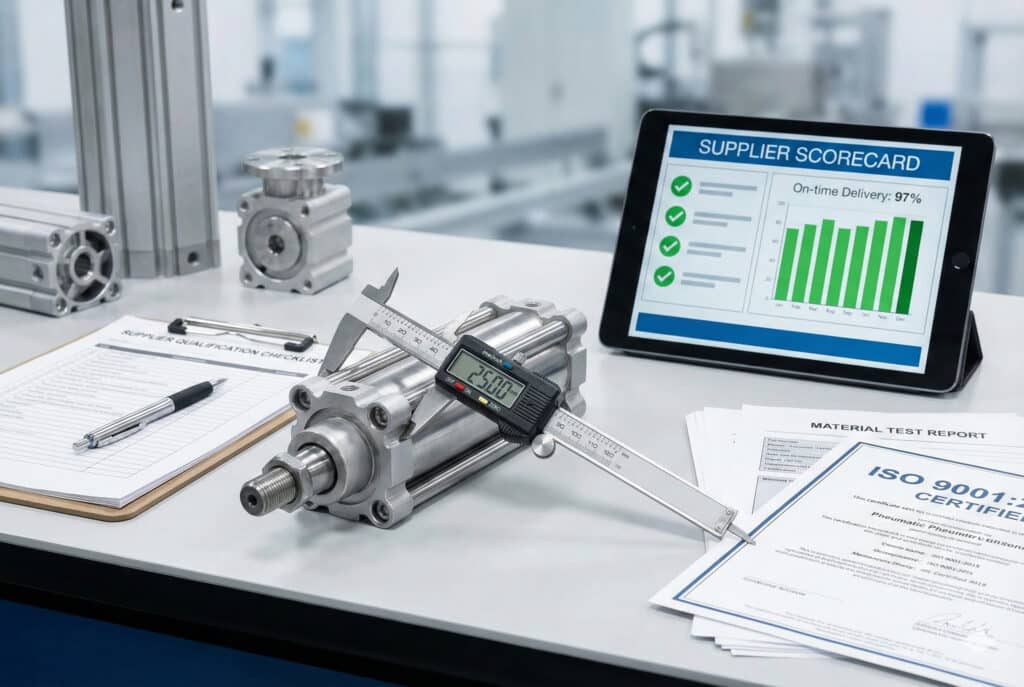
The Supplier Qualification Checklist
Here’s the exact checklist I use when evaluating unbranded pneumatic suppliers:
Phase 1: Documentation Review (Before Purchase)
Quality Certifications:
✅ ISO 9001:2015 certificate (verify with issuing body)
✅ Industry-specific certifications (IATF 16949 for automotive, ISO 13485 for medical)
✅ Material certifications (mill certs for aluminum, compound certs for elastomers)
✅ RoHS and REACH5 compliance documentation
Technical Capabilities:
✅ Dimensional drawings with tolerances for all products
✅ Material specifications (alloy grades, seal compounds, surface treatments)
✅ Pressure and temperature rating documentation
✅ Cycle life testing data
✅ Cross-reference guides for OEM equivalents
Business Stability:
✅ Years in business (prefer 5+ years)
✅ Manufacturing facility ownership (own factory vs. broker)
✅ Customer references in your industry
✅ Financial stability indicators
Red flags: 🚩
- Reluctance to provide certifications
- Vague answers about manufacturing location
- No technical staff available
- Pressure to buy without documentation
Phase 2: Sample Evaluation (Small Investment)
Physical Inspection:
✅ Surface finish quality (smooth, uniform, no defects)
✅ Dimensional accuracy (verify with calipers: ±0.1mm tolerance)
✅ Component fit and finish (ports, threads, seals)
✅ Packaging quality (proper protection, clear labeling)
✅ Documentation included (installation instructions, specs)
Functional Testing:
✅ Pressure test at 150% rated pressure (zero leakage)
✅ Stroke smoothness throughout travel
✅ Port thread quality (clean engagement, no cross-threading)
✅ Seal integrity (no visible air leaks at rated pressure)
✅ Mounting interface fit (verify against OEM dimensions)
Comparative Analysis:
Order samples from 2-3 potential suppliers plus one OEM sample. Compare side-by-side:
| Evaluation Criteria | OEM | Supplier A | Supplier B | Supplier C |
|---|---|---|---|---|
| Dimensional accuracy | Baseline | ±0.08mm | ±0.15mm | ±0.06mm |
| Surface finish | Baseline | Equivalent | Inferior | Equivalent |
| Documentation quality | Baseline | Good | Poor | Excellent |
| Price | Baseline | -35% | -58% | -42% |
| Lead time | Baseline | -60% | -40% | -65% |
| Overall rating | Reference | Qualified | Reject | Preferred |
This comparative approach removes subjectivity and provides clear data for decision-making. 📊
Phase 3: Pilot Installation (Controlled Risk)
Test Deployment:
✅ Install 3-5 cylinders in non-critical applications
✅ Monitor daily for 60-90 days
✅ Track performance metrics (cycle time, positioning, leaks)
✅ Compare against adjacent OEM cylinders
✅ Gather maintenance technician feedback
Performance Metrics to Track:
- Cycle count to first maintenance
- Positioning repeatability (if applicable)
- Air consumption per cycle
- Noise level (subjective but relevant)
- Seal wear rate
- Any unexpected issues
Example: A beverage bottling plant tested Bepto cylinders on three filler stations while maintaining Festo cylinders on three adjacent identical stations. After 90 days and approximately 450,000 cycles:
- Bepto cylinders: Zero failures, ±0.11mm positioning accuracy
- Festo cylinders: Zero failures, ±0.09mm positioning accuracy
- Conclusion: Performance difference negligible, cost savings significant
This data gave them confidence to expand deployment. ✅
Warning Signs of Low-Quality Suppliers
I’ve seen enough bad suppliers to recognize red flags instantly:
Critical Warning Signs:
🚩 No verifiable certifications: “We’re working on ISO certification” means they don’t have it
🚩 Vague origin: “Made in Asia” isn’t specific enough; legitimate suppliers state exact factory location
🚩 Inconsistent pricing: Dramatic price changes suggest inconsistent sourcing or quality
🚩 No technical support: If you can’t reach an engineer who understands pneumatics, walk away
🚩 Pressure tactics: “This price expires tomorrow” suggests desperation, not value
🚩 No warranty or return policy: Quality suppliers stand behind their products
🚩 Unrealistic claims: “Identical to Festo but 80% cheaper” defies economics
Moderate Concerns (Investigate Further):
⚠️ Limited product range (may indicate reseller, not manufacturer)
⚠️ No cross-reference data (suggests limited application knowledge)
⚠️ Slow response times (indicates poor customer service infrastructure)
⚠️ Minimum order quantities (may not suit your needs)
The Bepto Quality Promise
Since we’re discussing supplier evaluation, let me be transparent about what Bepto offers:
Our Qualifications:
✅ ISO 9001:2015 certified manufacturing facility (certificate available on request)
✅ 15+ years manufacturing pneumatic components
✅ Own factory in Zhejiang, China (not a broker or reseller)
✅ Complete documentation for every product (dimensional drawings, material certs, test reports)
✅ Technical support staffed by pneumatic engineers (not just sales reps)
✅ 24-month warranty covering parts and reasonable labor (vs. 12-18 month industry standard)
✅ Free samples available for qualified customers
✅ 30-day return policy if not satisfied
What We Don’t Offer:
❌ Global distribution in 147 countries (we focus on key markets)
❌ 10,000+ SKU catalog (we specialize in rodless cylinders and common configurations)
❌ Decades of brand recognition (we’re building reputation through performance)
❌ Cleanroom Class 5 certifications (we serve general industrial, not semiconductor)
This transparency helps customers understand exactly what they’re getting—and what they’re not paying for. 🎯
Building a Supplier Scorecard
I recommend creating a formal supplier scorecard to track performance over time:
| Metric | Weight | Target | Supplier A Score | Supplier B Score |
|---|---|---|---|---|
| On-time delivery | 25% | >95% | 97% ✅ | 89% ⚠️ |
| Quality (defect rate) | 30% | <0.5% | 0.3% ✅ | 1.2% ❌ |
| Price competitiveness | 20% | Index 100 | 105 ✅ | 118 ⚠️ |
| Technical support | 15% | <4hr response | 2.1hr ✅ | 6.3hr ⚠️ |
| Documentation quality | 10% | Complete | 95% ✅ | 78% ⚠️ |
| Total Score | 100% | 96% ✅ | 82% ⚠️ |
This data-driven approach removes emotion and politics from supplier decisions. When your CFO asks “Why are we using this unbranded supplier?”, you have objective performance data to support your decision. 📈
Conclusion
The branded-vs-unbranded decision isn’t about choosing cheap over expensive—it’s about matching component quality to application requirements and paying for genuine value rather than brand premium. Premium unbranded suppliers like Bepto Pneumatics deliver ISO-compliant quality at 60-70% of branded pricing for the 60-75% of applications that don’t require extreme precision, safety-critical performance, or customer-specified components. By strategically deploying unbranded alternatives in low-to-medium risk applications while maintaining premium brands where they deliver genuine value, you can achieve 35-45% procurement cost reduction without compromising reliability, safety, or quality. The key is rigorous supplier qualification, staged validation, and honest assessment of where brand premium delivers real engineering value versus pure marketing markup. 🚀
FAQs About Branded vs. Unbranded Pneumatic Components
Is there any performance difference between branded and premium unbranded cylinders?
In controlled testing, premium unbranded cylinders (Tier 1 suppliers like Bepto) that meet ISO 15552/21287 standards deliver statistically equivalent performance to branded alternatives—positioning accuracy within ±0.1mm, cycle life exceeding 1 million cycles, and seal longevity of 12-18 months in standard applications. The performance difference lies between quality tiers (premium vs. budget unbranded), not between branded vs. unbranded within the same quality tier. We’ve conducted blind testing where maintenance technicians couldn’t distinguish Bepto cylinders from Festo based on performance alone.
Will my customers know or care if I use unbranded pneumatic components?
Most customers never see internal pneumatic components and focus on your final product quality, delivery performance, and pricing—not the brand names inside your equipment. However, if your customer specifies particular brands in purchase orders or engineering drawings, you must comply. For OEM equipment builders, clearly communicate component specifications in your documentation; for internal manufacturing, customers typically don’t audit pneumatic component brands unless quality issues arise. We supply numerous Tier 1 automotive suppliers whose customers (major automakers) care about performance data, not brand names.
How do I convince my engineering team to try unbranded alternatives?
Start with data, not opinions: Provide ISO certifications, material specifications, and dimensional drawings showing equivalence to current branded components, then propose a low-risk pilot test on 3-5 non-critical applications with performance monitoring over 60-90 days. Engineers respond to engineering data—at Bepto, we provide complete technical documentation, free samples for evaluation, and support for validation testing. Once your team sees equivalent performance at 40% cost savings with better availability, resistance typically disappears. Many of our best customers were initially skeptical engineers who became advocates after seeing actual performance data.
What’s the biggest mistake companies make when switching to unbranded components?
Choosing suppliers based solely on lowest price without verifying quality credentials, documentation, and manufacturing capabilities—this leads to budget-tier components (Tier 3) that fail prematurely and cost far more in downtime than the purchase price savings. The second biggest mistake is trying to use unbranded components in inappropriate applications (safety-critical, customer-specified, extreme environments) where premium brands deliver genuine value. Success requires matching component quality tier to application criticality and thoroughly qualifying suppliers before deployment, not simply buying the cheapest option available.
Can I mix branded and unbranded components in the same pneumatic system?
Absolutely—pneumatic systems follow international standards (ISO 15552, ISO 21287) that ensure cross-brand compatibility when specifications match, including pressure ratings, port sizes, and mounting dimensions. We regularly integrate Bepto cylinders with Festo valves, SMC regulators, Parker fittings, and other branded components across thousands of installations. The optimal strategy is strategic mixing: use premium brands for high-criticality applications (15-25% of components) and premium unbranded for standard applications (60-75%), achieving 35-45% total cost reduction while maintaining reliability where it matters most. Verify compatibility before purchase—our technical team provides free verification within 2-4 hours. 💡
-
Learn more about the international standards governing pneumatic component dimensions and safety. ↩
-
Explore the international standard for quality management systems and its impact on manufacturing consistency. ↩
-
Understand the design and functional advantages of rodless cylinders in space-constrained applications. ↩
-
Discover how IO-Link enables smart communication and diagnostics between sensors and actuators. ↩
-
Compare the environmental regulations for hazardous substances in industrial and electronic equipment. ↩