
Introduction
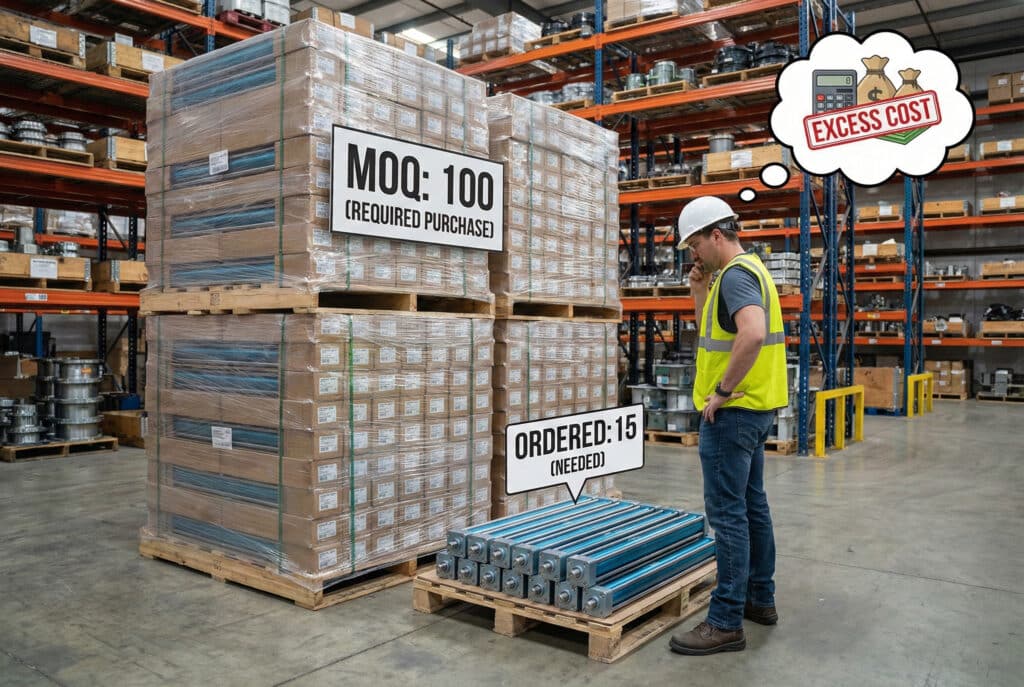
You’ve designed the perfect custom cylinder for your new machine—unique stroke length, special mounting, custom port configuration. You contact manufacturers, excited to order the 15 units you need for your pilot production run. Then reality hits: “Our MOQ is 100 pieces.” Another supplier says 50 minimum. A third won’t even quote custom work under 200 units. Your project stalls because you can’t afford to buy 85 cylinders you don’t need just to get the 15 you do. The MOQ wall just blocked your innovation. 😰
Minimum Order Quantities (MOQ) in custom cylinder manufacturing typically range from 10-100 units depending on customization complexity, with factors including tooling costs (special fixtures, custom components), setup time (machine programming, first-article validation), material purchasing minimums (special seals, non-standard materials), and production efficiency (batch processing reduces per-unit costs)—understanding MOQ drivers helps negotiate reasonable quantities or find flexible manufacturers willing to work with smaller volumes.
I remember when Thomas, a machine builder in Wisconsin, needed just 8 custom rodless cylinders for a specialized food processing application. His incumbent supplier demanded 50-piece MOQ, forcing him to either invest $15,000 in excess inventory or abandon his custom design. When he contacted Bepto Pneumatics, we worked with him at 10-piece MOQ because we understood his business reality. Sometimes flexibility matters more than volume. 🤝
Table of Contents
- What Factors Determine MOQ for Custom Pneumatic Cylinders?
- How Can You Reduce or Negotiate MOQ Requirements?
- What Are the True Costs of Low-Volume Custom Orders?
- When Should You Accept Higher MOQ vs. Seek Alternatives?
What Factors Determine MOQ for Custom Pneumatic Cylinders?
MOQ isn’t arbitrary—it’s driven by real manufacturing economics that vary by customization type. 💰
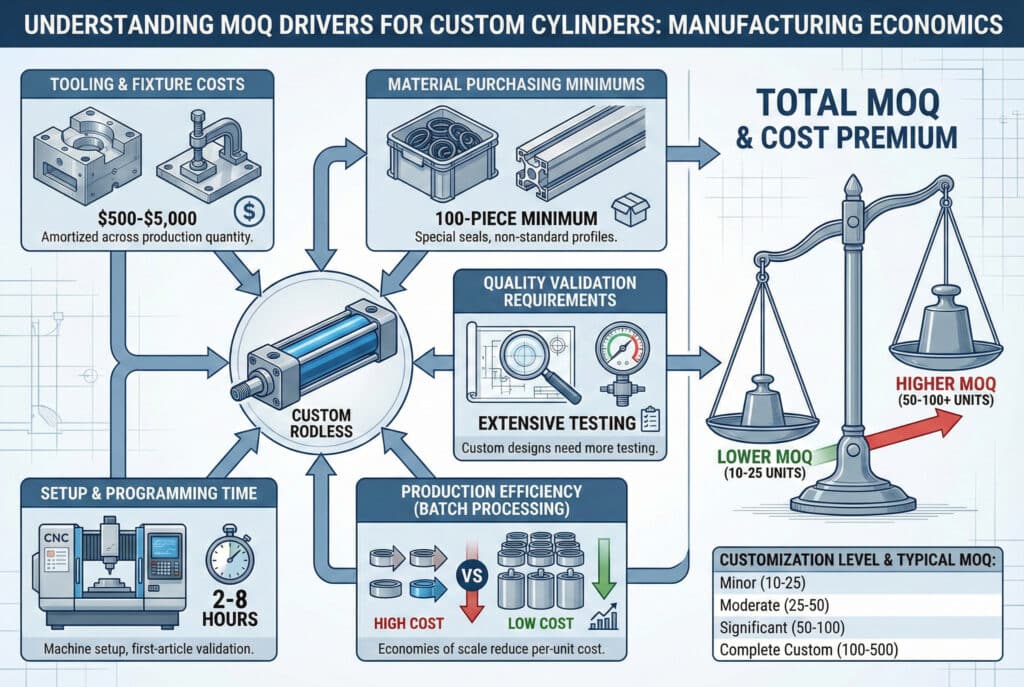
MOQ drivers include tooling and fixture costs ($500-$5,000 for custom components that must be amortized across production quantity), setup and programming time (2-8 hours for custom configurations requiring machine setup, first-article inspection, and process validation), material purchasing minimums (seal suppliers may require 100-piece minimum for non-standard profiles), production efficiency (batch processing reduces per-unit costs through economies of scale1), and quality validation requirements (custom designs need more extensive testing)—simple modifications have lower MOQ (10-25 units) while complex custom designs require higher volumes (50-100+ units).
Customization Complexity Levels
Understanding customization tiers helps predict MOQ:
| Customization Level | Examples | Typical MOQ | Lead Time | Cost Premium |
|---|---|---|---|---|
| Minor (Standard-Plus) | Non-standard stroke, port rotation, thread variation | 10-25 units | 2-3 weeks | +5-15% |
| Moderate | Special mounting, custom port location, non-standard rod end | 25-50 units | 3-4 weeks | +15-30% |
| Significant | Custom bore size2, special materials, unique design features | 50-100 units | 4-6 weeks | +30-60% |
| Complete Custom | Entirely new design, special performance requirements | 100-500 units | 8-12 weeks | +60-150% |
At Bepto Pneumatics, we classify customizations this way to provide transparent MOQ expectations upfront. 📊
Tooling Cost Impact
Why tooling drives MOQ:
Custom cylinders often require specialized tooling or fixtures:
Custom piston machining: $800-$2,000
- Special diameter or design
- Must amortize across production run
- At 10 units: $80-$200 per cylinder
- At 100 units: $8-$20 per cylinder
Custom mounting brackets: $500-$1,500
- Unique mounting configuration
- Fabrication fixtures needed
- Lower volume = higher per-unit cost
Special seals or components: $300-$1,000 minimum order
- Seal manufacturers have their own MOQs
- Non-standard profiles require minimum purchases
- Excess becomes inventory cost
Example calculation:
- Total tooling cost: $2,500
- Target tooling cost per unit: $25
- Required MOQ: 2,500 ÷ 25 = 100 units
I worked with Jennifer, an automation equipment builder in California, who needed custom mounting on 63mm cylinders. The tooling cost was $1,200. At her initial request of 15 units, that’s $80 per cylinder just for tooling. We negotiated 30-unit MOQ, reducing tooling cost to $40 per unit—still premium but manageable for her budget. 💡
Setup Time and Labor Costs
Why setup time matters:
Standard product: Machines already programmed, fixtures ready, process validated
- Setup time: 30 minutes
- First-piece inspection: 15 minutes
- Total setup: 45 minutes
Custom product: New programming, fixture modification, extensive validation
- Machine programming: 2-3 hours
- Fixture setup: 1-2 hours
- First-article inspection3: 1-2 hours
- Process validation: 1-2 hours
- Total setup: 5-9 hours
At $50/hour labor cost:
- Setup cost: $250-$450
- At 10 units: $25-$45 per cylinder
- At 50 units: $5-$9 per cylinder
- At 100 units: $2.50-$4.50 per cylinder
The more units produced, the more setup cost is diluted. This is why manufacturers prefer larger batches.
Material Purchasing Constraints
Component supplier MOQs cascade to you:
Standard seals: Available in any quantity
Custom seal profile: Seal supplier MOQ = 100 pieces minimum
Standard aluminum extrusion4: Stock material available
Special extrusion profile: Extrusion MOQ = 500kg minimum
Standard rod diameter: Inventory available
Non-standard rod size: Steel supplier MOQ = 1 ton minimum
Manufacturers face a dilemma:
- Order minimum quantity from component supplier
- Use what’s needed for your order
- Carry excess inventory (cost and risk)
- Pass cost to customer through higher MOQ or pricing
At Bepto Pneumatics, we maintain inventory of common custom components from previous orders, allowing us to offer lower MOQs when we have materials in stock. It’s worth asking if your “custom” specification matches previous orders. 🔍
How Can You Reduce or Negotiate MOQ Requirements?
MOQ isn’t always fixed—smart strategies can reduce quantities or costs. 🎯
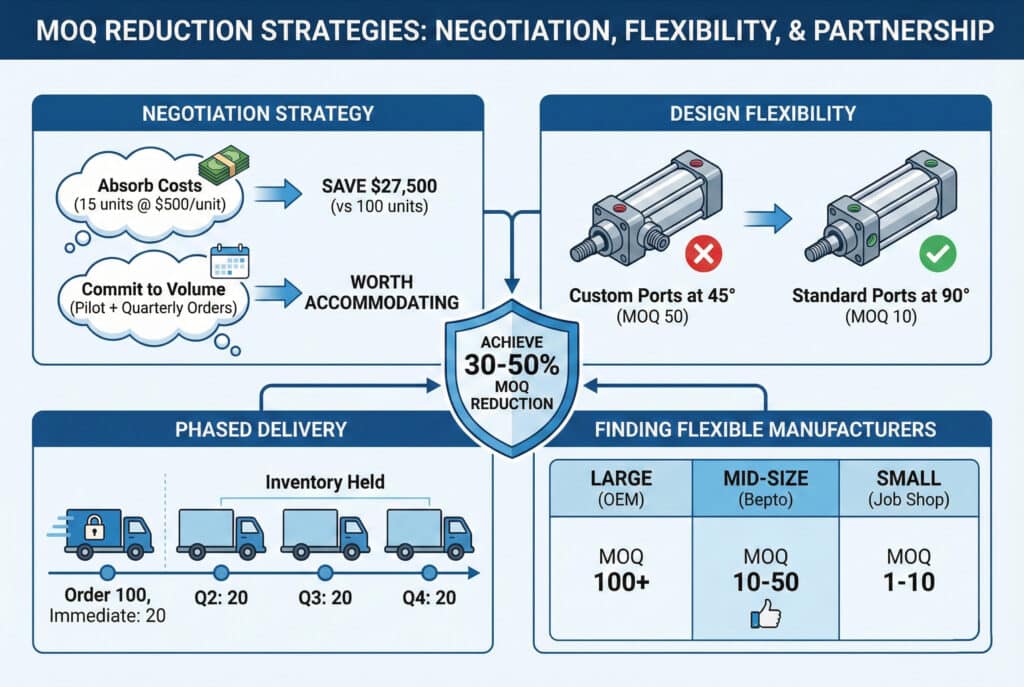
MOQ reduction strategies include accepting longer lead times (allows manufacturer to combine your order with others for efficiency), offering design flexibility (using available materials or standard components where possible), establishing long-term relationships (committed future volume justifies lower initial MOQ), paying premium pricing (covering tooling and setup costs in unit price rather than volume), considering phased delivery (order full MOQ but receive in installments), and finding flexible manufacturers (some specialize in low-volume custom work)—combination approaches often achieve 30-50% MOQ reduction.
Negotiation Strategy Framework
Approach 1: Absorb costs in unit price
Instead of: “I need 15 units at your 100-unit price”
Try: “I need 15 units. What’s the price if I cover tooling and setup costs?”
Example:
- Standard 100-unit MOQ price: $350/unit
- 15-unit order with absorbed costs: $500/unit
- Total: $7,500 vs. $35,000 for 100 units
- You save $27,500 by avoiding excess inventory
Approach 2: Commit to future volume
“I need 15 units now for pilot production. If successful, I’ll order 200+ units quarterly for three years.”
Manufacturer perspective:
- Pilot order: Low profit, high effort
- Future volume: High profit, established process
- Worth accommodating to win long-term business
Approach 3: Design flexibility
“My design calls for G3/8 ports at 45° orientation. If using standard G1/4 ports at 90° reduces MOQ, I can adapt my design.”
Impact:
- Eliminates custom port machining
- Uses standard components
- Reduces MOQ from 50 to 10 units
I worked with Robert, a packaging machinery designer in Pennsylvania, who initially specified custom mounting requiring 75-unit MOQ. By reviewing his design together, we identified that a standard mounting with a simple adapter plate achieved the same function. MOQ dropped to 15 units, and his adapter plates cost $12 each—far cheaper than excess cylinders. 🔧
Phased Delivery Arrangements
Order full MOQ, receive in installments:
Scenario: MOQ is 100 units, you need 20 now, 80 over next year
Arrangement:
- Order 100 units (locks in pricing, satisfies MOQ)
- Immediate delivery: 20 units
- Remaining 80: Quarterly releases of 20 units
- Manufacturer holds inventory (or charges storage fee)
Benefits:
- You get immediate units at volume pricing
- Avoid carrying excess inventory
- Secure supply for future needs
- Lock in pricing against increases
Considerations:
- May require deposit or payment terms
- Storage fees possible ($1-2 per unit per month)
- Specification changes difficult once ordered
- Manufacturer business continuity risk
When this works:
- You’re confident of future demand
- Design is stable (no changes expected)
- Pricing is favorable (worth locking in)
- Manufacturer is financially stable
Finding Flexible Manufacturers
Not all manufacturers have same MOQ policies:
Large manufacturers (OEMs, major brands):
- High MOQ (100-500+ units)
- Optimized for volume production
- Less flexible on custom work
- Premium pricing
Mid-size manufacturers (like Bepto Pneumatics):
- Moderate MOQ (10-50 units typical)
- Balance volume and flexibility
- Custom work capability
- Competitive pricing
Small job shops:
- Low/no MOQ (1-10 units)
- High flexibility
- Limited capacity and capability
- Premium pricing for low volume
The sweet spot: Mid-size manufacturers with custom capabilities and reasonable MOQ policies. At Bepto Pneumatics, our 10-25 unit MOQ for most custom work reflects our focus on serving machine builders and OEMs who need flexibility. 💪
What Are the True Costs of Low-Volume Custom Orders?
Understanding real costs helps make informed decisions about MOQ and alternatives. 📊
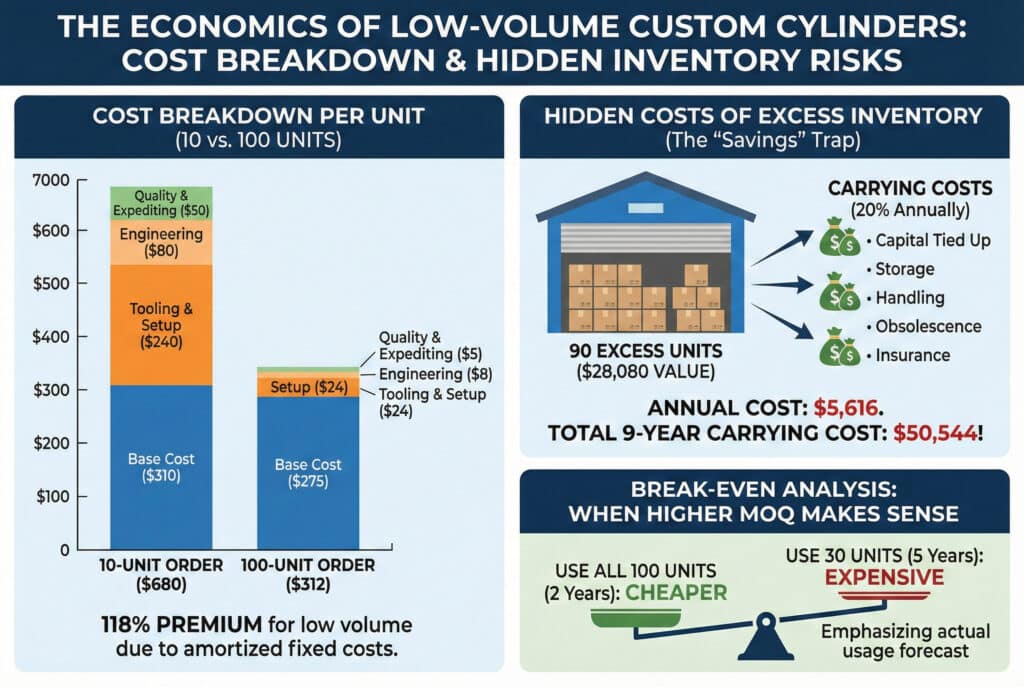
Low-volume custom cylinder costs include base manufacturing cost (materials, labor, overhead), tooling and setup costs ($500-$5,000 amortized5 across fewer units), engineering time (design review, drawing creation, validation—$500-$2,000), quality validation (first-article inspection, testing, documentation—$300-$1,000), expediting premiums (faster delivery adds 15-30%), and opportunity cost (manufacturer foregoes higher-margin volume work)—total cost for 10-unit custom order is typically 40-80% higher per unit than 100-unit order.
Cost Breakdown Example
Custom 80mm rodless cylinder, special mounting, 200mm stroke:
| Cost Component | 10 Units | 50 Units | 100 Units |
|---|---|---|---|
| Materials & labor | $250/unit | $240/unit | $230/unit |
| Tooling ($2,000) | $200/unit | $40/unit | $20/unit |
| Setup ($400) | $40/unit | $8/unit | $4/unit |
| Engineering ($800) | $80/unit | $16/unit | $8/unit |
| Quality validation ($500) | $50/unit | $10/unit | $5/unit |
| Overhead allocation | $60/unit | $50/unit | $45/unit |
| Total cost per unit | $680 | $364 | $312 |
| Total order cost | $6,800 | $18,200 | $31,200 |
Key insights:
- 10-unit order: 118% premium vs. 100-unit pricing
- 50-unit order: 17% premium vs. 100-unit pricing
- Doubling from 10 to 20 units reduces per-unit cost by 25%
Hidden Costs of Excess Inventory
But what if you order 100 units when you only need 10?
Carrying costs (annual):
- Capital tied up: 8-12% of inventory value
- Storage: 2-4% of inventory value
- Handling: 1-2% of inventory value
- Obsolescence risk: 3-8% of inventory value
- Insurance: 1-2% of inventory value
- Total: 15-28% annually
Example:
- 90 excess units @ $312 each = $28,080 inventory
- Annual carrying cost @ 20% = $5,616
- If you use 10 units/year, carrying 90 units for 9 years
- Total carrying cost: $50,544
The “savings” from volume pricing evaporated into inventory costs! 😱
I worked with Maria, who runs a specialty equipment company in Texas. She ordered 100 custom cylinders at great pricing to meet MOQ. Five years later, she still had 60 units in inventory, and her design had changed—making them obsolete. The $18,720 in excess inventory became a write-off. Sometimes paying more per unit for the quantity you actually need is the smarter financial decision. 💡
Break-Even Analysis
When does higher MOQ make sense?
Calculate break-even:
Option A: 10 units @ $680 = $6,800
Option B: 100 units @ $312 = $31,200
If you’ll use all 100 units within 2 years:
- Carrying cost: $31,200 × 20% × 1 year (average) = $6,240
- Total cost: $31,200 + $6,240 = $37,440
- Cost per unit: $374
- Still cheaper than $680 for 10 units
If you’ll only use 30 units over 5 years:
- 70 units become obsolete
- Obsolete inventory: 70 × $312 = $21,840
- Carrying cost on used units: ~$3,000
- Total cost: $31,200 + $3,000 = $34,200 for 30 units
- Cost per unit: $1,140
- Far more expensive than $680 for 10 units!
The decision depends on your actual usage forecast. 📈
When Should You Accept Higher MOQ vs. Seek Alternatives?
Strategic thinking about MOQ helps optimize costs and minimize risk. 🤔
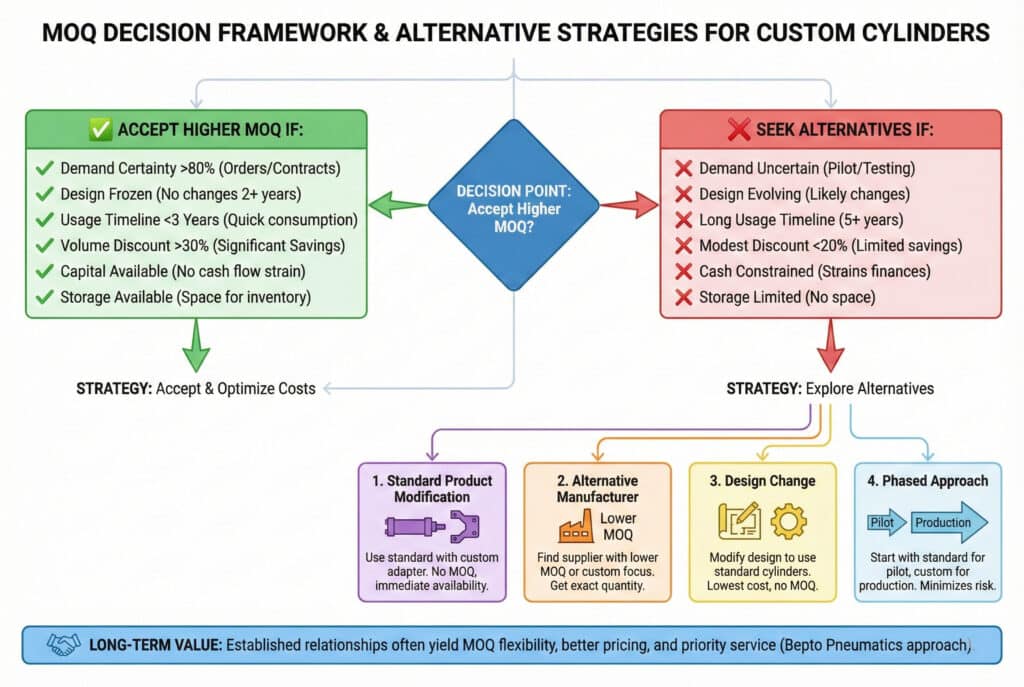
Accept higher MOQ when you have confirmed demand (existing orders or contracts for the volume), stable design (no changes expected that would obsolete inventory), favorable pricing (volume discount exceeds carrying costs), long product lifecycle (will use inventory within 2-3 years), and capital availability (can afford inventory investment)—seek alternatives when demand is uncertain, design is evolving, cash flow is constrained, or product lifecycle is short—wrong choice costs 30-50% in wasted inventory or premium pricing.
Decision Framework
Accept higher MOQ if:
✅ Demand certainty >80%: You have orders or contracts
✅ Design frozen: No changes anticipated for 2+ years
✅ Usage timeline <3 years: Will consume inventory quickly
✅ Volume discount >30%: Significant per-unit savings
✅ Capital available: Won’t strain cash flow
✅ Storage available: Have space for inventory
Seek alternatives if:
❌ Demand uncertain: Pilot project, market testing, new product
❌ Design evolving: Likely changes based on feedback
❌ Long usage timeline: Will take 5+ years to consume
❌ Modest discount <20%: Limited savings vs. carrying costs
❌ Cash constrained: Inventory investment strains finances
❌ Storage limited: No space for excess inventory
Alternative Strategies
When MOQ doesn’t work, consider:
1. Standard product modification:
Instead of custom cylinder, use standard cylinder with custom adapter or bracket
- Pros: No MOQ, immediate availability, lower cost
- Cons: May add complexity, slightly larger envelope
2. Alternative manufacturer:
Find manufacturer with lower MOQ or custom specialization
- Pros: Get exactly what you need in right quantity
- Cons: May cost more per unit, need to qualify new supplier
3. Design change:
Modify your design to use standard cylinders
- Pros: Lowest cost, fastest delivery, no MOQ
- Cons: Requires engineering time, may compromise performance
4. Phased approach:
Start with standard cylinders for pilot, order custom for production
- Pros: Minimizes risk, validates design before custom investment
- Cons: Two-step process, potential delays
I worked with David, who was developing a new material handling system. He needed 12 custom cylinders for prototypes but faced 50-unit MOQ. We provided standard cylinders with custom mounting brackets for his prototypes. After successful testing and securing production contracts, he ordered 200 custom cylinders at excellent pricing. Phased approach minimized risk and optimized costs. 🎯
Long-Term Relationship Value
MOQ flexibility often comes with partnership:
First order challenges:
- New customer (unknown volume potential)
- No relationship history
- Higher risk for manufacturer
- Result: Strict MOQ enforcement
Established relationship benefits:
- Proven volume history
- Payment reliability established
- Mutual trust developed
- Result: MOQ flexibility, better pricing, priority service
Building the relationship:
- Start with standard products (no MOQ issues)
- Demonstrate reliable ordering and payment
- Communicate future plans and volume potential
- Request custom work with relationship context
- Enjoy flexibility and preferential treatment
At Bepto Pneumatics, our best customers started with standard rodless cylinders, proved their business, then gained access to custom capabilities with minimal MOQ. We’re more flexible with partners we trust and who demonstrate growth potential. That’s the value of relationship. 🤝
When to Walk Away
Some MOQ situations aren’t worth accepting:
🚫 MOQ exceeds 5 years of usage: Obsolescence risk too high
🚫 Manufacturer inflexible despite reasonable alternatives: Poor partner indicator
🚫 Custom feature adds <10% performance value: Not worth complexity
🚫 Standard alternatives exist at <20% premium: Better to buy standard
🚫 Design still evolving significantly: Will likely change anyway
Sometimes the right answer is: “This custom approach doesn’t make economic sense. Let’s find a standard solution or alternative design.”
Conclusion
MOQ in custom cylinder manufacturing reflects real economics, not arbitrary rules—understanding the drivers, negotiating strategically, and making informed decisions about volume vs. alternatives optimizes your costs while minimizing inventory risk and enabling innovation. 💼
FAQs About MOQ in Custom Cylinder Manufacturing
Why do some manufacturers have much higher MOQ than others?
MOQ reflects business model and target market—large manufacturers optimized for volume production have high MOQ (100-500 units) because their processes, overhead, and profit margins require volume, while mid-size manufacturers like Bepto Pneumatics balance volume and flexibility with moderate MOQ (10-50 units), and small job shops have low/no MOQ but charge premium pricing—choosing the right manufacturer type for your volume needs is key. We positioned Bepto Pneumatics specifically to serve machine builders and OEMs who need custom capabilities without prohibitive MOQs. Our sweet spot is 10-100 unit orders where we can be flexible yet efficient. 🎯
Can I order below MOQ if I pay a premium price?
Yes—most manufacturers will accept below-MOQ orders if you cover the tooling, setup, and efficiency costs through higher unit pricing, typically adding 40-100% premium depending on how far below MOQ you’re ordering—this is often more cost-effective than buying excess inventory you won’t use. At Bepto Pneumatics, we calculate the actual cost difference and present options: order MOQ at standard pricing, or order your actual quantity at premium pricing that covers our costs. Transparency helps you make the right financial decision for your situation. 💰
How can I avoid MOQ issues in future projects?
Design with standard components whenever possible (80% of custom requests can use standard cylinders with minor modifications), establish relationships with flexible manufacturers before you need custom work, maintain communication about future volume potential to build partnership, consider modular designs where custom elements are separate from standard cylinders, and plan ahead for custom needs rather than urgent requests—proactive design and supplier relationship management eliminates 70% of MOQ challenges. The best time to discuss custom capabilities and MOQ is before you finalize your design, not after it’s locked in.
What if my volume grows—can I get better pricing on reorders?
Absolutely—once tooling is paid for and process is established, reorder pricing typically drops 20-40% compared to initial order, and growing volume enables further price reductions through economies of scale, better material purchasing, and relationship value—manufacturers reward loyal, growing customers with better pricing and service. At Bepto Pneumatics, we track customer volume and proactively offer price improvements as your business grows. Your success is our success, and pricing should reflect the partnership value. 📈
How does Bepto Pneumatics approach MOQ for custom cylinders?
We offer flexible MOQ starting at 10-25 units for most custom work, provide transparent cost breakdowns showing tooling and setup costs, work with customers to optimize designs for lower MOQ when possible, consider long-term relationship potential in MOQ decisions, maintain inventory of common custom components to reduce MOQ, and offer phased delivery options for larger orders—our goal is enabling your innovation, not blocking it with rigid policies. Custom work is core to our business model. We’ve invested in processes and flexibility specifically to serve customers who need custom solutions in reasonable quantities. Let’s discuss your custom cylinder needs and find a practical MOQ solution. 📞
-
Explore how economies of scale reduce per-unit manufacturing costs through increased production volume. ↩
-
Learn more about how bore size impacts pneumatic cylinder force and performance requirements. ↩
-
Read about the first-article inspection process used to verify that custom manufacturing meets design specifications. ↩
-
Gain insight into the aluminum extrusion process used to create high-precision pneumatic cylinder bodies. ↩
-
Understand how tooling costs are amortized over production runs to calculate unit pricing. ↩