

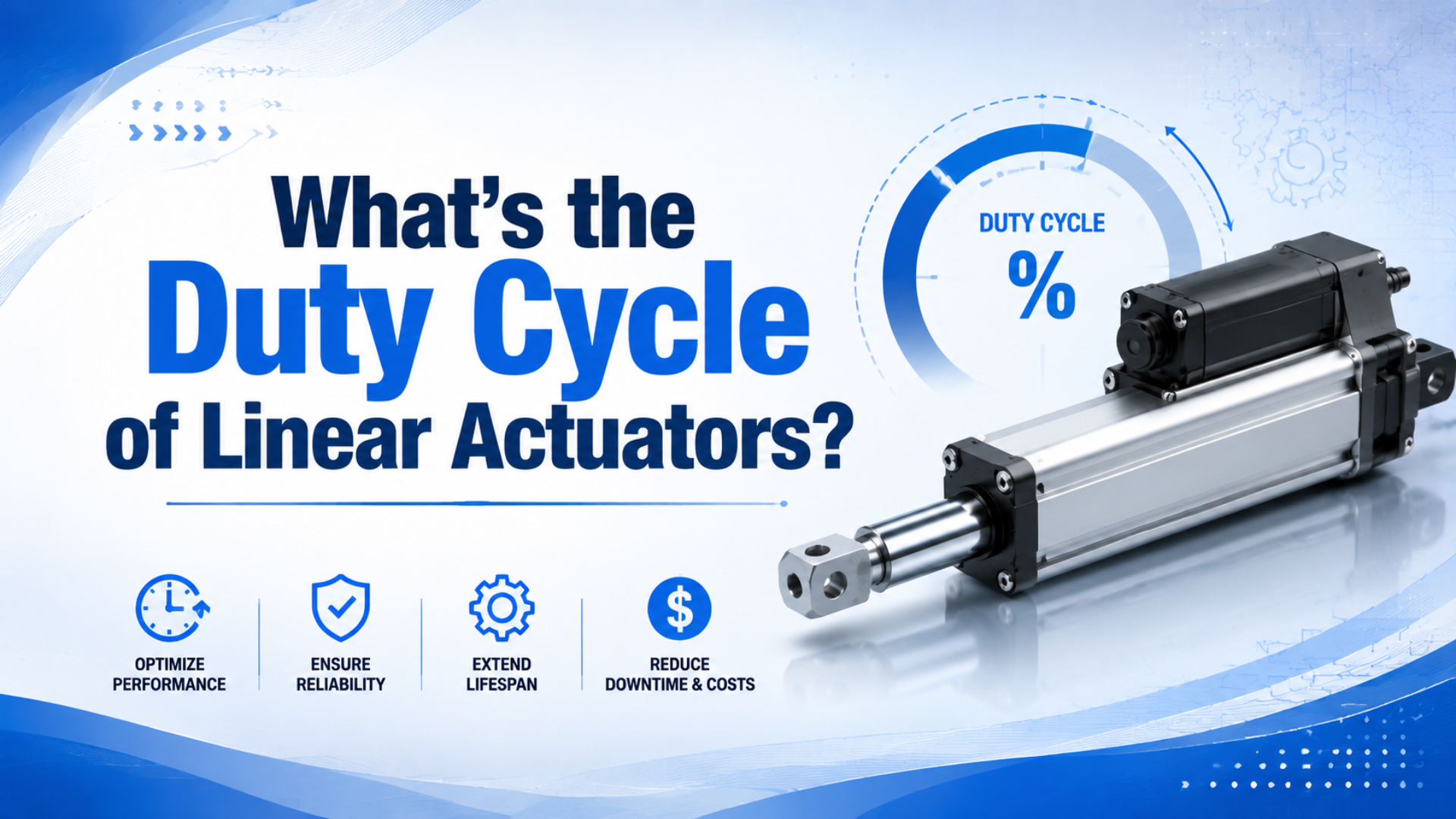
Linear actuator duty cycle is not one universal percentage for every drive technology. For a motor-driven electric actuator, it normally expresses powered on-time as a share of on-time plus off-time. For a pneumatic cylinder, engineers usually need a broader duty profile: cycle frequency, stroke time, dwell, load, speed, cushioning, air demand, valve duty, and accumulated travel.
That distinction prevents a common sizing error. A pneumatic cylinder can move all day without needing a motor-cooling pause, yet still exceed its permitted speed, impact energy, operating frequency, guide load, or component-life assumptions. An electric actuator can complete fewer strokes and still overheat because its motor remains powered under load.
Key Takeaways
- Thomson defines electric duty cycle from motor on-time.
- SMC lists up to 15 Hz only for a specific high-frequency cylinder and recommended circuit.
- Pneumatic selection also requires speed, load, cushioning, air demand, valve duty, accumulated travel, and stated failure criteria instead of an imported electric percentage.
Electric actuator duty cycle is the fraction of a stated reference period during which the actuator motor is energized. Pneumatic duty profile records cycles, stroke, dwell, speed, load, pressure, environment, stopping method, operating hours, and the failure criteria used for acceptance. Cycle time includes extend, dwell, retract, and return dwell.
The cleanest specification separates three questions: how long the electric motor is powered, how often the pneumatic mechanism moves, and how much energy the moving load must dissipate. One percentage cannot answer all three.
In our experience reviewing applications, teams often record commanded cycle time but omit powered dwell on an electric axis or cushion-entry speed on a pneumatic axis. Those missing conditions can change the controlling limit even when the nominal cycle count stays unchanged.
What Does Duty Cycle Mean for Different Linear Actuators?
Thomson’s electric-actuator example runs for 15 seconds and rests for 45 seconds, producing a 25% motor duty cycle (Thomson, Linear Actuators - Duty Cycle, accessed 2026). That formula fits motor on-time, while pneumatic cylinders require cycle, speed, energy, and life checks instead.
The phrase changes meaning with the component being discussed. Ask what is turning on, what is moving, and what limit the manufacturer is protecting.
| Component or system | Useful duty measure | Main limiting mechanism | Data to request |
|---|---|---|---|
| Electric linear actuator | Motor on-time percentage over the stated period | Motor, gearbox, brake, electronics, screw, temperature | Load-duty chart, reference period, ambient limit, powered holding rule |
| Pneumatic cylinder | Cycles/min, strokes/min, speed, travel, impact energy, operating hours | Seals, guides, cushions, stops, air path, contamination | Model frequency/speed limit, load and moment data, cushion rating, test conditions |
| Solenoid valve coil | Energized time or continuous/intermittent coil rating | Coil temperature and insulation | Voltage, frequency, ambient limit, coil duty rating |
| Compressor | Loaded/run time or average demand divided by available capacity | Motor and air-end temperature, control method | FAD capacity, pressure band, receiver, reserve, target duty |
Do not transfer a rating between rows. A continuously rated valve coil does not make the cylinder suitable for unlimited cycling. A cylinder that can withstand the mechanical cycle does not prove that the electric actuator beside it can remain energized for the same period.
For a broader technology comparison, see the guide to different types of linear actuators and the selection guide for pneumatic cylinders versus electric actuators. The separate cylinder-versus-actuator terminology guide explains the parent-category relationship; use this page for duty-profile calculation.
How Do You Calculate Electric Linear Actuator Duty Cycle?
Thomson defines electric actuator duty cycle as motor on-time divided by on-time plus off-time; its WhisperTrak example uses 10 seconds on and 90 seconds off for 10% (Thomson, WhisperTrak Electric Linear Actuator, accessed 2026). Calculate the ratio, then verify its load and temperature conditions.
Use the manufacturer’s reference period and definition:
Duty cycle (%) = powered on-time / (powered on-time + off-time) x 100Suppose one machine sequence includes 8 seconds extending, 7 seconds retracting, 5 seconds of powered holding, and 80 seconds with the motor de-energized:
Powered on-time = 8 + 7 + 5 = 20 seconds
Reference period = 20 + 80 = 100 seconds
Duty cycle = 20 / 100 x 100 = 20%
Count holding time only when the motor, brake, or drive remains energized under the product’s definition. A self-locking actuator that holds mechanically with power removed has a different thermal profile from a drive that produces current continuously at standstill.
The percentage is incomplete. Thomson states that permitted duty depends on maximum rated load and ambient temperature, so a valid calculation also needs the product conditions used to establish the limit. Record all six:
- Timed extension and retraction.
- Powered dwell, brake release, jogging, and setup motion under the real production sequence.
- Ambient temperature.
- Load direction, side load, mounting alignment, and how the mechanism reacts at full extension.
- Supply voltage and controller limits.
- The exact datasheet reference period, including any load or temperature curve that changes the permitted percentage.
Never convert a 20% calculation into approval for an actuator merely because its brochure says 25%. The two values must use the same load, ambient condition, timing convention, and product configuration.
Pneumatic Cylinder Duty Is a Different Engineering Problem
SMC publishes a maximum operating frequency of 12 Hz for its CM2-X3423 at a 25 mm stroke and 15 Hz for its CQ2-X3423 at a 5 mm stroke under recommended circuit conditions (SMC, High Speed/High Frequency Cylinder, accessed 2026). Pneumatic duty is therefore product- and condition-specific.
Compressed air does not create the same motor-winding cooling problem as an electric actuator. The pneumatic cylinder’s limits come from repeated sliding, seal condition, guide loading, impact, cushion capacity, tube and valve flow, lubrication, temperature, contamination, and the cumulative distance traveled.
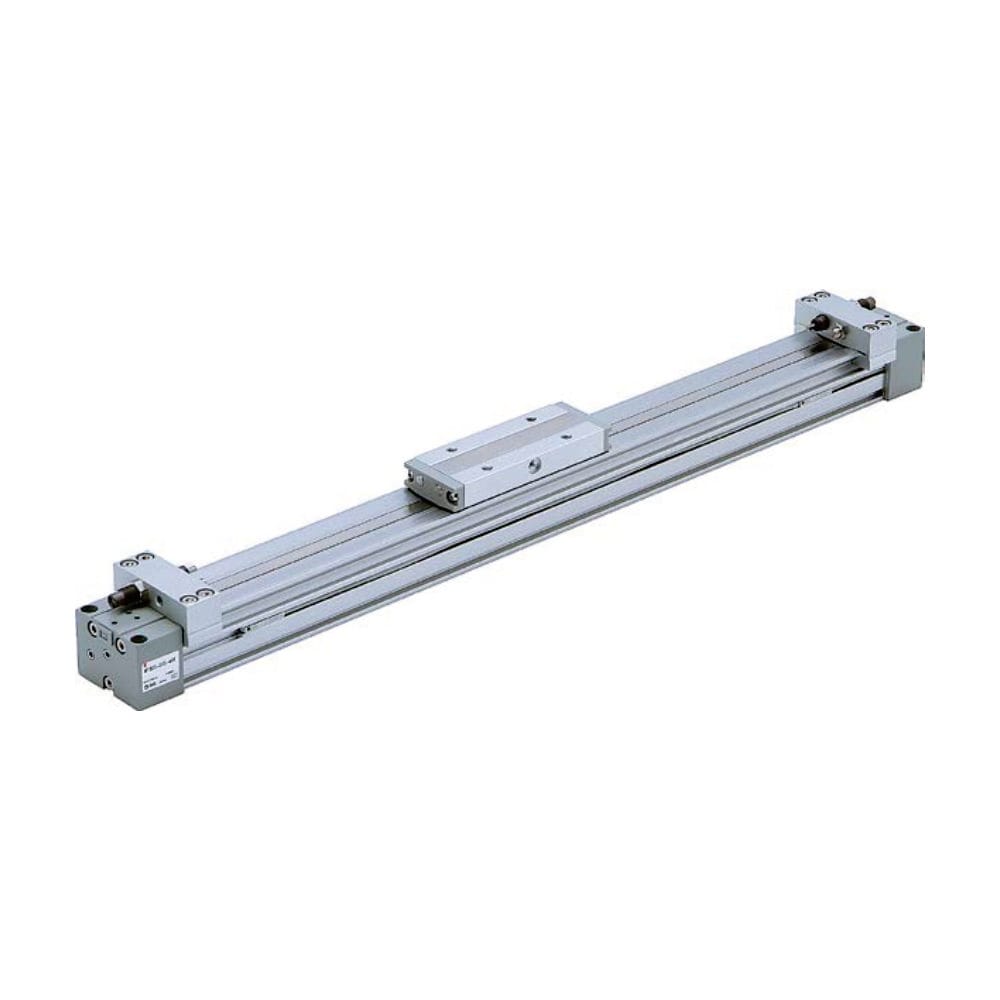
A rodless cylinder can repeat linear motion without an external piston rod, but its carriage load, speed, cushion entry, circuit flow, and accumulated travel still define the acceptable duty profile.
Electrical limits remain. A solenoid coil can stay energized during a long dwell even while the cylinder is stationary, so its temperature exposure continues without another cylinder stroke. Sensors and brakes have separate limits. Proportional valves and controllers do too. Treat every component separately instead of rolling them into one actuator percentage.
For pneumatic equipment, “rest time” is usually not the first sizing variable. A ten-second pause may cool a valve coil, but it does not erase seal travel, reverse a side-load wear pattern, or reduce the kinetic energy of the next end-of-stroke impact.
Use the high-speed pneumatic cylinder checklist when cycle time is aggressive, and review side loading on linear actuators when the moving tool has an offset center of gravity.
How Do You Build a Pneumatic Duty Profile?
ISO 19973-3:2015 specifies reliability-test procedures and reporting for pneumatic cylinders with piston rods, while ISO 19973-1 requires stated test conditions and statistical evaluation (ISO, ISO 19973-3:2015, 2015; ISO, ISO 19973-1:2015, 2015). Build a reproducible operating profile, not a vague “24/7” label.
Start with one complete machine cycle. Record each motion and dwell separately, then calculate frequency and travel.
Cycle time = extend + dwell extended + retract + dwell retracted
Cycles per minute = 60 / cycle time in seconds
Round-trip travel per cycle = 2 x stroke
Travel per shift = round-trip travel x cycles per shift
Example: a cylinder runs at 6 cycles/min with a 400 mm stroke for an 8-hour shift.
Cycles per shift = 6 x 60 x 8 = 2,880 cycles
Travel per cycle = 2 x 0.4 = 0.8 m
Travel per shift = 2,880 x 0.8 = 2,304 m, or 2.304 km
That result is not a life prediction. It is the exposure value to compare with supplier testing, maintenance intervals, seal data, guide limits, and the application’s acceptable loss of performance.
| Duty-profile input | Record | Why it matters |
|---|---|---|
| Cycle definition | Extend, dwell, retract, dwell, aborted cycles | Prevents different teams from counting different events |
| Stroke and frequency | mm, cycles/min, hours/shift | Converts calendar time into cycles and travel |
| Load geometry | Mass, direction, center-of-gravity offsets, moments | Defines guide and bearing reactions |
| Motion | Average and peak speed, acceleration, cushion-entry speed | Controls flow demand and stopping energy |
| Air circuit | Dynamic pressure, valve, tube ID, fittings, exhaust restriction | Shows whether the cylinder is starved or back-pressured |
| Environment | Temperature, particles, water, oil, washdown, chemicals | Changes seals, lubricant, corrosion, and sensing |
| Maintenance | Inspection, cleaning, lubrication, adjustment, replacement limits | Makes supplier tests comparable with plant practice |
Estimate point-of-use demand with the Pneumatic Air Consumption Calculator. If available flow is known but motion time is uncertain, use the Stroke Time Calculator as a first estimate, then confirm the real machine dynamically.
The Limits That Control High-Cycle Pneumatic Operation
SMC’s cited high-frequency series reaches 2,500 mm/s, but its catalog also limits allowable kinetic energy to 0.16-0.98 J depending on model and bore (SMC, High Speed/High Frequency Cylinder, accessed 2026). Frequency, speed, load, and stopping energy must pass together.
Find the smallest limit.
The smallest published limit governs the selection. A cylinder may meet the required cycles per minute and still be unsuitable because the payload reaches the end cap with too much kinetic energy. Parker’s engineering data instructs designers to evaluate cylinder cushion capacity using the moving load and maximum piston speed (Parker, Pneumatic Actuator Application Engineering Data, accessed 2026).
Check these limits as a linked system:
- Operating frequency: exact model limit.
- Piston or carriage speed: normal travel plus acceleration and deceleration zones.
- Kinetic energy: moving mass, peak speed, orientation, external force, cushion-entry condition, and the selected stopping device’s published capacity.
- Guide loads and moments: payload center of gravity in every relevant axis.
- Dynamic pressure and flow: pressure measured at the cylinder port during the highest-demand stroke, with the actual valve, tubing, fittings, and exhaust path.
- Temperature: cylinder body, seals, valve coil, sensor, and surrounding enclosure.
- Accumulated travel: cycles alone hide the large mechanical-exposure difference between a 5 mm test stroke and a 2,000 mm production stroke operating at the same frequency.
- Failure criteria: leakage, drift, speed loss, play, sensor error, seal wear, or inability to complete the cycle.
An endurance test applies only to its stated configuration. ISO 19973-1 notes that component service life varies and calls for statistical interpretation, documented conditions, and defined evaluation methods when reliability results are reported. One sample proves little.
For continuous production, the separate guide on rodless cylinder durability in 24/7 operation explains how to translate cycles into travel, qualification evidence, and a pilot-test plan. The air-cushion guide covers the stopping side of the problem.
How Should You Compare 25%, 50%, and 100% Ratings?
IEC 60034-1:2026 applies to rotating electrical machines, while Thomson says electric-actuator duty ratings vary with load and ambient temperature (IEC, IEC 60034-1:2026, 2026; Thomson, Linear Actuators - Duty Cycle, accessed 2026). Treat 25%, 50%, and 100% as product-specific declarations, not universal actuator classes.
Two actuators marked 25% can use different reference periods. One can restrict the rating below a stated load; another can use a load-versus-temperature chart. A nominal 100% rating can still have limits for force, speed, ambient temperature, mounting, controller current, brake use, or allowable side load.
Use this comparison sequence:
- Identify exact part numbers.
- Confirm the manufacturer’s duty-cycle definition and cited reference period.
- Compare continuous and peak load on both stroke directions, using the relevant load-versus-temperature chart when supplied.
- Check ambient temperature.
- Determine whether powered holding, braking, jogging, reversal, homing, and setup moves count as on-time.
- Check speed, side load, backlash, screw life, brake use, and controller limits separately from the percentage.
- Obtain written clarification that names the real sequence, load, temperature, and mounting condition when the datasheet leaves a required condition undefined.
For a pneumatic cylinder, do not translate these percentages into an assumed cooling schedule. Use its published frequency, speed, kinetic-energy, load, environment, and life-test information instead.
Machine Verification Before Production
ISO 4414:2010 covers significant hazards in pneumatic systems and includes intended operation, adjustment, maintenance, reliable operation, and uninterrupted service in its scope (ISO, ISO 4414:2010, 2010). Verify the actuator on the real machine through measured cycles, while applying the site’s energy-control and guarding procedures.
Before testing or servicing, isolate hazardous electrical and pneumatic energy. OSHA 29 CFR 1910.147 requires control of electrical, mechanical, hydraulic, pneumatic, thermal, and other hazardous energy during covered servicing (OSHA, Control of Hazardous Energy, accessed 2026).
Run a controlled verification sequence:
- Record the production recipe.
- Add the real payload, stroke, orientation, regulated pressure, ambient condition, shifts per day, and every setup or cleaning mode that moves the axis.
- Measure extend, dwell, retract, and return-dwell time over enough repeated cycles to expose drift.
- Record motor current and case temperature for electric axes; record cylinder, valve-coil, and exhaust behavior for pneumatic axes.
- Confirm cushion entry at maximum load and speed.
- Inspect mounts, guides, tubing, cables, and sensors for reaction loads or interference.
- Compare every measured value with its applicable product limit.
- Define stop-work thresholds for temperature, leakage, impact, drift, cycle-time change, abnormal noise, loose mounting, sensor error, and failure to reach the commanded endpoint.
Do not validate only at startup. Recheck after production-rate changes, new tooling, payload changes, control-program revisions, valve or tubing substitutions, and enclosure modifications. These changes can alter duty without changing the actuator nameplate.
For example, a heavier gripper can leave cycles per minute unchanged while increasing guide moment and stopping energy. A smaller replacement valve can leave the program unchanged while extending stroke time and reducing dynamic pressure.
A useful commissioning record contains both a timer and an odometer: time reveals thermal exposure, while cycle count and travel reveal mechanical exposure. Add load geometry and stopping energy, and the record becomes specific enough to compare with supplier evidence.
What Are the FAQs About Linear Actuator Duty Cycle?
Thomson’s 15-second-on and 45-second-off example equals 25%, whereas SMC publishes pneumatic limits such as 12 Hz at 25 mm stroke and 15 Hz at 5 mm stroke (Thomson, accessed 2026; SMC, accessed 2026). The correct answer depends on actuator technology and product conditions.
Is 25% a standard duty cycle for every linear actuator?
No. Thomson uses 25% as a calculation example, not a universal rating. An actuator’s permitted percentage can depend on reference period, load, ambient temperature, controller, and mounting. Check the exact product chart. For pneumatic cylinders, use model-specific frequency, speed, energy, load, and travel data instead of importing the percentage.
Does a pneumatic cylinder need 75% rest time if an electric actuator is rated 25%?
No. A 25% electric rating normally protects a motorized actuator under stated conditions. It does not create a pneumatic rest rule. The cylinder still needs checks for cycles per minute, piston speed, cushion energy, guide load, air quality, valve-coil duty, temperature, and accumulated travel under the actual production sequence.
Does powered holding count as electric actuator on-time?
Count it when power remains applied. In a 100-second sequence, 15 seconds of motion plus 5 seconds of powered holding produces 20% on-time under that definition, even though the output position is stationary during part of the interval. A self-locking mechanism can differ. Verify the product manual.
Can an actuator briefly exceed its rated duty cycle?
Do not assume that short overrun is acceptable. The thermal result depends on prior temperature, load, ambient condition, reference period, controller protection, and the manufacturer’s overload rules. A later rest period does not automatically authorize the excursion. Use written product limits or obtain the supplier’s application approval before changing the sequence.
Does solenoid valve coil duty belong in the pneumatic cylinder calculation?
Track it separately. The cylinder’s mechanical duty profile covers motion, speed, energy, load, and travel. The valve coil has its own energized-time and ambient-temperature rating. A cylinder may stop during a long dwell while the coil remains powered, so the electrical component can be the first thermal limit.
The practical answer is simple: calculate motor on-time for electric actuators, describe the full operating profile for pneumatic cylinders, and validate each component against its own documented limits. “Duty cycle” is useful only after the controlled variable and reference conditions are named.
External technical references and retrieval dates
Thomson, Linear Actuators - Duty Cycle. Retrieved 2026-07-15.
Thomson, WhisperTrak Electric Linear Actuator. Retrieved 2026-07-15.
SMC, High Speed/High Frequency Cylinder CM2/CQ2-X3423. Retrieved 2026-07-15.
ISO 19973-1:2015, Pneumatic Component Reliability - General Procedures. Retrieved 2026-07-15.
ISO 19973-3:2015, Pneumatic Cylinder Reliability Testing. Retrieved 2026-07-15.
IEC 60034-1:2026, Rotating Electrical Machines - Rating and Performance. Retrieved 2026-07-15.
Parker, Pneumatic Actuator Application Engineering Data. Retrieved 2026-07-15.
ISO 4414:2010, Pneumatic Fluid Power Safety Requirements. Retrieved 2026-07-15.
OSHA 29 CFR 1910.147, Control of Hazardous Energy. Retrieved 2026-07-15.