

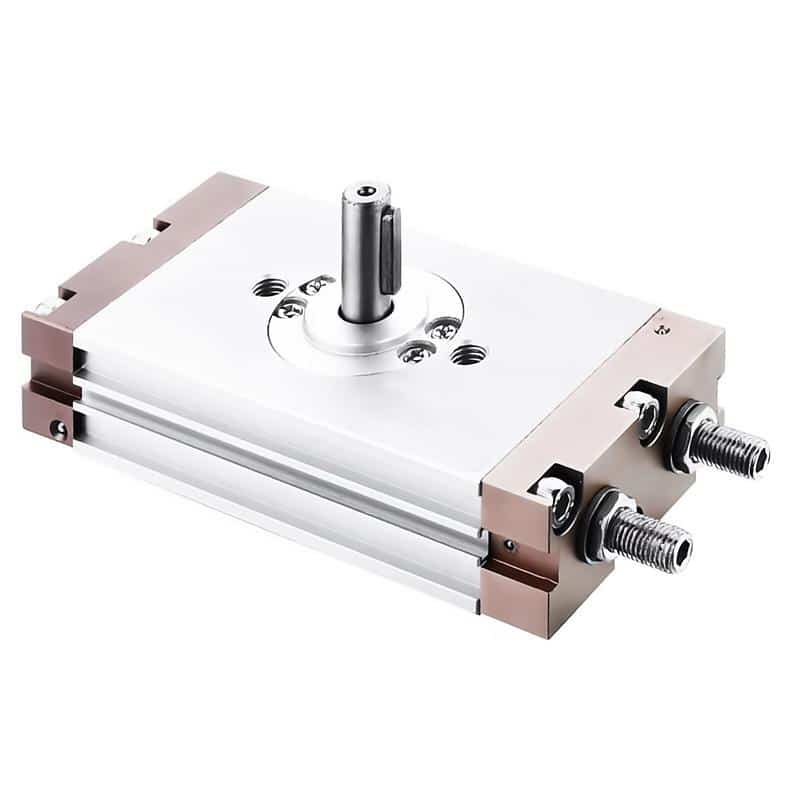
Correct sizing requires torque, movement time, working pressure, shaft loading, and stopping energy to pass together. SMC, for example, lists a stable rotation-time range of 0.2 to 1.0 seconds per 90 degrees for its MSQ rotary tables, while allowable kinetic energy varies from 0.161 to 1.82 J by size and shock-absorber option (SMC MSQ catalog, accessed July 15, 2026).
That difference matters. An actuator may have enough torque to accelerate a load but not enough cushion or shock-absorber capacity to stop it. Selection therefore has two branches: one for machine loads such as indexing arms and flip tables, and another for process valves whose breakaway and seating torques come from the valve manufacturer.
Key Takeaways
- Add resistance, gravity, friction, and acceleration torque before applying a documented design allowance.
- Compare the result with catalog torque at the lowest pressure measured during movement.
- Check kinetic energy, shaft loads, stops, and rotation time separately.
- Size process-valve actuators from valve torque data, not a generic friction equation.
If you only need a refresher on mechanisms and applications, start with how pneumatic rotary actuators work. This guide begins after the motion type has already been chosen.
What Data Must You Collect Before Sizing?
Collect the load, geometry, angle, movement time, pressure, and stopping method before opening a product catalog. SMC’s CRQ2 catalog offers nominal 90-degree and 180-degree configurations, but the catalog also requires checks for load type, rotation time, kinetic energy, and allowable shaft load (SMC CRQ2 catalog, accessed July 15, 2026).
Start with a short application sheet. Missing one of these inputs is more dangerous than using a slightly conservative estimate elsewhere.
| Input | What to record | Why it affects selection |
|---|---|---|
| Motion type | Limited-angle machine motion or quarter-turn valve | Determines which torque model applies |
| Rotation | Start angle, end angle, direction, adjustment range | Filters actuator families and stop arrangements |
| Load geometry | Mass, dimensions, center of gravity, lever arm | Determines resistance torque and moment of inertia |
| Orientation | Horizontal, vertical, or changing | Shows whether gravity assists or resists motion |
| Timing | Total move time and permitted dwell | Sets angular acceleration and valve-flow demand |
| Pressure | Minimum actuator-inlet pressure while moving | Sets available output torque |
| Duty | Cycles per minute, hours per day, expected life | Affects heat, seal, bearing, and shock-absorber review |
| Interfaces | Shaft, key, coupling, flange, mounting face | Sets mechanical compatibility and load path |
| End-of-travel control | Bumper, air cushion, hydraulic shock absorber, external stop | Sets allowable stopping energy |
| Environment | Temperature, washdown, corrosion, dust, hazardous area | Determines materials, seals, enclosure, and accessory approvals |
Define the motion before comparing actuator types. Pneumatic motors are intended for continuous rotation, while rotary actuators move through a limited angle and stop. See the pneumatic motor versus rotary actuator comparison for the selection boundary.
How Do You Calculate Static and Resistance Torque?
Parker calculates static-arm torque as force times arm length and compares it with effective torque at operating pressure. Its PRO/PRN guide uses a model-specific factor of 2 for stable loads and 5 for variable loads. This shows the allowance belongs to the manufacturer’s method, not a universal table (Parker PRO/PRN selection guide, accessed July 15, 2026).
The simplest static relationship is:
Torque = Force x perpendicular lever arm
T = F x r
For a machine load, build resistance torque from the parts that actually exist:
Resistance torque = external load torque + gravity torque + friction torque
Gravity torque = mass x 9.81 m/s² x center-of-gravity radius x sin(angle)
Demand torque is the torque the actuator must supply to overcome the real load and produce the required motion. Use the perpendicular distance from the shaft centerline to the force’s line of action: a 100 N force acting at 0.20 m creates 20 N·m. Then add gravity, friction, and other external resistance at the worst shaft angle. A balanced horizontal table rotating about a vertical shaft may have almost no gravity torque, yet it still has bearing friction and acceleration torque. An offset arm moving in a vertical plane can reach its highest gravity torque when horizontal. Parker’s method keeps load, friction, and acceleration components visible before applying the selected design factor, which makes the controlling assumption easier to test (Parker Pneumatic Actuator Products, accessed July 15, 2026).
Friction should come from measurement, bearing data, or a defensible mechanism estimate. Do not assume that running friction is always a fixed percentage of breakaway friction. Seal preload, bearing type, lubrication, temperature, dwell time, and side load can all change the relationship.
The safest calculation sheet keeps resistance torque and acceleration torque separate. Resistance torque is tied to load path and orientation; acceleration torque is tied to mass distribution and movement time. Combining them too early makes it hard to see which design change will reduce demand.
How Do You Add Inertia and Acceleration Torque?
Parker’s rotary-actuator guide expresses 90, 180, and 270 degrees as 1.5708, 3.1416, and 4.7124 radians before calculating acceleration torque. It then adds resistance and acceleration torque and compares their sum with effective torque at the chosen operating pressure (Parker PRO/PRN selection guide, accessed July 15, 2026).
Acceleration torque is:
Acceleration torque = moment of inertia x angular acceleration
Ta = J x alpha
Moment of inertia is the load’s resistance to angular acceleration, and it depends on mass distribution rather than mass alone. A point mass at radius r has J = m x r², while a solid disk about its center has J = 0.5 x m x r². Add the inertia of every rotating component, including the fixture, coupling, arm, and workpiece. Angular acceleration then comes from the chosen movement profile. For a symmetric triangular profile, the load accelerates for half the move and decelerates for the other half, so alpha = 4 x theta / t² and maximum angular velocity is 2 x theta / t. Parker likewise requires the rotation angle, movement time, load inertia, and resistance torque before comparing required torque with actuator output (Parker PRO/PRN selection guide, accessed July 15, 2026).
For that symmetric triangular velocity profile:
alpha = 4 x theta / t²
maximum angular velocity = 2 x theta / t
Here is a transparent first-pass example for a horizontal indexing arm:
| Assumption | Value |
|---|---|
| Point load | 8 kg |
| Load radius | 0.25 m |
| Rotation | 90 degrees = 1.571 rad |
| Total movement time | 0.60 s |
| Measured friction torque | 6.0 N·m |
| Project design allowance | 1.50, set by the responsible engineer |
The point-load inertia is 8 x 0.25² = 0.50 kg·m². The assumed profile gives alpha = 4 x 1.571 / 0.60² = 17.45 rad/s², so acceleration torque is 0.50 x 17.45 = 8.73 N·m. Add 6.0 N·m of friction and the movement demand becomes 14.73 N·m. Applying the documented project allowance gives a catalog comparison value of 22.10 N·m.
That is not a model selection yet. The actuator must produce at least that torque at the minimum pressure seen during movement, and the mechanism must pass the stopping-energy and shaft-load checks below.
Why Must You Check Stopping Energy Separately?
SMC’s MSQ data lists allowable kinetic energy from 0.161 J to 1.82 J across sizes and shock-absorber options, even though all listed models share a stable 0.2 to 1.0 second per 90-degree rotation-time range. The model therefore has to pass torque, time, and energy as separate catalog checks (SMC MSQ catalog, accessed July 15, 2026).
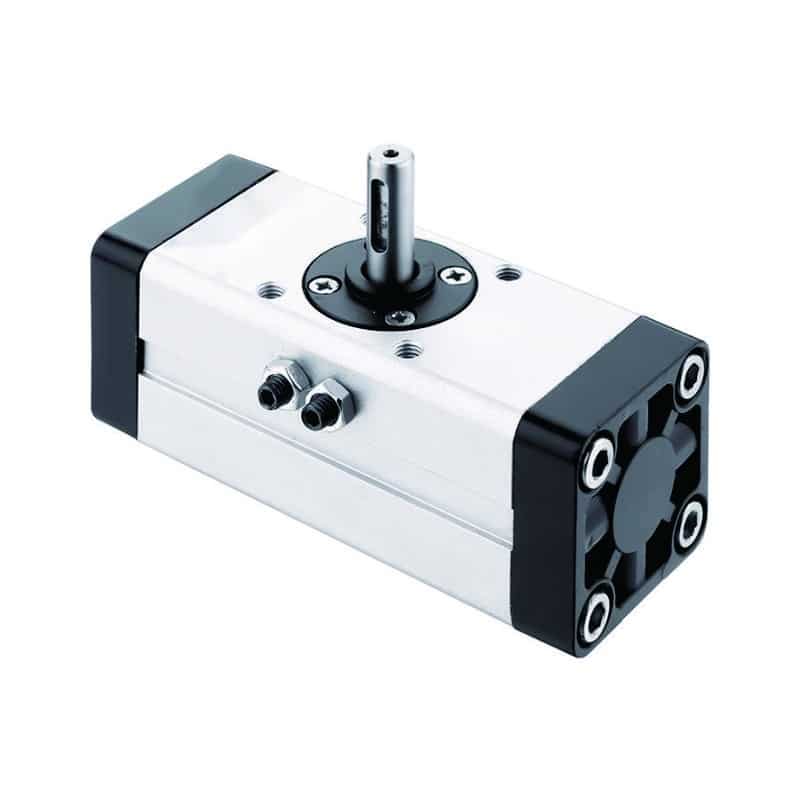
Rotational kinetic energy is:
Kinetic energy = 0.5 x moment of inertia x angular velocity²
E = 0.5 x J x omega²
Kinetic energy is the energy the moving load carries into deceleration, and a torque-only worksheet can miss it. In the worked example, maximum angular velocity is 2 x 1.571 / 0.60 = 5.24 rad/s. With J = 0.50 kg·m², peak kinetic energy is about 6.85 J. That result does not mean the cushion absorbs all 6.85 J in each mechanism; it means the deceleration profile, bumper, external stop, and shock absorber must be compared with published limits. An actuator can accelerate the arm while its rack, vane, bearing, or stop remains vulnerable at the end of travel. Parker defines design torque as the greater of demand torque or cushion torque and warns that excessive cushion torque can produce damaging pressure during deceleration (Parker Pneumatic Actuator Products, accessed July 15, 2026).
If the energy check fails, use a longer movement time, reduce rotating inertia, move mass closer to the shaft, or add a correctly sized external shock absorber and stop. Do not simply choose a higher-torque actuator and assume the stopping problem disappears.
Moving the same mass inward can reduce both acceleration torque and kinetic energy because inertia changes with the square of radius. This mechanical change may be more effective than raising supply pressure or increasing actuator size.
How Do You Compare Required and Catalog Torque?
Festo’s DFPD-20 double-acting model lists 20.1 N·m at both 0 and 90 degrees at nominal pressure, but that constant endpoint value belongs to that rack-and-pinion model and condition. Other mechanisms, especially spring-return and scotch-yoke units, have different torque curves through the stroke (Festo DFPD-20 technical data, accessed July 15, 2026).
Measure pressure at the actuator inlet while it is moving under the expected flow demand. A regulator gauge observed at rest does not show the loss through the directional valve, fittings, tube, flow control, or exhaust path. CAGI says a well-designed compressed-air system should have no more than 10% pressure drop from compressor discharge to the point of use, but that system target is not permission to assume a 10% drop at every actuator (CAGI pressure-drop brief, accessed July 15, 2026).
For some double-acting rack-and-pinion actuators, output torque is approximately proportional to pressure within the published operating range. A pressure ratio can be useful for screening:
Estimated torque at P2 = catalog torque at P1 x P2 / P1Use that only when the manufacturer confirms the relationship for the same model, direction, and shaft position. Final selection must use the catalog curve or sizing table. Spring-return units need separate checks for air start, air end, spring start, and spring end torque.
Pressure is only half of the speed question. The valve and tubing must fill and exhaust the actuator quickly enough without creating unstable motion. If pressure collapses during movement, check the flow-control valve sizing method and investigate pressure fluctuations at the point of use before increasing actuator size.
Size Quarter-Turn Valve Actuators From Valve Torque Data
Bray’s ball-valve guide uses application factors from 1.0 to 2.0 and frequency additions from 0 to 0.5, depending on media, valve design, and operating interval. These are manufacturer-specific inputs applied to valve torque requirements, not universal safety factors for every rotary actuator (Bray ball-valve actuator selection guide, accessed July 15, 2026).
For a ball, butterfly, or plug valve, request the valve supplier’s torque values at the actual size, seat material, differential pressure, temperature, media, and expected service condition. At minimum, compare:
- break-to-open torque
- running torque
- end-to-open torque
- break-to-close torque
- running-to-close torque
- seating or end-to-close torque
Then overlay those requirements on the actuator’s torque curve through the full 90-degree stroke. For a double-acting actuator, compare air torque at the relevant positions. For a spring-return actuator, compare both the air stroke and spring stroke in the required fail direction.
Do not estimate valve torque from line pressure, valve diameter, and a generic friction coefficient unless the valve manufacturer explicitly provides that method. Seat design, seal material, differential pressure, media deposits, temperature, and time at rest can change breakaway torque substantially.
The mechanical interface needs a second limit check. Festo notes that actuator operating torque must not exceed the permissible torque of the ISO 5211 mounting flange and coupling for the selected configuration (Festo DFPD-20 technical data, accessed July 15, 2026). Also verify the valve’s maximum allowable stem torque. More actuator torque is not automatically safer if the stem, key, bracket, or coupling becomes the weak part.
Machine-load sizing asks whether the actuator can accelerate and stop inertia. Valve sizing asks whether the actuator torque curve clears several valve-torque points without exceeding stem and mounting limits. Treating them as one calculation hides the controlling constraint in both cases.
Complete the Mechanical, Pneumatic, and Safety Checks
CAGI’s 10% system pressure-drop guidance covers the path from compressor to point of use, while SMC’s low-speed rotary selection procedure separately checks torque, rotation time, kinetic energy, allowable load, and air quantity. A reliable final review therefore has to examine the motion system, not just the actuator bore (CAGI pressure-drop brief, SMC CRQ2X/MSQX selection guide, accessed July 15, 2026).
Before releasing a part number, check the following:
- Torque through the stroke: Compare the controlling load point with the actuator’s effective torque at minimum moving pressure.
- Kinetic energy: Confirm that the bumper, cushion, shock absorber, or external stop can decelerate the load.
- Shaft loading: Check radial load, axial load, bending moment, and allowable load direction. Add an external bearing when the actuator shaft should not carry the machine load.
- Rotation time: Stay inside the model’s stable adjustment range. Avoid using a flow control to force a standard actuator far below its published stable speed.
- Valve and tubing flow: Size both supply and exhaust paths. Meter-out control often gives steadier pneumatic motion, but the permitted circuit depends on the actuator and load.
- Mechanical stops: Do not use adjustment screws as structural stops unless the catalog permits it. Locate external stops so the load path bypasses vulnerable internal parts.
- Coupling and alignment: Check shaft fit, key engagement, backlash, bracket stiffness, and angular alignment.
- Sensors and repeatability: End-position switches confirm position; they do not correct backlash, stop deflection, pressure variation, or fixture movement.
- Duty and environment: Verify temperature, seal material, lubrication policy, corrosion protection, ingress protection, washdown, and cycle life.
- Safe isolation: Define stored-energy release, guarding, restart prevention, and maintenance isolation in the machine risk assessment.
ISO 4414:2010 covers general safety requirements for pneumatic systems and components, including design, installation, adjustment, maintenance, reliable operation, and energy efficiency. It does not replace the machine-specific risk assessment or provide a universal rotary-actuator design factor (ISO 4414:2010, accessed July 15, 2026).
In hazardous locations, assess the complete assembly. Electrical rules may apply to the solenoid valve, position switches, and positioner, while the mechanical actuator may require separate ignition-risk and material review. OSHA 1910.307 specifically addresses electrical equipment and wiring in hazardous classified locations, so it should not be used as a blanket certification claim for a pneumatic actuator (OSHA 1910.307, accessed July 15, 2026).
FAQs About Pneumatic Rotary Actuator Sizing
The five questions below cover the decisions most likely to change the selected size. They reflect manufacturer methods that distinguish 90, 180, and 270-degree motion, multiple torque positions, and separate energy limits rather than relying on a single nameplate number (Parker PRO/PRN selection guide, accessed July 15, 2026).
What torque should I use to size a pneumatic rotary actuator?
Use the largest requirement found after adding resistance, gravity, friction, and acceleration torque for the defined motion. Apply only the design allowance documented for that project or manufacturer method. Then compare the result with effective actuator torque at the lowest inlet pressure measured during movement, not the static regulator setting.
Can I scale catalog torque directly with air pressure?
Pressure scaling is a useful estimate only when the manufacturer confirms near-linear behavior for the same actuator, direction, and shaft position. Use the actual model curve for final selection. Spring-return actuators need separate air-start, air-end, spring-start, and spring-end comparisons, so one pressure-ratio calculation is not enough.
Is an oversized rotary actuator always safer?
No. Extra torque margin does not solve excess kinetic energy, weak couplings, high shaft loads, unstable low-speed motion, or a valve stem torque limit. A larger actuator also has more chamber volume to fill and exhaust. Select the smallest model that passes every documented torque, energy, pressure, load, and life check.
How should I size a rotary actuator for a ball valve?
Obtain break, run, and end torque in both directions from the valve manufacturer at the real differential pressure, media, temperature, seat, and service condition. Apply the valve supplier’s documented factors, then compare each requirement with the actuator’s torque curve and confirm the valve stem, coupling, bracket, and flange limits.
When should the sizing calculation be reviewed again?
Review it whenever the load, movement time, pressure, valve, tubing, orientation, cycle rate, temperature, coupling, or stopping method changes. Recheck after a failure or unexplained slowdown. A fixed three-year or five-year recalculation interval is not a substitute for condition changes, maintenance findings, and the machine’s formal risk-review schedule.
Correct sizing is a chain of evidence: known load, stated motion profile, measured pressure, catalog torque, verified stopping energy, acceptable shaft loads, and compatible interfaces. If one link is estimated, label the assumption and test it during commissioning. That makes the final part number defensible and gives maintenance teams a useful baseline when performance changes.
If the catalog does not state the required torque curve, allowable kinetic energy, shaft-load limit, or stable rotation-time range, send the calculation sheet and application drawing through the technical contact page before approving the component.