
Introduction
Every week, I receive calls from engineers who’ve been told they must buy entire pneumatic systems from a single brand—or risk catastrophic failure. Their production lines are down, budgets are tight, and OEM suppliers are quoting 8-week lead times with premium prices. The fear of mixing components keeps them trapped in expensive vendor lock-in. 😰
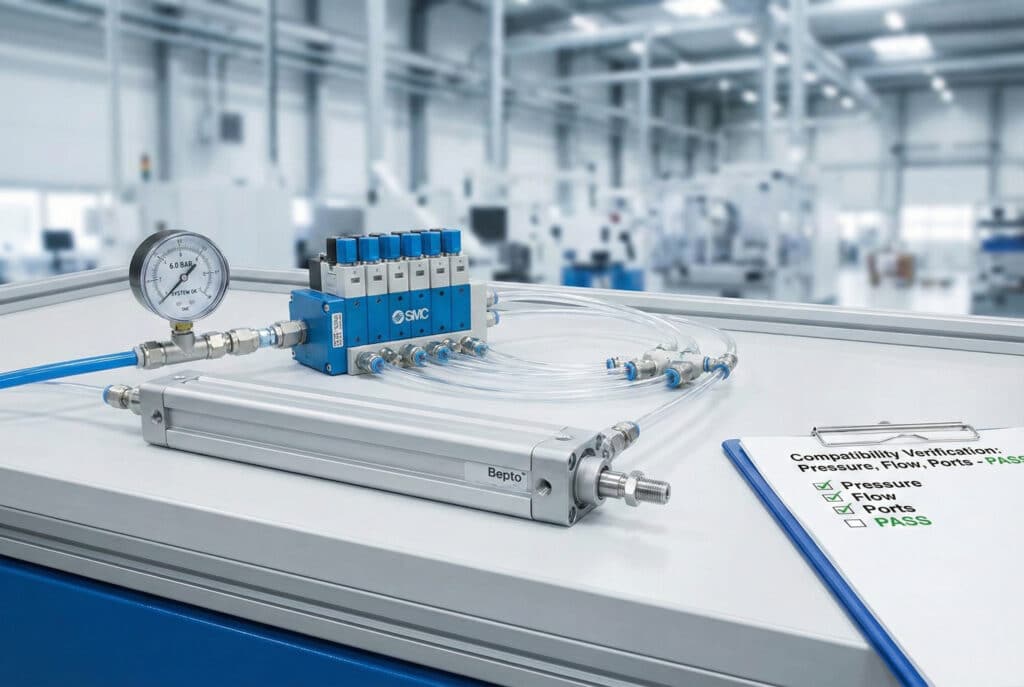
Yes, you can safely mix pneumatic valves and cylinders from different brands—as long as you verify key compatibility factors including pressure ratings, port sizes, flow capacity, and mounting standards. At Bepto Pneumatics, we’ve successfully helped hundreds of clients integrate our rodless cylinders with existing valve systems from SMC, Festo, Parker, and other major brands, achieving seamless operation while cutting costs by 30-40%.
Last month, an automotive parts manufacturer in Michigan contacted us in desperation. Their production line used Parker valves but needed urgent cylinder replacements. The OEM quote was astronomical, and they feared mixing brands would void warranties. After our compatibility assessment, they installed Bepto rodless cylinders—and the system has been running flawlessly for three months, saving them over $15,000. 💰
Table of Contents
- Can You Mix Pneumatic Valves and Cylinders from Different Manufacturers?
- What Are the Critical Compatibility Factors to Check?
- How Do You Verify Port Size and Thread Compatibility?
- What Risks Should You Avoid When Mixing Brands?
- FAQs About Pneumatic Component Compatibility
Can You Mix Pneumatic Valves and Cylinders from Different Manufacturers?
The short answer might surprise traditionalists in the industry. 🤔
Absolutely—pneumatic components follow international standards (ISO 155521, ISO 212872, VDMA 24562) that ensure cross-brand compatibility when specifications match. The key is understanding that pneumatic systems operate on universal principles of compressed air flow, regardless of the logo on the housing. Most industrial valves and cylinders are designed to industry standards, making strategic mixing not only possible but often advantageous.

The Truth About Brand Compatibility
For over 15 years at Bepto Pneumatics, we’ve specialized in providing high-quality replacement rodless cylinders that integrate seamlessly with existing valve systems. The pneumatic industry has matured to the point where standardization is the norm, not the exception.
Here’s what I’ve learned from real-world applications:
Industry Standards Work: ISO standards weren’t created as suggestions—they’re functional specifications that major manufacturers follow. When a valve outputs 6 bar through a G1/4″ port, any cylinder rated for that pressure with matching threads will function correctly.
OEM Fear-Mongering: Many original equipment manufacturers discourage mixing brands to protect market share, not because of legitimate technical concerns. I’ve seen countless successful mixed-brand installations across automotive, packaging, and food processing industries.
Real-World Success Story
Sarah, a maintenance manager at a pharmaceutical packaging facility in New Jersey, faced a common dilemma. Her line used Festo valves throughout but needed to replace three expensive rodless cylinders. The Festo quote was $8,400 with a 6-week lead time. 😤
After reviewing her system specifications, we supplied compatible Bepto rodless cylinders for $5,200, delivered in 10 days. The installation took less than two hours, and the line has operated without issues for over 18 months. Sarah now specifies Bepto cylinders for all new projects, mixing them confidently with her existing Festo valve infrastructure.
What Are the Critical Compatibility Factors to Check?
Before mixing any pneumatic components, you need a systematic verification process. ✅
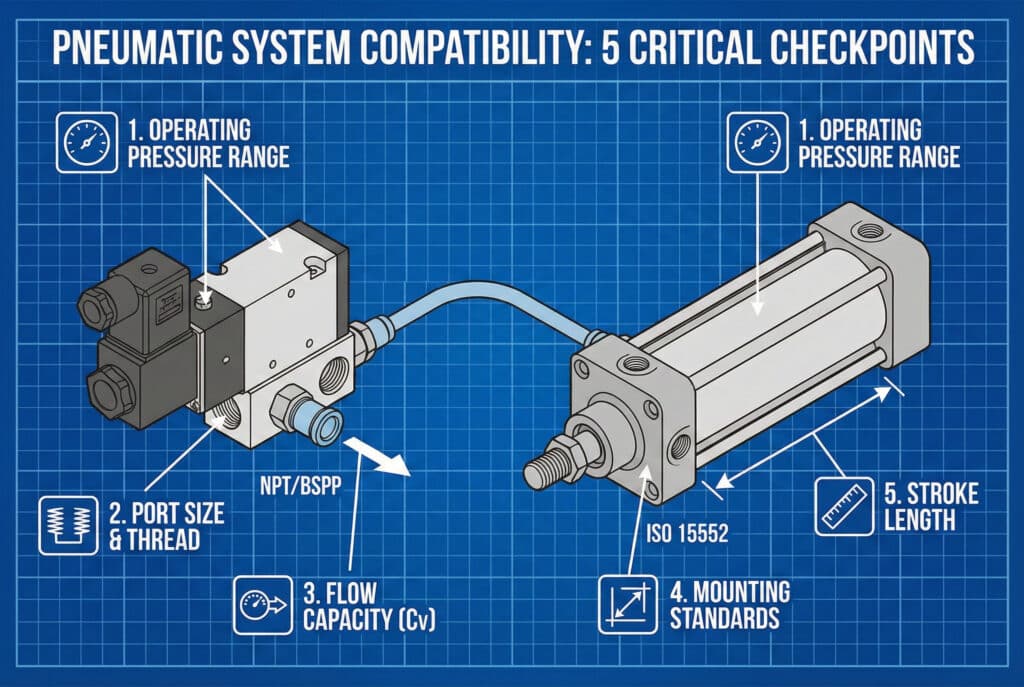
The five critical compatibility factors are: operating pressure range, port size and thread type, flow capacity (Cv value), mounting interface standards, and stroke length requirements. Matching these specifications ensures your mixed-brand system will perform reliably without compromising safety or efficiency.
Detailed Compatibility Checklist
1. Operating Pressure Range
Your valve and cylinder must share overlapping pressure ratings. Most industrial pneumatics operate between 0.5-10 bar (7-145 psi), but verify both minimum and maximum ratings.
| Component | Typical Range | Bepto Standard |
|---|---|---|
| Solenoid Valves | 0.5-10 bar | 0.5-10 bar |
| Rodless Cylinders | 1-10 bar | 1-10 bar |
| Standard Cylinders | 1-10 bar | 1-10 bar |
2. Port Size and Thread Standards
This is where most compatibility issues arise. Common thread types include:
- NPT3 (National Pipe Thread) – American standard, tapered
- BSPP (British Standard Parallel Pipe) – European/Asian, parallel with sealing washer
- BSPT (British Standard Tapered Pipe) – Less common, tapered
- Metric (M5, M7, etc.) – Increasingly common in modern equipment
3. Flow Capacity (Cv Value)
The valve must supply sufficient air volume to actuate the cylinder at your required speed. A valve with inadequate Cv will cause sluggish cylinder movement, while oversized valves waste energy.
Pro tip: For rodless cylinders, calculate required flow using: Cv = (Bore Area × Stroke Length × Cycles per Minute) / 60 📊
4. Mounting Standards
ISO 15552 (formerly ISO 6431) defines mounting dimensions for cylinders. Verify that your replacement cylinder matches existing mounting hole patterns and tie-rod spacing.
How Do You Verify Port Size and Thread Compatibility?
Thread mismatch is the #1 cause of failed mixed-brand installations. 🔧
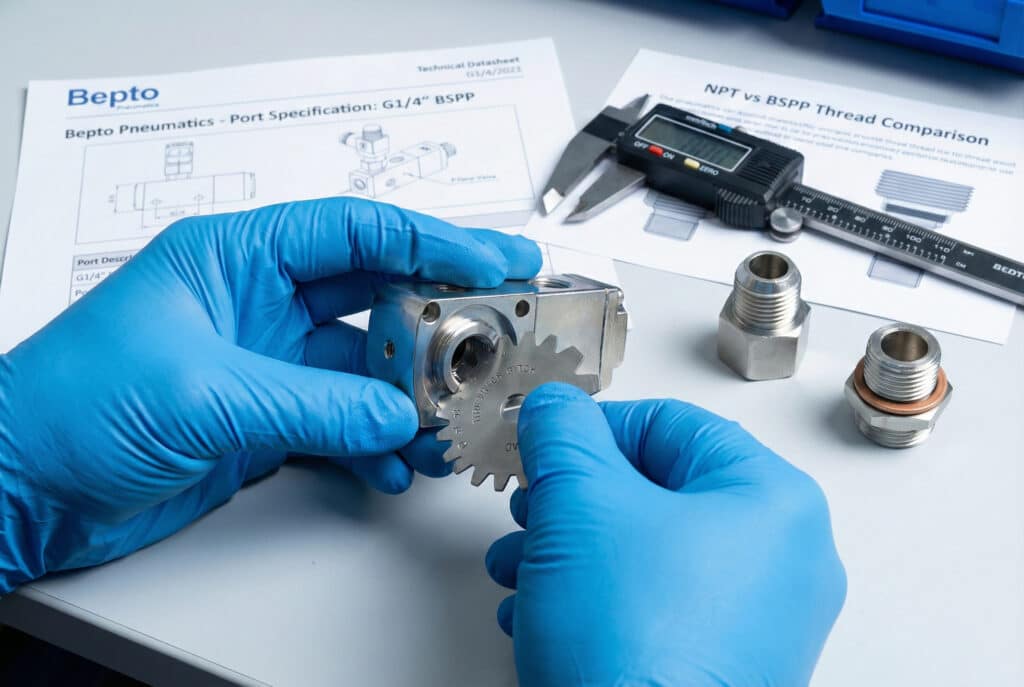
Use a thread pitch gauge4 to physically verify thread type, then cross-reference with manufacturer datasheets to confirm port size—never assume compatibility based on visual inspection alone. At Bepto, we provide detailed technical drawings showing exact thread specifications for every product, eliminating guesswork.
Step-by-Step Verification Process
Physical Measurement
- Thread Pitch Gauge: This inexpensive tool ($10-20) definitively identifies thread type
- Caliper Measurement: Measure outer diameter to distinguish between similar sizes
- Depth Check: Verify thread engagement depth matches your fittings
Documentation Cross-Reference
Always obtain technical datasheets for both components. Look for:
- Port designation (e.g., “2× G1/4” inlet/outlet)
- Thread specification with tolerance
- Recommended torque values
- Seal type (O-ring, washer, tape)
Adapter Solutions
When direct compatibility isn’t possible, quality adapters provide reliable solutions. We stock hundreds of adapter configurations at Bepto, from NPT-to-BSPP converters to metric-to-imperial reducers.
Common Thread Confusion
Many engineers confuse NPT and BSPP threads because they appear similar. Here’s the critical difference:
| Feature | NPT | BSPP |
|---|---|---|
| Taper | Yes (1:16) | No (parallel) |
| Sealing Method | Thread compound/tape | Bonded washer |
| Engagement | Tightens progressively | Stops at shoulder |
| Interchangeable? | NO – will leak | NO – will leak |
I once consulted with a food processing plant in Ontario where technicians had forced NPT fittings into BSPP ports. The resulting leaks caused three production stoppages before they called us. We identified the issue in minutes and provided correct adapters—problem solved permanently. ✨
What Risks Should You Avoid When Mixing Brands?
While mixing brands is generally safe, certain scenarios create genuine problems. ⚠️
Avoid mixing components with mismatched pressure ratings, incompatible seal materials for your media, proprietary communication protocols in smart valves, and non-standard mounting dimensions that require custom brackets. These issues can compromise safety, create maintenance headaches, or require expensive custom solutions.
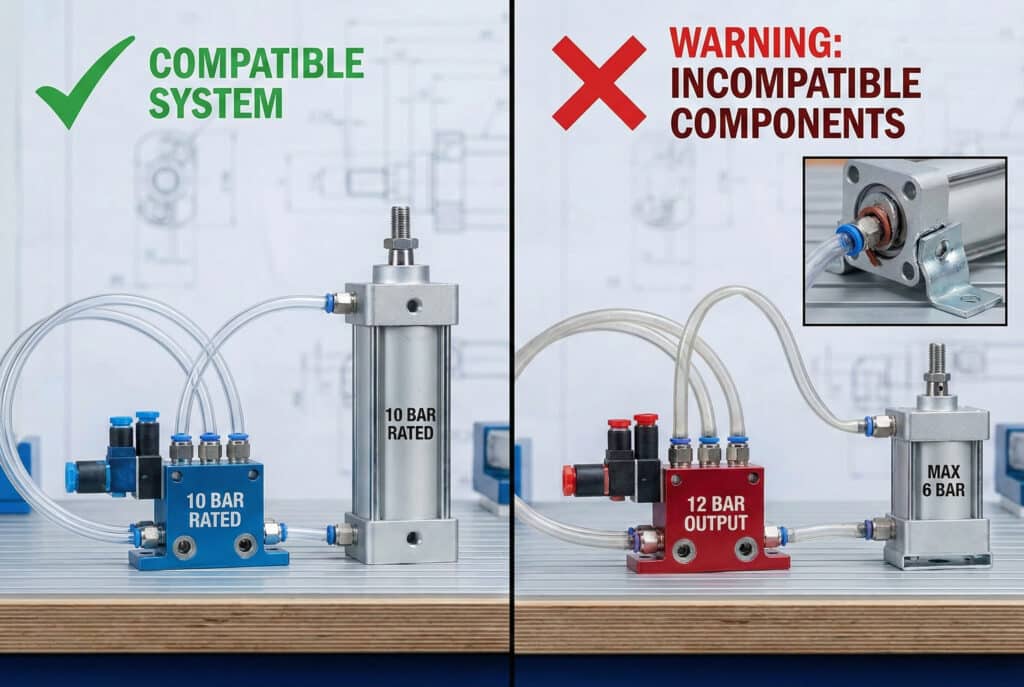
High-Risk Scenarios
Pressure Rating Mismatches
Never install a 6-bar cylinder on a system where the valve can output 10 bar. Pressure regulators fail, and the consequences can be dangerous. Always match or exceed the maximum system pressure.
Seal Material Incompatibility
Standard nitrile (NBR) seals work for compressed air, but specialized applications require specific materials:
- Food/Pharma: FDA-approved materials (Bepto offers PTFE and FKM options)
- High Temperature: Viton (FKM) for applications above 80°C
- Chemical Exposure: EPDM or PTFE depending on media
Smart Valve Integration
Modern “Industry 4.0” valves with IO-Link5 or fieldbus communication may not interface with standard cylinders. While the pneumatic connection works fine, you’ll lose diagnostic capabilities.
Bepto’s Compatibility Guarantee
we’ve eliminated the guesswork. Every product page includes:
- Complete dimensional drawings with tolerances
- Thread specifications for all ports
- Pressure and temperature ranges
- Seal material options
- Cross-reference guides for major OEM brands
We also offer free pre-purchase compatibility consultation. Send us your existing component specifications, and our engineering team will confirm compatibility within 24 hours—usually within 2-3 hours. 🚀
Cost-Benefit Reality Check
Let me share real numbers from a recent project. A packaging machinery manufacturer in Texas needed to replace four rodless cylinders in a system using SMC valves:
| Option | Cost | Lead Time | Result |
|---|---|---|---|
| SMC OEM | $12,800 | 7 weeks | Perfect fit (expected) |
| Bepto Compatible | $7,900 | 12 days | Perfect fit (verified) |
| Savings | $4,900 | 5 weeks faster | Identical performance |
The client invested 30 minutes verifying compatibility using our technical drawings. That’s a $9,800/hour return on time invested. 💡
Conclusion
Mixing pneumatic valves and cylinders from different brands isn’t just possible—it’s a strategic advantage when done correctly. By verifying pressure ratings, port compatibility, flow capacity, and mounting standards, you can break free from expensive vendor lock-in while maintaining system reliability. At Bepto Pneumatics, we’ve built our reputation on providing high-quality, fully compatible rodless cylinders that integrate seamlessly with your existing infrastructure, delivering 30-40% cost savings without compromising performance. 🎯
FAQs About Pneumatic Component Compatibility
Can I use a Bepto rodless cylinder with my existing Festo or SMC valves?
Yes, absolutely—as long as the pressure ratings, port sizes, and flow capacity match your application requirements (typically 1-10 bar with G1/4″ or G1/8″ ports). We provide detailed compatibility specifications for all major brands, and our engineering team offers free pre-purchase verification to ensure seamless integration with your existing valve system.
Will mixing brands void my equipment warranty?
Most equipment warranties cover the specific component purchased, not the entire system—mixing brands typically doesn’t void warranties unless explicitly stated in your service agreement. However, always review your specific warranty terms, and document that replacement components meet or exceed OEM specifications (which Bepto products consistently do).
How do I know if my valve provides enough airflow for a replacement cylinder?
Check the valve’s Cv (flow coefficient) value against your cylinder’s bore size and required cycle speed—a general rule is that Cv should be at least 0.1 for cylinders up to 40mm bore, 0.2 for 40-63mm, and 0.3+ for larger bores. Contact our technical team with your application details, and we’ll calculate the exact flow requirements within hours.
What’s the most common mistake when mixing pneumatic brands?
Assuming NPT and BSPP threads are interchangeable—they’re not, and forcing incompatible threads causes leaks and damaged ports. Always verify thread type with a pitch gauge or manufacturer documentation before installation, and use proper adapters when necessary (we stock hundreds of adapter configurations for exactly this reason).
Do Bepto cylinders meet international quality standards?
Yes, all Bepto pneumatic cylinders are manufactured to ISO 15552, ISO 21287, and VDMA standards, with materials and tolerances matching or exceeding OEM specifications. We provide full technical documentation, material certifications, and offer specialized options including FDA-approved seals for food/pharma applications and extended temperature ranges for demanding environments. 🏆
-
Review the international standard that ensures dimensional interchangeability for pneumatic cylinders across different manufacturers. ↩
-
Verify the standard specifications for compact pneumatic cylinders to ensure mounting compatibility. ↩
-
Understand the technical specifications of tapered (NPT) threads versus parallel (BSPP) threads to prevent connection failures. ↩
-
Learn how to use this essential measurement tool to definitively identify thread types and prevent leaks. ↩
-
Explore the point-to-point communication interface used in modern smart pneumatic valves. ↩