

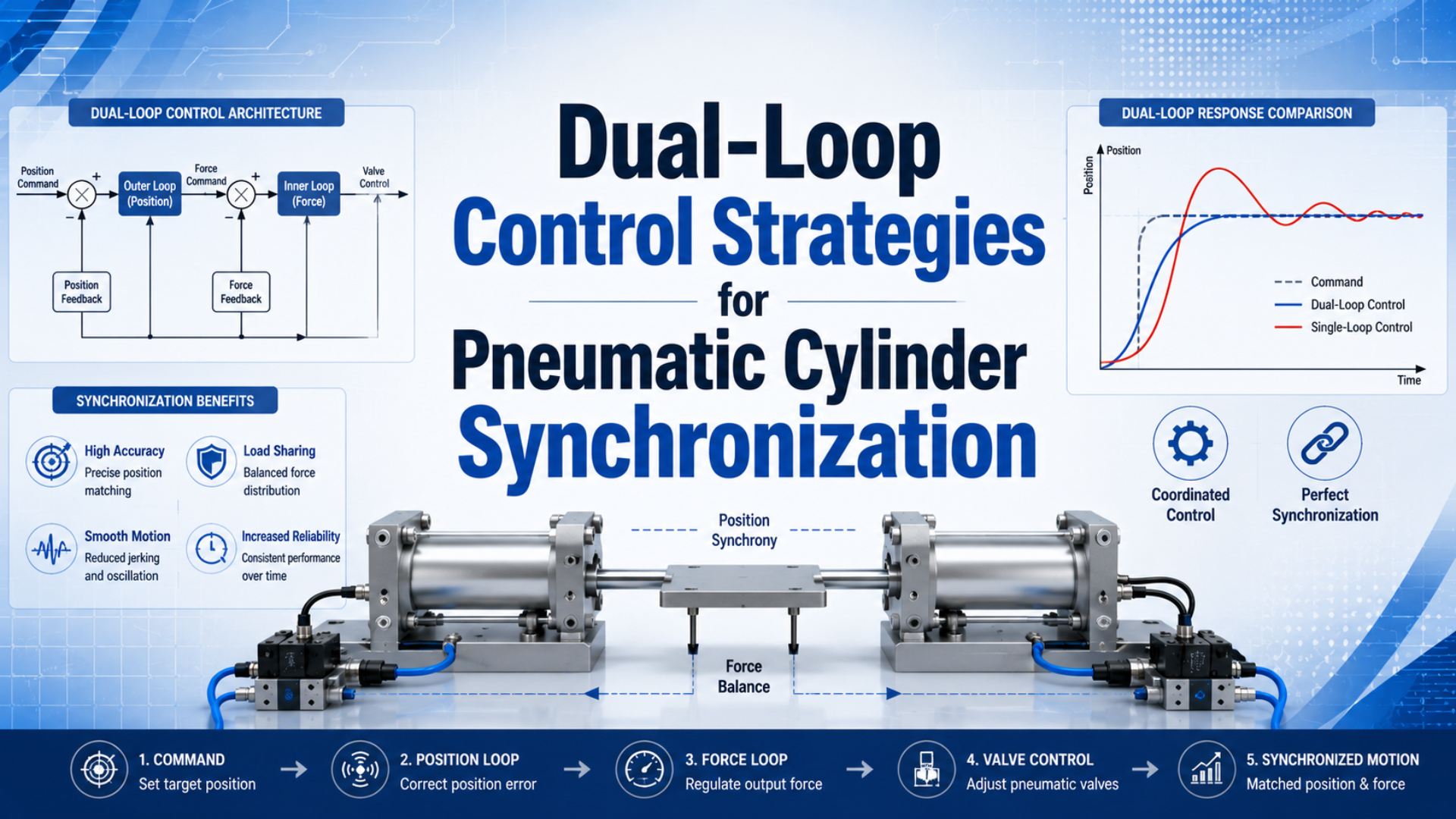
Dual-loop pneumatic cylinder synchronization is the coordination of two or more feedback-controlled axes by solving two different problems: each cylinder must follow the commanded trajectory, and the cylinders must remain aligned with one another. A controller that corrects only the difference between cylinders can keep them together while every axis is late, slow, or stopped short of the target.
The term “dual-loop” needs a defined boundary. It may describe a cascade inside each axis, such as position over velocity, or it may describe individual axis control plus an outer synchronization loop. The suitable structure depends on the valve, feedback signal, load path, controller timing, and the fault response required by the machine.
Key Takeaways
- A 2014 study controlled 2 pneumatic cylinders using both trajectory-tracking and synchronization errors.
- Equal cylinder positions do not prove that the commanded trajectory was followed.
- Sampling skew, valve saturation, structural flexibility, and poor guidance can defeat software correction.
- Position feedback used for process control is not automatically a safety function.
What Does Dual-Loop Cylinder Synchronization Actually Control?
A 2014 experimental study of a 2-cylinder pneumatic servo system combined trajectory-tracking errors with the synchronization error between the cylinders (Meng et al., 2014). That distinction defines the useful control objective: follow the machine trajectory while also limiting relative displacement between axes.
For a shared load, think of the controller as two coordinated layers:
- Axis control: each cylinder, valve, and sensor forms a controlled motion axis. Its loop must track the velocity, position, pressure, or force command assigned to it.
- Synchronization control: a supervisory calculation compares the axes and adds a bounded correction to each axis command.
This is not the same as connecting several cylinders to one directional valve. A common valve gives the cylinders the same nominal supply command, but it cannot correct unequal seal friction, chamber volume, hose restriction, load, or geometry. Each actively synchronized axis needs a controllable final element and feedback from the datum that matters.
The valve must have enough authority to change the axis motion in both directions around the operating point. Start with the system boundary described in the proportional-valve position-control guide, then add multi-axis error handling. Use the pneumatic flow-control valve sizing guide to check the air path before tuning. Synchronization cannot compensate for a valve that is undersized, saturated, badly biased, or too remote from the actuator.
Tracking Error and Synchronization Error Are Different
Meng and colleagues formed their coupled feedback from 2 trajectory-tracking errors and 1 inter-cylinder synchronization error (Meng et al., 2014). Keeping those channels separate prevents a deceptively good synchronization trace from hiding a common error against the commanded machine motion.
Let be the commanded position and the measured position of axis . Trajectory-tracking error is the difference between the commanded position and one measured axis position:
Here, has position units, such as millimetres. It answers whether each axis is following the command.
For two axes, synchronization error is the relative position difference between the measured axes:
The sign shows which cylinder leads. The acceptance requirement may use the signed value for control and the absolute value for pass/fail reporting.
For axes, a virtual position can be calculated as:
Each axis then receives a synchronization error . This distributes correction rather than forcing every slave to copy one physical master. Yet the virtual average contains no independent command. If every cylinder is 10 mm behind, their average is also 10 mm behind and every can still be zero.
That leads to a useful control law for a velocity-commanded inner loop:
In this definition, is the corrected velocity reference, is trajectory velocity, and and convert position errors into velocity corrections. Their units and signs must match the implementation. Apply correction and acceleration limits so a large error cannot demand motion beyond the valve, cylinder, guide, or load capability.
How Should the Inner Axis Loops Be Structured?
A 2022 ASME paper used 2 cascaded loops, with valve-position control inside pneumatic-actuator position control (Mandali and Dong, 2022). It demonstrates why “dual-loop” is not synonymous with one fixed position-over-velocity design. The inner controlled variable must match the available hardware and dynamics.
Three practical architectures are common enough to compare:
| Axis architecture | Inner feedback | Outer feedback | Suitable starting point |
|---|---|---|---|
| Position over velocity | Estimated or measured velocity | Cylinder position | Motion profiles where velocity shaping is important |
| Position over pressure or force | Chamber pressure, differential pressure, or force | Cylinder position | Load-sensitive processes with suitable pressure instrumentation |
| Actuator position over valve position | Spool position | Cylinder position | Servo valves with internal or external spool feedback |
Position-over-velocity control is intuitive, but numerical differentiation amplifies sensor quantization and electrical noise. A filtered estimate can be written as:
Here, is estimated velocity, is the sample interval in seconds, and the position units determine the velocity units. The filter reduces noise but adds phase lag. Select it from measured noise and closed-loop stability, not from a universal time constant.
The inner velocity error is . A bounded PI implementation may take this form:
The command drives the proportional valve, is an optional feedforward term, and is the integrator state. The saturation function represents real command limits. Add anti-windup so the integrator does not continue accumulating while the valve command is pinned at a limit.
Do not infer axis performance from signal resolution alone. A 12-bit output cannot remove spool overlap, hysteresis, insufficient flow, pressure collapse, stiction, or structural play. Use the flow-versus-pressure valve comparison to specify which pneumatic variable the selected device actually regulates.
Which Multi-Axis Coordination Strategy Fits the Machine?
Festo states that CPX-CMAX can operate up to 8 axes in parallel and independently and provides 128 configurable position sets (Festo CPX-CMAX, accessed 2026). “Eight axes” describes controller capacity, not automatic synchronization. Coordinated motion still needs a defined reference, coupling law, timing method, and machine-level fault response.
| Strategy | What each axis follows | Main advantage | Main limitation |
|---|---|---|---|
| Master-slave | One measured master axis | Simple signal flow | Master tracking error propagates to every slave |
| Virtual master | Average or generated group state | Shares relative correction across axes | A measured average can hide common-mode tracking error |
| Cross-coupled | Trajectory error plus relative axis errors | Directly addresses tracking and alignment | Requires careful signs, limits, timing, and stability analysis |
Master-slave control fits a machine with one meaningful mechanical leader, provided the master also tracks the independent trajectory reference. It is a weaker choice when a master sensor failure would leave the group without a valid command basis or when load sharing must remain symmetric.
A virtual master should normally be a generated trajectory state, not merely the average of measured cylinders. If a measured average is used for load sharing, retain separately. Otherwise, the controller can produce excellent agreement between axes while the group misses the process position.
Cross-coupling is useful when relative displacement is itself a process risk. A wide platen, frame, or panel can rack before either cylinder develops a large individual tracking error. Even then, control is the second line of defence. The frame, external guides, cylinder mounting, and load centre must prevent the actuators from fighting an overconstrained mechanism.
Sampling and Filtering Need an Error Budget
The 2014 dual-cylinder study treated 2 tracking errors and 1 synchronization error as distinct feedback quantities (Meng et al., 2014). Those signals must refer to nearly the same instant. Sampling skew is their measurement-time difference, and it creates an apparent position mismatch even when the mechanical axes are aligned.
For motion at velocity , the apparent mismatch caused by sampling skew is approximately:
If the design maximum is and two measurements can be apart, the timing contribution is . This is a design example, not a universal requirement. A faster axis or tighter tolerance needs a smaller skew budget.
Build the total measurement budget from sensor accuracy, resolution, mounting error, structural deflection, input conversion timing, filtering, and time-base alignment. Continuous position feedback is different from endpoint sensing; the position-sensing technology guide explains that boundary.
Run related control tasks from a common clock when the platform permits it. Log the actual task interval and overruns. A nominal high update rate does not guarantee high closed-loop bandwidth, because valve dynamics, pneumatic volume, transport delay, filters, and mechanical resonance still limit stable response.
Filter only as much as the signal needs. An aggressive low-pass filter can make a velocity trace look smooth while delaying the correction that keeps the frame square. Judge each filter from synchronized raw and filtered traces, then include its delay in the stability review.
How Should You Commission the System?
The CPX-CMAX offers 128 configurable position sets, yet Festo still describes commissioning and configuration as explicit tasks (Festo CPX-CMAX, accessed 2026). A synchronized machine needs an ordered test sequence because tuning every loop at once makes valve capacity, mechanics, feedback polarity, and controller interaction difficult to separate.
1. Prove the mechanics at low energy
Disconnect or limit synchronization correction. Check guidance, mounting alignment, load-centre position, carriage rotation, hose routing, and freedom from binding. Measure the production datum, not only the piston or carriage sensor. A flexible platen can distort while both feedback positions agree.
2. Verify each signal and command direction
Move one axis at a time with conservative pressure and output limits. Confirm position scaling, sign, datum, travel limits, valve neutral, extend and retract commands, sensor plausibility, and stop response. A sign error in cross-coupling turns correction into divergence.
3. Tune each inner axis independently
Use the intended valve, tubing, payload, pressure, and motion direction. Start with feedforward and integral action disabled or tightly limited. Increase only the necessary feedback action while watching position, estimated velocity, both chamber pressures when available, and valve command. Tune extend and retract separately if their dynamics differ.
In our experience, the most productive first diagnostic is the valve-command trace. A command that remains at its limit points to missing flow, pressure, or force authority before it points to a gain problem. A command that reverses repeatedly near the target instead directs attention toward delay, friction, neutral behaviour, filtering, and excessive gain.
4. Test trajectory tracking before coupling
Command the same conservative profile to every independent axis. Record individual following errors and saturation. If one axis cannot follow without remaining at its output limit, adding synchronization gain will not create missing flow or force. Correct the hardware or reduce the profile demand.
5. Add bounded synchronization correction
Begin with a small coupling gain and explicit correction limits. Test a known load offset and repeat the motion in both directions. Increase coupling only while the recorded errors improve without oscillation, output chattering, excessive pressure difference, or mechanical fighting.
6. Exercise the faults
Test sensor disconnection, frozen feedback, out-of-range values, missed task deadlines, valve saturation, low supply pressure, communication loss, and power removal. Confirm the transition to the specified state with the real payload. Don’t assume that a controller fault bit removes pneumatic energy or restrains a vertical load.
Fault Handling Is Separate from Normal Control
ISO 4414:2010 is a 38-page, third-edition standard covering significant hazards in pneumatic systems and was confirmed current in 2021 (ISO). Normal synchronization feedback can improve process control, but it is not automatically safety-rated. The required safe state must come from the machine risk assessment and validated architecture.
Use separate thresholds and actions for process deviation and safety-related faults:
| Condition | Control-system response | Design question |
|---|---|---|
| Small synchronization error | Apply bounded correction | Is correction authority available without saturation? |
| Persistent following error | Reduce profile or stop the process | Is the axis flow-limited, overloaded, bound, or leaking? |
| Implausible sensor signal | Inhibit normal synchronization and enter the specified fault state | Can the remaining feedback prove a safe condition? |
| Excessive axis separation | Execute the risk-assessed stop strategy | Could abrupt stopping increase racking or load-drop risk? |
| Loss of electrical power or air | Move to or maintain the defined state | Is a brake, restraint, dump function, or stored-energy control required? |
ISO 13849-1:2023 applies to safety-related control-system parts across electrical, hydraulic, pneumatic, and mechanical technologies, but it does not assign the safety function or required performance level for a specific machine (ISO). If synchronization monitoring initiates a safety function, design and validate that function separately from the normal motion algorithm.
Differential pressure can support diagnostics, but it does not replace continuous position feedback. Two cylinders can have similar pressure while their positions differ because of geometry, friction, trapped volume, or external loading. Likewise, a redundant sensor only improves safety integrity when its architecture, diagnostic coverage, common-cause exposure, and validation support the required function.
What Must the Acceptance Test Record?
ISO 4414:2010 covers design, construction, modification, installation, adjustment, uninterrupted operation, maintenance, and reliable intended use (ISO). A synchronization claim therefore needs more than one final-position reading. Record the hardware, software, operating conditions, time base, disturbances, and measured errors needed to reproduce the result after maintenance or a recipe change.
Freeze these metrics before testing:
| Metric | Definition | Why it matters |
|---|---|---|
| Maximum dynamic synchronization error | Largest relative position error during the commanded move | Captures racking risk while the load is moving |
| End-position synchronization error | Relative error after the specified settling window | Confirms final alignment |
| Trajectory following error | Commanded position minus each measured axis position | Detects common-mode lag hidden by relative error |
| Settling time | Time until every required error remains inside its band | Sets the earliest safe next process step |
| Valve saturation | Peak value and time spent at command limits | Reveals missing control authority |
| Dynamic pressure margin | Valve-inlet and chamber pressures during motion | Separates tuning symptoms from pneumatic capacity |
| Fault response time | Time from detected fault to the defined machine state | Supports the risk-assessed stop requirement |
Also record cylinder and valve models, bore, stroke, sensor type, guide arrangement, payload, orientation, supply pressure, tube dimensions, task periods, sampling skew, filters, gains, feedforward, output limits, software revision, temperature, warm-up state, and test-cycle count. Without those conditions, a millimetre result cannot be transferred responsibly to another machine.
Run acceptance in both directions and at representative payload extremes. Add the disturbances the system is expected to tolerate, such as a shifted load centre or controlled supply-pressure variation. Compare controller feedback with an independent measurement at the process datum when the tolerance is tight.
The best diagnostic plot uses one time base for reference position, every measured position, tracking errors, synchronization errors, valve commands, controller state, and relevant pressures. That trace shows whether the limit came from coupling, an individual axis, the air path, the mechanics, or a fault transition.
For a project review, send the same trace with the component models, motion profile, load, and required fault state through the technical contact page. Publisher and engineering context is available on About Bepto. That record makes it possible to discuss valve authority, sensor timing, and mechanical guidance without reducing the problem to one unsupported accuracy number.
Pneumatic Cylinder Synchronization FAQs: What Should Engineers Check?
ISO 13849-1:2023 is the fourth edition of the machinery-control safety standard and expressly includes pneumatic technology (ISO). These 5 answers separate normal synchronization performance from machine-specific safety requirements, while keeping accuracy, axis count, valve choice, timing, and fault behaviour tied to the actual hardware and acceptance test.
Can two pneumatic cylinders synchronize with one directional valve?
They can move together approximately, but one valve provides no independent correction for friction, load, hose, chamber, or geometry differences. Tight synchronization needs feedback from each relevant axis and a controllable way to alter its motion. A mechanical linkage or flow divider can change the problem, but it still requires application-specific verification.
What synchronization accuracy can a dual-loop pneumatic system achieve?
There is no universal accuracy value. The result depends on the sensor datum, timing, valve authority, air volume, friction, guide stiffness, payload, motion profile, temperature, filtering, and acceptance definition. State dynamic and settled limits separately, then verify the loaded machine with synchronized traces and an independent measurement where the process tolerance requires it.
Do all dual-loop systems need an inner velocity loop?
No. A velocity inner loop is one useful option, especially when the controller must shape motion and reject speed disturbances. Other systems close an inner loop around spool position, pressure, or force. Choose the controlled variable from the valve and sensor architecture, then prove that the inner loop is faster than the supervisory function it supports.
Is a virtual master better than master-slave control?
Neither is always better. Master-slave control is simple but can propagate the physical master’s tracking error. A measured average distributes relative correction, yet it can conceal common-mode lag. A generated trajectory reference plus cross-coupled error is often clearer when both command tracking and alignment must be controlled and reported independently.
What should happen if one position sensor fails?
The controller should detect implausible, frozen, missing, or inconsistent feedback and enter the state defined by the risk assessment. Continuing from remaining sensors is not automatically safe because the failed axis position is unknown. If the response performs a safety function, implement and validate it with the required safety-related architecture rather than ordinary control logic alone.
Sources and technical references
- Meng et al., dual-cylinder pneumatic servo synchronization study, Journal of Zhejiang University SCIENCE C, 2014, DOI 10.1631/jzus.C1300360.
- Mandali and Dong, “Modeling and Cascade Control of a Pneumatic Positioning System”, Journal of Dynamic Systems, Measurement, and Control, 2022, DOI 10.1115/1.4053966.
- Festo CPX-CMAX axis controller documentation, accessed 2026.
- ISO 4414:2010, Pneumatic fluid power, general rules and safety requirements.
- ISO 13849-1:2023, Safety-related parts of control systems.