


Introduction
You’ve found a cylinder manufacturer offering prices 40% below your current supplier. Their website looks professional, their sales rep is responsive, and the samples seem acceptable. You place a large order, only to discover inconsistent quality, missed delivery dates, and zero technical support when problems arise. Your production line suffers, customers complain, and the “savings” evaporate into crisis management costs. Choosing the wrong cylinder manufacturer just became an expensive lesson in due diligence. 😰
Evaluating cylinder manufacturers requires assessing production capabilities (machining precision, assembly processes, quality control systems), technical competence (engineering support, testing facilities, R&D investment), quality certifications (ISO 9001, industry-specific standards), supply chain stability (material sourcing, inventory management, delivery performance), and customer support infrastructure (technical assistance, warranty handling, communication responsiveness)—comprehensive factory evaluation prevents 80% of supplier-related failures.
I remember when Patricia, a procurement director at an automotive equipment company in Michigan, switched to a low-cost cylinder supplier without proper vetting. Within six months, she faced 15% defect rates, delivery delays averaging three weeks, and complete inability to get technical support. After visiting our Bepto Pneumatics facility and seeing our processes firsthand, she understood what she’d been missing. Factory capabilities aren’t just about price—they’re about partnership reliability. 🏭
Table of Contents
- What Manufacturing Capabilities Should a Quality Cylinder Factory Possess?
- How Do You Assess Quality Control Systems and Certifications?
- What Technical and Engineering Support Should You Expect?
- How Can You Verify Supply Chain Stability and Delivery Reliability?
What Manufacturing Capabilities Should a Quality Cylinder Factory Possess?
Manufacturing capability directly determines product quality, consistency, and your long-term satisfaction. 🔧
Quality cylinder manufacturers must have precision CNC machining centers1 (±0.01mm tolerance capability for critical dimensions), automated honing equipment for cylinder bores (achieving Ra 0.4μm surface finish), professional assembly lines with torque-controlled tools and clean environments, comprehensive testing stations (pressure testing, leakage testing, cycle testing), and adequate production capacity (ability to scale from prototypes to volume production)—inadequate manufacturing capability causes 60% of quality problems in pneumatic cylinders.
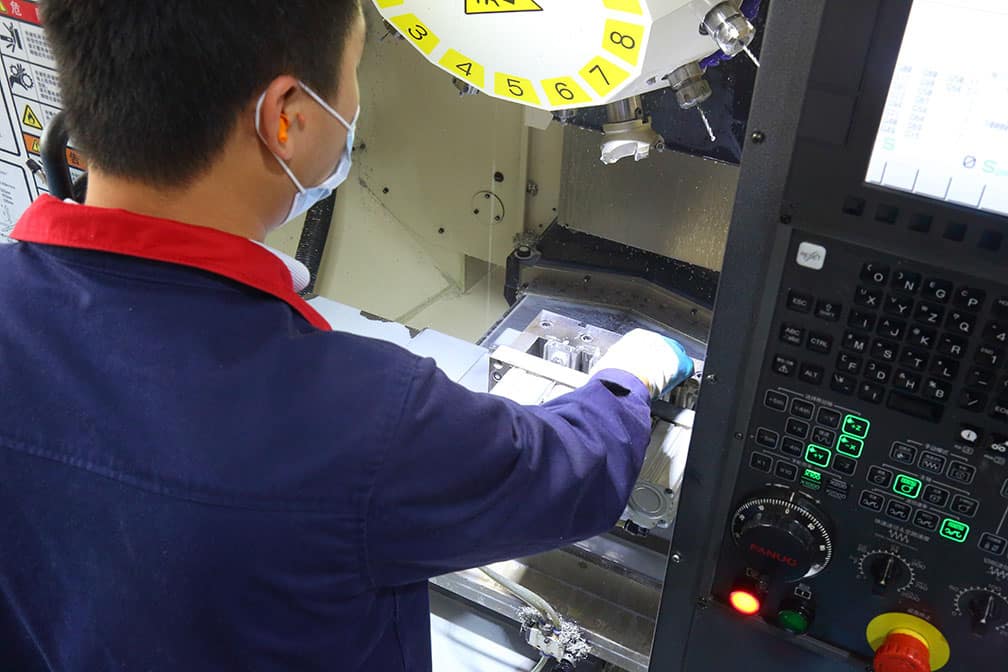
Critical Manufacturing Equipment
What to look for during factory visits:
| Equipment Type | Purpose | Quality Indicator | Red Flag |
|---|---|---|---|
| CNC Machining Centers | Precision component manufacturing | 4-axis or 5-axis machines, <10 years old | Manual machines, outdated equipment |
| Honing Machines | Cylinder bore finishing | Automated honing, Ra 0.4μm capability | Manual honing, inconsistent finish |
| Assembly Lines | Cylinder assembly | Organized workstations, torque tools | Cluttered benches, hand tools only |
| Testing Equipment | Quality verification | Automated test stations, data logging | Manual testing, no documentation |
| Inspection Tools | Dimensional verification | CMM, precision measuring instruments | Calipers only, limited inspection |
Manufacturing Process Maturity
Evaluate process sophistication:
Level 1 (Basic): Manual operations, minimal automation, inconsistent processes
- Risk: High variability, quality issues, limited capacity
Level 2 (Developing): Some automation, documented procedures, basic quality control
- Risk: Moderate variability, scaling challenges
Level 3 (Mature): Significant automation, standardized processes, statistical process control
- Capability: Consistent quality, scalable production, reliable delivery
Level 4 (Advanced): Full automation where appropriate, continuous improvement, Industry 4.0 integration
- Capability: Excellent quality, flexible capacity, innovation leadership
At Bepto Pneumatics, we operate at Level 3-4, with automated honing, CNC machining centers, and statistical process control ensuring every rodless cylinder meets exacting standards. Our investment in manufacturing technology directly translates to your product reliability. 💪
Production Capacity Assessment
Key questions to ask:
✅ What’s your monthly production capacity?
- Adequate capacity prevents delays during demand spikes
- Look for 20-30% excess capacity for flexibility
✅ What’s your current capacity utilization?
- 70-85% is healthy (room to grow, not desperate for orders)
- 95% means potential delivery delays
- <50% may indicate business problems
✅ Can you scale production for large orders?
- Ability to add shifts or expand lines
- Supplier network for components
- Workforce flexibility
✅ What’s your lead time for standard vs. custom products?
- Standard: 2-3 weeks is reasonable
- Custom: 4-6 weeks typical
- Rush capability: Premium pricing acceptable
I worked with Daniel, an equipment manufacturer in Ohio, who needed to scale from 50 cylinders monthly to 200 during a product launch. His previous supplier couldn’t handle the volume increase. At Bepto Pneumatics, we scaled seamlessly by adding a second shift, meeting his timeline without quality compromise. Capacity matters when your business grows. 📈
How Do You Assess Quality Control Systems and Certifications?
Quality systems reveal whether consistent excellence is systematic or accidental. ✅
Robust quality control includes ISO 9001:2015 certification (minimum standard for B2B suppliers), documented inspection procedures at incoming, in-process, and final stages, statistical process control (SPC)2 monitoring critical parameters, traceability systems3 linking products to production batches and materials, calibrated measurement equipment with regular certification, and corrective action processes for nonconformances—manufacturers without systematic quality control have 5-10× higher defect rates than certified facilities.
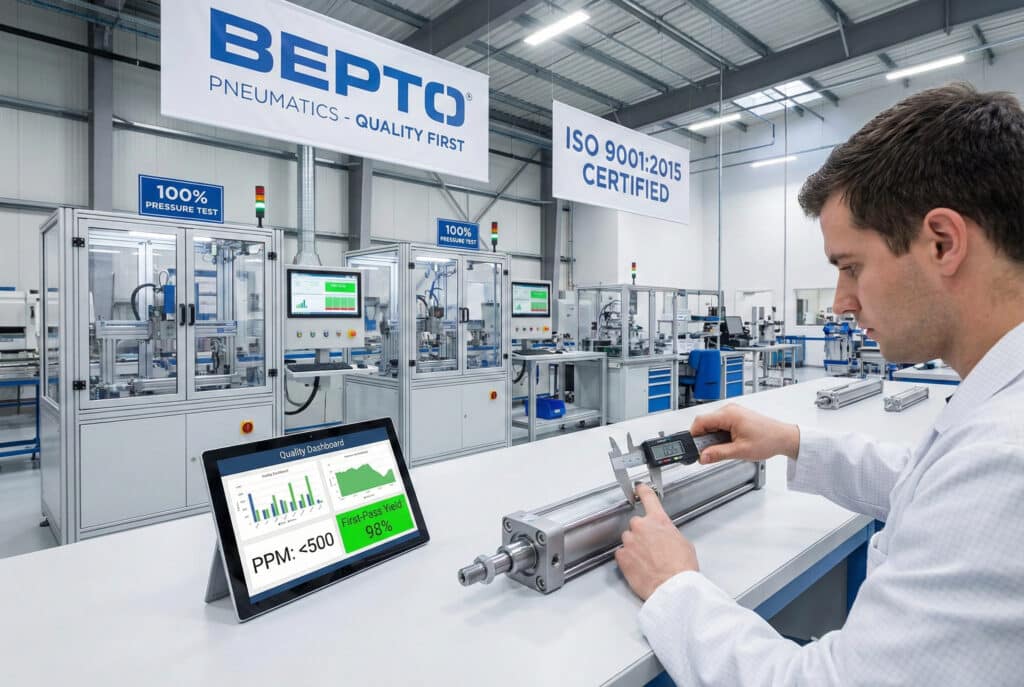
Essential Quality Certifications
ISO 9001:2015 (Quality Management System):
- What it means: Documented, audited quality processes
- Why it matters: Ensures consistency and continuous improvement
- Verification: Request certificate, check expiration, verify scope
Industry-Specific Certifications:
| Certification | Relevance | Indicates |
|---|---|---|
| ISO 14001 | Environmental management | Responsible manufacturing practices |
| CE Marking | European market compliance | Product safety standards met |
| ATEX | Explosive atmosphere equipment | Specialized capability for hazardous environments |
| FDA Registration | Food/pharma applications | Clean manufacturing, material compliance |
Red flag: Manufacturers who can’t provide current, valid certificates or whose certificates don’t cover pneumatic cylinder production.
Quality Control Process Evaluation
What to observe during factory visits:
Incoming inspection:
- Are raw materials and components inspected upon receipt?
- Are inspection records maintained?
- Are nonconforming materials quarantined?
In-process inspection:
- Are critical dimensions checked during machining?
- Are assembly steps verified?
- Is SPC used to monitor process stability?
Final inspection:
- Is every cylinder pressure tested?
- Is leakage testing performed?
- Are functional tests conducted?
- Is inspection data recorded and traceable?
Documentation:
- Can they provide inspection reports?
- Is traceability maintained (serial numbers to materials)?
- Are nonconformance records available?
At Bepto Pneumatics, every rodless cylinder undergoes 100% pressure testing at 1.5× working pressure, leakage testing, and functional cycling before shipment. We maintain complete traceability from raw materials through final inspection. When you receive a Bepto cylinder, you receive documented quality assurance. 📋
Defect Rate and Quality Metrics
Request actual performance data:
✅ Defect rate (PPM – parts per million):
- Excellent: <500 PPM (0.05%)
- Good: 500-2,000 PPM (0.05-0.2%)
- Acceptable: 2,000-5,000 PPM (0.2-0.5%)
- Poor: >5,000 PPM (>0.5%)
✅ First-pass yield:
- Percentage of products passing inspection without rework
- Target: >95%
✅ Customer return rate:
- Percentage of products returned by customers
- Target: <1%
✅ On-time delivery rate:
- Percentage of orders delivered on promised date
- Target: >95%
Be skeptical of manufacturers who:
- Can’t provide quality metrics
- Claim zero defects (unrealistic)
- Refuse to share performance data
- Have no formal quality tracking
I remember visiting a potential supplier with Kevin, a machine builder from Pennsylvania. They claimed “excellent quality” but couldn’t provide any metrics. We visited Bepto Pneumatics next—I showed him our real-time quality dashboards, monthly performance reports, and customer satisfaction data. Transparency builds trust. 📊
What Technical and Engineering Support Should You Expect?
Technical capability separates manufacturers from true partners who help you succeed. 🎓
Comprehensive technical support includes application engineering assistance (cylinder sizing, mounting selection, performance optimization), CAD design support4 (3D models, custom modifications, integration drawings), testing capabilities (custom testing protocols, performance validation, failure analysis), product development resources (custom designs, prototype development, material selection), and responsive technical communication (engineers accessible, not just sales reps)—manufacturers without strong technical teams can’t solve complex problems or support innovation.
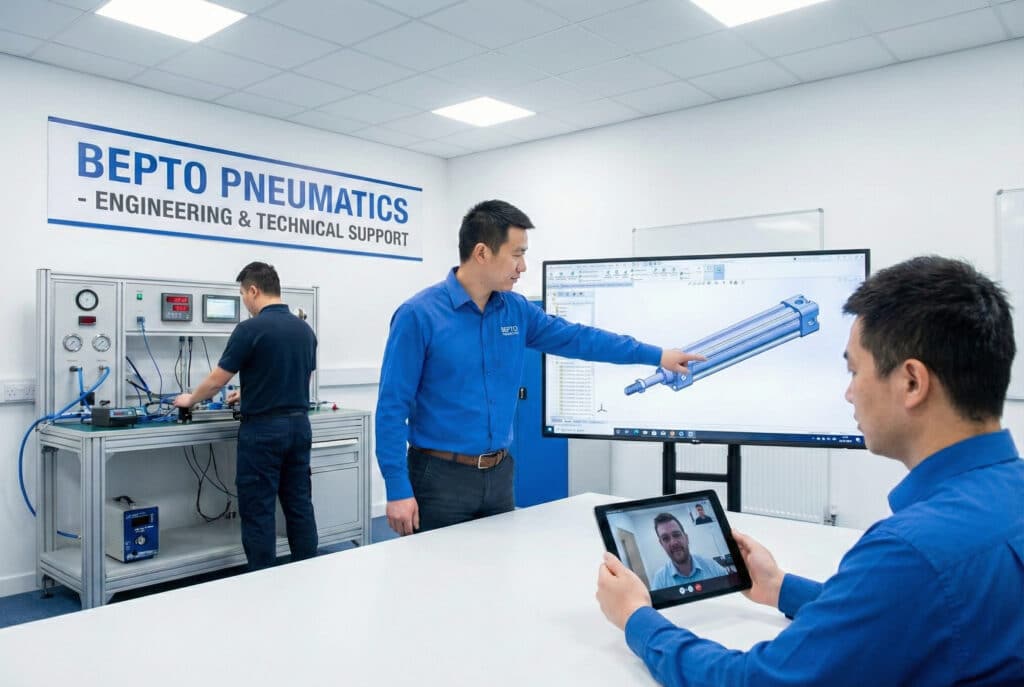
Engineering Team Assessment
Key questions:
✅ How many engineers do you employ?
- Ratio of engineers to production staff indicates technical investment
- Look for dedicated engineering department, not just sales engineers
✅ What engineering disciplines are represented?
- Mechanical design engineers
- Application engineers
- Quality engineers
- Test engineers
✅ Can I speak with an engineer about my application?
- Access to technical expertise is crucial
- Sales-only communication is a red flag
✅ Do you have R&D capabilities?
- Ongoing product development
- Material research
- Process improvement initiatives
Technical Documentation Quality
Evaluate documentation standards:
Product catalogs:
- Comprehensive technical specifications
- Clear dimensional drawings
- Performance curves and data
- Application guidelines
CAD support:
- 3D models available (STEP, IGES formats)
- 2D drawings (DXF, PDF)
- Custom model generation capability
Technical manuals:
- Installation instructions
- Maintenance procedures
- Troubleshooting guides
- Spare parts information
Poor documentation indicates:
- Limited engineering resources
- Lack of technical depth
- Potential support challenges
At Bepto Pneumatics, we provide complete 3D CAD models for all standard products and can generate custom models for modified designs within 48 hours. Our engineering team has over 50 years combined experience in pneumatic systems. When you have a technical challenge, you talk to engineers who can solve it. 🔧
Testing and Validation Capabilities
What testing should manufacturers offer?
Standard testing (should be included):
- Pressure testing (1.5× working pressure minimum)
- Leakage testing
- Functional cycling
- Dimensional verification
Advanced testing (available on request):
- Extended cycle testing (life testing)
- Environmental testing (temperature, humidity)
- Contamination resistance testing
- Custom test protocols for specific applications
Failure analysis:
- Ability to investigate field failures
- Root cause analysis capability
- Corrective action implementation
I worked with Sarah, an aerospace equipment manufacturer in Washington, who needed cylinders tested to 50,000 cycles before acceptance. Our test lab conducted the validation, documented results, and identified a minor design optimization that improved performance. That’s the value of comprehensive testing capability. 🧪
How Can You Verify Supply Chain Stability and Delivery Reliability?
Even excellent manufacturing means nothing if products don’t arrive when needed. 📦
Supply chain evaluation includes material sourcing strategy (multiple suppliers for critical materials, quality material suppliers, inventory buffers), production planning systems (MRP/ERP software, capacity planning, order tracking), logistics capabilities (reliable freight partners, international shipping experience, packaging quality), inventory management (safety stock for common items, finished goods availability, component inventory), and delivery performance history (on-time delivery rate >95%, communication during delays, expediting capability)—supply chain failures cause 40% of customer dissatisfaction despite good product quality.
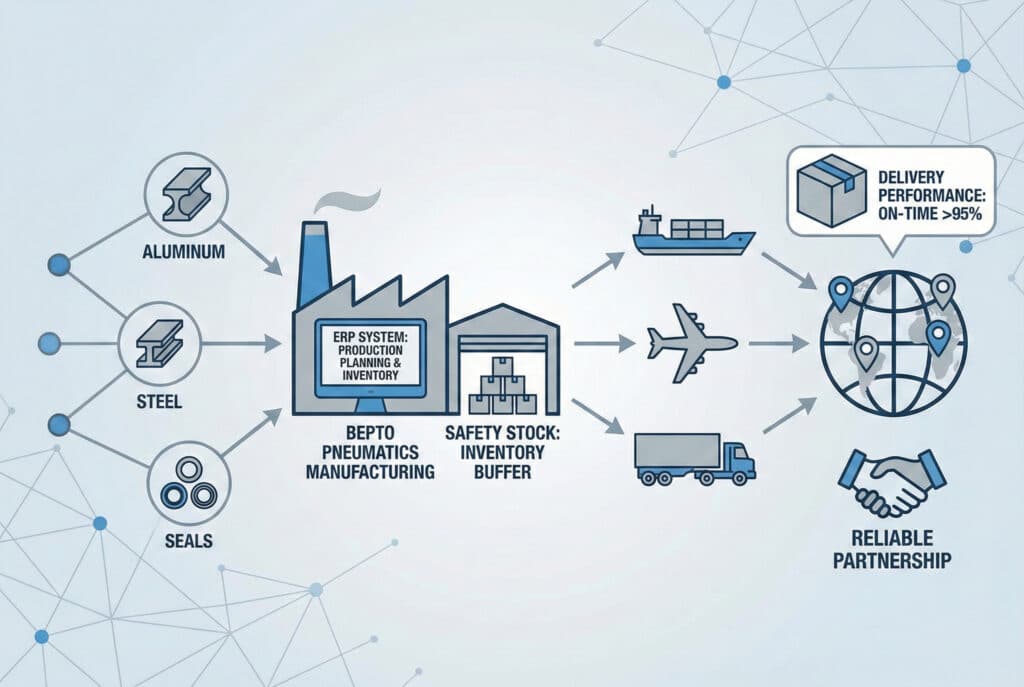
Material Sourcing Assessment
Critical questions:
✅ Who supplies your key materials?
- Aluminum extrusions, steel rods, seals, etc.
- Quality suppliers vs. lowest-cost suppliers
✅ Do you have backup suppliers?
- Single-source dependency is risky
- Multiple qualified suppliers ensure continuity
✅ What material inventory do you maintain?
- Buffer stock prevents material shortages
- Just-in-time is efficient but risky
✅ How do you qualify material suppliers?
- Formal approval process
- Regular audits
- Quality agreements
Red flags:
- Unwillingness to disclose suppliers
- No backup suppliers
- Zero inventory (pure just-in-time)
- Frequent material-related delays
Delivery Performance Verification
Request concrete data:
| Metric | Target | Acceptable | Poor |
|---|---|---|---|
| On-time delivery | >95% | 90-95% | <90% |
| Lead time consistency | ±2 days | ±5 days | >±5 days |
| Order accuracy | >98% | 95-98% | <95% |
| Damage rate | <0.5% | 0.5-1% | >1% |
Ask for references:
- Contact current customers
- Ask about delivery reliability
- Inquire about communication during issues
Evaluate communication:
- Do they proactively communicate delays?
- Is order status easily accessible?
- Are they responsive to inquiries?
I remember when Michael, a packaging equipment builder in Illinois, was frustrated with his cylinder supplier’s erratic deliveries—sometimes early, often late, never predictable. Since switching to Bepto Pneumatics, he’s experienced 97% on-time delivery over 18 months. Reliability enables his production planning. That’s the partnership difference. 🤝
Logistics and International Shipping Capability
For international suppliers, verify:
Export experience:
- Years exporting to your region
- Understanding of customs requirements
- Proper documentation capability
Freight partnerships:
- Relationships with reliable forwarders
- Multiple shipping options (air, ocean, express)
- Competitive freight rates
Packaging quality:
- Proper protection for international transit
- Labeling compliance
- Damage rates during shipping
Incoterms flexibility:
At Bepto Pneumatics, we’ve shipped to over 40 countries with 99.2% damage-free delivery rate. We work with top-tier freight forwarders, provide complete export documentation, and offer flexible Incoterms to match your preferences. International shipping shouldn’t be complicated. 🌍
Financial Stability Indicators
Assess business health:
✅ Years in business: 10+ years indicates stability
✅ Facility ownership: Owned facility vs. rented suggests investment
✅ Equipment age: Modern equipment indicates ongoing investment
✅ Employee tenure: Low turnover suggests good management
✅ Growth trajectory: Steady growth indicates market success
Warning signs:
- Frequent ownership changes
- Deteriorating facilities
- Mass employee departures
- Desperate pricing (below sustainable levels)
Due diligence:
- Request financial references
- Check business registrations
- Review credit reports (if available)
- Talk to long-term customers
Conclusion
Choosing a cylinder manufacturer based solely on price or promises is risky—thorough evaluation of manufacturing capabilities, quality systems, technical support, and supply chain stability protects your operations and ensures long-term partnership success. 🎯
FAQs About Evaluating Cylinder Manufacturers
What’s the most important factor when evaluating a cylinder manufacturer?
Quality system maturity (ISO 9001 certification, documented processes, statistical process control) is most critical because it ensures consistent product quality regardless of individual operators or daily variations—manufacturers with robust quality systems have 5-10× lower defect rates and better long-term reliability than those relying on inspection alone. At Bepto Pneumatics, our ISO 9001:2015 certified quality system, combined with 100% testing and statistical process control, delivers the consistency your operations demand. Quality isn’t inspected in—it’s built in through systematic processes.
Should I always visit a factory before placing large orders?
Yes—factory visits reveal capabilities that websites and sales presentations can’t show, including actual equipment condition, process organization, quality control implementation, employee competence, and overall manufacturing culture—virtual tours and certifications supplement but don’t replace in-person evaluation for significant supplier relationships. I encourage all major customers to visit our Bepto Pneumatics facility in Zhejiang. Seeing our processes firsthand builds confidence and understanding. We have nothing to hide and everything to demonstrate. 🏭
How can I verify quality certifications are legitimate?
Request original certificates (not copies), verify certification body is accredited (check IAF or national accreditation body databases), confirm certificate scope covers pneumatic cylinders, check expiration dates, and contact the certification body directly to verify validity—fake certificates are unfortunately common, making verification essential. All Bepto Pneumatics certifications are verifiable through official channels. We provide certificate numbers and certification body contact information for your verification. Trust, but verify—we respect thorough due diligence.
What if a manufacturer won’t share quality metrics or performance data?
Refusal to share basic quality metrics (defect rates, on-time delivery, customer returns) is a major red flag indicating either poor performance or lack of systematic tracking—reputable manufacturers track these metrics and share them with prospective customers, though specific customer names may be confidential. At Bepto Pneumatics, we openly share our quality performance data, delivery metrics, and customer satisfaction scores. Transparency demonstrates confidence in our capabilities. If a supplier won’t share data, ask yourself what they’re hiding. 🚩
How does Bepto Pneumatics demonstrate factory capability to potential customers?
We offer comprehensive factory tours (in-person or virtual), provide detailed capability documentation including equipment lists and process flows, share quality metrics and performance data transparently, connect you with current customer references, supply complete technical documentation and CAD models, and demonstrate our testing and validation capabilities—we believe informed customers make the best partners. Our goal is complete transparency about our capabilities, processes, and performance. When you understand what we can do, you can confidently partner with us for your pneumatic cylinder needs. Schedule your factory tour today. 📞
-
Discover how CNC machining centers provide the precision and repeatability required for high-tolerance industrial components. ↩
-
Learn how statistical process control helps manufacturers monitor and control quality through data-driven analysis. ↩
-
Understand the role of traceability systems in linking finished products to their specific raw material batches and production history. ↩
-
Explore how CAD design support enables the creation of accurate 3D models and facilitates seamless integration into existing machinery. ↩
-
Review the official definitions of Incoterms to understand the responsibilities and risks shared between buyers and sellers in international trade. ↩