

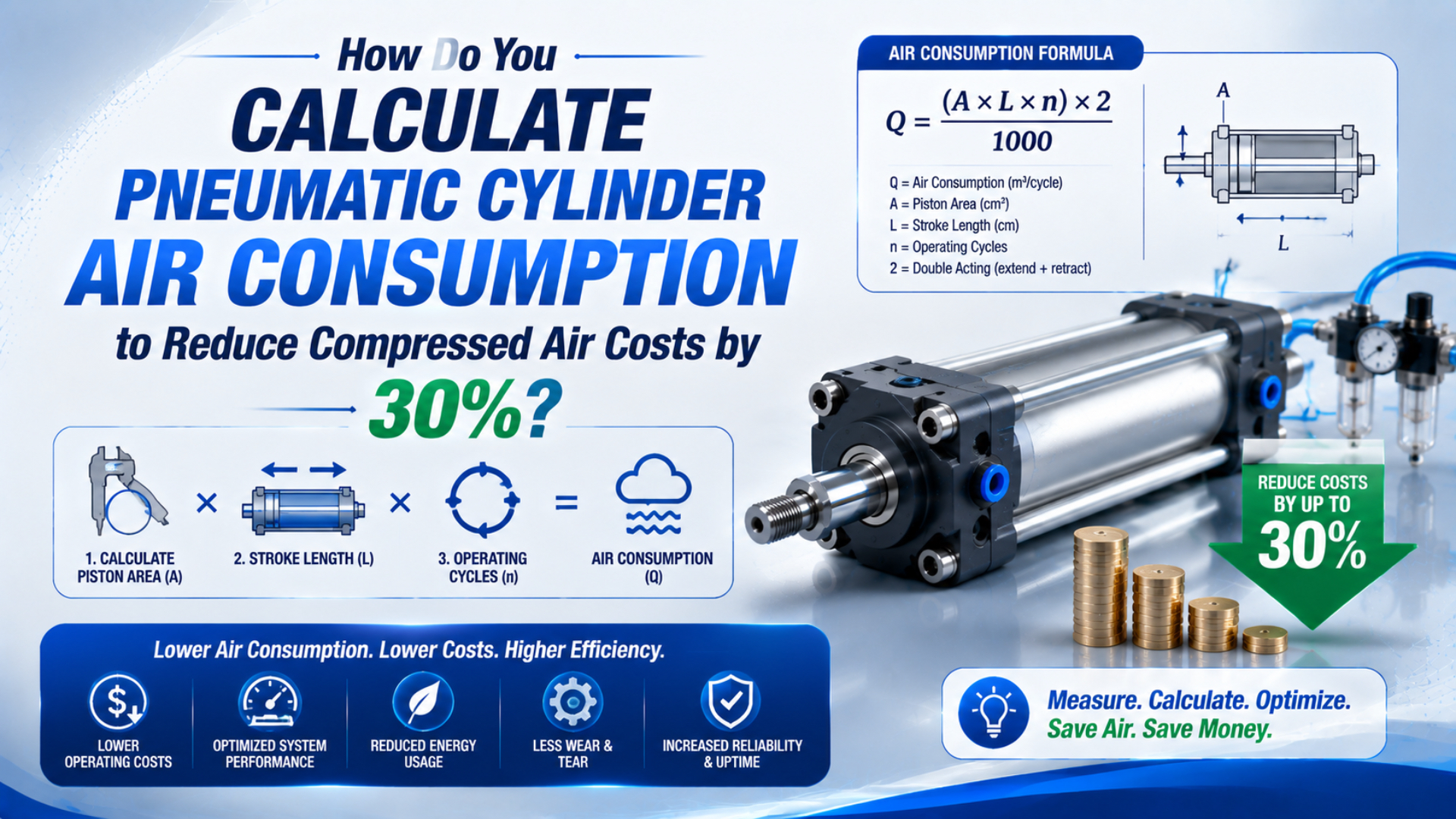
Calculate pneumatic cylinder air consumption by finding the swept volume of each pressurized chamber, converting that volume to a declared free-air reference condition with an absolute-pressure ratio, and multiplying by complete cycles per minute. For a single-rod double-acting cylinder, extension and retraction must be calculated separately because the piston rod reduces the retraction-side area.
That result is average cylinder demand. It is not automatically the valve’s peak flow, the complete machine’s measured air use, or the compressor’s electrical cost. A 30% cost reduction is therefore a testable scenario, not a guaranteed outcome. First establish the boundary, then change one verified source of demand and measure again.
Key Takeaways
- Festo’s 32 mm bore example uses 5.234 L per cycle at 6 bar.
- Add extension, retraction, and switched tube volumes before multiplying by cycle rate.
- Treat 30% as a measured target; cost also depends on compressor specific power and controls. (Festo, 2025)
What Does Pneumatic Cylinder Air Consumption Actually Measure?
ISO 8778:2003 supplies 1 standard reference atmosphere for reporting pneumatic component and system performance. Cylinder air consumption is therefore the swept chamber air converted to a declared reference condition, usually reported as standard cubic feet, normal liters, or another supplier-defined free-air basis (ISO 8778:2003, confirmed 2022).
A free-air volume is the equivalent amount of air at the stated reference atmosphere. An actual chamber volume is the physical space filled inside the cylinder at operating pressure. These values aren’t interchangeable. A one-liter chamber charged to several bar requires several reference liters of air.
SCFM, NL/min, L/min (ANR), ACFM, and FAD can use different reporting conventions. Don’t convert the number by label alone. Confirm the reference pressure, temperature, humidity treatment, and whether the value is inlet flow, delivered free air, or air at the local line condition.
Three boundaries must remain separate:
| Boundary | What it answers | Typical output |
|---|---|---|
| Cylinder consumption | How much reference air is charged per stroke or cycle? | L/cycle, SCF/cycle, L/min, SCFM |
| Required stroke flow | How quickly must the supply and exhaust paths move that air? | L/min or SCFM during the stroke |
| Machine or compressor demand | What does the complete system consume over production and idle time? | Measured flow, accumulated volume, kWh, annual cost |
Why split them? A slow indexing cylinder and a fast reject cylinder can average the same SCFM, yet the fast cylinder needs much more flow during its short stroke. Use the separate pneumatic flow-rate guide when valve Cv, tubing, exhaust, or point-of-use pressure is the main question.
Cylinder Inputs Required Before Air-Consumption Calculation
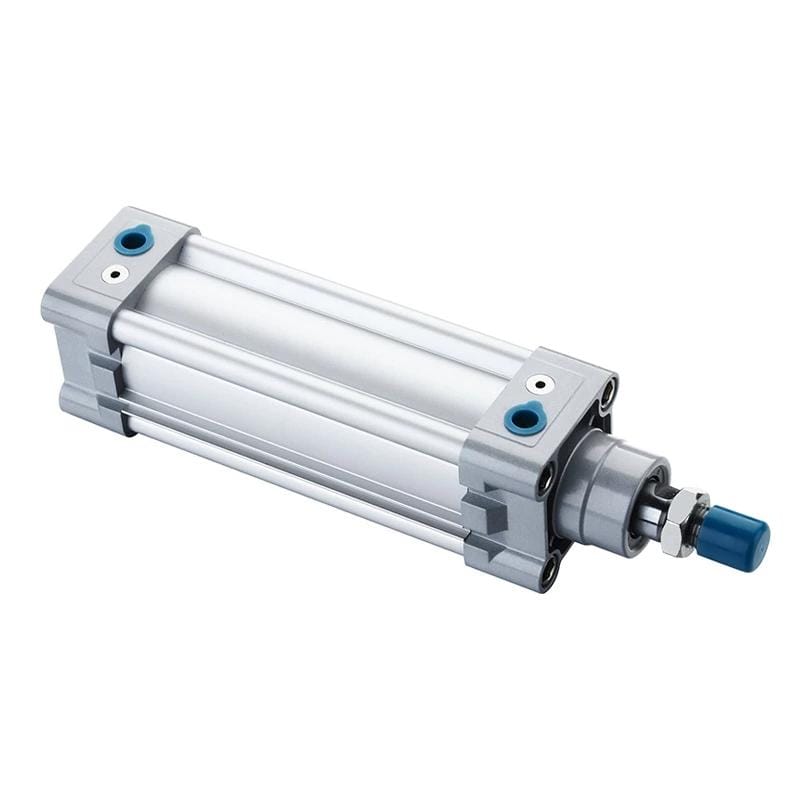
Festo’s cylinder tool uses 5 core operating inputs: mode of operation, piston diameter, cycles, stroke, and operating pressure. A single-rod double-acting calculation needs a 6th input, rod diameter, because retraction fills an annular chamber rather than the full piston area (Festo General Operating Conditions, 2025).
Collect these inputs from the configured cylinder and real machine cycle:
| Input | Symbol | Use in the calculation | Common mistake |
|---|---|---|---|
| Bore diameter | Full piston area | Using outside tube width | |
| Rod diameter | Retraction annular area | Assuming both chambers are equal | |
| Actual stroke | Swept volume | Using machine pitch instead of cylinder travel | |
| Gauge pressure at the port | Absolute-pressure ratio | Using regulator setting during a pressure sag | |
| Complete cycles per minute | Average demand | Confusing one stroke with one full cycle | |
| Action type | none | Decides which chambers consume air | Treating spring return as double acting |
Also record extension and retraction pressure separately when they differ. An unloaded return may run at lower pressure through a two-pressure circuit. If the machine uses long valve-to-cylinder tubes, record each tube’s inside diameter and switched length as well.
In our experience, the cycle definition causes more spreadsheet errors than the area formula. One complete double-acting cycle normally means one extension plus one retraction. A controller counter may instead record strokes, accepted parts, valve commands, or machine cycles. Confirm the event behind the number before multiplying.
How Do You Calculate Air Use for a Double-Acting Cylinder?
Festo’s published 32 mm bore, 12 mm rod, 500 mm stroke example consumes 2.815 L on extension and 2.419 L on retraction at 6 bar gauge. The correct method calculates both areas, converts both swept volumes with absolute pressure, and adds them before applying cycle rate (Festo, 2025).
First calculate piston and rod areas:
Here, is piston area in square millimeters, is rod area in square millimeters, is bore in millimeters, and is rod diameter in millimeters.
Then calculate geometric chamber volumes:
and are liters of swept chamber volume when dimensions are in millimeters. The conversion factor is liters per cubic millimeter.
Convert both chamber volumes to the declared reference condition:
is reference-air volume per complete cycle. Both operating pressures must be absolute. For the common approximation of equal gauge pressure in bar and a one-bar reference atmosphere, each pressure ratio becomes .
Finally:
is average reference-air demand per minute, and is complete cycles per minute. Convert liters per minute to SCFM only after confirming both values use compatible reference conditions.
Worked example: 32 mm bore at 6 bar
For , , , equal pressure of 6 bar gauge, and :
| Step | Result |
|---|---|
| Piston area | 804.25 mm² |
| Rod area | 113.10 mm² |
| Extension reference air | 2.815 L |
| Retraction reference air | 2.419 L |
| Total per complete cycle | 5.234 L |
| Average at 60 cycles/min | 314.03 L/min |
The result matches Festo’s published example. It does not yet include switched tube volume, pilot air, leakage, blow-off, vacuum generation, or other machine loads.
Formula Adjustments for Single-Acting, Double-Rod, and Rodless Cylinders
SMC separates 4 charged quantities in a double-acting circuit: extension cylinder volume, extension piping volume, retraction cylinder volume, and retraction piping volume. Different actuator types change which chamber areas and events belong in that sum; the word “cylinder” alone doesn’t define the air boundary (SMC Technical Data, 2026).
| Cylinder type | Air-consumption treatment | Design note |
|---|---|---|
| Single acting, spring return | Count the powered chamber event | Spring force and exhaust still affect motion |
| Single rod, double acting | Add full-bore extension and annular retraction volumes | Rod area lowers return-side volume |
| Double rod, double acting | Subtract rod area on both sides | Equal rod sizes can produce equal chamber areas |
| Rodless cylinder | Calculate both configured chamber areas | No external rod means no automatic air-saving credit |
| Multi-position cylinder | Count every chamber charged in the sequence | Use the actual valve timing diagram |
A rodless cylinder may solve a space, guidance, or long-stroke packaging problem. It isn’t inherently an energy-saving substitute. For equal bore, stroke, and pressure, many rodless designs have two chamber volumes close to full piston area, while a single-rod cylinder has a smaller annular return volume.
What about cushioning? Standard pneumatic cushioning changes end-of-stroke pressure and exhaust behavior, but there is no universal 10% or 20% consumption adder. Use the configured cylinder and circuit data, then measure if the cushion arrangement changes the charged volume or final pressure materially.
For bore-selection tradeoffs, use the dedicated guide on bore size, air consumption, and operating cost. That article covers why swept volume changes with the square of diameter.
How Should Multiple Cylinders Be Combined Without Oversizing the Compressor?
SMC’s total-demand method multiplies 3 terms: air per operating event, cycles per minute, and the number of cylinders. That produces average reference-air demand. Compressor and receiver selection still need the real timing sequence because ten cylinders moving together create a different peak from ten cylinders spread across a machine cycle (SMC Air Cylinder Selection, 2026).
Start with an event schedule:
- Calculate reference-air volume for every extension and retraction.
- Add switched tube volume for each valve-to-cylinder path.
- Mark when every event occurs in the production cycle.
- Sum all events over one minute for average demand.
- Sum events that overlap in the same time window for local peak demand.
- Compare average demand with compressor FAD and peak demand with valve, manifold, regulator, tubing, and receiver capability.
Average SCFM and peak stroke flow should never share one unlabeled spreadsheet column. Average flow is an accumulation problem. Peak flow is a time-window problem. If the cycle changes, one may remain nearly constant while the other changes sharply.
Don’t solve a short pressure sag by raising the whole plant header before checking the timing. A local receiver, larger valve path, shorter tubing, corrected sequencing, or leak repair may address the peak without increasing every unregulated demand.
Why Is Measured Machine Air Use Higher Than the Cylinder Formula?
SMC includes both cylinder and switched piping air in its consumption method, while DOE notes that unregulated uses can represent 30% to 50% of plant demand in some systems near 100 psig. The gap between calculated cylinder air and measured machine air must therefore be separated by load type, not hidden inside one generic multiplier (DOE Sourcebook, 2003).
The cylinder formula covers the chamber boundary you define. A machine inlet flow meter may also see:
- valve-to-cylinder tubes that are repeatedly charged and exhausted;
- pilot-operated valve consumption;
- external leaks and internal cylinder or valve leakage;
- blow-off nozzles, vacuum ejectors, air bearings, and purge flows;
- pressure regulators or drains that vent continuously;
- rejected cycles, idle cycling, and motions that don’t produce accepted parts.
Measure each branch instead of applying a blanket “real-world factor.”
| Observation | Likely branch | Verification |
|---|---|---|
| Flow continues while commands are stopped | Leaks, purge, venting regulator, idle blow-off | Isolate branches under an approved safe procedure |
| Air per accepted cycle rises | Extra movements, leakage, pressure, product change | Pair accumulated air with the production counter |
| Average demand is correct but pressure sags | Peak overlap, valve, tubing, FRL, receiver | Log dynamic pressure and event timing |
| One direction uses more than the model | Different pressure, tube volume, seal condition, exhaust restriction | Measure both port pressures and stroke times |
| Compressor kWh doesn’t fall with machine air | Control mode, unloaded power, other plant loads | Review compressor-specific power and control response |
We’ve found that accumulated air divided by accepted production cycles is a much cleaner baseline than a single flow snapshot. Record idle time, rejected parts, pressure, product, and cycle program beside the air total. Otherwise a faster shift or a longer standby period can be mistaken for an efficiency change.
Use the internal cylinder leakage guide when the measured branch remains high after external leaks and auxiliary uses are isolated.
How Do You Convert Air Consumption Into Cost and Test a 30% Target?
DOE reports that poorly maintained compressed-air systems with many modifications can sometimes achieve 20% to 50% system energy savings, but that range is conditional and plant-wide. A cylinder calculation alone can’t promise 30%. Build the target from verified air volume, compressor specific power, operating hours, control behavior, and electricity price (DOE Sourcebook, 2003).
For a stable operating boundary:
is annual electricity in kWh, is average active free-air flow in cubic meters per minute, is measured compressor specific power in kW per cubic meter per minute, and is annual active operating hours.
Then:
is annual energy cost and is the site electricity price per kWh. Add demand charges, maintenance, cooling, and other site costs only when the accounting model includes them consistently.
A 30% air-volume target is:
Here, for a 30% target. The Festo example’s 314.03 L/min baseline would therefore have a target of 219.82 L/min under the same production boundary. That arithmetic is a comparison target, not proof that the cylinder can meet its load, timing, and safety requirements at the lower demand.
Will a 30% drop in machine air always produce a 30% electricity-cost drop? No. Compressor sequencing, unload power, variable-speed range, pressure setpoints, dryer purge, other users, and tariffs can weaken or strengthen the response. Use measured system data in the Compressed Air Energy Cost Calculator.
Which Changes Should Be Tested After the Baseline Is Credible?
ISO/TR 22165:2018 gives 1 system-level framework for improving pneumatic energy efficiency while considering function and economic efficiency. The safe order is to remove nonproductive demand first, then test pressure, stroke, bore, tubing, and circuit changes without losing force, timing, process quality, or fault response (ISO/TR 22165:2018, 2018).
Use this sequence:
- Repair external and internal leakage.
- Stop unnecessary cycling and safe-to-isolate idle air.
- Remove avoidable blow-off, purge, or vacuum demand.
- Set the lowest verified point-of-use pressure that passes the load case.
- Reduce unloaded return pressure with an approved circuit where suitable.
- Shorten switched tubing and unnecessary stroke.
- Recheck bore size against force, guidance, speed, and cushioning requirements.
- Test air-saving circuits with manufacturer-specific limits and a before-and-after measurement.
What should remain in this article? The calculation boundary and acceptance evidence. The detailed hardware tradeoffs belong in Optimizing Air Consumption in Double-Acting Pneumatic Cylinders, which covers pressure, bore, stroke, tubing, valves, and measurement in greater depth.
The lowest air reading isn’t automatically the best result. The correct endpoint is the lowest repeatable air per accepted cycle that still meets force, timing, cushioning, quality, safety, and fault-response requirements. Save that test sheet as the machine’s new reference condition.
Pneumatic Cylinder Air Consumption FAQs
Festo’s published example needs 6 practical inputs when rod diameter is counted: bore, rod, stroke, pressure, action type, and cycles per minute. These 5 answers keep units, cycle definitions, peak flow, measured demand, and the title’s 30% target separate so one number isn’t asked to represent the whole system (Festo, accessed 2026).
How do I calculate SCFM for a double-acting cylinder?
Calculate full-bore extension volume and annular retraction volume separately. Multiply each by its absolute-pressure ratio, add the reference-air volumes, and multiply by complete cycles per minute. Convert the final flow to SCFM only after confirming the source and destination values use compatible standard reference conditions.
Is one extension a cycle or half a cycle?
For most double-acting calculations, one complete cycle is one extension plus one retraction. Some machine counters record strokes, valve commands, or accepted parts instead. Define the counted event explicitly. An unnoticed factor-of-two error can double or halve the reported air demand without changing any hardware.
Why is required valve flow higher than average SCFM?
Average SCFM spreads air use across one minute, while the valve must fill a chamber during the actual stroke time. A cylinder using 5.234 L per cycle can have modest average demand but a high short-duration requirement if its stroke completes rapidly. Check both supply and exhaust paths.
Should I add a fixed leakage or safety percentage?
Don’t hide unrelated loads inside one arbitrary multiplier. Calculate cylinder and switched tube demand, then measure leakage, pilot air, auxiliary uses, and simultaneity separately. Manufacturer sizing guidance may specify a capacity margin for a defined product, but that doesn’t replace compressor controls, storage, dynamic pressure, or field measurement.
Does calculating air consumption guarantee a 30% cost reduction?
No. The calculation establishes a baseline and a 30% comparison target. Actual savings require a verified change in air per accepted cycle and a compressor system that converts lower air demand into lower kWh. Confirm force, timing, process quality, safety, and compressor control response before claiming cost savings.
Sources and technical references
- ISO 8778:2003, Pneumatic fluid power, standard reference atmosphere, current reference-atmosphere standard; confirmed 2022, retrieved 2026-07-19.
- Festo General Operating Conditions, air-consumption formula and 32 mm cylinder example; August 2025 edition, retrieved 2026-07-19.
- Festo Cylinder Air Consumption, configured cylinder inputs and comparison tool; retrieved 2026-07-19.
- SMC Air Cylinders Model Selection Technical Data, cylinder and piping consumption plus required-flow distinction; retrieved 2026-07-19.
- SMC Best Pneumatics Air Cylinder Selection, multiple-cylinder and switched-piping calculation method; retrieved 2026-07-19.
- DOE, Improving Compressed Air System Performance, system economics, pressure effects, controls, unregulated demand, and conditional savings; retrieved 2026-07-19.
- ISO/TR 22165:2018, pneumatic application guidance for energy efficiency; retrieved 2026-07-19.
- NIST Pressure and Gas Flow Unit Conversions, absolute pressure and unit-conversion reference; retrieved 2026-07-19.