

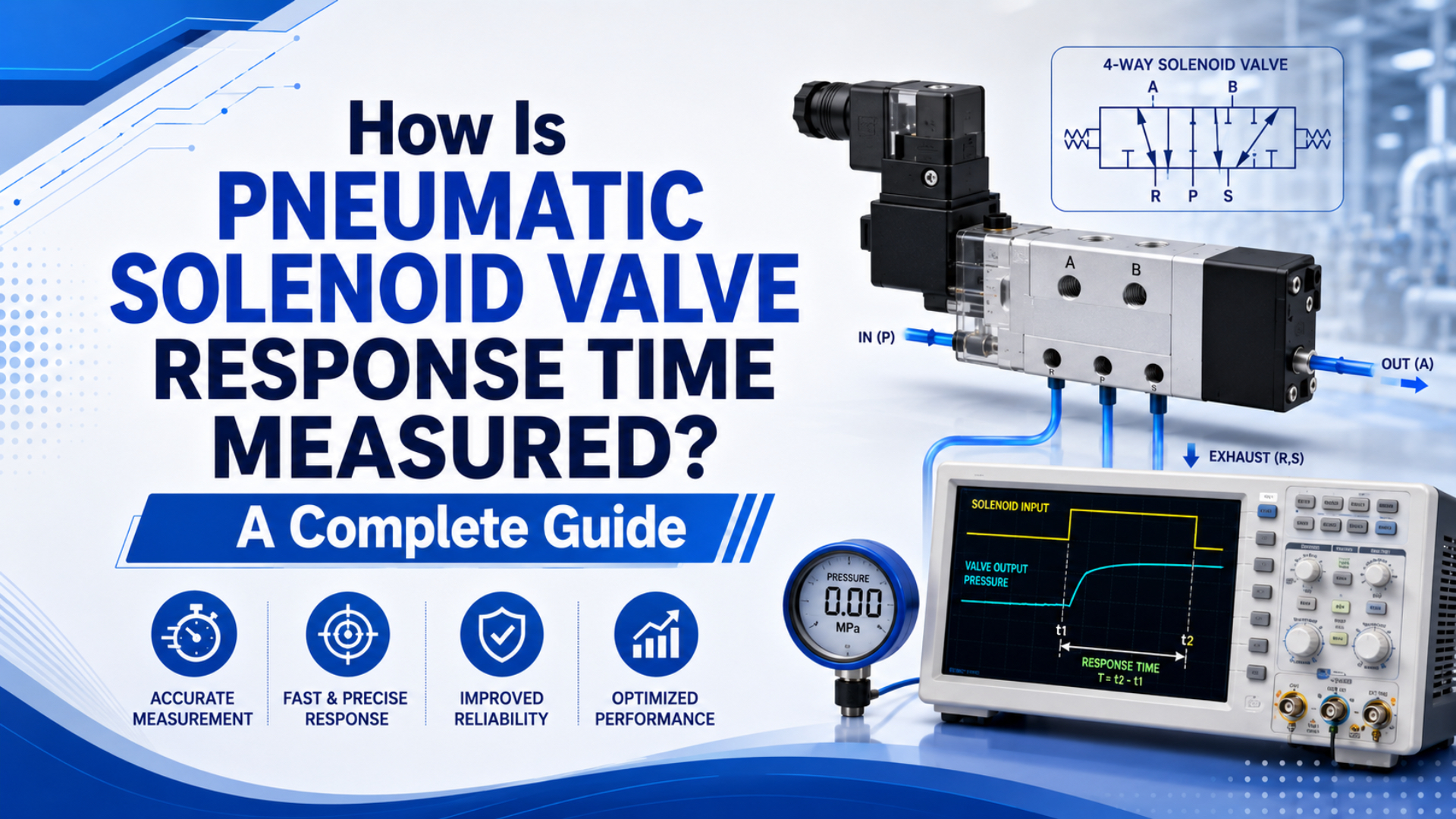
Pneumatic solenoid valve response time is measured from the electrical command to a defined pneumatic result, usually a valve shift, pressure rise, pressure decay, or downstream actuator event. The useful number is not just coil pickup time. It includes the electrical driver, armature or pilot movement, main valve shift, air path, tubing volume, exhaust path, and sensor threshold.
The practical answer: measure the electrical input and pneumatic output on the same time base. Use a pressure transducer, oscilloscope or high-speed logger, repeatable supply pressure, known downstream volume, and a written threshold such as signal-to-90% pressure for opening or signal-to-10% pressure for exhaust. Which threshold are you quoting?
Key Takeaways
- ISO 12238 is the relevant directional-control-valve shifting-time standard, while ISO 6358 belongs to flow-rate characterization.
- Use synchronized electrical and pressure traces before blaming the valve.
- Treat response time as a budget: command, coil, valve shift, tube fill, exhaust, and actuator motion.
In our experience, most “slow valve” complaints are mixed measurements. A maintenance team times the reed switch, the purchasing team reads coil response from a catalog, and the machine builder cares about part arrival at the next station. Those are three different numbers.
For adjacent context, use the broader guide on how pneumatic solenoid valves control compressed air and the electrical deep dive on coil inductance and solenoid response time.
What does response time measure?
Response time measures a defined event boundary, not a vague feeling of fast or slow. ISO 12238:2001 is specifically titled for directional-control-valve measurement of shifting time, while many machine checks use 90% pressure rise or 10% pressure decay as practical output thresholds (ISO 12238, 2001).
For a pneumatic solenoid valve, the timing chain has at least five parts:
- Controller output turns on or off.
- Solenoid current rises or decays.
- Plunger, armature, pilot, poppet, or spool moves.
- Pressure changes at the measured port.
- The actuator or machine sensor reacts.
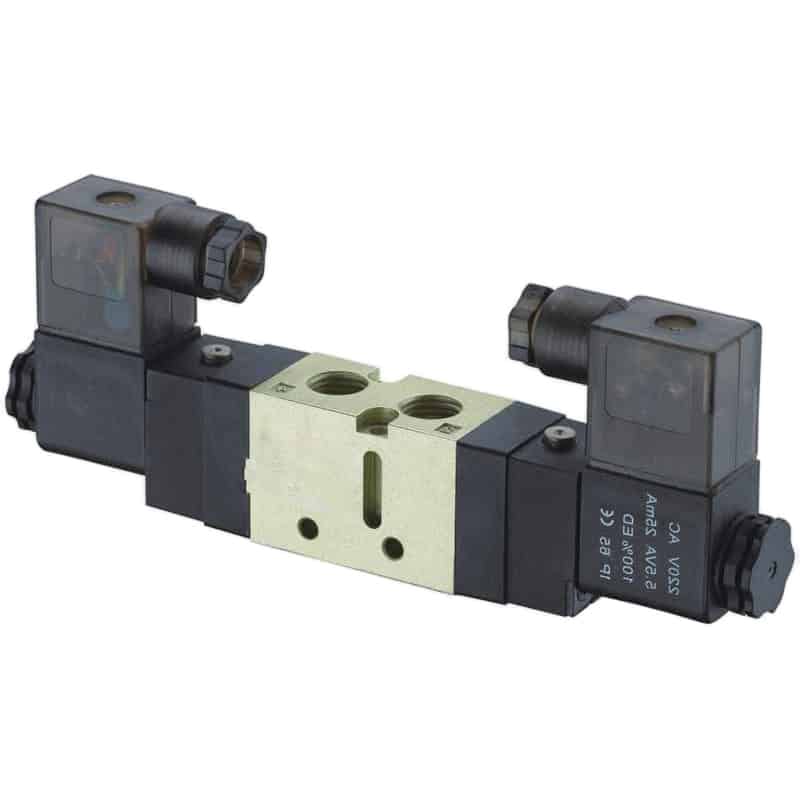
Do not mix these boundaries. A coil pickup number may be only an electrical event. A shifting-time number belongs to the valve. A cylinder arrival time includes valve flow, fittings, tubing, cushion settings, exhaust, and load. That is why two technicians can both be honest and still report different times for the same station.
When we review a fast packaging or indexing complaint, we ask the team to label the measured point first. “Command to valve outlet pressure” is useful. “Command to cylinder sensor” is useful. “Valve response is 30 ms” without a threshold is not useful enough to buy from.
Which test setup gives a trustworthy reading?
A trustworthy setup records the command and pressure response on the same time base. ISO 6358-1:2013 is for flow-rate characteristics of pneumatic components, not shifting-time measurement, so use it for flow context rather than the main response-time method (ISO 6358-1, 2013).
The minimum bench setup is simple:
| Test item | Practical requirement | Why it matters |
|---|---|---|
| Electrical channel | coil voltage or driver command | proves when the valve was told to move |
| Pressure channel | fast pressure transducer near the outlet | proves when air actually changed |
| Supply pressure | recorded before and during actuation | prevents a weak supply from looking like a slow valve |
| Downstream volume | fixed tube, cavity, or test chamber | prevents volume changes from changing the result |
| Temperature | recorded near the valve and coil | helps explain coil resistance, friction, and seal behavior |
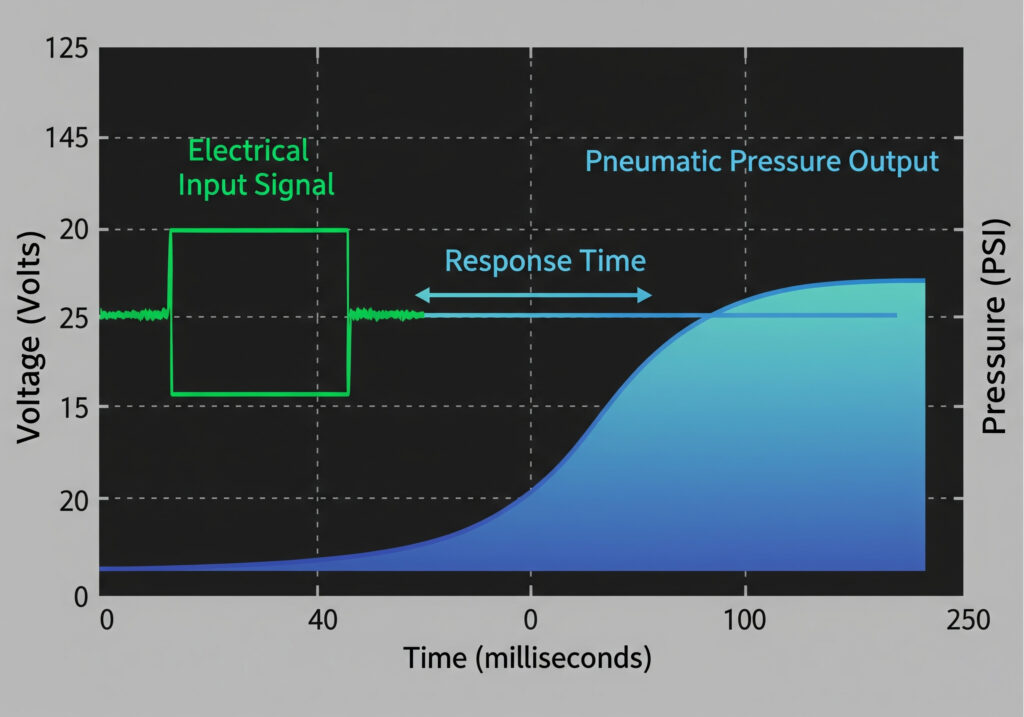
A dual-channel oscilloscope is ideal, but a high-speed data logger can work if sample rate, transducer response, and timestamp alignment are good enough for the target. If the acceptance limit is 25 ms, a logger that updates every 20 ms is too blunt. The measurement tool must be faster than the decision it is supporting.
Keep the sensor close to the port when you want valve response. Move the sensor to the actuator only when the question is machine response. Long tubing can add enough fill and exhaust delay to make a good valve look slow.
How are opening, closing, and stroke timing different?
Opening, closing, and stroke timing answer 3 different engineering questions in real machines. ISO 12238 deals with valve shifting time. Separately, SMC gives cylinder speed as s = 28.8q / A, where actuator speed depends on flow and piston area (SMC, 2026).
Opening response usually means command-on to pressure buildup at the working port. Closing response usually means command-off to pressure decay or return-port pressure change. Stroke time means the actuator moved a known distance. Do not compare a valve opening number with a full-cylinder movement number and call the difference a catalog error.
If the target is sequence timing, use the full stroke event. If the target is valve replacement, keep the measured cavity fixed and compare valve output pressure at the same pressure, temperature, tube volume, and load condition. A fast valve can still miss a machine sensor if the actuator is starved for flow.
Which factors change the measured result?
At least five variables can change a response-time trace: supply pressure, downstream volume, coil and driver design, valve size, and exhaust restriction. SMC states that actuator speed is not controlled by air flow alone and also depends on port and tubing sizes (SMC, 2026).
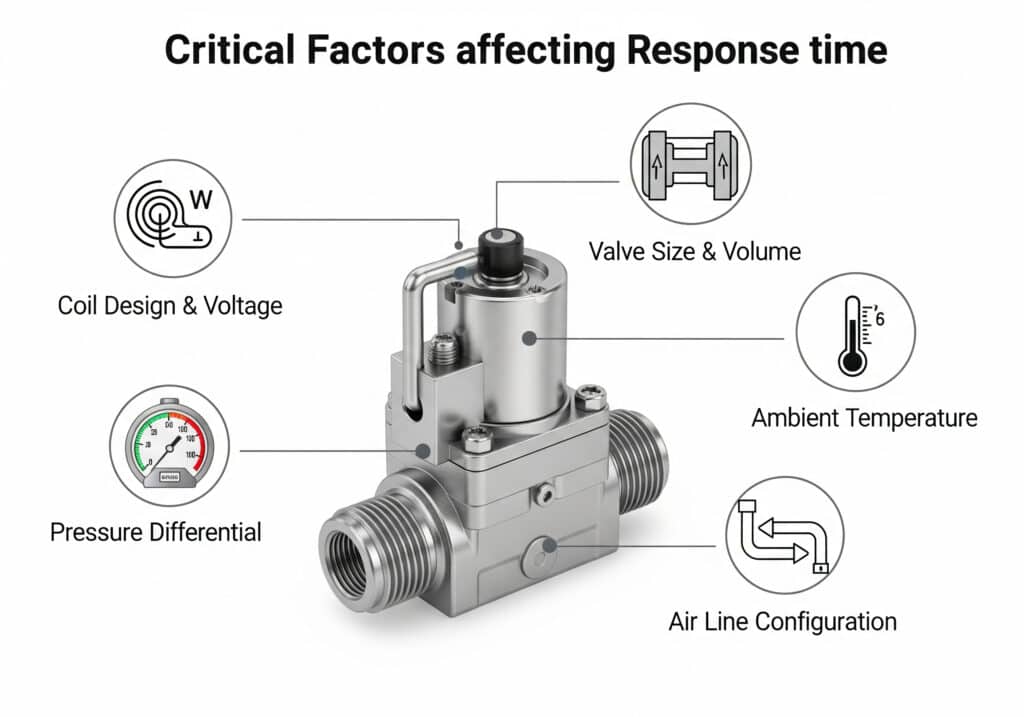
Use this factor table before replacing the valve:
| Factor | What changes | How to test it |
|---|---|---|
| Coil voltage | magnetic force and pickup current | measure voltage at the coil during command |
| Driver circuit | pickup current, hold current, dropout clamp | compare coil current trace or driver datasheet |
| Valve type | direct acting, pilot operated, spool, poppet | confirm minimum pressure and function |
| Downstream volume | pressure rise and decay slope | keep test chamber or tube length fixed |
| Exhaust path | closing and return timing | test with muffler condition documented |
| Supply pressure | pilot force and actuator force | record pressure during the event, not only idle |
| Temperature | coil resistance, seal drag, lubricant behavior | repeat cold and warm if the process sees both |
Texas Instruments describes the DRV110 as a current controller for solenoids, relays, and valves, with peak and hold current behavior for activation and lower hold power (Texas Instruments DRV110, 2025). That matters because a valve connected to a peak-and-hold driver can respond differently from the same nominal coil on a simple supply.
The easiest field check is not exotic: measure voltage at the coil while the machine cycles. A 24 VDC coil that sees a lower loaded voltage may click on the bench but shift late on the machine. We have seen that more than once.
How do you separate valve delay from tubing and actuator delay?
Separate valve delay by measuring pressure near the valve first, then moving the same measurement downstream. SMC’s formula s = 28.8q / A ties cylinder speed to air flow and piston area. Next, the tube and actuator volume decide how long the pneumatic side takes after the valve shifts (SMC, 2026).
Run the test in three passes:
- Measure command to pressure change at the valve outlet.
- Measure command to pressure change at the actuator port.
- Measure command to the machine sensor or end-position switch.
The gaps show where the delay lives. If the valve outlet responds quickly but the actuator port is late, look at tube length, tube ID, fittings, flow controls, manifolds, and mufflers. If the actuator port responds quickly but the sensor is late, inspect load, seals, guide friction, cushion setting, and mechanical stops.
For flow-related troubleshooting, pair this article with Cv sizing for pneumatic valves and pressure drop troubleshooting. Then connect the result to the meter-in vs meter-out speed-control guide.
What should a response-time test report include?
A useful test report includes at least 10 fields: valve model, function, coil voltage, driver type, pressure, temperature, volume, sensor location, threshold, and repeated measurements. Tameson includes response time among solenoid-valve selection factors, but the test boundary still has to be written down (Tameson, 2024).
Write the threshold directly in the report. Good examples include:
| Report field | Better wording |
|---|---|
| Opening response | command-on to 90% outlet pressure |
| Closing response | command-off to 10% outlet pressure |
| Stroke event | command-on to extend reed switch |
| Test pressure | 6 bar supply measured during actuation |
| Downstream volume | 1 m of 6 mm ID tube plus fixed test cavity |
| Sample rate | logger or oscilloscope setting |
| Repetition | minimum, average, maximum, and number of cycles |
Also record whether the valve was direct acting, pilot operated, or semi-direct. Tameson describes solenoid valve selection as depending on media, flow requirement, material, orifice size, temperature, pressure, voltage, response time, and certification (Tameson, 2024). Response time is only one line in that specification set.
If the test is for purchasing, include a short phone video of the setup. It does not replace the trace, but it catches obvious mistakes: the wrong port measured, a blocked exhaust muffler, a manual override left half-engaged, or a tube route that is nothing like the real machine.
How should you improve slow response without guessing?
Improve slow response by changing the measured bottleneck, not by replacing random parts. CAGI’s pressure-drop brief says a well-designed compressed-air system usually targets no more than 10% pressure drop from compressor discharge to point of use. It also warns that raising compressor pressure should not be the first fix (CAGI, 2022).
Start with the trace. If coil voltage rises late, review the PLC output, relay, wiring, common, and driver. If coil current rises slowly, review voltage, coil data, suppression, and driver type. If outlet pressure rises slowly, review valve function, Cv, pilot pressure, contamination, and exhaust restriction. If the actuator is late, review flow path and mechanics.
Use this sequence:
- Confirm voltage at the coil during the real cycle.
- Compare valve outlet pressure to actuator port pressure.
- Remove or inspect mufflers only as a controlled test.
- Check flow-control settings and cushion needles.
- Measure point-of-use pressure during motion.
- Compare valve Cv and tube ID against target stroke time.
- Replace the valve only after the timing boundary points to the valve.
The fastest improvement may be a shorter tube, larger fitting, cleaner muffler, different suppression circuit, or better driver. A new valve helps when the valve is actually the limit. It does not fix a starved actuator circuit.
RFQ checklist for response-time-critical solenoid valves
A response-time RFQ should state the acceptance event in 1 sentence. Tameson lists response time among solenoid-valve selection factors, but the buyer still has to define pressure, threshold, and measured point (Tameson, 2024). Example: “command-on to 90% pressure at port A must be under X ms at 6 bar.”
Include these details:
| RFQ detail | Why it matters |
|---|---|
| Valve function | 3/2, 5/2, 5/3, spring return, double solenoid |
| Coil data | AC or DC, rated voltage, duty cycle, connector |
| Driver type | direct output, relay, MOSFET, peak-and-hold, suppression |
| Pressure range | pilot force and actuator force |
| Flow demand | Cv, target stroke time, tube ID, exhaust condition |
| Measurement point | valve outlet, actuator port, or machine sensor |
| Threshold | 90% pressure, 10% pressure, switch arrival, or full stroke |
| Environment | temperature, dust, oil mist, washdown, vibration |
For replacement context, review the pneumatic solenoid valve product category and VF and VZ Series directional-control solenoid valves. For pilot-stage uncertainty, use the guide on pneumatic pilot operated valves. For site background or engineering contact, use About Bepto and contact.
Conclusion
Response time is only useful when the boundary is defined. ISO 12238:2001 is the directional-control-valve shifting-time reference. ISO 6358-1:2013 belongs to flow-rate characteristics, so a good test report separates valve timing from flow sizing and actuator motion (ISO 12238, 2001; ISO 6358-1, 2013).
If the machine depends on millisecond timing, measure the electrical command and pneumatic output together. Then move the pressure measurement downstream and compare the gaps. That method shows whether the delay sits in the driver, coil, valve shift, tube volume, exhaust, flow path, or actuator load.
The best field rule is simple: never quote a solenoid valve response time without the threshold, pressure, downstream volume, and measurement location. Without those details, the number is not wrong. It is just incomplete.
FAQs About Pneumatic Solenoid Valve Response Time
Short answers should preserve the same measurement boundary. ISO 12238 covers valve shifting time. SMC’s s = 28.8q / A speed relation then shows why actuator movement can be slower than valve output pressure even when the valve shifts correctly (ISO 12238, 2001; SMC, 2026).
What is pneumatic solenoid valve response time?
Pneumatic solenoid valve response time is the time from an electrical command to a defined valve or pressure event. In a good report, that event is named directly: command-on to 90% outlet pressure, command-off to 10% pressure decay, or command to actuator sensor arrival.
Is coil response time the same as valve response time?
No. Coil response is the electrical current and magnetic-force part of the event. Valve response includes mechanical movement and air switching. Machine response adds tubing volume, exhaust, flow controls, load, cylinder friction, cushion settings, and sensor position.
Why can the same valve measure faster on the bench than on the machine?
Bench tests often use short tubing, clean air, stable pressure, fixed downstream volume, and a direct driver. A machine may add long tube runs, manifold pressure drop, mufflers, speed controllers, load variation, contamination, and a different driver circuit.
What sample rate should I use for response-time testing?
Use a sampling rate that is much faster than the pass-fail limit. If a valve must meet a 25 ms limit, a 20 ms logger update is not enough. Use an oscilloscope or fast logger that can show command and pressure edges clearly.
How do I decide whether to replace the valve?
Replace the valve when the trace proves the delay occurs between the electrical command and the valve outlet pressure event under correct pressure, voltage, temperature, and downstream volume. If the delay appears after the outlet, fix flow path, tube volume, exhaust, or actuator mechanics first.
Sources
- ISO 12238:2001, Pneumatic fluid power, directional control valves, measurement of shifting time. Retrieved 2026-07-08.
- ISO 6358-1:2013, Pneumatic fluid power, determination of flow-rate characteristics of components using compressible fluids. Retrieved 2026-07-08.
- SMC: Control Air Flow of Cylinders, cylinder speed equation, port and tubing size note, and meter-out flow-control guidance. Retrieved 2026-07-08.
- Texas Instruments: DRV110 datasheet, current controller for solenoids, relays, and valves with peak-and-hold behavior. Retrieved 2026-07-08.
- CAGI: Pressure Drop Technical Brief, 10% pressure-drop guideline and point-of-use pressure advice. Retrieved 2026-07-08.
- Tameson: Solenoid Valve Types, valve type selection factors and solenoid-valve selection context. Retrieved 2026-07-08.
- AutomationDirect: Understanding Pneumatic Valve Ports and Ways, video reference for valve port and way naming. Retrieved 2026-07-08.