

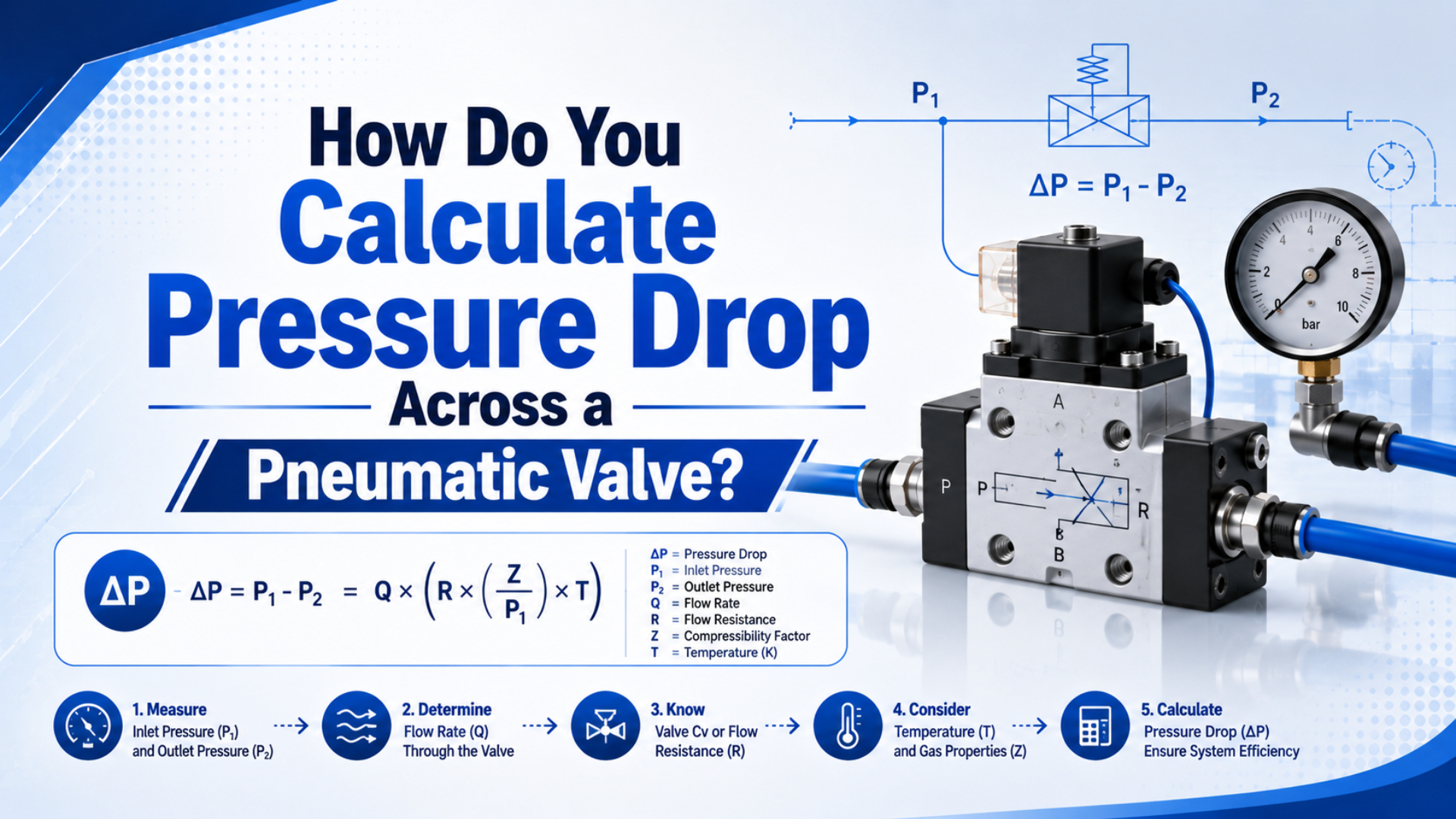
To calculate pressure drop across a pneumatic valve, measure the upstream pressure P1 and downstream pressure P2 while air is flowing, then subtract: DeltaP = P1 - P2. Emerson defines control-valve pressure drop as the difference between inlet and outlet pressure, usually measured in psid, and says it varies with flow (Emerson, 2026).
That direct measurement is the safest answer. Cv formulas are useful for screening valve capacity, but compressed air is compressible. For final sizing, compare the measured pressure drop with the valve manufacturer’s air-flow curve or ISO 6358 flow-rate data, not only a port thread size.
Key Takeaways
- Valve pressure drop is
P1 - P2measured during flow, not the static pressure shown before the valve opens.- CAGI says most well-designed compressed-air systems stay within 10% pressure drop from compressor discharge to point of use.
- Use Cv for quick comparison, but use manufacturer pneumatic flow curves or ISO 6358 data for final gas-flow selection.
The useful troubleshooting question is not “What is the valve Cv?” It is “How much pressure reaches the actuator during the exact part of the cycle that fails?” A valve can look acceptable on a datasheet and still starve a fast cylinder if the manifold, fittings, tube, muffler, or supply regulator restricts the same flow path.
What Is Pressure Drop Across a Pneumatic Valve?
Pressure drop across a pneumatic valve is the inlet-to-outlet pressure difference while air passes through one active flow path. Emerson says control-valve pressure drop is inlet pressure minus outlet pressure and varies with flow, usually measured in psid (Emerson, 2026).
Use the actual path being tested. On a 5-port directional valve, the supply-to-cylinder path and the cylinder-to-exhaust path are different. A slow extend stroke may be limited by the supply path from P to A. A slow retract stroke may be limited by P to B, or by the opposite chamber exhausting through EA or EB.
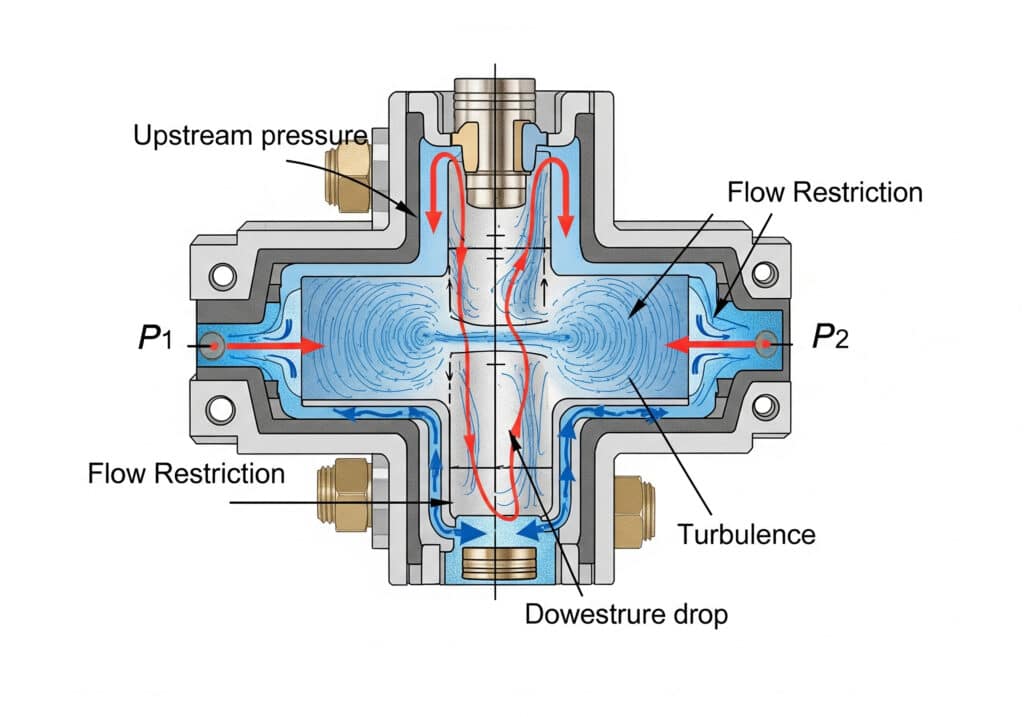
Valve pressure drop is the pressure loss across one active valve flow path while air is moving. The basic field equation is:
DeltaP = P1 - P2Use gauge pressure for both readings when you are only measuring the drop between two nearby points. Use absolute pressure when you are doing gas-flow calculations that depend on pressure ratio, density, or choked flow. Do not mix gauge and absolute pressure in the same calculation.
Which Data Do You Need Before Calculating Valve Pressure Drop?
Collect pressure, flow, valve path, and cycle timing before using any formula. CAGI says compressed-air equipment sizing depends on 3 parameters: demand in cfm, pressure in psig, and air quality (CAGI, 2026).
For a valve pressure-drop check, the minimum data set is:
| Data item | Why it matters | Field note |
|---|---|---|
Upstream pressure P1 |
pressure available before the valve | measure while the valve is flowing |
Downstream pressure P2 |
pressure delivered after the valve | measure close to the actuator or test outlet |
Flow demand Q |
pressure drop rises with flow | use SCFM, L/min, or manufacturer units consistently |
| Valve path | each spool path can have a different capacity | supply path and exhaust path both matter |
| Cv or rated flow | capacity comparison | use the actual model and port path |
| Tube and fitting sizes | add loss outside the valve | separate valve drop from system drop |
| Cycle event | identifies the failure moment | record pressure during the fastest stroke |
For example, a rodless cylinder that fails only at high speed may not have a weak cylinder. It may have a valve path that cannot pass the required peak flow. The related 4-way 5-port valve guide explains the P, A, B, EA, and EB port logic before you measure each path.
Which Formula Should You Use for Pneumatic Valve Pressure Drop?
Use DeltaP = P1 - P2 for measured valve pressure drop, and use a Cv relationship only as a clean screening estimate. ISO 6358-1 specifies steady-state test methods for pneumatic components using compressible fluids and internal flow paths (ISO 6358-1, 2013).
Valve Cv is a flow-capacity coefficient used to compare how much flow a valve path can pass under a stated pressure-drop condition. For a quick catalog comparison, many engineers use a simplified Cv screening relationship:
Q = Cv x sqrt(DeltaP / SG)
DeltaP = SG x (Q / Cv)^2
This simplified relationship is useful when the calculator, catalog, and units all use the same reference convention. It is not a universal compressed-air law. Air density changes with pressure and temperature, and high pressure ratios can move the valve path toward choked flow. That is why final pneumatic valve sizing should use the manufacturer’s gas-flow curves, rated flow tables, or ISO 6358-style conductance data.
Here is a safer calculation sequence:
- Measure
P1andP2under the real machine cycle. - Calculate
DeltaP = P1 - P2. - Compare the result with the valve’s rated flow or curve at the same pressure.
- If you do not have a curve, use Cv only as a preliminary comparison.
- Confirm whether the exhaust path is the restriction, not only the inlet path.
Use the flow coefficient Cv guide when you need the broader explanation of Cv, Kv, ISO 6358, and valve sizing. This article stays on the narrow calculation: pressure drop across one pneumatic valve path.
How Do You Measure Valve Pressure Drop on a Running Machine?
Measure valve pressure drop with 2 gauges or pressure sensors, one upstream and one downstream, during the failed motion. CAGI recommends adding pressure-monitoring taps and says most well-designed systems stay within 10% pressure drop from compressor to point of use (CAGI Pressure Drop Technical Brief, 2026).
Dynamic pressure is pressure recorded while the valve and actuator are consuming air. Do not rely on a static regulator gauge. At rest, little air flows through the valve, so a restriction may hide. When the valve opens and cylinder demand rises, the same restriction creates a larger loss.
That is why a machine can show 7 bar before the cycle and still act like the actuator is receiving much less. The U.S. Department of Energy lists compressed-air tools, tip sheets, training, case studies, and technical publications for improving compressed-air performance and saving energy (DOE, 2026).
Use this field setup:
| Step | Action | What it tells you |
|---|---|---|
| 1 | Install gauge 1 at valve inlet | verifies supply pressure during flow |
| 2 | Install gauge 2 at the working port or near the actuator | shows delivered pressure |
| 3 | Run the machine at the failed cycle speed | captures dynamic pressure |
| 4 | Record minimum P1, minimum P2, and timing |
separates sag from restriction |
| 5 | Repeat on the opposite stroke and exhaust path | finds direction-specific loss |
In our experience, the biggest false lead is a single gauge on the regulator. It proves the set pressure, not the delivered pressure. We measured valve banks where inlet pressure stayed stable, but one working port collapsed during a fast stroke. Our team found the root cause in the common manifold and exhaust muffler, not the cylinder.
How Do Cv, Port Size, and Exhaust Path Affect the Result?
Cv, port size, and exhaust capacity affect valve pressure drop because actuator speed depends on flow. SMC gives the cylinder speed relation s = 28.8q / A, where speed depends on airflow in SCFM and piston area when inlet pressure is held constant (SMC, 2026).
Port thread size is not the same as flow capacity. A 1/4 inch port can feed a restrictive internal passage, a small manifold gallery, or a narrow spool path. Cv gives a better comparison, but even Cv is path-specific. A directional valve may have different effective flow on supply and exhaust.
Exhaust restriction is easy to miss. If a cylinder chamber cannot vent, the trapped pressure creates back pressure. The actuator then fights itself. A slow one-direction stroke often points to one speed controller, one muffler, one exhaust port, or one tube run instead of the whole valve.
For a complete circuit check, use the compressed-air pressure drop calculator after you isolate the valve. It helps estimate losses through tube length, inside diameter, equivalent fittings, and working pressure. Keep the boundary clear: one tool checks valve capacity; the other checks line losses.
When Should You Use Manufacturer Curves Instead of a Shortcut?
Use manufacturer flow curves when the pressure ratio is high, the valve is near its rated flow, or the motion is safety-critical. ISO 6358-1 covers steady-state flow-rate characterization for pneumatic components with compressible fluids, and its scope includes fixed or variable internal flow paths (ISO 6358-1, 2013).
Shortcut formulas are useful for early screening. They become weak when the valve sees pulsed flow, changing upstream pressure, hot air, long manifolds, silencers, meter-out controls, or exhaust restrictions. They also become weak when downstream pressure is much lower than upstream pressure because compressed-air flow no longer behaves like a simple liquid pressure-drop problem.
Use curves or test data when any of these are true:
- The calculated drop consumes a large share of your pressure margin.
- The valve is feeding a large bore, long stroke, or fast cycle.
- The exhaust side controls speed.
- Several valves fire at the same time on one manifold.
- The downstream pressure is near half the upstream absolute pressure.
- The air is hot, wet, oily, or outside the valve’s normal catalog condition.
- The application has a clamp, press, stopper, gripper, or lift where force loss matters.
If the calculation and the field measurement disagree, trust the field measurement first. Then check sensor placement, units, pressure regulator droop, manifold sharing, and the actual valve model. Calculations should explain the machine, not override it.
What Troubleshooting Order Prevents Wrong Valve Replacement?
Troubleshoot valve pressure drop in order: measurement, flow demand, valve path, exhaust, line loss, and actuator load. CAGI says all compressed-air systems have pressure drop, and costly responses such as raising compressor pressure should not be the first step (CAGI Pressure Drop Technical Brief, 2026).
Use this order before replacing a pneumatic valve:
- Confirm the symptom: slow stroke, weak clamp, missed sensor, or unstable speed.
- Measure valve inlet pressure during the failed motion.
- Measure working-port pressure during the same motion.
- Calculate
DeltaP = P1 - P2. - Check the opposite direction and the exhaust port.
- Compare the measured drop with valve rated flow or Cv data.
- Check tube ID, fitting count, quick disconnects, and mufflers.
- Confirm the actuator load, guide friction, and speed requirement.
- Only then choose a higher-flow valve, larger manifold, or shorter tube run.
This order also prevents topic confusion. For system-wide losses, use what causes pressure drop in pneumatic systems. For flow coefficient basics, use the Cv valve sizing article. For pilot-stage behavior, use pneumatic pilot operated valves.
RFQ Checklist for a Pneumatic Valve Pressure-Drop Review
Send RFQ data that lets the supplier separate valve restriction from system restriction. CAGI lists demand, pressure, and air quality as core compressed-air sizing parameters, and valve review adds path, port, Cv, tube, and timing details (CAGI, 2026).
For a valve pressure-drop review, include these details:
| RFQ item | Include this detail |
|---|---|
| Valve model | brand, series, port size, spool type, voltage, manifold type |
| Flow path | P to A, P to B, A to EA, B to EB, or 2-way inlet to outlet |
| Measured pressure | P1, P2, and calculated DeltaP during motion |
| Flow demand | SCFM, L/min, cycle rate, or actuator bore and stroke time |
| Actuator data | bore, stroke, load, orientation, guide friction, speed target |
| Tubing | OD, ID if known, length, fitting count, quick disconnects |
| Exhaust parts | muffler, speed controller, meter-out setting, shared exhaust |
| Air quality | filter, regulator, dryer, oil, water, and contamination notes |
| Failure timing | video or trend of the exact cycle step that fails |
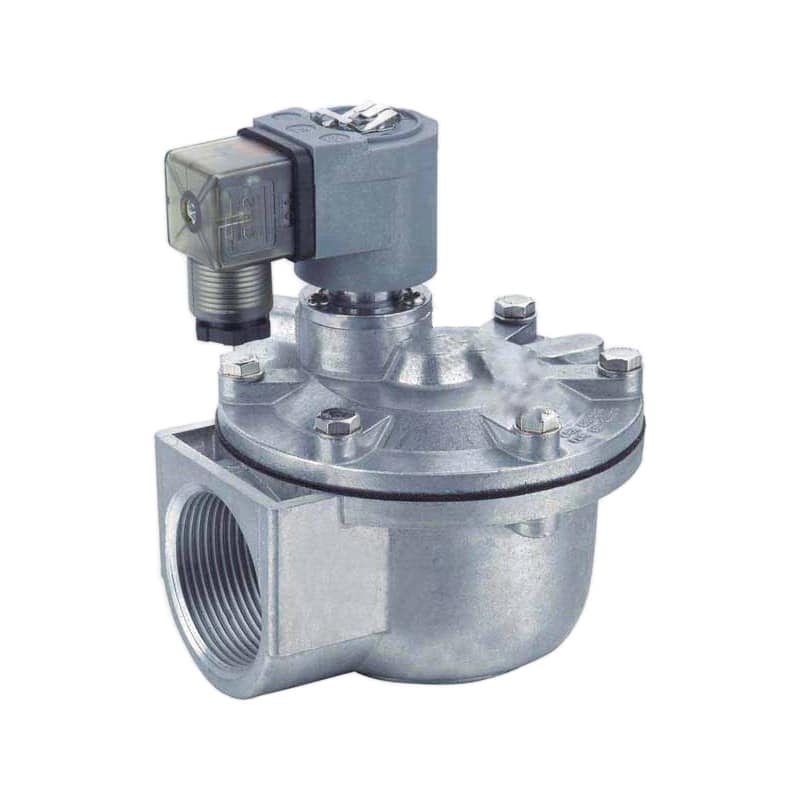
For product context, compare the current valve with solenoid valves, control components, and the upstream FRL unit. For author background and application review context, see About Us before sending the measured data through Contact.
FAQ
What is the basic formula for pressure drop across a pneumatic valve?
The basic measured formula is DeltaP = P1 - P2, where P1 is upstream pressure and P2 is downstream pressure during flow. Use the same pressure reference for both readings. Static readings before the valve opens are not enough because pressure drop depends on flow.
Can I calculate valve pressure drop from Cv alone?
You can estimate pressure drop from Cv as a screening step, but Cv alone is not final proof for compressed air. You still need flow demand, pressure conditions, units, valve path, exhaust behavior, and manufacturer pneumatic flow data. ISO 6358-style data is better for final gas-flow sizing.
What pressure drop across a pneumatic valve is acceptable?
There is no single acceptable value for every valve. The drop is acceptable only if the actuator still receives enough pressure and flow during the worst cycle. As a system guardrail, CAGI says well-designed compressed-air systems usually stay within 10% pressure drop from compressor discharge to point of use.
Why does valve pressure drop appear only when the cylinder moves fast?
Pressure drop rises when flow demand rises. A fast stroke needs more air per second, so the same valve, tube, fitting, or muffler creates more restriction. SMC’s speed relation connects cylinder speed to airflow, which is why high-speed faults often expose low Cv or small tubing.
Should I replace the valve if I measure high pressure drop?
Not immediately. First confirm the measurement, then check exhaust restriction, manifold sharing, tube ID, fittings, regulator droop, and actuator load. Replace or resize the valve only after the measured drop is clearly across the valve path and the valve curve cannot support the required flow.
Sources and Retrieval Notes
The source groups below separate valve pressure-drop calculation from broader system-pressure-drop troubleshooting and Cv-only valve selection.
- Emerson, “Control Valves,” retrieved 2026-07-08: https://www.emerson.com/en/final-control/catalog/products-and-software/valves/control-valves
- Compressed Air and Gas Institute, “Working with Compressed Air,” retrieved 2026-07-08: https://www.cagi.org/working-with-compressed-air/
- CAGI, “Pressure Drop Technical Brief,” retrieved 2026-07-08: https://www.cagi.org/assets/documents/pdfs/PressureDropTechnicalBrief.pdf?updated=1657712700
- U.S. Department of Energy, “Compressed Air Systems,” retrieved 2026-07-08: https://www.energy.gov/eere/amo/compressed-air-systems
- ISO, “ISO 6358-1:2013 Pneumatic fluid power - Determination of flow-rate characteristics of components using compressible fluids,” retrieved 2026-07-08: https://www.iso.org/standard/56612.html
- SMC USA, “Control Air Flow of Cylinders,” retrieved 2026-07-08: https://www.smcusa.com/help-and-support/best-practices/control-air-flow-of-cylinders
- YouTube video embedded for port and way context: https://www.youtube.com/watch?v=TM-XLgcmlEI