Engineers often overlook surface area calculations, leading to inadequate heat dissipation and premature seal failure. Proper surface area analysis prevents costly downtime and extends cylinder life.
Surface area calculation for cylinders uses , where A is total surface area, r is radius, and h is height. This determines heat transfer and coating requirements.
Three weeks ago, I helped David, a thermal engineer from a German plastics company, solve overheating issues in their high-speed cylinder applications. His team ignored surface area calculations, causing 30% seal failure rates. After proper thermal analysis using surface area formulas, seal life improved dramatically.
Table of Contents
- What is the Basic Cylinder Surface Area Formula?
- How Do You Calculate Piston Surface Area?
- What is Rod Surface Area Calculation?
- How Do You Calculate Heat Transfer Surface Area?
- What are Advanced Surface Area Applications?
What is the Basic Cylinder Surface Area Formula?
The cylinder surface area formula determines total surface area for heat transfer, coating, and thermal analysis applications.
The basic cylinder surface area formula is , where A is total surface area, π is 3.14159, r is radius, and h is height or length.

Understanding Surface Area Components
Total cylinder surface area consists of three main components:
Where:
- = 2πr² (both circular ends)
- = 2πrh (curved side surface)
- = 2πr² + 2πrh (complete surface)
Component Breakdown
Circular End Areas
Each circular end contributes πr² to total surface area.
Lateral Surface Area
The curved side surface area equals circumference times height.
Surface Area Calculation Examples
Example 1: Standard Cylinder
- Bore Diameter: 4 inches (radius = 2 inches)
- Barrel Length: 12 inches
- End Areas: 2 × π × 2² = 25.13 sq in
- Lateral Area: 2 × π × 2 × 12 = 150.80 sq in
- Total Surface Area: 175.93 square inches
Example 2: Compact Cylinder
- Bore Diameter: 2 inches (radius = 1 inch)
- Barrel Length: 6 inches
- End Areas: 2 × π × 1² = 6.28 sq in
- Lateral Area: 2 × π × 1 × 6 = 37.70 sq in
- Total Surface Area: 43.98 square inches
Surface Area Applications
Surface area calculations serve multiple engineering purposes:
Heat Transfer Analysis
Where:
- = Heat transfer coefficient1
- = Surface area
- = Temperature difference
Coating Requirements
Coating Volume = Surface Area × Coating Thickness
Corrosion Protection
Protection Area = Total Exposed Surface Area
Material Surface Areas
Different cylinder materials affect surface area considerations:
| Material | Surface Finish | Heat Transfer Factor |
|---|---|---|
| Aluminum | Smooth | 1.0 |
| Steel | Standard | 0.9 |
| Stainless Steel | Polished | 1.1 |
| Hard Chrome | Mirror | 1.2 |
Surface Area vs Volume Ratio
The SA/V Ratio2 affects thermal performance:
SA/V Ratio = Surface Area ÷ Volume
Higher ratios provide better heat dissipation:
- Small Cylinders: Higher SA/V ratio
- Large Cylinders: Lower SA/V ratio
Practical Surface Area Considerations
Real-world applications require additional surface area factors:
External Features
- Mounting Lugs: Additional surface area
- Port Connections: Extra surface exposure
- Cooling Fins: Enhanced heat transfer area
Internal Surfaces
- Bore Surface: Critical for seal contact
- Port Passages: Flow-related surfaces
- Cushioning Chambers: Additional internal area
How Do You Calculate Piston Surface Area?
Piston surface area calculations determine seal contact area, friction forces, and thermal characteristics for pneumatic cylinders.
Piston surface area equals π × r², where r is the piston radius. This circular area determines pressure force and seal contact requirements.
Basic Piston Area Formula
The fundamental piston area calculation:
Where:
- = Piston surface area (square inches)
- = 3.14159
- = Piston radius (inches)
- = Piston diameter (inches)
Standard Piston Areas
Common cylinder bore sizes with calculated piston areas:
| Bore Diameter | Radius | Piston Area | Pressure Force at 80 PSI |
|---|---|---|---|
| 1 inch | 0.5 inch | 0.79 sq in | 63 lbs |
| 1.5 inch | 0.75 inch | 1.77 sq in | 142 lbs |
| 2 inch | 1.0 inch | 3.14 sq in | 251 lbs |
| 3 inch | 1.5 inch | 7.07 sq in | 566 lbs |
| 4 inch | 2.0 inch | 12.57 sq in | 1,006 lbs |
| 6 inch | 3.0 inch | 28.27 sq in | 2,262 lbs |
Piston Surface Area Applications
Force Calculations
Force = Pressure × Piston Area
Seal Design
Seal Contact Area = Piston Circumference × Seal Width
Friction Analysis
Friction Force = Seal Area × Pressure × Friction Coefficient
Effective Piston Area
Real-world piston area differs from theoretical due to:
Seal Groove Effects
- Groove Depth: Reduces effective area
- Seal Compression: Affects contact area
- Pressure Distribution: Non-uniform loading
Manufacturing Tolerances
- Bore Variations: ±0.001-0.005 inches
- Piston Tolerances: ±0.0005-0.002 inches
- Surface Finish: Affects actual contact area
Piston Design Variations
Different piston designs affect surface area calculations:
Standard Flat Piston
Dished Piston
Stepped Piston
Seal Contact Area Calculations
Piston seals create specific contact areas:
O-Ring Seals
Where:
- = Seal diameter
- = Contact width
Cup Seals
V-Ring Seals
Thermal Surface Area
Piston thermal characteristics depend on surface area:
Heat Generation
Heat Dissipation
I recently worked with Jennifer, a design engineer from a US food processing company, who experienced excessive piston wear in high-speed applications. Her calculations ignored seal contact area effects, leading to 50% higher friction than expected. After properly calculating effective piston surface areas and optimizing seal design, friction reduced by 35%.
What is Rod Surface Area Calculation?
Rod surface area calculations determine coating requirements, corrosion protection, and thermal characteristics for pneumatic cylinder rods.
Rod surface area equals π × D × L, where D is rod diameter and L is exposed rod length. This determines coating area and corrosion protection requirements.
Basic Rod Surface Area Formula
The cylindrical rod surface area calculation:
Where:
- = Rod surface area (square inches)
- = 3.14159
- = Rod diameter (inches)
- = Exposed rod length (inches)
Rod Area Calculation Examples
Example 1: Standard Rod
- Rod Diameter: 1 inch
- Exposed Length: 8 inches
- Surface Area: π × 1 × 8 = 25.13 square inches
Example 2: Large Rod
- Rod Diameter: 2 inches
- Exposed Length: 12 inches
- Surface Area: π × 2 × 12 = 75.40 square inches
Rod End Surface Area
Rod ends contribute additional surface area:
Total Rod Surface Area
Rod Surface Area Applications
Chrome Plating Requirements
Plating Area = Total Rod Surface Area
Chrome thickness typically 0.0002-0.0005 inches.
Corrosion Protection
Protection Area = Exposed Rod Surface Area
Wear Analysis
Rod Material Surface Considerations
Different rod materials affect surface area calculations:
| Rod Material | Surface Finish | Corrosion Factor |
|---|---|---|
| Chrome Plated Steel | 8-16 μin Ra | 1.0 |
| Stainless Steel | 16-32 μin Ra | 0.8 |
| Hard Chrome | 4-8 μin Ra | 1.2 |
| Ceramic Coated | 2-4 μin Ra | 1.5 |
Rod Seal Contact Area
Rod seals create specific contact patterns:
Rod Seal Area
Wiper Seal Area
Total Seal Contact
Surface Treatment Calculations
Various surface treatments require area calculations:
Hard Chrome Plating
- Base Area: Rod surface area
- Plating Thickness: 0.0002-0.0008 inches
- Volume Required: Area × Thickness
Nitriding Treatment
- Treatment Depth: 0.001-0.005 inches
- Affected Volume: Surface area × depth
Rod Buckling Considerations
Rod surface area affects buckling analysis:
Critical Buckling Load
Where surface area relates to moment of inertia (I).
Environmental Protection
Rod surface area determines protection requirements:
Coating Coverage
Coverage Area = Exposed Rod Surface Area
Boot Protection
Rod Maintenance Calculations
Surface area affects maintenance requirements:
Cleaning Area
Cleaning Time = Surface Area × Cleaning Rate
Inspection Coverage
Inspection Area = Total Exposed Rod Surface
How Do You Calculate Heat Transfer Surface Area?
Heat transfer surface area calculations optimize thermal performance and prevent overheating in high-duty pneumatic cylinder applications.
Heat transfer surface area uses , where external area provides basic heat dissipation and fins enhance thermal performance.
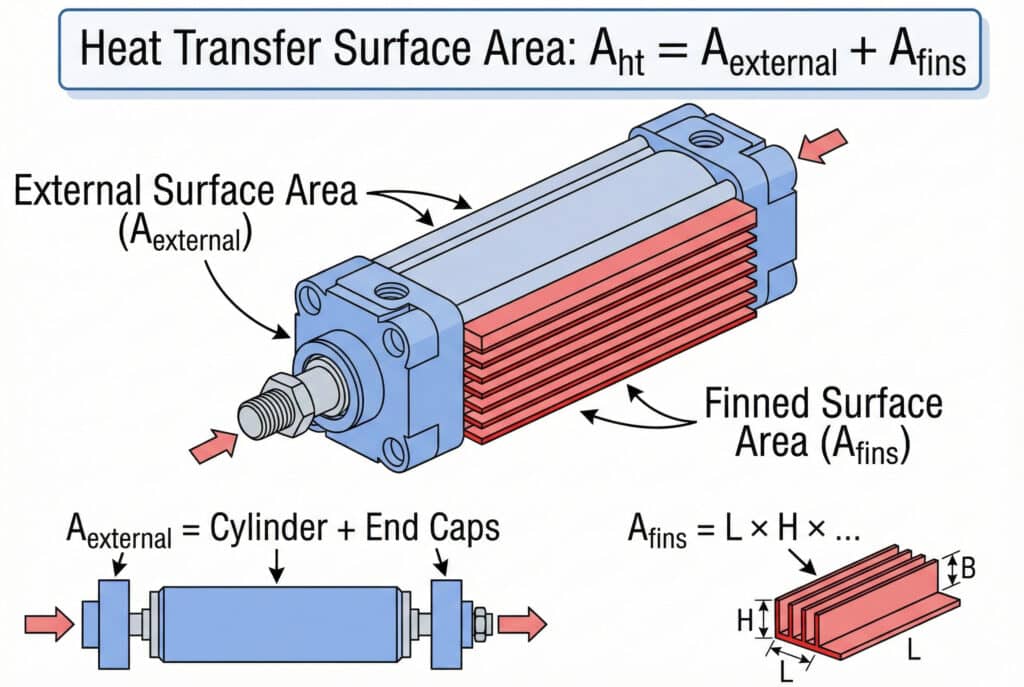
Basic Heat Transfer Area Formula
The fundamental heat transfer area includes all exposed surfaces:
External Cylinder Surface Area
The primary heat transfer surface:
Where:
- = Lateral cylinder surface
- = Both end cap surfaces
Heat Transfer Coefficient Applications
Surface area directly affects heat transfer rate:
Where:
- = Heat transfer rate (BTU/hr)
- = Heat transfer coefficient (BTU/hr·ft²·°F)
- = Surface area (ft²)
- = Temperature difference (°F)
Heat Transfer Coefficients by Surface
Different surfaces have varying heat transfer capabilities:
| Surface Type | Heat Transfer Coefficient | Relative Efficiency |
|---|---|---|
| Smooth Aluminum | 5-10 BTU/hr·ft²·°F | 1.0 |
| Finned Aluminum | 15-25 BTU/hr·ft²·°F | 2.5 |
| Anodized Surface | 8-12 BTU/hr·ft²·°F | 1.2 |
| Black Anodized | 12-18 BTU/hr·ft²·°F | 1.6 |
Fin Surface Area Calculations
Cooling fins significantly increase heat transfer area:
Rectangular Fins
Where:
- = Fin length
- = Fin height
- = Fin thickness
Circular Fins
Enhanced Surface Area Techniques
Various methods increase effective heat transfer area:
Surface Texturing
- Roughened Surface: 20-40% increase
- Machined Grooves: 30-50% increase
- Shot Peening3: 15-25% increase
Coating Applications
- Black Anodizing: 60% improvement
- Thermal Coatings: 100-200% improvement
- Emissive Paints: 40-80% improvement
Thermal Analysis Examples
Example 1: Standard Cylinder
- Cylinder: 4-inch bore, 12-inch length
- External Area: 175.93 square inches
- Heat Generation: 500 BTU/hr
- Required ΔT: 500 ÷ (8 × 1.22) = 51°F
Example 2: Finned Cylinder
- Base Area: 175.93 square inches
- Fin Area: 350 square inches
- Total Area: 525.93 square inches
- Required ΔT: 500 ÷ (20 × 3.65) = 6.8°F
High-Temperature Applications
Special considerations for high-temperature environments:
Material Selection
- Aluminum: Up to 400°F
- Steel: Up to 800°F
- Stainless Steel: Up to 1200°F
Surface Area Optimization
Where:
- = Thermal conductivity
- = Fin thickness
- = Heat transfer coefficient
Cooling System Integration
Heat transfer area affects cooling system design:
Air Cooling
Liquid Cooling
Cooling Jacket Area = Internal Surface Area
I recently helped Carlos, a thermal engineer from a Mexican automotive plant, solve overheating in their high-speed stamping cylinders. His original design had 180 square inches of heat transfer area but generated 1,200 BTU/hr. We added cooling fins to increase effective area to 540 square inches, reducing operating temperature by 45°F and eliminating thermal failures.
What are Advanced Surface Area Applications?
Advanced surface area applications optimize cylinder performance through specialized calculations for coating, thermal management, and tribological analysis.
Advanced surface area applications include tribological analysis4, coating optimization, corrosion protection, and thermal barrier calculations for high-performance pneumatic systems.
Tribological Surface Area Analysis
Surface area affects friction and wear characteristics:
Friction Force Calculation
Where:
- = Coefficient of friction
- = Normal force
- = Actual contact area
- = Nominal surface area
Surface Roughness Effects
Surface finish significantly impacts effective surface area:
Actual vs Nominal Area Ratio
| Surface Finish | Ra (μin) | Area Ratio | Friction Factor |
|---|---|---|---|
| Mirror Polish | 2-4 | 1.0 | 1.0 |
| Fine Machined | 8-16 | 1.2 | 1.1 |
| Standard Machined | 32-63 | 1.5 | 1.3 |
| Rough Machined | 125-250 | 2.0 | 1.6 |
Coating Surface Area Calculations
Precise coating calculations ensure proper coverage:
Coating Volume Requirements
Multi-Layer Coatings
Corrosion Protection Analysis
Surface area determines corrosion protection requirements:
Cathodic Protection
Coating Life Prediction
Thermal Barrier Calculations
Advanced thermal management uses surface area optimization:
Thermal Resistance
Multi-Layer Thermal Analysis
Surface Energy Calculations
Surface energy affects adhesion and coating performance:
Surface Energy Formula
Wetting Analysis
Advanced Heat Transfer Models
Complex heat transfer requires detailed surface area analysis:
Radiation Heat Transfer
Where:
- = Surface emissivity
- = Stefan-Boltzmann constant
- = Surface area
- = Absolute temperature
Convection Enhancement
Surface Area Optimization Strategies
Maximize performance through surface area optimization:
Design Guidelines
- Maximize Heat Transfer Area: Add fins or texturing
- Minimize Friction Area: Optimize seal contact
- Optimize Coating Coverage: Ensure complete protection
Performance Metrics
- Heat Transfer Efficiency:
- Coating Efficiency:
- Friction Efficiency:
Quality Control Surface Measurements
Surface area verification ensures design compliance:
Measurement Techniques
- 3D Surface Scanning: Actual area measurement
- Profilometry: Surface roughness analysis
- Coating Thickness: Verification methods
Acceptance Criteria
- Surface Area Tolerance: ±5-10%
- Roughness Limits: Ra specifications
- Coating Thickness: ±10-20%
Computational Surface Analysis
Advanced modeling techniques optimize surface area:
Finite Element Analysis
You can use Finite Element Analysis5 to model these complex interactions.
CFD Analysis
Economic Optimization
Balance performance and cost through surface area analysis:
Cost-Benefit Analysis
Life Cycle Costing
Conclusion
Surface area calculations provide essential tools for pneumatic cylinder optimization. The basic A = 2πr² + 2πrh formula, combined with specialized applications, ensures proper thermal management, coating coverage, and performance optimization.
FAQs About Cylinder Surface Area Calculations
What is the basic cylinder surface area formula?
The basic cylinder surface area formula is , where A is total surface area, r is radius, and h is height or length of the cylinder.
How do you calculate piston surface area?
Calculate piston surface area using , where r is the piston radius. This circular area determines pressure force and seal contact requirements.
How does surface area affect heat transfer in cylinders?
Heat transfer rate equals , where A is surface area. Larger surface areas provide better heat dissipation and lower operating temperatures.
What factors increase effective surface area for heat transfer?
Factors include cooling fins (2-3x increase), surface texturing (20-50% increase), black anodizing (60% improvement), and thermal coatings (100-200% improvement).
How do you calculate surface area for coating applications?
Calculate total exposed surface area using , then multiply by coating thickness and waste factor to determine material requirements.
-
Learn what the heat transfer coefficient is and how it quantifies the intensity of heat transfer between a surface and a fluid. ↩
-
Explore the scientific importance of the surface-area-to-volume ratio and how it influences processes like heat dissipation. ↩
-
Discover how the shot peening process works to strengthen metal surfaces and improve fatigue life and stress corrosion resistance. ↩
-
Understand the principles of tribology, the science of friction, wear, and lubrication between interacting surfaces in relative motion. ↩
-
Learn about Finite Element Analysis (FEA), a powerful computational tool used by engineers to simulate physical phenomena and analyze designs. ↩