

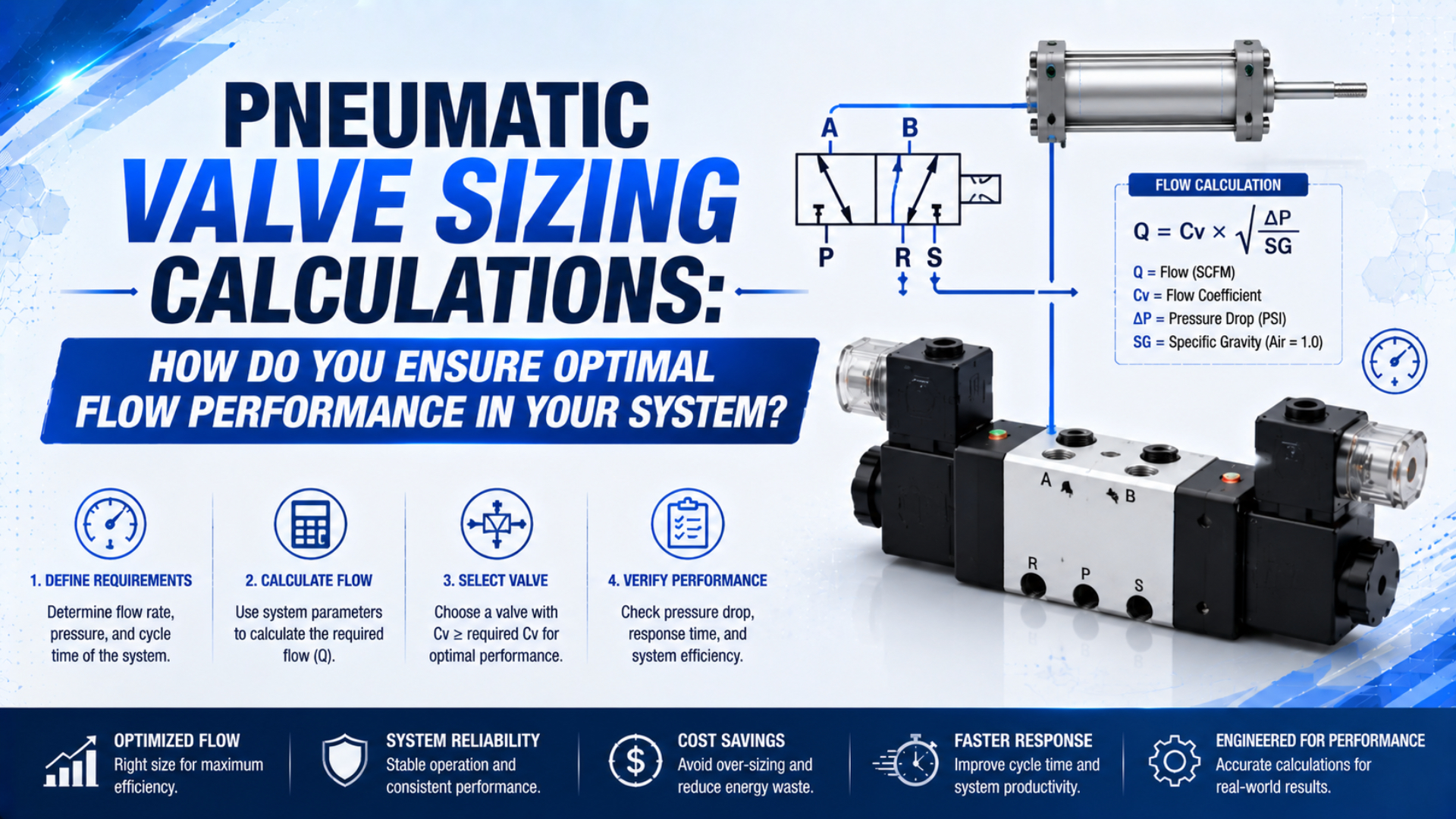
Pneumatic valve sizing calculations are a traceable chain from cylinder geometry and stroke time to catalog flow data and loaded-machine verification. Start with the air required during the commanded stroke, not cycle-average consumption or port thread. Calculate both chamber volumes, use absolute pressure, and apply one manufacturer-supported Cv or ISO 6358 method.
This article audits a completed calculation: it checks missing inputs, units, pressure references, rating methods, directional paths, and acceptance evidence. For the initial sizing workflow around a fixed motion target, use sizing a solenoid valve for a specific cylinder stroke time. For coefficient fundamentals, read what Cv means in a pneumatic system.
Key Takeaways
- Parker’s worked cylinder example requires Cv 1.06 for a one-second stroke.
- Use absolute pressure and the target time for each stroke.
- Calculate extension and retraction separately.
- Check supply and exhaust ratings at stated catalog conditions.
- Prove the choice with dynamic pressure and timed-stroke tests.
Calculation Audit Gate 1: Are the Required Inputs Complete?
Parker’s published Cv 1.06 example uses five application inputs: 3.25-inch bore, 12-inch stroke, 80 psig supply, a five-psi permitted pressure drop, and a one-second stroke (Parker Pneumatic Valve Products Engineering Data, accessed July 22, 2026). Missing any one changes the result.
Record the following values for both extension and retraction:
| Input | Required value | Why it changes valve sizing |
|---|---|---|
| Cylinder geometry | Bore, rod diameter, stroke | Defines cap-end and rod-end chamber volume |
| Motion target | Extension time, retraction time, dwell time | Separates stroke demand from average consumption |
| Pressure | Loaded valve inlet and cylinder-port pressure | Defines usable pressure and permitted drop |
| Load state | Mass, direction, acceleration, friction | Determines whether the calculated pressure can move the load |
| Air path | Valve model, tube ID and length, fittings, controls, mufflers | Identifies restrictions outside the valve body |
| Operating pattern | Cycles per minute and simultaneous actuators | Defines branch and compressor demand |
| Environment | Air temperature and catalog reference conditions | Keeps standard-flow conversions consistent |
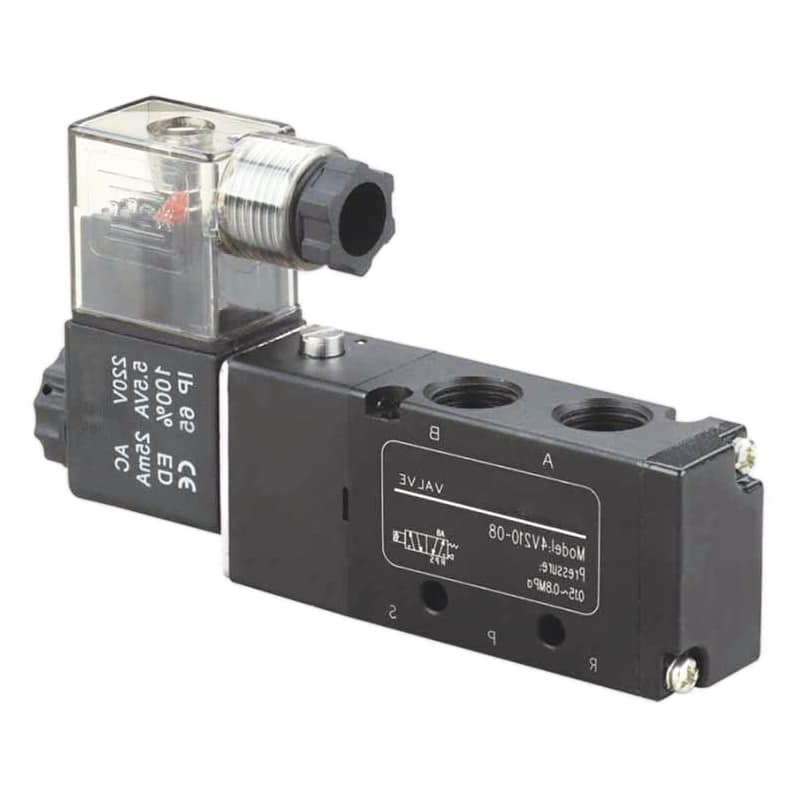
Port size belongs on the list, but it isn’t a capacity rating. Two G1/4 valves can have different spool passages, internal turns, pilot arrangements, and exhaust ratings. Ask for the flow data for the actual inlet-to-work-port and work-port-to-exhaust paths. Don’t assume one headline value describes every route through a 5/2 or 5/3 valve.
The minimum usable dataset is directional. A single value called “required SCFM” hides which chamber is filling, which chamber is exhausting, how long that stroke may take, and which valve path is active. A worksheet with separate extension and retraction columns prevents that ambiguity before a model number enters the discussion.
Calculation Audit Gate 2: Are Extension and Retraction Volumes Correct?
A 4-inch bore with a 1-inch rod has 12.566 in² cap-end area and 11.781 in² rod-side area, a 6.25% difference. The geometry follows the pressure-area relationships used in pneumatic cylinder catalogs such as Parker’s P1F technical catalogue (Parker P1F Catalogue, accessed July 22, 2026).
For a single-rod cylinder, cap-end piston area is:
Here, is cap-end area and is bore diameter. The rod-side annular area is:
Here, is rod-side area and is rod diameter. Use compatible length units throughout.
Geometric chamber volumes are:
In these equations, and are extension and retraction volumes, and is stroke. Add tube and manifold dead volume when it is large relative to the cylinder chamber. That addition can matter on small-bore cylinders connected through long tubing.
A double-rod cylinder can have equal working areas when both rods have the same diameter. A rodless cylinder needs its own effective-volume information. In either case, use the actual actuator geometry rather than forcing the single-rod equations onto a different construction.
Calculation Audit Gate 3: Are Pressure and Standard Flow Defined?
NIST defines one standard atmosphere as 14.6959 psi, so a 90 psig chamber is approximately 104.7 psia before a standard-volume conversion is made (NIST Pressure and Gas Flow Unit Conversions, accessed July 22, 2026). Using 90 instead of 104.7 understates the pressure ratio.
First convert gauge pressure to absolute pressure:
Here, is absolute chamber pressure, is gauge pressure, and is local atmospheric pressure. Use measured local atmospheric pressure when altitude or weather materially affects the acceptance tolerance.
For a first-pass ideal-gas conversion from chamber volume to the manufacturer’s standard reference volume:
Here, is equivalent volume at the stated standard condition, is chamber volume, and are the catalog’s standard absolute pressure and temperature, and is the air’s absolute operating temperature. This estimate assumes the same gas composition and does not model transient heat transfer or valve dynamics.
Convert that volume into average flow during one commanded stroke:
Here, is standard volume per minute and is stroke time in seconds. Use cubic feet for SCFM or litres for standard L/min. Always state the reference conditions because “standard” is not identical in every catalog.
The calculator provides a demand estimate, not a final valve model. It helps expose missing inputs and compare extension with retraction. The next step is to translate that demand with the chosen valve manufacturer’s pneumatic flow data.
Required stroke flow is the average standard-volume rate needed while one commanded movement occurs. It sizes the local supply and exhaust path. Cycle-average consumption serves a different purpose: it estimates recurring demand on the branch, receiver, and compressor over a longer interval.
Calculation Audit Gate 4: Does the Cv Method Match the Catalog?
Parker calculates Cv 1.06 for a 3.25-inch bore cylinder moving 12 inches in one second at 80 psig with a permitted five-psi drop (Parker Engineering Data, accessed July 22, 2026). The catalog method includes pressure-specific constants that a liquid-flow shortcut omits.
Parker expresses its cylinder method as:
In this catalog equation, is cylinder area in square inches, is stroke in inches, is the supply-pressure compression factor, and is stroke time in seconds. Parker calls the “A Constant” for permitted pressure drop. At 80 psig and a five-psi drop, its worked example uses .
This isn’t a universal constant set. Use the table and units supplied with the candidate valve family. A coefficient calculated with Parker’s method cannot be dropped into another supplier’s catalog without checking how that supplier states pneumatic capacity.
ISO 6358-1 specifies steady-state testing for pneumatic components using compressible fluids, while ISO 6358-3 describes how component characteristics are used to estimate system flow in both subsonic and choked regimes (ISO 6358-1, confirmed 2022; ISO 6358-3, confirmed 2025). Catalogs following this method commonly provide sonic conductance and critical pressure ratio .
Use one route from beginning to end:
| Available catalog data | Correct next step | Avoid |
|---|---|---|
| Manufacturer pneumatic Cv method | Apply its pressure, temperature, gas, and unit instructions | A liquid-only shortcut |
| ISO 6358 and | Use the supplier’s ISO equation, software, or flow curves | Guessing from Cv |
| Rated SCFM or standard L/min | Match the published inlet, outlet, temperature, and standard conditions | Comparing headline flows at different conditions |
| Flow curves | Read capacity at the intended pressure pair | Extrapolating past the plotted range |
For catalog comparison only, use the Cv/Kv converter. That conversion compares coefficient units; it does not calculate compressible air flow.
Calculation Audit Gate 5: Was Choked Flow Checked Correctly?
Parker limits its stated subcritical air equation to outlet absolute pressure above 0.53 times inlet absolute pressure, while ISO 6358 uses the tested component’s own critical pressure ratio (Parker Engineering Data; SMC Flow-Rate Characteristics, accessed July 22, 2026). Therefore, 0.53 isn’t universal.
Calculate the absolute pressure ratio at the active valve path:
Here, is upstream absolute pressure and is downstream absolute pressure. For ISO-style data, compare with the published :
Critical pressure ratio is the component’s tested boundary between its subsonic and choked-flow regions. It must come from the applicable catalog or ISO 6358 data rather than from a fixed rule copied between different valve families.
- When , the component is in its choked-flow region.
- When , use the supplier’s subsonic relationship or curve.
“Choked” has a precise gas-dynamics meaning. Don’t use it as a synonym for any restrictive valve. A tube, muffler, or undersized fitting can limit cylinder speed without the valve itself operating at sonic conditions.
SMC’s pneumatic calculation software models components in series and parallel and warns that calculated results can differ from actual equipment (SMC Flow, Pressure, Pressure-Drop and Sonic-Conductance Software, accessed July 22, 2026). That warning is practical: sizing calculations choose a candidate, while measurements accept or reject the installed path.
Worked Error Check: Why Cycle-Average SCFM Is Not Valve Flow
At 90 psig and a 14.7 psia atmospheric reference, the absolute-pressure ratio is about 7.12. NIST’s 14.6959 psi standard-atmosphere definition supports that conversion (NIST, accessed July 22, 2026). The example below keeps temperature equal to the selected standard condition for clarity.
Assume a double-acting cylinder with these worksheet inputs:
| Input | Value |
|---|---|
| Bore | 4.00 in |
| Rod diameter | 1.00 in |
| Stroke | 12.00 in |
| Chamber pressure | 90 psig |
| Atmospheric reference | 14.7 psia |
| Extension target | 1.0 s |
| Retraction target | 1.0 s |
| Full cycles | 15 per minute |
The cap-end area is 12.566 in², giving 150.8 in³ or 0.0873 ft³ geometric volume. At the 7.12 pressure ratio, one extension uses about 0.622 standard ft³. Completing that extension in one second requires an average of approximately 37.3 SCFM during the stroke.
The rod-side area is 11.781 in², giving 141.4 in³ or 0.0818 ft³. One retraction uses about 0.583 standard ft³ and requires about 35.0 SCFM during a one-second retract.
By contrast, 15 complete cycles per minute consume approximately:
Here, and are standard volumes per extension and retraction, and is full cycles per minute. The result is about 18.1 SCFM before tube volume, leakage, and other allowances.
| Result | Approximate value | What it sizes |
|---|---|---|
| Extension filling-path average | 37.3 SCFM | Average standard-volume demand while the cap-end chamber fills |
| Retraction filling-path average | 35.0 SCFM | Average standard-volume demand while the rod-end chamber fills |
| Cycle-average consumption | 18.1 SCFM | Branch, receiver, and compressor planning |
The filling-path values do not define exhaust flow by themselves. During extension, the rod-side chamber exhausts through its own changing pressure profile; during retraction, the cap-end chamber does the same. Check each exhaust route with the supplier’s directional flow data and confirm its back pressure on the machine.
The 18.1 SCFM average cannot justify a valve rated for only 18.1 SCFM at unrelated conditions. During motion, the filling path must pass roughly twice that average in this example. If both strokes must finish in half a second, their required average filling flows double again even though the volume consumed per cycle does not.
The exact valve coefficient still cannot be determined from these numbers alone. You must choose an allowed pressure drop and apply the candidate supplier’s pneumatic method or flow curve. That boundary is useful: it prevents a precise-looking but unsupported Cv from entering the bill of materials.
Calculation Audit Gate 6: Are Supply and Exhaust Paths Separated?
Parker states that each valve flow path has its own Cv, and its worked cylinder calculation uses a five-psi permitted drop rather than a generic percentage margin (Parker Engineering Data, accessed July 22, 2026). A valid review therefore follows every active route through the valve.
For cylinder extension, check inlet to cap-end supply and rod-end to exhaust. For retraction, check inlet to rod-end supply and cap-end to exhaust. A 5/2 valve may have different capacity for those paths. A meter-out controller and silencer then add direction-specific restrictions after the valve rating.
Use this flow-path worksheet:
| Stroke | Filling path | Exhausting path | Required evidence |
|---|---|---|---|
| Extension | Regulator, manifold, valve P-to-A, tube, cap port | Rod port, controller, valve B-to-exhaust, silencer | Dynamic pressures and extension time |
| Retraction | Regulator, manifold, valve P-to-B, tube, rod port | Cap port, controller, valve A-to-exhaust, silencer | Dynamic pressures and retraction time |
Don’t add fixed pressure losses for elbows, filters, or quick couplers. Their loss depends on flow, bore, geometry, and operating pressure. Use supplier curves or measure the assembled path. For long tubing, compare the result with compressed-air pressure-drop causes and corrections and the Pressure Drop Calculator.
Simultaneous actuators need a time-based review. Add only the demands that genuinely overlap, then check the shared branch, manifold inlet, regulator, and local receiver. Adding every actuator’s maximum flow produces needless oversizing; ignoring overlap produces pressure sag.
Acceptance Evidence That Proves the Selection
CAGI recommends limiting pressure drop from compressor discharge to the point of use to 10% in a well-designed system (CAGI Pressure Drop Technical Brief, accessed July 22, 2026). That system-level target doesn’t replace local testing, but it gives a useful trigger for investigating loaded pressure loss.
Before the machine is released, record:
- Valve part number and the source page for each relevant Cv, , , or rated-flow value.
- Published inlet, outlet, temperature, gas, and standard reference conditions.
- Cylinder bore, rod diameter, stroke, load direction, and target time for each stroke.
- Tube ID and length, fitting count, speed-controller orientation, and silencer model.
- Valve inlet pressure and both cylinder-port pressures while the actuator moves.
- Extension and retraction times at cold start, normal temperature, maximum permitted load, and production cycle rate.
- Concurrent machine functions that share the same air branch.
In our experience, a regulator gauge observed at rest is one of the least useful acceptance readings. The pressure trace during acceleration tells a different story. If the valve inlet collapses, investigate the upstream branch. If inlet pressure holds but the cylinder port lags, examine the valve, fittings, and tube. If exhaust pressure rises, inspect the meter-out path and silencer.
Change one restriction at a time and repeat the same loaded cycle. A larger valve is justified when the valve has been isolated as the controlling restriction and the replacement’s stated flow data cover the actual pressure pair. Otherwise, the bigger body may leave stroke time unchanged.
Parker’s Virtual Engineer valve workflow allows a generic actuator or general pneumatic flow requirement as the starting application and then compares suitable valve options (Parker Virtual Engineer Valve Overview, accessed July 22, 2026). Use selection software as a documented cross-check, not as a substitute for recording its inputs and testing the installed circuit.
What Should the Final Calculation-Audit Record Contain?
ISO 6358-1 was confirmed in 2022, ISO 6358-3 in 2025, and Amendment 2 to Part 1 was published in April 2026 to address measurement uncertainty (ISO 6358-1; ISO 6358-1 Amendment 2:2026, accessed July 22, 2026). A traceable record must identify the test method and conditions.
Keep one calculation package with four layers:
- Demand: extension and retraction volume, absolute pressure, temperature reference, and target stroke time.
- Selection: the exact catalog equation, curve, or ISO 6358 data used for each valve path.
- Circuit: tubing, fittings, manifold, regulator, speed controls, and exhaust accessories.
- Acceptance: loaded pressure traces, stroke times, test conditions, instrument IDs, and pass limits.
The record should also state what is not known. If rod diameter, downstream pressure, or the catalog’s standard-flow reference is missing, mark the calculation incomplete. That’s safer than hiding the gap behind an arbitrary 25% safety factor.
For a broader installed-system diagnosis, see how valve Cv affects system performance and how pressure fluctuations affect pneumatic equipment.
Pneumatic Valve Sizing FAQs
Parker’s Cv 1.06 example and ISO 6358’s separate subsonic and choked regimes show why one shortcut cannot cover every pneumatic valve (Parker Engineering Data; ISO 6358-3, accessed July 22, 2026). These answers address the decisions most likely to change a selection.
Can I size a pneumatic valve from cylinder cycles per minute alone?
No. Cycles per minute estimate average air consumption, but the valve must pass air during each commanded stroke. Add bore, rod diameter, stroke, working pressure, and separate extension and retraction times. Then compare the stroke demand with catalog flow data at the same inlet, outlet, temperature, and standard conditions.
Is port size enough to compare two directional valves?
No. Port size describes the connection, not the internal capacity. Compare the stated Cv, ISO 6358 conductance, critical pressure ratio, or flow curve for each relevant supply and exhaust path. Also check tube ID, fittings, manifold passages, speed controls, and silencers because any one can dominate the installed pressure drop.
Should I add a fixed safety factor to calculated Cv?
There is no universal percentage that covers every pneumatic circuit. Select the next suitable catalog capacity only after defining allowed pressure loss and uncertainty. Validate it at low supply pressure, maximum permitted load, cold start, production rate, and simultaneous demand. Record the tested margin between passing performance and the acceptance limit.
Can Cv be converted directly into ISO 6358 sonic conductance?
Not with a universal divisor. Cv and Kv originate from liquid reference tests, while ISO 6358 characterizes compressible pneumatic flow with values such as sonic conductance and critical pressure ratio . Use manufacturer-reported data or approved software for the exact component instead of estimating one rating from another.
Why is the cylinder still slow after installing a higher-Cv valve?
The valve may not be the controlling restriction. Measure valve inlet pressure, both cylinder-port pressures, and stroke time during motion. A small tube, undersized regulator, restrictive fitting, meter-out setting, clogged silencer, cushion adjustment, shared branch, or insufficient exhaust path can prevent a larger valve from improving speed.
Sources and technical references
- Parker Pneumatic Valve Products Engineering Data, pneumatic Cv equations, pressure-drop factors, path-specific Cv, and the Cv 1.06 example.
- ISO 6358-1, steady-state testing of pneumatic components using compressible fluids.
- ISO 6358-3, system flow calculations using component flow characteristics.
- ISO 6358-1 Amendment 2:2026, measurement uncertainty amendment.
- SMC Flow-Rate Characteristics, sonic conductance, critical pressure ratio, and standard reference conditions.
- SMC Pneumatic Calculation Software, series and parallel pneumatic-device calculations and limitations.
- NIST Pressure and Gas Flow Unit Conversions, standard atmosphere and pressure conversions.
- CAGI Pressure Drop Technical Brief, compressed-air distribution pressure-drop guidance.
- Parker Virtual Engineer Valve Overview, documented valve selection workflow.