

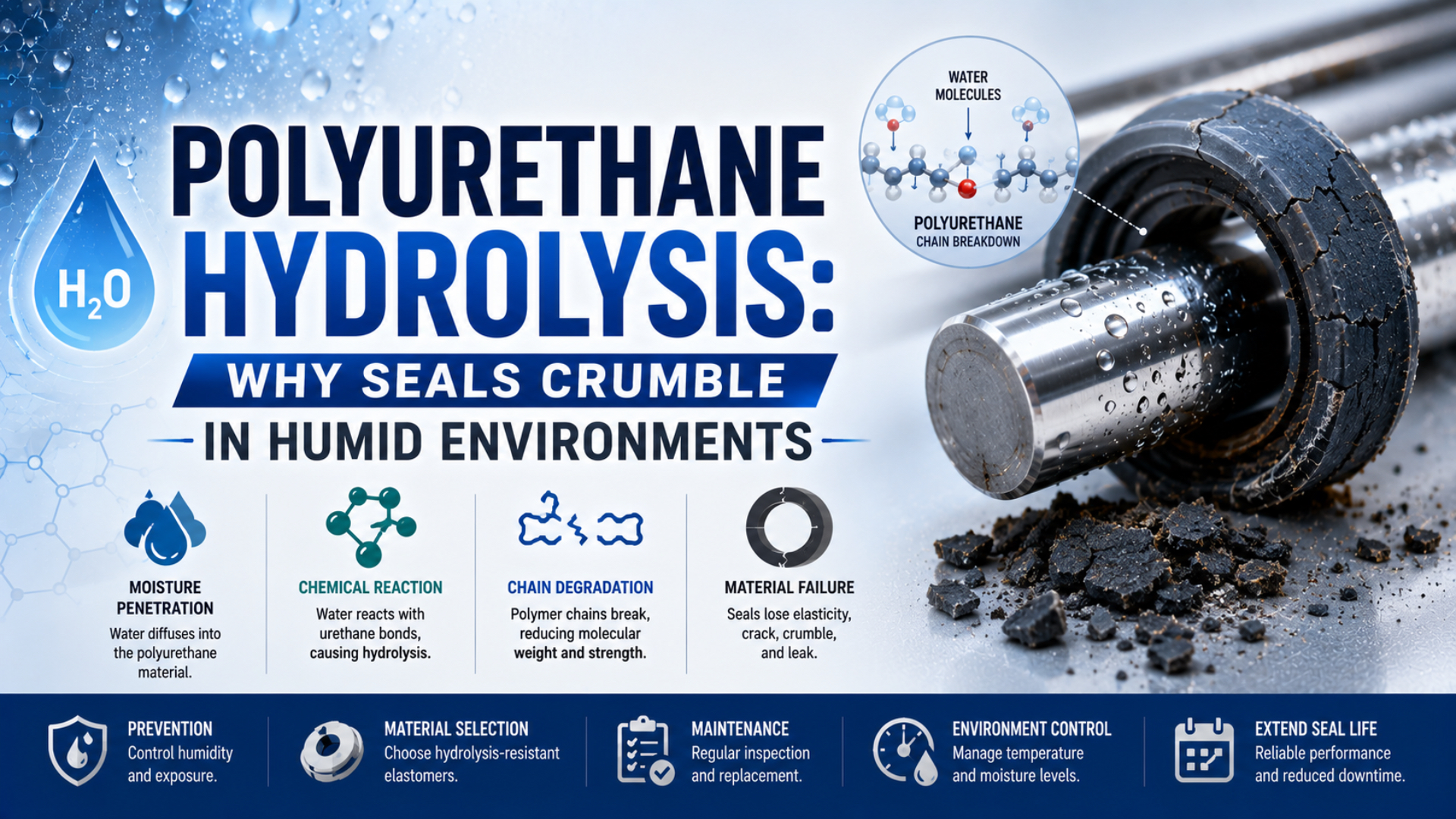
Polyurethane seal hydrolysis is irreversible chain degradation caused by water reacting with susceptible polymer segments. Suspect it when a seal loses tensile strength or elongation after sustained water, vapor, condensation, or hot-humid exposure. Humidity alone does not prove the diagnosis. Material chemistry, temperature, exposure time, additives, cleaning fluids, lubrication, and measured property changes all matter.
Key Takeaways
- Polyester-based polyurethane is generally more vulnerable to hydrolysis than polyether-based material.
- Ambient humidity, pressure dew point, steam, condensation, and washdown are different exposures.
- Tackiness or crumbling is evidence of degradation, not proof of one root cause.
- Approve the exact compound with representative aging and property-retention data.
What Actually Happens During Polyurethane Hydrolysis?
BASF describes thermoplastic polyurethane as the reaction product of 3 component groups: polyols, diisocyanates, and short-chain diols. Polyol chemistry strongly influences hydrolysis resistance, but the finished compound also depends on raw materials, reaction conditions, component ratios, and additives (BASF Elastollan Material Properties, accessed 2026).
Polyurethane is a material family, not one recipe. Polyols, chain extenders, isocyanates, additives, and processing conditions change the finished properties. A datasheet that says only “PU” does not establish hydrolysis resistance.
In a susceptible polyester soft segment, water can cleave ester linkages and reduce molecular-chain length. A simplified reaction is:
This expression shows the bond-cleavage relationship, not a complete seal formulation. As molecular weight falls, tensile strength, elongation, tear resistance, and elastic recovery can decline. The result may appear as softening, tackiness, cracking, loss of lip force, fragmentation, or leakage, but the visible sequence is not universal.
BASF’s chemical-properties guide compares two named TPU grades and uses tensile strength and elongation at break as separate end criteria. That is the right level of evidence: identified compounds, defined exposure, and measured property limits. The curves should not be converted into a universal field-life table for every pneumatic seal.
Why Isn’t Relative Humidity a Universal Failure Threshold?
ISO 8573-1 separates compressed-air purity into 3 principal contaminant groups: particles, water, and oil. Its water class describes compressed air at a stated system location (ISO 8573-1:2010, accessed 2026). It does not classify ambient relative humidity, direct washdown, rain, steam, or liquid trapped around a seal.
Relative humidity describes water vapor in surrounding air at a given temperature. Pressure dew point is the temperature at which water begins to condense in compressed air at pressure. Neither value states how much water reaches a particular seal or how long it remains there.
Keep these exposure paths separate:
| Exposure path | What to document | Why it matters |
|---|---|---|
| Compressed air inside the cylinder | Pressure dew point or water class, measurement point, pressure, oil and particles | Internal air may condense after cooling or pressure changes |
| Ambient plant air | Relative humidity and temperature over time | It affects exposed wipers and stored parts but not every internal seal equally |
| Washdown or rain | Fluid, temperature, duration, frequency, detergent and drainage | Direct wetting can dominate the exposure even when plant air is dry |
| Steam or hot vapor | Surface temperature, condensate, dwell and shutdown cycle | Heat and condensed water act together |
| Process liquid or cleaner | Exact chemistry, concentration, pH, contact time and rinse | Chemical attack can resemble or accelerate hydrolytic damage |
| Storage | Packaging, temperature, humidity, light and inventory age | A spare can degrade before installation if storage controls are poor |
The engineering boundary is the seal’s water and temperature history, not one room-humidity reading. For instance, an air dryer can reduce water carried through the line, but it cannot stop washdown water reaching a wiper. A boot may reduce external wetting, yet it will not correct internal condensation.
Use the ISO compressed-air quality guide to specify internal air correctly. For dry-air friction and wear, the PTFE versus polyurethane seal comparison explains why water, oil, particles, grease, counterface, and motion must be recorded separately.
How Can You Distinguish Hydrolysis from Other Seal Failures?
ISO 37:2024 identifies 6 tensile stress-strain properties that can be determined for vulcanized or thermoplastic rubber, including tensile strength and elongation at break (ISO 37:2024). A credible diagnosis compares retained properties and exposure history; appearance alone cannot establish hydrolysis.
Start with the failure location. A rod seal exposed to coolant, sunlight, and a damaged wiper has a different evidence path from a piston seal protected inside the bore. For example, a seal cut during installation can fragment without polymer degradation. A seal running on a scored rod can shed particles even when its chemistry is intact.
Use symptoms as prompts for investigation:
| Finding | Hydrolysis is possible when | Also check |
|---|---|---|
| Tackiness or softening | Water exposure and property loss are documented | Cleaner, oil, grease, plasticizer migration, heat and incompatible chemicals |
| Cracking or embrittlement | The compound and exposure support hydrolytic chain damage | UV, ozone, thermal oxidation, flex fatigue and low-temperature damage |
| Crumbling or tearing | Tensile or elongation retention has fallen | Installation cuts, extrusion, abrasive wear and excessive gland clearance |
| Discoloration | It appears with other mechanical changes | Pigment aging, UV exposure, heat, microbes, lubricant and process staining |
| Progressive leakage | Seal force or geometry has degraded | Rod or bore scoring, guide wear, side load, contamination and valve leakage |
| Premature compression set | Material properties changed after exposure | Excess temperature, wrong squeeze, long dwell and incompatible fluid |
Do not use odor as a pass-fail test. Do not identify polyester or polyether polyurethane by color, transparency, or a narrow Shore hardness range. Commercial grades overlap, pigments hide the base material, and additives alter both appearance and hardness.
The industrial cylinder seal-type guide helps identify whether the failed item is a piston seal, rod seal, wiper, static seal, guide, or rodless-cylinder band. That functional distinction should come before material conclusions.
Which Polyurethane Type Should You Specify?
BASF distinguishes 2 common TPU polyol families in its material overview: polyester-based and polyether-based. Polyester polyols provide strong mechanical, heat, and mineral-oil properties. Polyether polyols provide the highest hydrolysis resistance and low-temperature flexibility within that product family (BASF Elastollan Material Properties, accessed 2026).
That comparison is a screening rule, not an approval. A hydrolysis-stabilized polyester grade can outperform an unsuitable generic material in a defined duty. Polyether polyurethane is not immune to oxidation, chemicals, heat, abrasive wear, poor lubrication, or mechanical overload. Polycarbonate-based polyurethane can be another candidate, but its suitability also requires exact compound data and representative testing.
| Candidate | Useful reason to screen it | Evidence still required |
|---|---|---|
| Polyester-based polyurethane | Wear, mechanical strength, mineral-oil exposure, known dry duty | Hydrolysis stabilization, water and temperature exposure, retained properties |
| Polyether-based polyurethane | Sustained water, vapor, humid-heat or microbiological exposure | Exact chemical compatibility, wear, compression set, temperature and lubricant data |
| Polycarbonate-based polyurethane | Specialized long-term aqueous or biomedical duties | Supplier-specific data, cost, availability, friction, wear and processing evidence |
| Non-PU alternative | Exposure exceeds the qualified PU envelope | Seal profile, friction, extrusion, temperature, media and counterface compatibility |
Specify the finished seal compound, not merely the polymer family. The purchase record should include the supplier’s compound code, manufacturing batch or traceability reference, hardness scale and target, color only as an identification aid, applicable medium, temperature range, and the test evidence used for release.
Also review the complete seal system. The pressure seal, wiper, energizer, backup ring, guide material, grease, adhesive, rod coating, and cleaner can have different limits. The pneumatic cylinder seal-material guide provides a broader comparison of NBR, FKM, EPDM, polyurethane, and PTFE-based options. For valve applications, use the separate valve seal compatibility guide.
A Defensible Validation Plan for Hydrolysis Resistance
ISO 1817:2024 is the 8th edition of the standard for evaluating vulcanized and thermoplastic rubber before and after immersion in service or reference liquids (ISO 1817:2024). It provides a comparison framework. The liquid, temperature, duration, specimen, and acceptance limits must still represent the seal application.
Property retention is the percentage or amount of a measured property that remains after a defined exposure. It is meaningful only when the starting value, conditioning, specimen, method, exposure, and acceptance limit are recorded.
Build the validation plan around a baseline and a controlled exposure:
- Record the exact compound, batch, specimen geometry, conditioning procedure, and starting properties.
- Define the exposure medium. Use actual process water, condensate, cleaner, lubricant, or a justified reference fluid.
- Define temperature, duration, replenishment, agitation, and whether exposure is immersion, vapor, cyclic wet-dry, or another method.
- Measure mass, dimensions, hardness, tensile strength, elongation, appearance, and any application-specific property before and after exposure.
- Test the finished seal or representative hardware when lip force, leakage, friction, compression set, or gland interaction matters.
- Set written acceptance limits before the test begins.
BASF’s hydrolysis curves demonstrate why end criteria matter. One curve uses tensile strength of 20 MPa; another uses elongation at break of 300 percent. Those thresholds describe the compared grades and test method. They are not universal pneumatic-seal failure limits.
Do not turn a short accelerated test into an exact number of field years without a validated model. Temperature acceleration may follow Arrhenius-type behavior over a suitable range, but reaction mechanism, water uptake, diffusion, additives, specimen thickness, and changing failure criteria can invalidate a simple conversion.
A practical qualification matrix uses at least four evidence layers:
| Evidence layer | Question it answers |
|---|---|
| Supplier compound data | What material was actually supplied? |
| Controlled property-retention test | How does it respond to the defined exposure? |
| Finished-seal or component test | Does the profile still seal and move acceptably? |
| Field inspection trend | Does installed performance match the laboratory boundary? |
If supplier data covers only a material coupon, do not assume the same result for a thin sealing lip under squeeze, reciprocation, contamination, and repeated wet-dry cycles.
Risk Controls for Service and Storage
ISO 2230:2026 organizes rubber-product storage around 4 connected controls: inspection, records, packaging, and storage conditions (ISO 2230:2026). The same systems approach works in service: identify the water path, control temperature and exposure, preserve traceability, and inspect against a documented baseline.
Use controls that match the actual exposure:
- Select an exact compound qualified for the expected water, temperature, lubricant, cleaner, motion, and service interval.
- Reduce internal condensation with a suitable compressed-air water specification and verified pressure dew point at the relevant location.
- Improve drainage so wash water and condensate do not remain around the wiper, gland, boot, or mounting recess.
- Use shields, covers, bellows, or appropriate enclosures when they reduce direct wetting without trapping water or heat.
- Keep hot surfaces, steam lines, radiant heat, and stagnant enclosures away from the cylinder where practical.
- Verify detergents, sanitizers, coolants, oils, greases, and corrosion inhibitors against every exposed material.
- Preserve failed parts and track compound batch, installation date, duty, exposure, and inspection findings.
- Store spare seals in supplier-approved packaging under the supplier’s temperature, humidity, light, ozone, and stock-rotation requirements.
Do not assign a generic shelf life from polymer family alone. Follow the seal manufacturer’s date-control and reinspection instructions. Packaging damage, unknown warehouse conditions, or missing traceability justifies inspection before installation, even when the calendar age appears acceptable.
The air-lubrication and seal-material guide explains why changing airline lubrication can alter an existing grease and seal system. Moisture control should not create a new lubricant-compatibility problem.
What Should Be Included in a Failure Report or RFQ?
A failure report should cover 5 evidence groups: part identity, seal function, operating duty, environmental exposure, and failed-part condition. These mirror controls in ISO 37, ISO 1817, and ISO 2230. Together they help a supplier recommend a testable compound.
Send:
- Cylinder manufacturer, model, bore, stroke, rod size, mounting, and drawing or clear nameplate photos.
- Seal position and function: piston, rod, wiper, static joint, cushion, energizer, backup, or rodless-cylinder sealing band.
- Existing seal dimensions, profile, compound code, hardness, color, batch, and supplier documentation.
- Pressure, speed, stroke frequency, dwell, load direction, side load, alignment, lubrication, and expected service measure.
- Compressed-air pressure dew point or water class at a stated location, plus oil and particle requirements.
- Ambient temperature and humidity trend, direct water, rain, steam, condensation, washdown, cleaner, coolant, and process chemicals.
- Leakage trend, motion symptoms, inspection photos, fracture surface, deposits, rod or bore condition, and guide wear.
- Unused reference seals from the same batch when available.
- Required acceptance limits for leakage, breakaway, running friction, retained properties, and inspection interval.
FAQs About Polyurethane Seal Hydrolysis
BASF compares hydrolysis resistance using 2 mechanical end criteria. ISO 8573-1 separates compressed-air particles, water, and oil into 3 purity categories. The questions below keep material identity, exposure route, and property retention separate instead of collapsing them into one humidity threshold.
Can a hydrolyzed polyurethane seal be restored?
No. Hydrolysis breaks susceptible polymer chains and reduces molecular weight, so drying the seal does not rebuild the original material. Replace the damaged seal, preserve it for analysis, inspect the mating surfaces and guides, and correct the water, temperature, chemical, or material-selection condition before installing the replacement.
Can I identify polyester or polyether polyurethane by color or hardness?
No. Pigments, additives, processing, aging, and overlapping hardness ranges make visual identification unreliable. Use the supplier’s compound code, batch record, drawing, certificate, or material analysis. Treat color and Shore hardness as supporting identification details, not proof of the polyurethane’s polyol chemistry or hydrolysis resistance.
Does ISO 8573-1 Class 4 prevent seal hydrolysis?
No. ISO 8573-1 classifies compressed-air contaminants at a stated system location. A water class can support internal condensation control, but it does not address rain, external humidity, steam, washdown, trapped liquid, cleaning chemicals, or the hydrolysis resistance of the exact seal compound.
Is polyether polyurethane always the best replacement?
No. Polyether-based polyurethane is generally screened first for hydrolysis resistance, but the finished seal must also meet wear, friction, compression set, temperature, chemical, lubricant, extrusion, and counterface requirements. A named, tested compound is more defensible than selecting a generic polymer family from one property.
How should accelerated aging be converted into field life?
Do not use a universal conversion. A defensible life model needs evidence that the same degradation mechanism and acceptance criterion apply across test and service conditions. Water uptake, diffusion, temperature, additives, specimen thickness, stress, motion, and wet-dry cycling can all change the relationship between laboratory aging and field performance.
Sources and technical references
Manufacturer material guides and current ISO pages are linked inline beside the claims they support and were checked on 2026-07-23.