Introduction
Have you ever ordered a pneumatic cylinder based on SCFM ratings, only to find it underperforming in your actual application? 😰 This costly mistake happens more often than you’d think. The confusion between SCFM and ACFM has led to thousands of dollars in wasted equipment purchases, production delays, and frustrated engineering teams across manufacturing facilities worldwide.
SCFM (Standard Cubic Feet per Minute) measures air flow under standardized conditions (14.7 psia, 68°F, 0% humidity), while ACFM (Actual Cubic Feet per Minute) measures the real volumetric flow rate at your specific operating conditions including actual temperature, pressure, and humidity. Understanding this difference is critical for properly sizing pneumatic equipment like rodless cylinders and avoiding costly system failures.
I’m Chuck, Sales Director at Bepto Pneumatics, and I’ve seen this confusion cause serious headaches for our clients. Just last month, a maintenance engineer named David from a automotive plant in Michigan called us in panic—his newly installed rodless cylinder system was moving sluggishly because the compressor was spec’d in SCFM but his high-temperature application needed ACFM calculations. Let me help you avoid this expensive mistake.
Table of Contents
- What Is SCFM and Why Does It Matter for Pneumatic Systems?
- What Is ACFM and How Does It Differ from SCFM?
- How Do You Convert Between SCFM and ACFM?
- Which Should You Use: SCFM or ACFM for Rodless Cylinders?
What Is SCFM and Why Does It Matter for Pneumatic Systems?
When you’re comparing compressors or pneumatic components from different manufacturers, you need a level playing field for specifications. That’s exactly where SCFM comes in. 📊
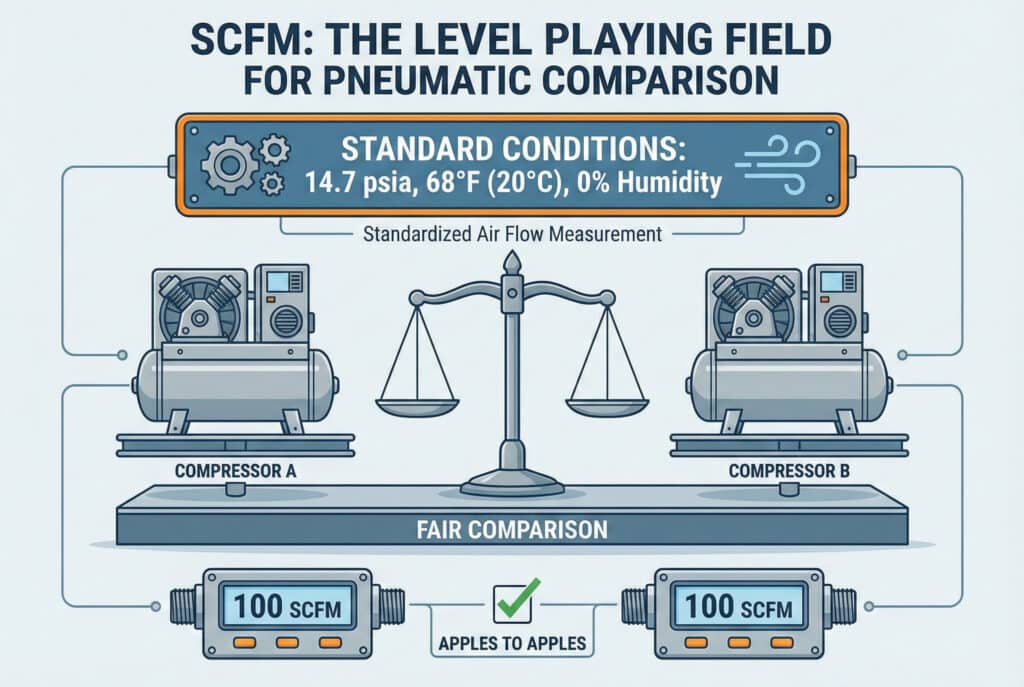
SCFM is a standardized measurement that allows fair comparison between equipment by measuring air flow at consistent baseline conditions: 14.7 psia pressure, 68°F (20°C) temperature, and 0% relative humidity. This standardization eliminates variables so engineers can compare apples to apples when evaluating different pneumatic products.
The Standard Conditions Defined
The pneumatic industry has agreed upon these standard conditions for SCFM:
- Pressure: 14.7 psia1 (pounds per square inch absolute) or 1 atmosphere at sea level
- Temperature: 68°F (20°C) or sometimes 60°F depending on the standard used
- Humidity: 0% relative humidity2 (completely dry air)
- Density: Approximately 0.075 lb/ft³
Why Manufacturers Use SCFM
At Bepto Pneumatics, we publish our rodless cylinder specifications in SCFM because it gives you a consistent baseline. When you’re comparing our replacement cylinders against OEM parts from major brands, SCFM lets you make accurate technical comparisons without worrying about where the testing was performed or under what conditions.
The Hidden Problem with SCFM
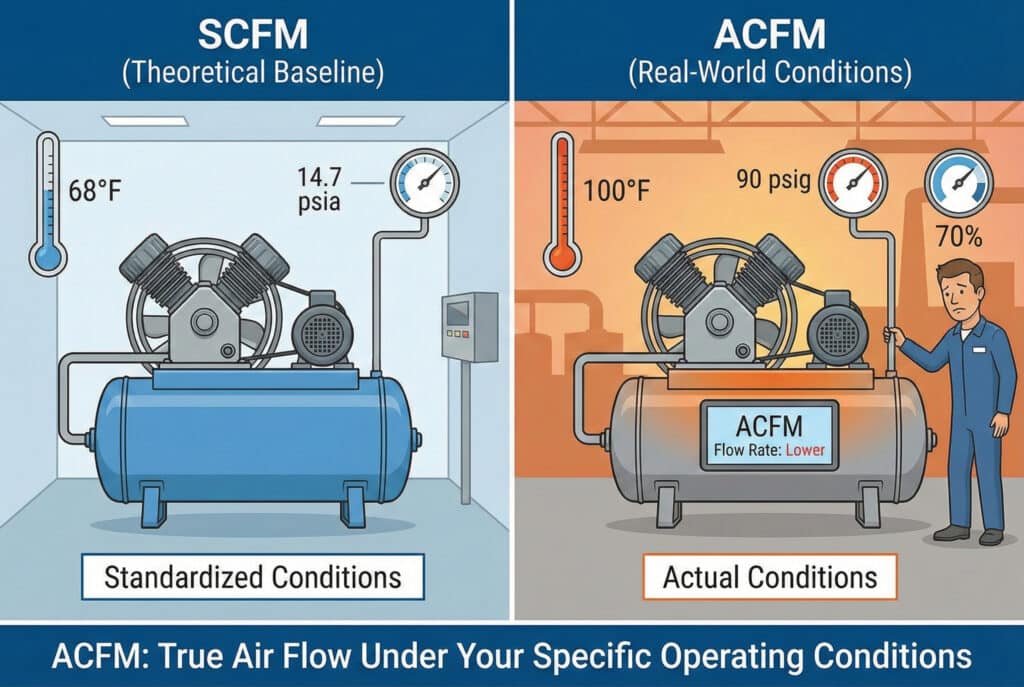
Here’s the catch: your factory floor isn’t at standard conditions. Your compressed air system operates at actual temperature, actual pressure, and actual humidity levels. A compressor rated at 100 SCFM might only deliver 85-90 ACFM in your hot, humid facility. This gap causes undersized systems and performance issues.
What Is ACFM and How Does It Differ from SCFM?
ACFM represents the real world—the actual air flowing through your pneumatic system right now, under your specific operating conditions. 🌡️
ACFM (Actual Cubic Feet per Minute) measures the true volumetric flow rate3 of compressed air at the actual temperature, pressure, and humidity present in your facility. Unlike SCFM’s theoretical baseline, ACFM reflects real-world performance and is essential for determining if your system will actually meet production demands.
Real-World Variables That Affect ACFM
Several factors cause ACFM to differ significantly from SCFM ratings:
| Factor | Impact on ACFM | Typical Range |
|---|---|---|
| Temperature | Higher temp = Higher ACFM | 60°F to 120°F in facilities |
| Pressure | Lower pressure = Higher ACFM | 80-125 psig operating range |
| Humidity | Higher humidity = Slightly higher ACFM | 20%-80% relative humidity |
| Altitude | Higher altitude = Higher ACFM | Sea level to 5,000+ feet |
A Real Story from the Field
Let me share a case that perfectly illustrates this. Sarah, a procurement manager at a packaging machinery company in Phoenix, Arizona, contacted us frustrated after installing a “100 SCFM” compressor that couldn’t keep up with her production line’s rodless cylinders. 😓
When we analyzed her situation, we discovered the problem: Phoenix’s high altitude (1,100 feet) and summer temperatures (often 100°F+ in the facility) meant her compressor was actually delivering only about 82 ACFM. Her pneumatic system needed 95 ACFM to run properly. We helped her calculate the correct compressor size using ACFM, and switched her to our Bepto high-efficiency rodless cylinders that required 15% less air flow. Within 48 hours of installation, her line was running smoothly, and she saved $8,000 compared to buying an oversized OEM compressor.
Why ACFM Matters for System Design
When you’re designing or troubleshooting a pneumatic system with rodless cylinders, ACFM tells you:
- Actual delivery capacity of your compressor
- Real air consumption of your cylinders during operation
- True system requirements including line losses
- Whether you have sufficient margin for peak demand
How Do You Convert Between SCFM and ACFM?
Converting between SCFM and ACFM isn’t guesswork—it’s straightforward physics using the ideal gas law4. Let me show you the practical approach we use at Bepto. 🔧
The conversion formula is: ACFM = SCFM × (Pstd/Pact) × (Tact/Tstd) × (1 + humidity factor), where Pstd is standard pressure (14.7 psia), Pact is actual absolute pressure, Tstd is standard temperature (528°R or 68°F), and Tact is actual absolute temperature in Rankine5 (°F + 460). This formula accounts for how air volume changes with pressure and temperature.
![A technical diagram illustrating the conversion from SCFM to ACFM. The top section displays the formula: ACFM = SCFM × (Pstd / Pact) × (Tact / Tstd) × (1 + Humidity Factor). Below it, a flowchart visualizes the process: a large blue cube representing SCFM (Standard Volume) at 68°F and 14.7 psia passes through a "CONVERSION PROCESS" icon (gears). This process is shown to be affected by "PRESSURE EFFECT (Pstd/Pact)" (compressed spring icon) and "TEMPERATURE EFFECT (Tact/Tstd)" (heating coil icon). The result is a smaller orange cube representing ACFM (Actual Volume) at 95°F and 104.7 psia. A practical example is included at the bottom: "50 SCFM → [CONVERSION] → 7.4 ACFM".](https://rodlesspneumatic.com/wp-content/uploads/2025/12/The-Physics-of-Compressed-Air-Flow-Diagram-1024x687.jpg)
Step-by-Step Conversion Process
Converting SCFM to ACFM
- Identify your actual conditions: Measure actual pressure (psig), temperature (°F), and if critical, humidity
- Convert to absolute values: Add 14.7 to psig to get psia; add 460 to °F to get Rankine
- Apply the formula: ACFM = SCFM × (14.7/Pact) × (Tact/528)
- Add safety margin: Include 10-15% for line losses and peak demand
Practical Example
Let’s say you need a rodless cylinder system that consumes 50 SCFM, but your facility operates at:
- Pressure: 90 psig (104.7 psia absolute)
- Temperature: 95°F (555°R absolute)
- Humidity: Moderate (negligible effect)
Calculation:
ACFM = 50 × (14.7/104.7) × (555/528)
ACFM = 50 × 0.1404 × 1.051
ACFM ≈ 7.4 ACFM
Notice how the actual volume is much smaller! This is because the air is compressed and slightly warmer. Your compressor needs to supply 50 SCFM (the mass flow), but it only occupies 7.4 cubic feet per minute at your operating pressure.
Common Conversion Mistakes to Avoid
❌ Forgetting to convert to absolute pressure (adding 14.7 to psig)
❌ Using Fahrenheit instead of Rankine for temperature
❌ Ignoring altitude effects on atmospheric pressure
❌ Not accounting for line pressure drops between compressor and application
Quick Reference Conversion Table
| SCFM | ACFM at 100 psig, 70°F | ACFM at 100 psig, 100°F |
|---|---|---|
| 10 | 1.5 | 1.6 |
| 50 | 7.3 | 7.7 |
| 100 | 14.6 | 15.4 |
| 200 | 29.2 | 30.8 |
Which Should You Use: SCFM or ACFM for Rodless Cylinders?
The answer depends entirely on what you’re trying to accomplish—and using the wrong one can cost you thousands in equipment and downtime. 💰
Use SCFM when comparing equipment specifications, calculating total mass air consumption, or sizing compressors, because it provides standardized comparison across manufacturers. Use ACFM when measuring actual system performance, troubleshooting flow issues, or verifying that your existing compressor can handle additional equipment at your specific operating conditions.

When to Use SCFM
Equipment Selection & Comparison
When you’re shopping for rodless cylinders or comparing our Bepto replacement parts against OEM options, SCFM gives you the fair comparison you need. All reputable manufacturers publish SCFM ratings at standard conditions.
System Air Consumption Calculations
If you’re adding up the air requirements for multiple cylinders, valves, and tools, do it in SCFM. This tells you the total mass of air your compressor must generate.
Compressor Sizing
Compressor manufacturers rate their output in SCFM because it represents the actual mass of air they can compress, regardless of delivery conditions.
When to Use ACFM
Verifying Existing System Capacity
When a client like David from Michigan asks “Can my current compressor handle three more rodless cylinders?”, we calculate in ACFM based on his actual facility conditions.
Troubleshooting Performance Issues
If cylinders are moving slowly or stalling, measuring ACFM at the point of use reveals whether you have adequate flow at operating pressure.
Pipe and Valve Sizing
Flow velocities through pipes and valves depend on ACFM, not SCFM. Undersized piping creates pressure drops that rob your system of performance.
The Bepto Approach: Best of Both Worlds
At Bepto Pneumatics, we provide both specifications for our rodless cylinders:
| Specification Type | What We Provide | Why It Matters |
|---|---|---|
| SCFM Rating | Air consumption at standard conditions | Fair comparison with OEM parts |
| ACFM Calculator | Online tool for your conditions | Real-world performance prediction |
| Pressure Range | Optimal operating pressure | Ensures proper sizing |
| Technical Support | Free consultation with our team | Avoid costly mistakes |
We’ve helped hundreds of clients avoid the expensive trial-and-error approach. Our replacement rodless cylinders are designed to match or exceed OEM performance while delivering 25-35% cost savings and faster delivery times—typically 3-5 days versus 4-6 weeks for original parts.
Conclusion
Understanding the difference between SCFM and ACFM isn’t just technical trivia—it’s the key to properly sizing your pneumatic systems, avoiding costly equipment failures, and maximizing your compressed air efficiency. Use SCFM for standardized comparisons and system planning, but always verify with ACFM calculations for your actual operating conditions. 🎯
FAQs About SCFM vs ACFM in Compressed Air Systems
Is SCFM higher than ACFM?
Not necessarily—it depends entirely on your operating conditions. At typical compressed air pressures (80-125 psig), ACFM will be much lower than SCFM because the air is compressed into a smaller volume. However, at atmospheric pressure with high temperature, ACFM could be higher than SCFM. The key is that SCFM measures mass flow while ACFM measures volumetric flow at actual conditions.
Can I use SCFM ratings directly to size my pneumatic system?
No, you must convert to ACFM for your specific conditions first. While SCFM is perfect for comparing equipment, your actual system operates at real-world pressure, temperature, and humidity. A compressor rated at 100 SCFM might only deliver 85 ACFM in a hot facility at high altitude. Always calculate ACFM to ensure adequate capacity, and add 10-15% safety margin for peak demand.
Why do rodless cylinder manufacturers specify air consumption in SCFM?
SCFM provides a standardized baseline that allows fair comparison across all manufacturers and operating conditions. At Bepto Pneumatics, we publish SCFM ratings so you can directly compare our replacement cylinders against OEM parts. This standardization eliminates confusion caused by different testing conditions. However, we also provide conversion tools to help you determine actual performance in your facility.
How does altitude affect the SCFM to ACFM conversion?
Higher altitude reduces atmospheric pressure, which increases ACFM relative to SCFM at the same gauge pressure. At sea level, atmospheric pressure is 14.7 psia, but at 5,000 feet elevation it drops to about 12.2 psia. This means your compressor works harder to achieve the same gauge pressure, and the ACFM will be higher for the same SCFM rating. If you’re operating at significant altitude, factor this into your calculations or contact our technical team for assistance.
What’s more important for rodless cylinder performance: SCFM or ACFM?
Both matter, but for different reasons. SCFM tells you the mass of air the cylinder consumes, which determines compressor sizing. ACFM tells you the actual volumetric flow rate at your operating pressure, which affects cylinder speed and force. For optimal performance, you need sufficient SCFM capacity from your compressor AND adequate ACFM flow through properly sized valves, fittings, and supply lines. We at Bepto help clients optimize both aspects for maximum efficiency and cost savings.
-
Understand the critical difference between PSIA (Absolute) and PSIG (Gauge) pressure measurements. ↩
-
Explore how relative humidity measures water vapor saturation and affects air density. ↩
-
Learn the definition of volumetric flow rate and how it differs from mass flow rate. ↩
-
Review the fundamental physics principles governing the behavior of gases under varying temperature and pressure. ↩
-
Learn about the Rankine absolute temperature scale used in engineering thermodynamics calculations. ↩