

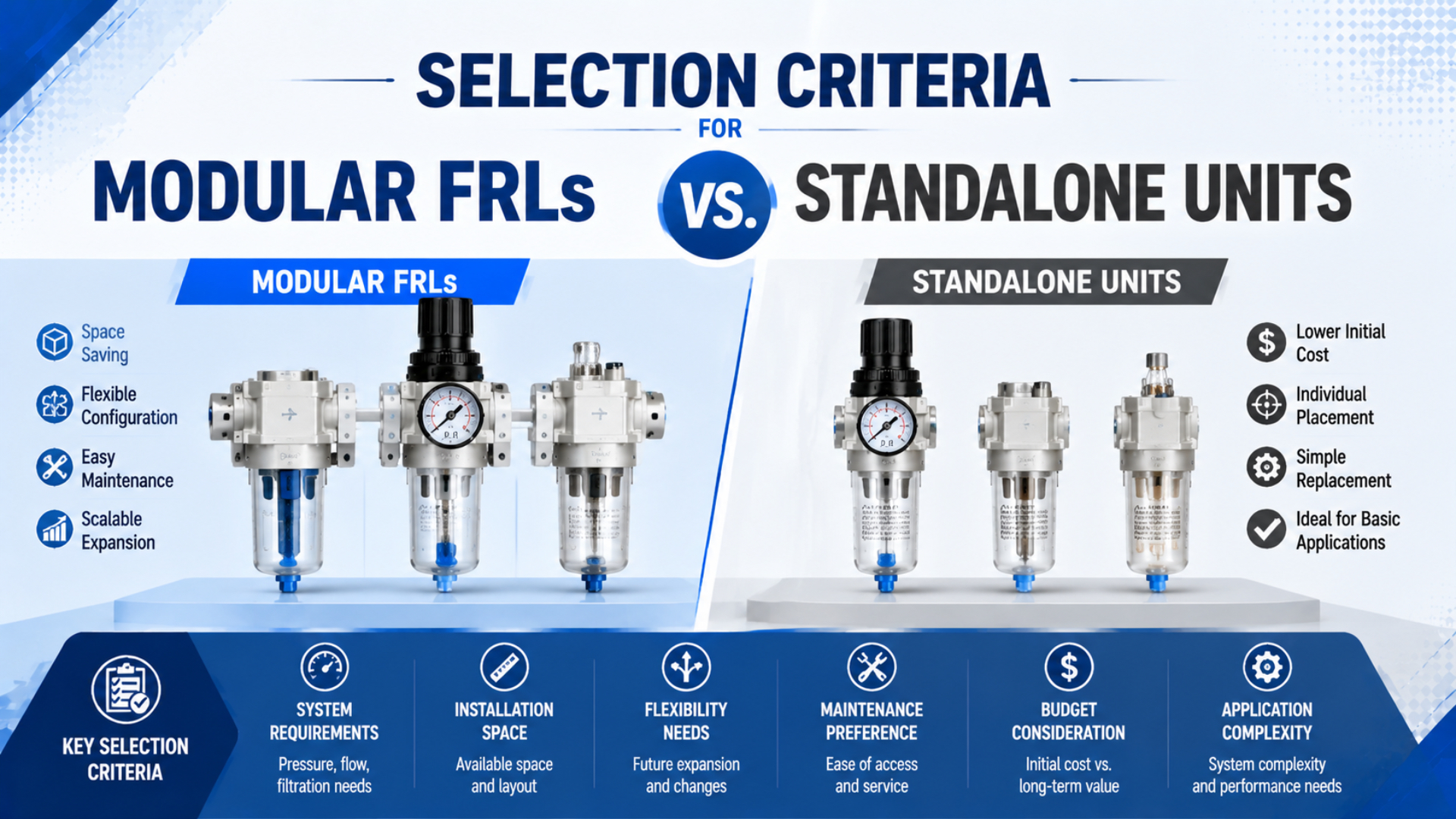
Choose a modular FRL when the machine needs a configurable air-preparation stack, family-matched accessories, or future function changes. Choose a standalone combination when the treatment duties are fixed, the unit fits the available envelope, and replacing or servicing that catalog assembly is acceptable. Neither architecture is automatically cheaper, lower-loss, or easier to maintain.
The useful comparison begins with function, not packaging. Define the filtration grade, regulator behaviour, drain, isolation, soft-start or dump function, sensing, bowl material, and lubrication policy. Then compare complete flow curves, mounting dimensions, service access, connector fit, and spare-part strategy under the machine’s real operating conditions.
Key Takeaways
- “Standalone” must be defined: a fixed combination is different from separately piped components.
- Compare complete-assembly pressure loss at peak flow, not port size alone.
- Modular connectors help configuration, but safe service still requires isolation, depressurization, and verified spare compatibility.
In this guide
- Define the comparison before selecting hardware
- Which air-preparation functions belong in the assembly?
- How should you size the complete flow path?
- When does modular packaging earn its space?
- When is a standalone unit the cleaner choice?
- Maintenance access must include energy isolation
- How should you compare lifecycle cost?
- FRL architecture RFQ and commissioning checklist
- Modular vs. standalone FRL FAQs
Define the Comparison Before Selecting Hardware
SMC’s AC-D catalog lists five modular air-preparation combinations, with available ports ranging from 1/8 to 1 inch depending on the function set (SMC AC-D Web Catalog, accessed 2026-07-27). That range shows why “FRL unit” is not one fixed internal arrangement.
Use three architecture names in the specification:
- A modular service-unit stack is a set of family-matched function blocks joined by the manufacturer’s body connectors, spacers, or port blocks. Modules can be selected and ordered as one assembly, but each interface remains part of the pressure and fit check.
- A standalone combination unit is a fixed catalog assembly installed as one item. It may integrate a filter-regulator or combine filtration, regulation, and optional lubrication. Internal service parts may still be replaceable.
- A discrete piped layout is made from individual filters, regulators, lubricators, or valves connected with nipples, tubing, or fittings. This is a third architecture, not another name for a standalone combination.
The title compares modular and standalone units, but an RFQ should state which standalone meaning applies. Otherwise one supplier may quote a compact filter-regulator while another quotes three separately piped components. Both can appear compliant until dimensions, pressure loss, service parts, and installation labour are compared.
This packaging decision is also different from regulator location. A machine can use a modular entry assembly and still add selected branch regulators. The separate guide to centralized FRL versus point-of-use regulation covers that pressure-zone question.
Which Air-Preparation Functions Belong in the Assembly?
Festo states that its MS filter-regulator can be installed as a service-unit module and offers four sizes across a wide flow spectrum (Festo MS Series, accessed 2026-07-27). Size and modularity are separate decisions; first select only the functions the machine actually needs.
Start with the air-quality and control requirements:
| Required function | Selection evidence | Common specification error |
|---|---|---|
| Particle filtration | Point-of-use purity target, element grade, flow curve, differential-pressure limit | Selecting the finest element without accounting for loading and pressure loss |
| Bulk-liquid separation | Inlet moisture condition, drain type, bowl capacity, installation orientation | Expecting a local bowl to replace a correctly sized dryer |
| Pressure regulation | Inlet range, outlet range, relieving behaviour, flow characteristic, adjustment lock | Selecting from port size and static setpoint |
| Lubrication | Downstream equipment manual, oil type, minimum flow, contamination restrictions | Treating a lubricator as mandatory in every FRL |
| Safe isolation and exhaust | Site energy-control design, exhaust capacity, lock provision, residual-pressure check | Calling a shut-off knob an energy-isolation procedure |
| Soft start | Machine restart risk, allowed pressure ramp, valve flow and dump behaviour | Assuming one ramp rate suits every actuator group |
| Pressure or flow sensing | Measurement range, accuracy, location, output, alarm logic | Adding a sensor without defining the decision it supports |
A lubricator belongs in the stack only when every downstream device and process served by that oil mist permits it. Factory-lubricated valves and cylinders may not need continuous oil, while paint, clean, food-contact, or sensing applications may prohibit it. Once oil is introduced into a branch, later removal can be difficult.
The FRL function and reliability guide explains filtration, regulation, lubrication, and sizing in more detail. If the choice is between liquid separation and fine aerosol control, use the separate water separator and coalescing-filter comparison.
How Should You Size the Complete Flow Path?
Parker reports filter flow at 90 psig inlet and 5 psig pressure drop, while several regulator ratings use 100 psig inlet, a 90 psig no-flow setting, and 10 psig pressure drop (Parker Prep-Air II Catalog, 2026). A flow number is meaningful only with its test conditions. Test the stack as one flow path.
Check the full assembly at peak simultaneous demand. A modular stack can contain a filter, coalescer, regulator, lubricator, shut-off valve, soft-start valve, sensor block, and several connectors. The smallest or most restrictive element can control the available flow even when every body has the same nominal port thread.
Measure or obtain the complete-assembly pressure loss at the required flow:
Here, is pressure loss across the installed air-preparation assembly, is the stated flow at consistent reference conditions, and and are synchronized pressures during that flow. Use the manufacturer’s combination curve when available, then verify the installed result during the actual machine cycle.
Port size is a connection dimension, not a capacity rating. Two 1/2-inch products can use different internal passages, filter media, valve seats, springs, and connectors. Regulator droop also matters. For example, an outlet set correctly at zero flow can fall during a clamp, rapid cylinder stroke, or blow-off event.
The Pressure Drop Calculator can estimate straight pipe and fitting loss. It does not model the internal FRL filter element or regulator characteristic, so it remains an inline aid rather than the article’s primary calculator. For component-level flow relationships, see the pneumatic valve pressure-drop guide.
When Does Modular Packaging Earn Its Space?
Parker lists both two-unit and three-unit modular combinations, and its port-block catalog covers NPT and BSPP connections from 1/4 to 3/4 inch depending on series (Parker Prep-Air II Catalog, 2026, pp. E47-E50). Modular value comes from a documented family interface, not from appearance alone.
A modular stack is a strong candidate when:
- the function set includes more than a basic filter-regulator;
- the enclosure needs a compact, supported assembly with consistent body sizes;
- the manufacturer offers the required shut-off, soft-start, sensor, branch, or coalescing modules;
- one module is likely to need a different specification during the machine’s life;
- service kits and replacement modules are stocked for the exact family and generation;
- the mounting and connector system allows safe access after surrounding hardware is installed.
Do not assume that any same-size module can be inserted later. Connector geometry, sealing method, flow direction, body width, generation, pressure rating, and accessory fit can change within one brand. A new module can also increase overall length, weight, pressure loss, or support requirements.
Multiple pressure zones require a branching design. SMC’s AR□M(K)-D is a dedicated common-supply regulator that connects with AC-D combinations and supplies different pressures to multiple air lines (SMC Modular Type Common Supply Regulator, accessed 2026-07-27). Serially stacking ordinary regulators does not create independent parallel zones.
Reserve physical and pneumatic expansion capacity separately. An empty DIN-rail space does not prove that the existing filter, shut-off valve, or supply branch can carry another module’s flow. Likewise, unused flow capacity does not prove that the enclosure has room to remove a bowl or release a body connector.
When Is a Standalone Unit the Cleaner Choice?
SMC’s AC-D family includes combinations from filter-regulator plus lubricator to filter-regulator plus mist separator, with some configurations available from 1/8 to 1 inch ports (SMC AC-D Web Catalog, accessed 2026-07-27). A fixed combination can still provide several treatment functions without a future reconfiguration requirement.
A standalone combination is often cleaner when the machine has one stable air specification, one established flow range, and a direct replacement strategy. It can reduce selection decisions and eliminate family-specific expansion planning. That benefit is real only when the complete unit’s flow curve, mounting, drains, bowls, gauge, and repair parts match the application.
Choose the fixed combination when:
- the required function set is unlikely to change;
- a validated catalog code can be standardized across several machines;
- the unit fits the pipe centres and service envelope without adapters;
- the supplier supports the expected filter, bowl, drain, gauge, and regulator repairs;
- replacing the complete assembly is acceptable if an internal repair is unavailable;
- the installed pressure-loss and outlet-pressure tests pass at peak demand.
Discrete components are preferable in a different set of cases. For example, a large main-line filter may need a different body size from a precision regulator, or the drain may need to sit away from the control panel. Separately piped components can solve those constraints, but every added joint, bracket, and unsupported mass must be included in the install plan and leak checks.
Simple is not the same as cheap. A fixed unit that forces pipe modification during every replacement can cost more over its life than a modular assembly with stocked connectors. Conversely, a modular family with proprietary parts and no local stock can make a basic machine depend too much on one supply chain.
Maintenance Access Must Include Energy Isolation
OSHA’s 29 CFR 1910.147 addresses hazardous energy during servicing, including pneumatic energy, and requires employers to establish applicable control procedures and training (OSHA Control of Hazardous Energy, accessed 2026-07-27). A removable bowl or body connector is not permission to service a pressurized FRL.
Design the service envelope around the actual task. A technician may need space below a bowl, around a drain tube, behind a pressure gauge, or beside a connector release. Check whether the module can be removed without disturbing adjacent wiring, valves, guards, or structural brackets.
The machine’s risk assessment and site procedure remain controlling. A normal service sequence generally needs a defined isolation point, lock or equivalent control where required, downstream exhaust, verification that residual pressure is safe, and control of any load that pneumatic pressure normally supports. Reaccumulation through another branch must also be prevented.
Do not promise “hot swap” unless the system contains a specifically engineered isolation and bypass arrangement whose procedure protects the worker and maintains the required air treatment. Even then, the term should describe the approved system capability, not an ordinary module connector.
Maintenance triggers should come from evidence. Record filter differential pressure, regulator outlet behaviour during flow, drain performance, bowl condition, and contamination found downstream. The FRL reliability diagnosis guide provides a measurement sequence for separating shared air-preparation faults from local valve or actuator faults.
How Should You Compare Lifecycle Cost?
Parker catalogs both modular and close-nippled two-unit and three-unit combinations, along with repair and service kits for many of the individual components (Parker Prep-Air II Catalog, 2026). Packaging alone therefore does not determine whether one failed part requires complete-unit replacement.
Build the cost comparison from the site’s service model:
Here, is the evaluated lifecycle cost over a stated period. The terms cover initial hardware, installation, stocked spares, planned and corrective service, verified downtime, and future modification. Use the same period, labour rate, downtime basis, and production scope for both architectures.
| Cost input | Evidence to collect | Why architecture matters |
|---|---|---|
| Purchase | Comparable quotations with the same functions and ratings | Modular connectors and accessories may be separate line items |
| Installation | Fittings, supports, panel work, assembly and commissioning hours | A fixed combination may arrive ready to mount |
| Spares | Approved stocked parts and shelf value | A modular family may reduce replacement scope but increase SKU count |
| Service | Task time from isolation through verified restart | Access can matter more than connector style |
| Downtime | Confirmed production impact for the serviced machine | Parallel isolation or a stocked replacement can change restoration time |
| Future change | Known expansion scenarios and required revalidation | Modular interfaces help only within documented compatibility and capacity |
In our experience reviewing applications, the decisive line is often not purchase price. It is whether maintenance can identify one approved replacement, isolate the machine safely, reach the failed item, and restore the documented settings without rebuilding the pipework. Capture those steps before assigning a cost advantage.
Avoid invented savings percentages. A modular stack can lower service cost on one machine and raise inventory cost on another. Use purchase records, maintenance hours, actual downtime, and supplier stocking data. If a benefit cannot be tied to one of those records, keep it qualitative.
FRL Architecture RFQ and Commissioning Checklist
SMC’s five AC-D function combinations and port range from 1/8 to 1 inch illustrate how much detail one family name can hide (SMC AC-D Web Catalog, accessed 2026-07-27). A reproducible quotation needs the complete function, flow, connection, environment, service, and acceptance specification.
Provide these RFQ fields:
- required filtration and delivered air-quality target at a stated measurement point;
- regulator inlet range, outlet range, relieving requirement, peak flow, and acceptable droop;
- lubricator requirement or explicit oil-free downstream policy;
- normal, minimum, and peak simultaneous flow with reference conditions;
- maximum allowed pressure loss for the complete assembly;
- port thread, tube size, flow direction, and available mounting envelope;
- bowl material, guard, drain type, drain routing, and ambient compatibility;
- shut-off, dump, soft-start, gauge, sensor, and branch functions;
- modular family, body size, generation, connector, and spacer requirements;
- filter elements, seals, bowls, drains, gauges, and regulator service kits to stock;
- isolation, depressurization, removal clearance, and restart procedure;
- required drawings, flow curves, material data, manuals, and selection record.
Commission the selected unit under the production cycle. Record inlet and outlet pressure at peak demand, regulator recovery, drain operation, leakage, sensor outputs, and the pressure state after isolation and exhaust. Confirm that every module and connector remains accessible with the surrounding panel complete.
Modular vs. Standalone FRL FAQs
Festo offers four MS filter-regulator sizes, while Parker catalogs both two-unit and three-unit modular combinations (Festo MS Series, 2026; Parker Prep-Air II Catalog, 2026). Those product variations explain why short FRL answers still need an exact function set and model context.
Is a filter-regulator a standalone FRL?
It can be a standalone air-preparation combination, but it is not a three-function FRL because it has no lubricator. State the actual functions instead of relying on the FRL abbreviation. A filter-regulator may also belong to a modular family, so “standalone” should describe the intended connection and replacement architecture.
Does a modular FRL always have lower pressure drop?
No. Pressure loss depends on flow, element grade, regulator design, lubricator, valves, connectors, and test conditions. Compare the complete combination curve at the required flow, then measure synchronized inlet and outlet pressure during peak machine demand. A shared connector does not guarantee lower loss than every standalone design.
Can one modular FRL create several pressure zones?
Only with a documented branching arrangement and suitable regulators. Modules connected in one serial flow path do not create independent parallel outlets. SMC uses a dedicated common-supply regulator for multiple air lines. Define each branch flow, pressure, isolation behaviour, and effect on the common upstream treatment assembly.
Can a modular FRL module be replaced while the system is pressurized?
Not merely because it has a quick connector. Pneumatic energy can create hazardous motion or eject components during service. Follow the machine risk assessment and applicable energy-control procedure: isolate the source, control stored energy, exhaust the affected volume, verify the safe state, and prevent pressure from reaccumulating.
Which architecture has the lower lifecycle cost?
It depends on installation labour, stocked spares, service access, failure history, downtime, and future changes. Compare equivalent functions over the same evaluation period. Modular replacement can reduce the scope of one repair, while a standardized standalone unit may simplify inventory and shorten a complete swap.