

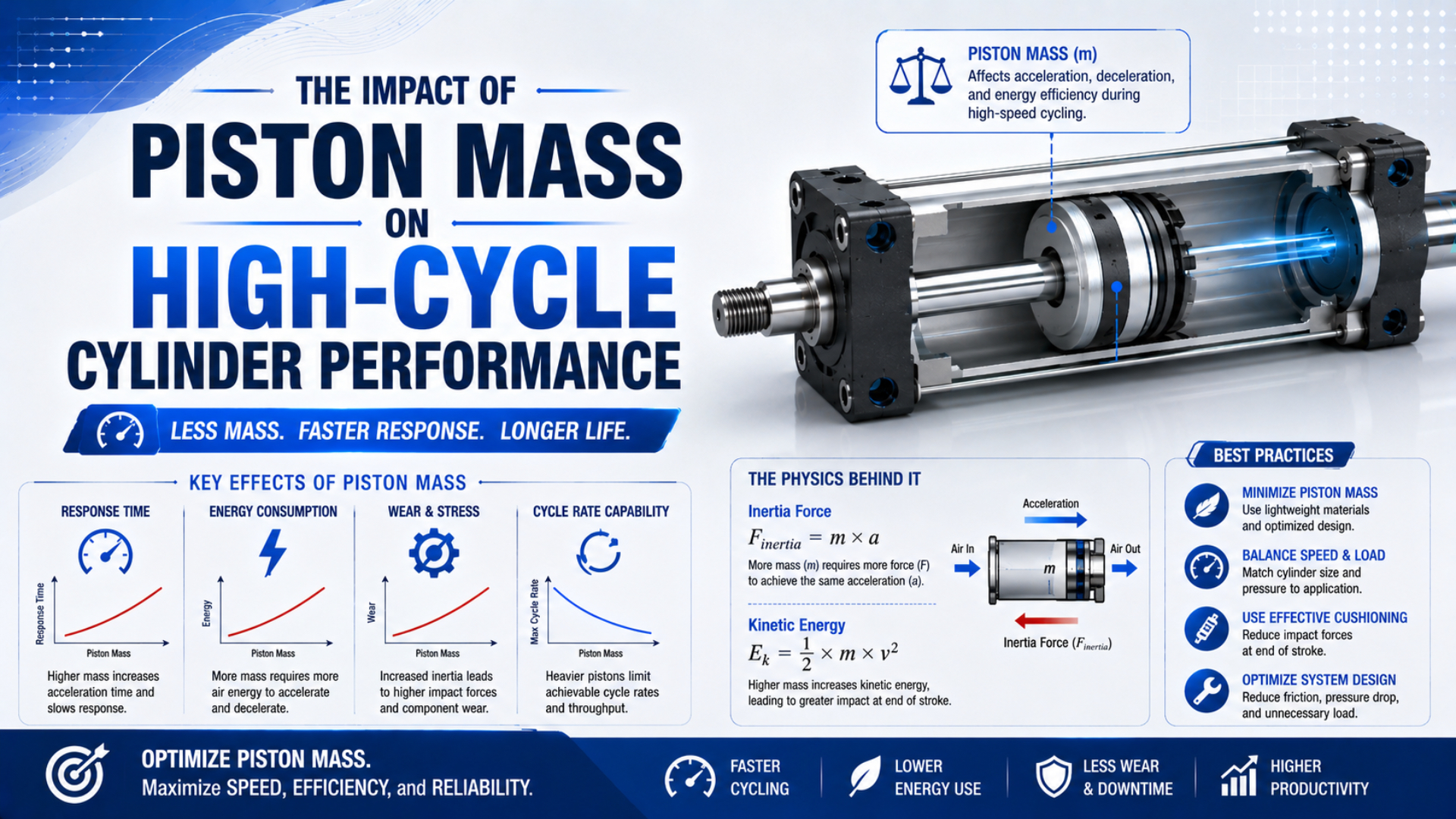
Piston mass affects acceleration force, momentum, and end-of-stroke energy, but it rarely acts alone. The useful engineering input is total moving mass: internal piston and rod components plus the payload, tooling, carriage, cables, and other hardware that accelerates with the cylinder.
A lighter internal assembly can matter in short-stroke, rapid-reversing machines with a small payload. It may have little effect when a large fixture dominates the mass. Cycle rate also cannot predict impact by itself. Stroke length, motion time, velocity profile, cushion-entry speed, stopping distance, pressure, and dwell all change the result.
Key Takeaways
- Festo lists 440 g moving mass and 1 J end-position impact energy for one 50 mm bore, 30 mm stroke cylinder.
- Inertial force and kinetic energy change linearly with mass.
- Kinetic energy changes with velocity squared.
- Reliability improvement must be demonstrated by controlled cycle testing, not inferred from a weight-reduction percentage.
Does Piston Mass Determine High-Cycle Cylinder Performance?
Piston mass is one contributor, not a complete performance rating. Festo’s 50 mm bore, 30 mm stroke DSBC example lists 440 g moving mass and 1 J impact energy in the end positions, showing that manufacturers rate the assembled moving system and its stopping limit together (Festo, accessed 2026).
The piston influences how much force is needed to accelerate the internal mechanism and how much energy must be removed when it slows. Yet a high-cycle application can still fail with a light piston if the payload is heavy, the cushion is undersized, the guide is misaligned, the valve cannot supply the required flow, or heat accumulates faster than the assembly can reject it.
The reverse is also true. A comparatively heavy internal assembly may operate reliably when speed is moderate, deceleration is controlled, and the load path stays aligned. Mass changes the physics, but it does not establish service life by itself.
The decision should therefore start with a ratio: how much of the total moving mass is inside the cylinder? If the piston and rod account for only a small share, redesigning them may produce less benefit than reducing tooling mass, lowering cushion-entry speed, or increasing stopping distance.
What Belongs in Total Moving Mass?
Total moving mass is every component that follows the piston during the evaluated motion. Parker’s cushion example combines about 14 lb of piston and rod with an 85 lb external load to obtain roughly 99 lb for sizing, so ignoring internal mass would understate that example by about 14% (Parker, accessed 2026).
Use the following relationship:
Here, includes the piston, moving rod length, rod attachment, magnet, cushion hardware, and any moving carriage parts specified by the manufacturer. The other terms include the workpiece, gripper, fixture plate, external guide carriage, cable carrier, hoses, and attachments that accelerate with the axis. Use kilograms when later equations use SI units.
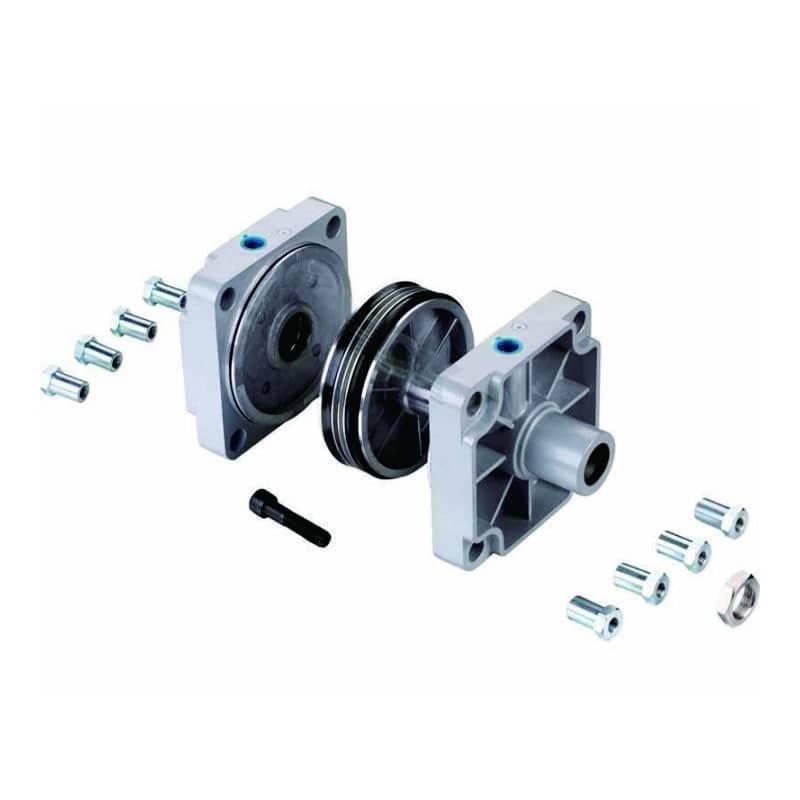
The photographed assembly shows why “piston mass” is often too narrow. The moving package can include sealing elements, a magnet, fasteners, rod connection, cushion bosses, and part of the piston rod. These pieces must remain compatible with pressure, fatigue, sealing, sensing, and cushioning requirements.
Festo’s DSBC data provides a practical example. Its 50 mm bore, 30 mm stroke configuration lists 365 g moving mass at zero stroke plus 25 g for every 10 mm of stroke, yielding 440 g. The added mass comes mainly from the longer moving rod rather than a changing piston.
How Does Mass Change Acceleration and Cushion Energy?
Inertial force is the force associated with accelerating a mass. It changes linearly with mass, while velocity has the stronger squared effect on kinetic energy. NASA states Newton’s second law as force proportional to mass and acceleration; Parker says cushion-entry speed is typically about 50% above average cylinder speed (NASA; Parker, accessed 2026).
The inertial force required for a commanded acceleration is:
is in newtons, is in kilograms, and is acceleration in metres per second squared. At the same acceleration, reducing moving mass by 10% reduces this inertial-force term by 10%. There is no exponential mass multiplier.
Momentum is:
Here, is momentum in kilogram-metres per second and is velocity in metres per second. Momentum matters when a stop changes velocity over a short time, but peak impact force also depends on the stopping time, stopping distance, compliance, and force profile.
The kinetic energy entering the deceleration zone is:
is in joules. Reducing mass by 10% reduces kinetic energy by 10% at the same velocity. Doubling velocity makes the kinetic-energy term four times larger. This is why measuring cushion-entry speed can matter more than debating a modest piston-mass difference.
The cushion or external shock absorber may also need to absorb drive energy while pressure continues pushing through the stopping distance. Use the exact product method rather than assuming kinetic energy is the only term.
For a deeper treatment of cushion mechanics, see how pneumatic cylinder cushioning prevents damage and noise. This article stays focused on the mass input.
Worked Example: When Internal Mass Is and Is Not the Main Lever
Use the Festo DSBC-50-30 moving mass of 0.440 kg with a hypothetical 5.0 kg payload and 0.8 kg fixture. At 0.75 m/s, the resulting 6.24 kg total has 1.76 J of kinetic energy, already above that exact cylinder configuration’s listed 1 J end-position impact energy (Festo, accessed 2026).
The total moving mass is:
The kinetic energy at cushion entry is:
The internal 0.440 kg contributes only:
Suppose an approved alternative cylinder reduces internal moving mass from 0.440 kg to 0.300 kg while all external mass and motion conditions stay equal. The new total is 6.10 kg and kinetic energy becomes 1.72 J. The 0.14 kg internal reduction removes about 0.04 J, or only 2.2% of the original total energy.
Now consider a light mechanism with a 0.30 kg payload and 0.10 kg fixture. Total moving mass begins at 0.84 kg. The same 0.14 kg internal reduction lowers the total by 16.7%, so inertial force and kinetic energy also fall 16.7% at unchanged acceleration and speed.
The mass-reduction benefit is approximately the removed mass divided by total moving mass:
is the fractional reduction in mass-dependent inertial force and kinetic energy when the motion profile is unchanged. It is not a service-life multiplier. In the heavy-payload example, lowering speed or increasing stopping distance offers a much larger cushion benefit than trimming 0.14 kg from the internal assembly.
The 1 J Festo value is a product-specific impact-energy rating, not a universal boundary for 50 mm cylinders. The worked example also excludes pressure drive energy through the cushion zone, so a final selection must follow the exact catalog method.
Why Can’t CPM Predict Impact Force?
Cycle rate is the number of repeated cycles per unit time, not the motion shape inside each cycle. Parker says cushion-entry speed can be about 50% higher than average speed, so two axes running at 120 CPM can reach the end cap with different velocity and energy even when their cycle counts match (Parker, accessed 2026).
One 120 CPM application may use a 20 mm stroke, gentle acceleration, long dwell, and controlled deceleration. Another may use a 300 mm stroke with little dwell and a late stop. Their average cycle rate is identical, but their speed, flow demand, cushion-entry condition, and heat generation are not.
CPM still matters because it determines how often energy passes through the mechanism. A useful exposure calculation is:
is the number of relevant acceleration or stopping events per hour, and is the energy handled during one event. This value describes energy throughput, not component temperature or fatigue life. Cooling, pressure cycles, material stress, lubrication, and load direction still matter.
Record at least stroke, extend time, retract time, dwell at both ends, measured peak speed, acceleration or deceleration estimate, cushion length, pressure, and load. If only stroke and flow are known, the Cylinder Speed Calculator can provide a preliminary estimate before measurement.
When Does Lower Internal Moving Mass Help Most?
Lower internal mass has the greatest relative effect when it is a large share of total moving mass. In the two worked cases, removing 0.14 kg changes mass-dependent energy by 16.7% with a 0.40 kg external assembly but only 2.2% with a 5.80 kg external assembly; the underlying 0.440 kg value comes from Festo (Festo, accessed 2026).
Internal mass deserves closer attention when the application has:
- Short, rapid-reversing strokes with little payload.
- High acceleration and frequent direction changes.
- Tight cushion or shock-absorber energy margins.
- A small cylinder driving light tooling.
- Sensitive positioning where structural vibration matters.
- A long rod whose added moving mass is significant relative to the workpiece.
Other changes may dominate when the payload, carriage, or fixture is much heavier than the internal assembly. In those cases, reducing tool-plate mass, shortening an adapter, moving a valve closer, lowering entry velocity, reshaping the motion profile, or installing a correctly sized shock absorber can yield more practical benefit.
Mass also interacts with available pneumatic force. A lighter system reaches a target acceleration with less net force, but the valve and tubing must still fill the chamber fast enough. The piston-velocity guide covers that flow-limited side of the problem.
In our experience, the fastest review is to weigh or document the payload, tooling, guide carriage, and attachments before debating piston material. Teams often discover that a thick adapter plate or oversized gripper outweighs the entire internal moving assembly.
Reliability Needs Test Evidence
ISO 19973-3 treats pneumatic-cylinder life as cycles or kilometres and specifies test procedures, reporting methods, equipment, and threshold levels. It does not provide a formula that converts piston-mass reduction into a fixed life extension, so claims such as 2x, 3x, or 300% need controlled comparative evidence (ISO, confirmed 2025).
Lower moving mass can reduce inertial force and energy under the same motion profile. That can lower demand on cushions, mounts, rod connections, guides, and stops. It does not prove which component will fail first or how many additional cycles the cylinder will achieve.
A defensible comparison should hold these conditions constant:
- Cylinder model family, bore, stroke, seals, grease, magnet, and cushion design.
- Payload, tooling, alignment, mounting, side load, and rod connection.
- Supply pressure, both cylinder-port pressure traces, valve, tubing, and exhaust restriction.
- Speed profile, cushion-entry speed, acceleration, dwell, and cycle rate.
- Ambient temperature, contamination, air quality, and maintenance policy.
- Failure definition, inspection method, sample size, and recorded cycle count.
For temperature accumulation and sensor placement, use the separate guide to high-cycle cylinder thermal analysis. A mass calculation cannot replace that test.
Why Do Lightweight Piston Retrofits Need Manufacturer Approval?
A pneumatic piston is part of a pressure-rated assembly, not a free-standing weight. The cited Festo DSBC operates up to 1.2 MPa and combines a wrought-aluminium piston, steel rod, polyurethane seals, POM cushion boss, magnet sensing, and model-specific cushioning, so changing one piece can affect several verified interfaces (Festo, accessed 2026).
Do not assume a lighter material creates a valid replacement. Density alone says nothing about required wall thickness, thread engagement, fatigue strength, pressure deformation, wear, thermal expansion, seal-groove stability, magnet position, cushion geometry, or compatibility with the rod attachment.
An internal piston change can alter:
- Seal squeeze, sliding resistance, leakage, and breakaway pressure.
- Rod retention and tensile or fatigue capacity.
- Magnetic switch actuation position and field strength.
- Cushion engagement length, trapped volume, and check-valve operation.
- Dead volume, compression behaviour, and end clearance.
- Balance and guidance in a mechanical-joint or magnetically coupled rodless design.
Use an OEM-approved assembly, a documented manufacturer variant, or a new cylinder whose catalog data already meets the motion requirement. Field machining or substitution without design validation can compromise pressure integrity and predictable end-of-stroke behaviour.
The high-speed pneumatic cylinder specification checklist helps collect the load, motion, mounting, environment, and acceptance data before selecting an alternative.
High-Cycle Piston Mass FAQs
Piston mass should be checked against total moving mass and the exact cushion rating. Festo’s 50 mm by 30 mm example lists 440 g moving mass and 1 J end-position impact energy, while ISO 19973-3 requires controlled reliability testing rather than a universal mass-to-life conversion (Festo; ISO).
Does a lighter piston automatically increase cylinder speed?
No. Lower moving mass reduces the force needed for a given acceleration, but steady piston speed also depends on valve flow, tubing, pressure, effective area, exhaust restriction, load, and controls. If flow already limits the axis, reducing piston mass may change acceleration without materially changing the final travel speed.
Does reducing piston mass reduce compressed-air consumption?
Not automatically. At fixed bore, stroke, pressure, and cycle count, geometric chamber volume remains essentially unchanged. Lower mass may permit a lower pressure or different motion profile in a redesigned system, which can reduce air use, but the saving must be calculated and measured for that application.
Should cushion calculations use piston mass or payload mass?
Use total moving mass as defined by the manufacturer. That normally includes internal piston and moving rod components plus the external payload, tooling, carriage, and attachments. Add drive energy or other terms required by the exact cushion or shock-absorber selection method.
Can cycle rate determine the impact force?
No. CPM tells you how often a cycle repeats, not the stroke distance, velocity profile, acceleration, cushion-entry speed, or stopping distance. Measure or calculate the motion profile first. Then use cycle rate to describe repeated exposure or hourly energy throughput.
Can an existing cylinder be fitted with a custom lightweight piston?
Only with manufacturer approval or a fully validated redesign. The piston carries seals, connects to the rod, may hold a sensing magnet, and often engages the cushion. Changing its mass or material can affect pressure integrity, friction, sensing, fatigue, and end-of-stroke behaviour.