

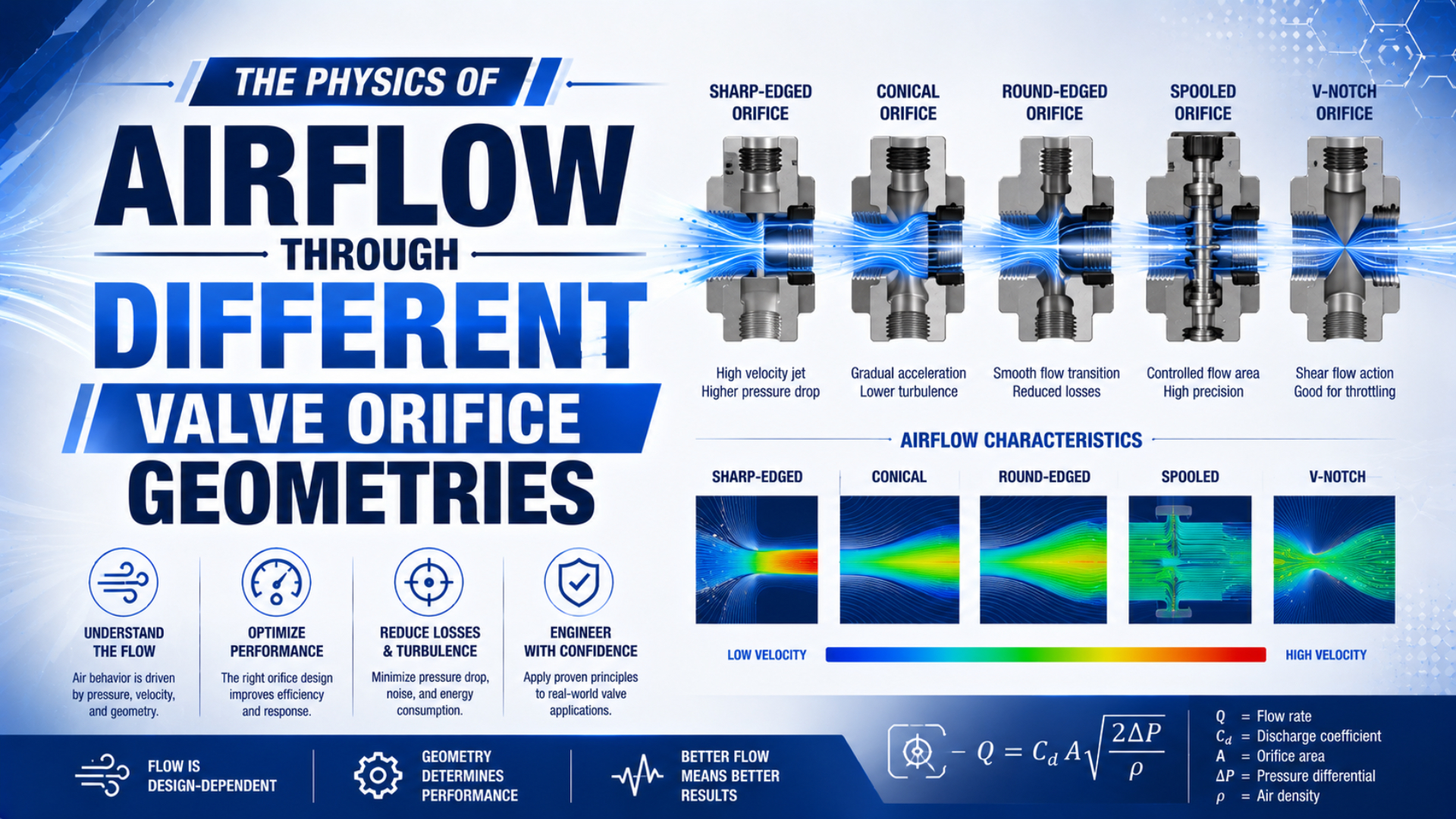
Valve orifice geometry changes where the jet separates, how far it contracts, whether it reattaches inside a bore, and how much actual mass flow passes a given geometric area. It does not divide valves neatly into “laminar” and “turbulent” designs. Pressure ratio, gas properties, opening position, Reynolds number, and the rest of the valve path still matter.
There is also no universally best shape. A rounded converging entrance can reduce inlet separation, while a sharp edge can create a predictable contraction for a defined metering geometry. A proportional valve may need controllable flow near a small opening; a directional valve may prioritize maximum path conductance. The right evidence is tested performance for the exact geometry and state.
Key Takeaways
- A 1991 study tested 4 geometry families, not one universal discharge coefficient (Kayser and Shambaugh).
- Diameter sets geometric area; edge radius and bore length change actual flow.
- Choking limits mass flow, but it does not erase geometry losses.
- Select complete valves from tested path data such as ISO 6358 and .
What Does Orifice Geometry Change in Compressed-Air Flow?
A 1991 experiment tested 16 orifice and nozzle elements with diameters from 0.9 to 1.9 mm and temperatures from 295 to 700 K (Kayser and Shambaugh, 1991). Geometry changed the discharge behavior, but the governing relationship also depended on pressure and flow conditions.
At a restriction, air accelerates and static pressure falls. A sudden edge can force the streamlines to separate from the wall. The jet then contracts to a smaller effective section downstream, commonly called the vena contracta. A gradual inlet can guide the streamlines toward the throat and reduce that entrance contraction.
Valve orifice geometry is the controlled combination of throat shape, inlet edge, bore length, outlet contour, and flow direction. A diameter alone describes only one part of that geometry.
That description does not mean a sharp-edged jet is “all turbulence” or a rounded inlet is “laminar.” Reynolds number describes the local balance between inertial and viscous effects; Mach number and pressure ratio describe compressible-flow behavior. Geometry influences both fields, but it does not replace them. The laminar versus turbulent valve-sizing guide keeps those regimes separate.
Discharge coefficient is the ratio of actual mass flow to an ideal reference flow through the same nominal area and stated thermodynamic conditions:
Here, is dimensionless, and both mass-flow terms use the same units, such as kg/s. The ideal reference must be defined. A coefficient from a water test, a gas test, an orifice plate, or an assembled pneumatic valve is not automatically transferable to another geometry.
Treat as a test result attached to a geometry and operating range, not as a permanent label for “sharp,” “chamfered,” or “rounded.” The 1991 study found different useful correlations for knife-edge orifices, straight bores, and rounded or elliptical nozzles. One lookup number cannot preserve those distinctions.
How Do Sharp, Straight-Bore, and Rounded Entrances Behave?
The same experimental program compared 4 families: knife-edge orifices, straight-bore orifices, rounded-entry nozzles, and elliptical-entry nozzles (Kayser and Shambaugh, 1991). Their coefficients followed different correlations, which is why a geometry name without bore length, edge condition, and test range is incomplete.
A thin sharp-edged or knife-edge orifice promotes separation at the inlet and a contracted free jet. Its useful behavior depends on preserving the edge condition. Rounding, burrs, thickness, or a bevel can turn the intended geometry into another flow element.
A straight-bore or short-tube orifice adds wall contact after the inlet. The separated jet may reattach inside the bore, and friction then acts over the remaining length. Kayser and Shambaugh found that straight-bore coefficients were highly sensitive to length-to-diameter ratio even when other tested influences were smaller.
A rounded or elliptical entrance guides flow toward the throat. Separation can be reduced, but the coefficient is still not automatically 0.95 or any other fixed value. The 1991 results correlated these nozzles with throat Reynolds number and showed a pronounced coefficient decrease below for the tested geometries.
Chamfers deserve their own drawing callout on a supplier print. Their inlet or outlet location, angle, depth, remaining cylindrical land, and flow direction decide what they do. “45-degree chamfer” alone is not proof of a particular discharge coefficient or of best performance.
Which Dimensions Matter Beyond Orifice Diameter?
A 1973 edge study reported that rounding equal to only 0.002 times the orifice diameter increased the measured coefficient by 1% for the square-edged orifice plates studied (Brain and Reid, 1973). That result is plate-specific, but it proves that apparently small edge changes can alter calibrated flow.
Diameter remains important because circular area follows:
Here, is the geometric throat area and is its measured diameter. Use consistent units. Doubling quadruples geometric area, but it does not guarantee four times the flow of a complete valve because , pressure ratio, upstream conditions, and other restrictions can also change.
For a manufactured valve orifice, document at least these dimensions:
| Geometry parameter | Why it matters | Drawing or inspection evidence |
|---|---|---|
| Minimum diameter or opening area | Establishes the nominal throat | Diameter, slot width, or area by valve state |
| Edge radius | Changes inlet separation and contraction | Maximum radius or controlled contour |
| Bore length | Determines wall contact and possible reattachment | Land length and |
| Chamfer | Changes approach or exit geometry | Side, angle, depth, and remaining land |
| Upstream approach | Sets velocity profile and local losses | Gallery diameter, bend distance, seat approach |
| Downstream expansion | Affects jet recovery and interaction with the next restriction | Cavity, outlet drilling, or diffuser contour |
| Surface and defects | Burrs, erosion, deposits, and damage change the intended edge | Surface requirement and inspection method |
The dimensionless ratios and are more portable than radius or length alone. A 0.05 mm edge break is large relative to a 0.5 mm metering hole but much smaller relative to a 10 mm passage. Scale changes the geometry class.
In our experience, supplier drawings often state an “orifice diameter” but omit the edge radius, land length, and flow direction. That is enough for a clearance check, not for reproducing a calibrated flow element. Ask which dimensions were controlled on the tested part and which complete path the published flow value represents.
How Does Geometry Enter the Compressible-Flow Calculation?
ISO 6358-1 is a 61-page component test standard covering fixed and variable internal flow paths, and it now has 2 amendments addressing effective conductance and measurement uncertainty (ISO 6358-1, accessed July 22, 2026). That scope explains why geometry alone cannot replace tested pneumatic flow characteristics.
For an isolated orifice with a known correlation, geometry enters through area and discharge coefficient . Upstream absolute pressure, downstream absolute pressure, gas temperature, and gas properties determine the ideal compressible-flow term. A practical calculation therefore needs more than diameter.
Use the absolute pressure ratio:
Here, is dimensionless, is upstream absolute pressure, and is downstream absolute pressure. Gauge pressure cannot be used directly in this ratio. Add the local atmospheric pressure first.
The calculation also needs a defensible . Do not choose 0.61 merely because the opening looks sharp, or 0.95 because an inlet looks smooth. Use a tested value, a validated correlation covering the same geometry and regime, or a conservative documented assumption followed by testing.
The calculator is appropriate for a defined isolated restriction. A multiway spool valve contains galleries, windows, turns, fittings, and separate supply and exhaust paths. For that assembly, use model-specific , , Cv, or a manufacturer flow curve rather than back-calculating the entire valve from one hole.
The flow-coefficient Cv guide explains why coefficient conventions and test conditions must be identified before comparing catalog values.
Why Does Choked Flow Not Erase Geometry Effects?
NASA’s ideal compressible-flow derivation reaches maximum mass flow at Mach at the controlling throat (NASA Glenn, updated 2021). Choking limits the response to further downstream-pressure reduction, but throat area, upstream state, gas properties, and real-flow losses still determine the maximum rate.
For an adiabatic, isentropic ideal-gas reference with a discharge correction, a choked-flow estimate can be written as:
Here, is mass flow in kg/s, is throat area in m², is upstream total absolute pressure in Pa, is upstream total temperature in K, is the specific-heat ratio, and is the specific gas constant in J/(kg·K).
The formula assumes a known controlling throat and an appropriate . A real valve may choke at a spool window, seat gap, drilled passage, fitting, or silencer rather than at the diameter highlighted on the drawing. Changing downstream pressure after that point will not repair an upstream geometric bottleneck.
The familiar ideal-air critical pressure ratio near 0.528 comes from specific ideal-gas assumptions. It is not a universal published value for every assembled pneumatic component. Under ISO-style characterization, compare with the component’s measured critical pressure ratio . The sonic-conductance guide explains that boundary.
How Do You Translate an Isolated Orifice into Valve Selection?
SMC’s pneumatic flow-characteristics procedure derives sonic conductance from maximum flow, then uses measurements at 80%, 60%, 40%, and 20% of that flow to calculate the critical ratio (SMC technical data, accessed July 22, 2026). Tested path data are stronger than one inferred diameter.
Sonic conductance is a choked-flow capacity parameter for the tested path. Critical pressure ratio is the downstream-to-upstream absolute pressure ratio below which that path is treated as choked under the stated method.
Use a two-level selection method:
- Analyse the local geometry. Identify diameter, shape, edge radius, bore length, opening position, flow direction, and a justified discharge coefficient. This is where an isolated-orifice calculation helps.
- Select the complete path. Use ISO 6358 and , Cv with the supplier’s compressed-gas method, or a pressure-flow curve for the exact part number and valve state.
- Check both directions. Supply-to-cylinder and cylinder-to-exhaust flow can use different spool windows and galleries.
- Add external restrictions. Include fittings, tubing, manifolds, flow controls, quick exhausts, and silencers.
- Verify during motion. Measure valve-inlet pressure, active actuator-port pressure, exhaust back pressure, and stroke time during the demanding cycle.
The port size versus internal orifice guide explains why a thread size does not establish capacity. The Cv chart reading guide covers paths, axes, reference conditions, and curve limits. This article stays with the physical geometry behind those measured values.
Use the pneumatic valve pressure-drop guide when the next task is to compare dynamic upstream and downstream pressure across the installed component.
A designer can improve one local restriction and see no machine benefit. If a fitting throat, second spool window, shared gallery, meter-out control, or exhaust silencer has lower conductance, it remains the bottleneck. Geometry optimization should follow a path map and dynamic pressure measurements, not begin with the easiest visible hole to enlarge.
Manufacturing, Wear, and Inspection Rules
Brain and Reid compared 3 edge-inspection methods: casting, lead-foil impression, and optical examination. Their 1973 work found the optical method least reliable for precise edge assessment, although it could screen large plates for burrs or excessive rounding (Measurement + Control, 1973).
Apply that lesson carefully to valve production. The cited experiment concerns square-edged metering plates, not every valve seat. Still, it establishes a sound control principle: when flow depends on a sharp or calibrated edge, edge condition is a measurable feature, not a cosmetic note.
For new parts:
- define the flow direction and the edge that controls separation;
- specify diameter, radius, land length, chamfer, and surface requirements;
- control deburring so the edge is neither left with a wire burr nor rounded unpredictably;
- inspect the feature with a method suited to its size and access;
- correlate dimensional inspection with flow testing on the complete configured path.
For used valves, compare contamination, erosion, seat damage, and deposits with the original function. Wear does not automatically improve flow. It can enlarge an opening while worsening leakage, repeatability, shutoff, proportional control, or path symmetry. A higher bench flow value after damage is not proof that the valve performs better.
Troubleshoot the installed system before blaming microscopic geometry. A slow actuator may instead reflect regulator droop, restricted tubing, a small fitting, meter-out adjustment, silencer back pressure, load friction, or cushioning. The pneumatic valve-sizing workflow starts from required motion and pressure rather than from an assumed geometry upgrade.
Sources and Technical Basis
This guide uses 6 primary or authoritative sources, led by ISO 6358-1 and the 1991 compressible-orifice experiment. The set includes 2 peer-reviewed geometry studies plus NASA, SMC, and NIST material. Their scopes differ, so plate, isolated-nozzle, and complete-valve results are not combined into one universal coefficient.
- ISO 6358-1:2013, steady-state testing of pneumatic components
- Kayser and Shambaugh, compressible flow through small-diameter orifices and convergent nozzles
- Brain and Reid, measurement of orifice plate edge sharpness
- NASA Glenn, mass flow choking
- SMC, flow characteristics of pneumatic components
- NIST, gas orifice meter discharge coefficients determined by mass-flow measurements
Valve Orifice Geometry FAQs
Kayser and Shambaugh tested 16 elements across 4 geometry families and found that the useful discharge-coefficient correlation changed with geometry (Chemical Engineering Science, 1991). These 5 answers keep geometry, flow regime, choking, and complete-valve test data within their proper technical boundaries.
Which valve orifice geometry gives the highest airflow?
No geometry wins under every condition. A rounded converging entrance can reduce inlet separation, while diameter, throat contour, bore length, pressure ratio, Reynolds number, and downstream geometry still affect mass flow. Compare tested coefficients or conductance over the required range, then check controllability, leakage, manufacturing, contamination tolerance, and cost.
Is 0.61 a universal discharge coefficient for a sharp-edged orifice?
No. A value near 0.61 appears in specific sharp-edged orifice models, but it is not a universal constant for every gas, diameter, thickness, pressure ratio, or edge condition. Use a correlation validated for the actual geometry and regime. For an assembled valve, prefer its tested flow characteristic.
Does a smooth or rounded inlet guarantee laminar flow?
No. A rounded inlet can reduce separation, but laminar or turbulent behavior depends on local Reynolds number and geometry. Compressible subsonic and choked states are separate classifications. Do not label a valve “laminar” from appearance alone or apply the familiar long-pipe transition thresholds to every short valve restriction.
Does choked flow make downstream geometry irrelevant?
Not completely. Once the controlling section is choked, lowering downstream pressure further does not increase mass flow in the same way. Downstream geometry can still affect shock structure, recovery, noise, and which location becomes controlling. Upstream geometry, throat area, and discharge losses continue to determine the choked mass-flow capacity.
Can an orifice calculator size a complete pneumatic valve?
Only as a first-pass check for a defined isolated restriction with a justified discharge coefficient. A complete valve can include several windows, galleries, turns, fittings, and unequal supply and exhaust paths. Select the valve from path-specific ISO 6358 data, Cv guidance, or manufacturer flow curves, then verify dynamic machine pressure and timing.