

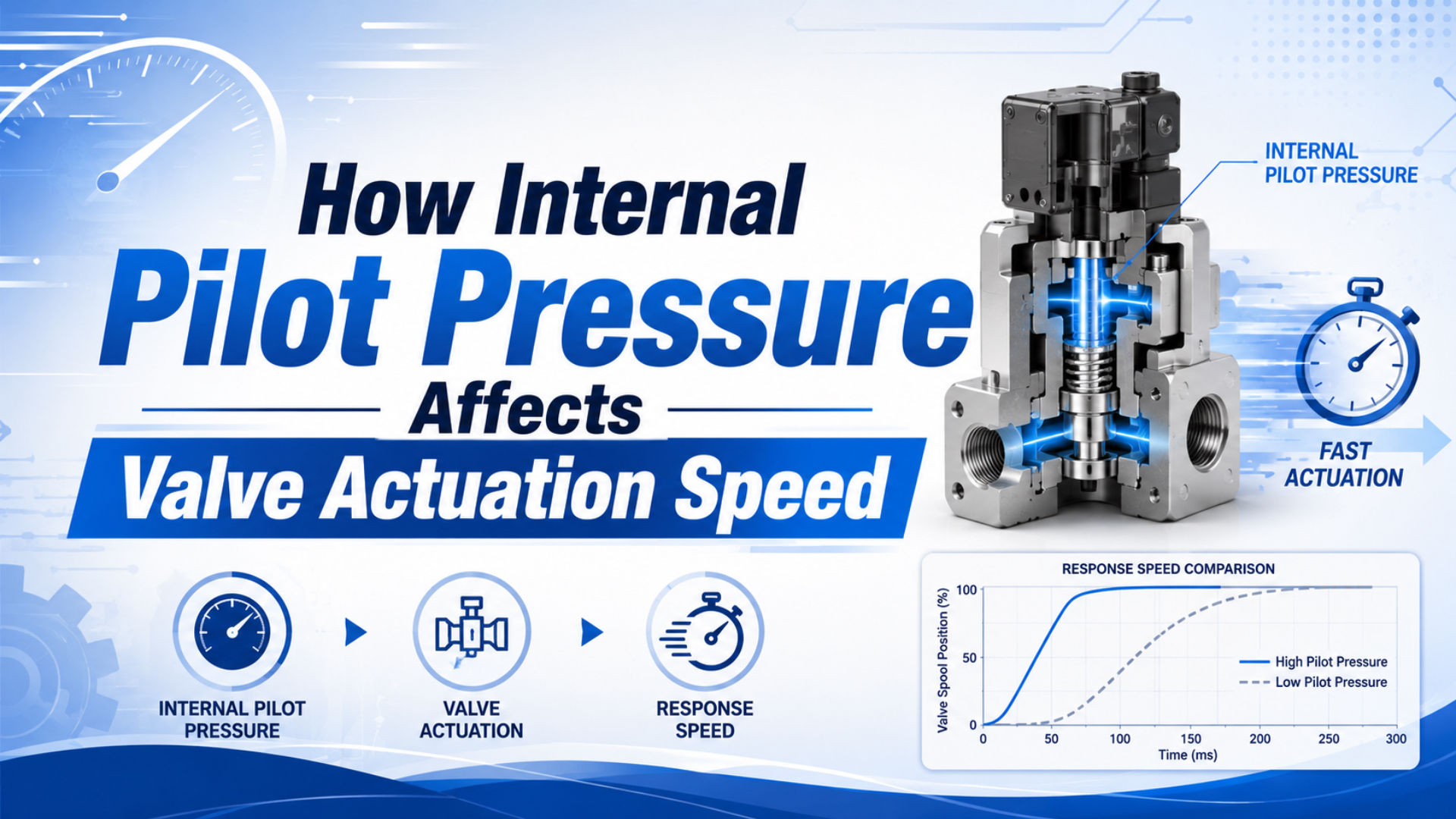
Internal pilot pressure is the supply-derived pressure used to operate a valve’s pilot stage and shift its main spool. Too little dynamic pressure can delay or prevent a shift. More pressure can improve margin, but it doesn’t create a universal pressure-to-speed curve. The exact valve, pilot passages, exhaust path, voltage, temperature, and test method all matter.
That makes the datasheet more useful than a generic pilot-pressure ratio. SMC, for example, publishes internal-pilot operating ranges and response times for exact SYJ valve series. Parker states the supply pressure, temperature, and pressure thresholds used for its response-time figures. Those conditions determine whether two numbers can be compared.
Key Takeaways
- SMC lists 0.15 MPa as the lower internal-pilot operating pressure for several SYJ examples, not as a universal valve minimum.
- ISO 12238:2023 standardizes directional-valve shifting-time measurement.
- Diagnose dynamic pressure, coil voltage, pilot flow, exhaust restriction, and spool condition before raising plant pressure.
What Is Internal Pilot Pressure?
SMC distinguishes three operating methods: internal pilot, external pilot, and direct operation. Its internal-pilot design routes supply pressure through the valve to operate the pilot stage, while external pilot uses a separate source when main pressure is below the minimum or the application uses vacuum (SMC, retrieved 2026).
In a solenoid-piloted directional valve, the coil first moves a small pilot element. That pilot stage connects supply air to one end of the main spool and vents the other. Pressure acting on the pilot piston or spool-end area then provides the force needed to overcome the return spring, seal friction, flow forces, and any opposing pressure.
The basic force contribution is:
Here, is the pneumatic pilot force, and are the pressures acting on opposite sides of the pilot area, and is the effective pilot area. Use consistent pressure and area units. This relationship explains available force, but it does not calculate shifting time by itself.
Why not? The pilot chamber must fill or exhaust, the moving assembly must accelerate, and the main spool must travel far enough to change the port connections. Passage conductance, trapped volume, seal friction, spring rate, exhaust back pressure, and the pressure transient all affect that motion.
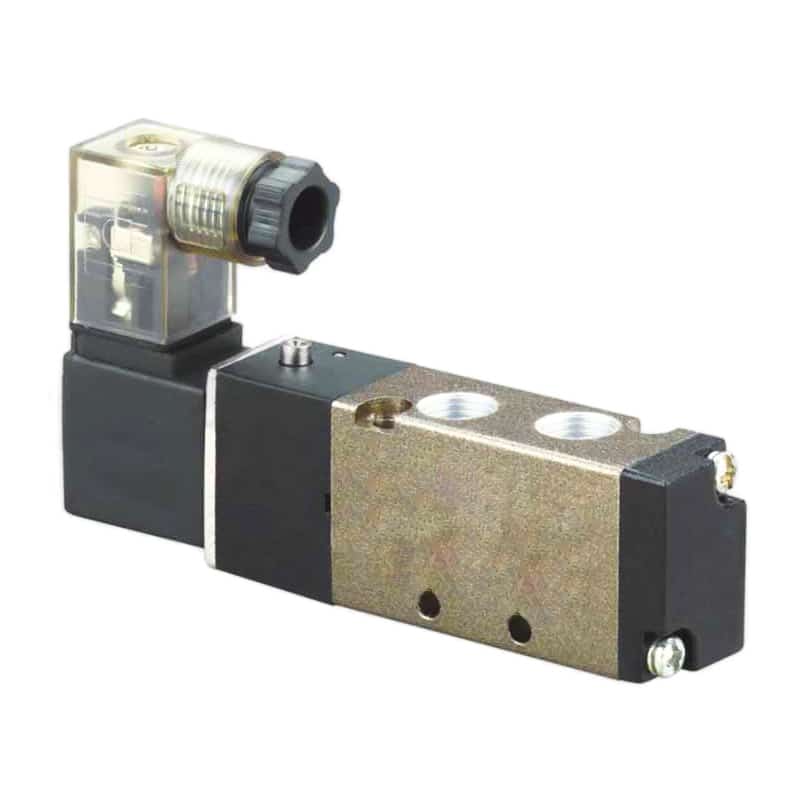
A product photo can identify the valve architecture, but the exact order code and datasheet establish its pilot-pressure and response-time limits.
For the broader two-stage operating sequence, start with the pneumatic pilot-operated valve guide. This article stays focused on speed and diagnosis.
Is There an Ideal Main-to-Pilot Pressure Ratio?
There is no universal 3:1, 4:1, or 5:1 optimum. SMC’s SYJ300, SYJ500, and SYJ700 internal-pilot examples share a published operating range beginning at 0.15 MPa, yet their response-time limits at 0.5 MPa differ by series (SMC SYJ catalog). The exact design owns the requirement.
An internal-pilot valve normally takes pilot air from the main supply. Calling 60 psi main pressure and 15 psi pilot pressure a “4:1 ratio” uses main-to-pilot notation. Calling the same relationship “pilot-to-main” reverses it. Neither notation establishes a performance rule without a valve-specific pressure-reducing or separate pilot circuit.
The reliable selection rule is simpler:
- Stay inside the exact valve’s main and pilot pressure ranges.
- Maintain the minimum pressure dynamically while the circuit is flowing.
- Do not exceed the maximum pilot or operating pressure.
- Compare switching data only at documented test conditions.
Pressure above the minimum can increase force margin, especially when friction or return-spring load is significant. It can also produce a harder end impact. Once pilot filling, exhaust, coil delay, spool mass, or geometry becomes the limiting factor, further pressure may provide little useful reduction in time.
A ratio hides the variables that technicians can actually verify. Two valves can have the same supply pressure and very different pilot areas, passage sizes, chamber volumes, springs, seals, and spool strokes. A model-specific minimum pressure plus a documented response-time test is therefore more transferable than a universal ratio chart.
How Strongly Does Pilot Pressure Affect Valve Speed?
At 0.5 MPa, SMC lists response times of 15 ms or less for an SYJ300 example, 25 ms or less for SYJ500, and 30 ms or less for SYJ700 (SMC SYJ catalog). Those three values at one pressure show why pressure alone cannot predict speed.
The strongest pressure effect usually appears near the valve’s minimum operating boundary. If dynamic supply falls far enough, available force and pilot flow may no longer overcome friction and spring load promptly. The result can be delayed shifting, chatter, incomplete travel, failure to reset, or a valve that works unloaded but fails during peak air demand.
Farther above the minimum, other constraints take over. A small pilot orifice limits mass flow. A restricted pilot exhaust slows depressurization on the opposite side. Cold or contaminated seals raise friction. A larger spool has more mass and may require more travel. A surge suppressor or power-saving circuit can alter the electrical portion of the response.
| Published example | Internal-pilot range | Response-time condition | Published response time |
|---|---|---|---|
| SMC SYJ300 | 0.15 to 0.7 MPa | 0.5 MPa, rated voltage, specified test notes | 15 ms or less |
| SMC SYJ500 | 0.15 to 0.7 MPa | 0.5 MPa, rated voltage, specified test notes | 25 ms or less |
| SMC SYJ700 | 0.15 to 0.7 MPa | 0.5 MPa, rated voltage, specified test notes | 30 ms or less |
These are catalog examples, not a ranking of every valve in each size. Porting, function, seal option, voltage, suppressor, manifold configuration, and order code can change the applicable data. Always confirm the current sheet for the part being purchased.
Reading Catalog Response-Time Data Correctly
ISO 12238:2023 specifies procedures for measuring the shifting times of electrically or pneumatically operated, monostable or bistable directional control valves with two or three positions (ISO, 2023). A catalog time is meaningful only when its event definition, pressure, temperature, voltage, load, and valve configuration are known.
Parker’s Viking catalog supplies a useful example. It defines response time using pressure rising to 90% of supply and exhausting to 10%, with catalog measurements at 93 psig (6.3 bar) and 68°F (20°C) (Parker). A different threshold or test pressure can produce a different number for the same hardware.
Keep four timing boundaries separate:
| Timing boundary | Starts with | Ends with | Typical measurement |
|---|---|---|---|
| Electrical command delay | PLC or switch command | rated voltage/current at coil | oscilloscope or controller trace |
| Pilot-stage response | coil or air signal | pilot passage changes state | pilot pressure or internal test point |
| Main-valve shifting time | valve command | specified outlet-pressure threshold | ISO-aligned valve test setup |
| Machine response | command | cylinder position or process event | pressure sensors, position sensor, motion trace |
A cylinder that begins moving 80 ms after a command does not prove that the valve took 80 ms to shift. Tubing volume, cylinder chamber filling, breakaway friction, load, flow controls, and exhaust restriction can add delay after the main spool has already changed position.
The related solenoid-coil inductance guide explains the electrical part. Treat it as a separate measurement layer, not a substitute for pilot-pressure data.
What Else Can Limit Valve Actuation Speed?
Parker reports different response times for 1/8-inch, 1/4-inch, and 3/8-inch Viking valves under the same 6.3 bar and 20°C reference conditions. This size-dependent spread confirms that valve geometry, function, actuation method, and return arrangement, not just pilot pressure, affect the published response (Parker).
Check these limits before changing pressure:
- Coil voltage at the terminals: cable drop, undersized outputs, incorrect voltage, or a weak power supply can delay the pilot stage.
- Pilot passage conductance: debris, varnish, moisture, or a small internal restriction slows pressure buildup.
- Pilot exhaust: a blocked exhaust path traps pressure and resists spool movement or return.
- Main exhaust: a clogged silencer may make the actuator slow even when the valve shifts normally.
- Dynamic inlet pressure: a nearby high-flow event can pull supply below the pilot minimum during the command.
- Temperature: seal friction, lubricant viscosity, coil resistance, and air density change with temperature.
- Valve construction: spool mass, pilot area, spring load, seal type, travel, and manual-override geometry are model-specific.
- Suppressor and electronics: surge suppression and power-saving circuits can change energizing or de-energizing behavior.
ISO 8573-1 classifies compressed-air contaminants by particles, water, and oil (ISO, 2010). The valve manufacturer still specifies the acceptable purity for the exact product. Small pilot passages often show contamination symptoms before the main flow path appears blocked.
Use the control-valve contamination guide when sticking changes with operating hours. If the problem follows exhaust loading, inspect the silencer restriction guide.
A Dynamic Pilot-Pressure Diagnostic Workflow
SMC’s cited SYJ examples begin their internal-pilot operating range at 0.15 MPa, while SMC recommends external pilot when main pressure is below a valve’s minimum or the circuit uses vacuum (SMC, retrieved 2026). Before changing architecture, measure the installed pressure during the failed cycle.
1. Freeze the exact configuration
Record the manufacturer, complete order code, valve function, seal type, voltage, suppressor, manifold base, pressure zones, fittings, and silencers. Obtain the datasheet revision that applies to that configuration. A family-level brochure is not enough.
2. Define the observed delay
State whether the problem is coil pickup, main-spool shift, outlet pressure rise, cylinder breakaway, or completed stroke time. Choose sensors for that boundary. Without a definition, every delay is casually blamed on the valve.
3. Capture voltage and pressure during motion
Measure coil-terminal voltage and valve-inlet pressure on the same time base. If an accessible external-pilot port exists, measure there as well. Use a transducer with adequate range and sample rate; a slow mechanical gauge may miss the short pressure dip that causes intermittent failure.
4. Compare the lowest dynamic value with the datasheet
Do not use the compressor-room gauge or the static pressure before the cycle. Compare the minimum measured value at the valve during peak demand with the exact operating and pilot range. The compressed-air pressure-drop guide helps trace distribution losses when the pressure collapses under flow.
5. Inspect pilot and main exhaust paths
Temporarily test with the manufacturer-approved exhaust arrangement, observing safety and contamination controls. A restricted pilot exhaust can slow the spool. A restricted main exhaust can leave valve shift time normal while delaying the cylinder.
6. Separate valve behavior from actuator behavior
Monitor the valve outlet and the actuator chamber. If outlet pressure changes promptly but motion starts late, investigate tube volume, flow controls, cylinder friction, load, alignment, and back pressure. If outlet pressure changes late, focus on the electrical, pilot, and main-spool stages.
In our experience, synchronized voltage, valve-inlet pressure, and actuator-port pressure traces resolve more disputes than a stopwatch. We’ve found that the three traces quickly separate a weak electrical command, a supply-pressure dip, a delayed valve shift, and a downstream motion problem without replacing components by guesswork.
7. Repeat at the worst credible condition
Test at minimum supply pressure, the coldest and hottest specified temperatures, maximum simultaneous demand, and the longest normal idle period. Record energizing and de-energizing separately. A spring-return valve can meet the energizing target yet return slowly because its pilot or main exhaust is restricted.
When Should You Use an External Pilot?
SMC describes external pilot as a separate pressure source and recommends it when the main circuit is below minimum operating pressure or uses vacuum; the cited SYJ internal-pilot examples begin at 0.15 MPa (SMC, retrieved 2026). External pilot is a pressure-stability option, not an automatic speed upgrade.
Consider it when:
- the main circuit intentionally operates below the internal-pilot minimum;
- a large actuator causes a short inlet-pressure collapse;
- the main flow path switches vacuum or an unusual pressure state;
- separate, cleaner control air is required by the valve manufacturer;
- a manifold pressure zone cannot provide stable pilot supply;
- testing proves the internal pilot crosses its minimum during the command.
External pilot adds its own design work. Specify the permitted pilot-pressure range, regulator flow, tubing ID and length, air quality, exhaust routing, failure response, isolation procedure, and startup sequence. The pilot source must remain available whenever the valve must shift or return safely.
Do not raise plant pressure as the first response to a local pilot problem. Repair restrictions, size the supply path, add local storage where justified, or provide an approved external pilot. Higher system pressure affects every leak, actuator, fitting, and energy load connected to the header.
What Should an RFQ and Acceptance Test Include?
ISO 12238:2023 provides a standardized basis for directional-valve shifting-time measurement, while the cited SMC and Parker examples show that pressure, temperature, voltage, configuration, and thresholds belong with every response-time value. An RFQ should request those conditions instead of asking only for “fast actuation.”
Include:
- complete valve function, porting, normal state, actuation, and return method;
- internal or external pilot arrangement and full order code;
- minimum and maximum main operating pressure;
- minimum and maximum pilot pressure, including dynamic minimum;
- rated flow, Cv, Kv, or sonic conductance for the main path;
- pilot passage or pilot-flow information when available;
- coil voltage, tolerance, power, duty, suppressor, and connector;
- energizing and de-energizing times with test pressure, temperature, thresholds, and standard;
- expected ambient and compressed-air temperatures;
- compressed-air purity and lubrication requirements;
- pilot and main exhaust arrangement, including silencers;
- manifold station count, simultaneous demand, and pressure zones;
- acceptance sensors, sample rate, trigger, load, repetitions, and pass limits.
For the acceptance test, capture command, coil voltage, inlet pressure, outlet pressure, and the relevant position or process signal on one clock. Keep tube lengths, fittings, exhaust hardware, pressure, temperature, and load representative of the machine. Compare like with like.
Main-valve flow still affects the actuator after the spool shifts. Use the Cv selection guide for that separate sizing task, but do not use main-port Cv as a substitute for pilot-stage response evidence.
Internal Pilot Pressure FAQs
SMC’s SYJ catalog begins the cited internal-pilot ranges at 0.15 MPa, while ISO 12238:2023 standardizes directional-valve shifting-time measurement. These FAQs apply those two facts to common pressure, exhaust, measurement, troubleshooting, and pilot-architecture decisions.
Does higher internal pilot pressure always make a valve faster?
No. More pressure can increase force and improve margin near the minimum operating boundary, but pilot flow, exhaust, coil delay, friction, spool mass, spring load, and geometry can become limiting. Stay inside the exact valve’s range and compare response only under documented test conditions.
What is the minimum internal pilot pressure for a pneumatic valve?
There is no universal minimum. SMC lists 0.15 MPa for the cited SYJ examples, while other designs and options use different limits. Check the complete order code, valve function, pilot arrangement, temperature, and datasheet revision, then verify the minimum dynamically at the installed valve.
How should pilot pressure be measured during a shift?
Use a pressure transducer close to the valve inlet or accessible pilot port, with enough bandwidth and sample rate to capture short dips. Record it on the same time base as the command and coil voltage. A mechanical gauge or upstream static reading can miss the event that causes delayed shifting.
Can a blocked exhaust mimic low pilot pressure?
Yes. Trapped pilot pressure can oppose spool movement or delay spring return, while a clogged main exhaust can slow the cylinder after the valve has shifted. Measure valve outlet pressure and actuator response separately, then inspect the pilot and main exhaust arrangements allowed by the manufacturer.
When is external pilot better than internal pilot?
Use external pilot when the manufacturer permits it and the main circuit operates below the internal-pilot minimum, experiences unacceptable dynamic pressure dips, or handles vacuum or special pressure states. A separate pilot source must still meet pressure, flow, air-quality, exhaust, and safe-failure requirements.
Sources and technical references
- ISO 12238:2023: Pneumatic fluid power - Directional control valves - Measurement of shifting time
- SMC: Solenoid Valve Technical Data - Internal, External, and Direct Operation
- SMC: SYJ300, SYJ500, and SYJ700 Pilot Solenoid Valve Catalog
- Parker: Viking Series Pneumatic Valve Catalog and Response-Time Conditions
- Festo: Solenoid Valve Operating, Pilot-Pressure, and Switching-Time Data
- ISO 8573-1:2010: Compressed-Air Contaminants and Purity Classes