

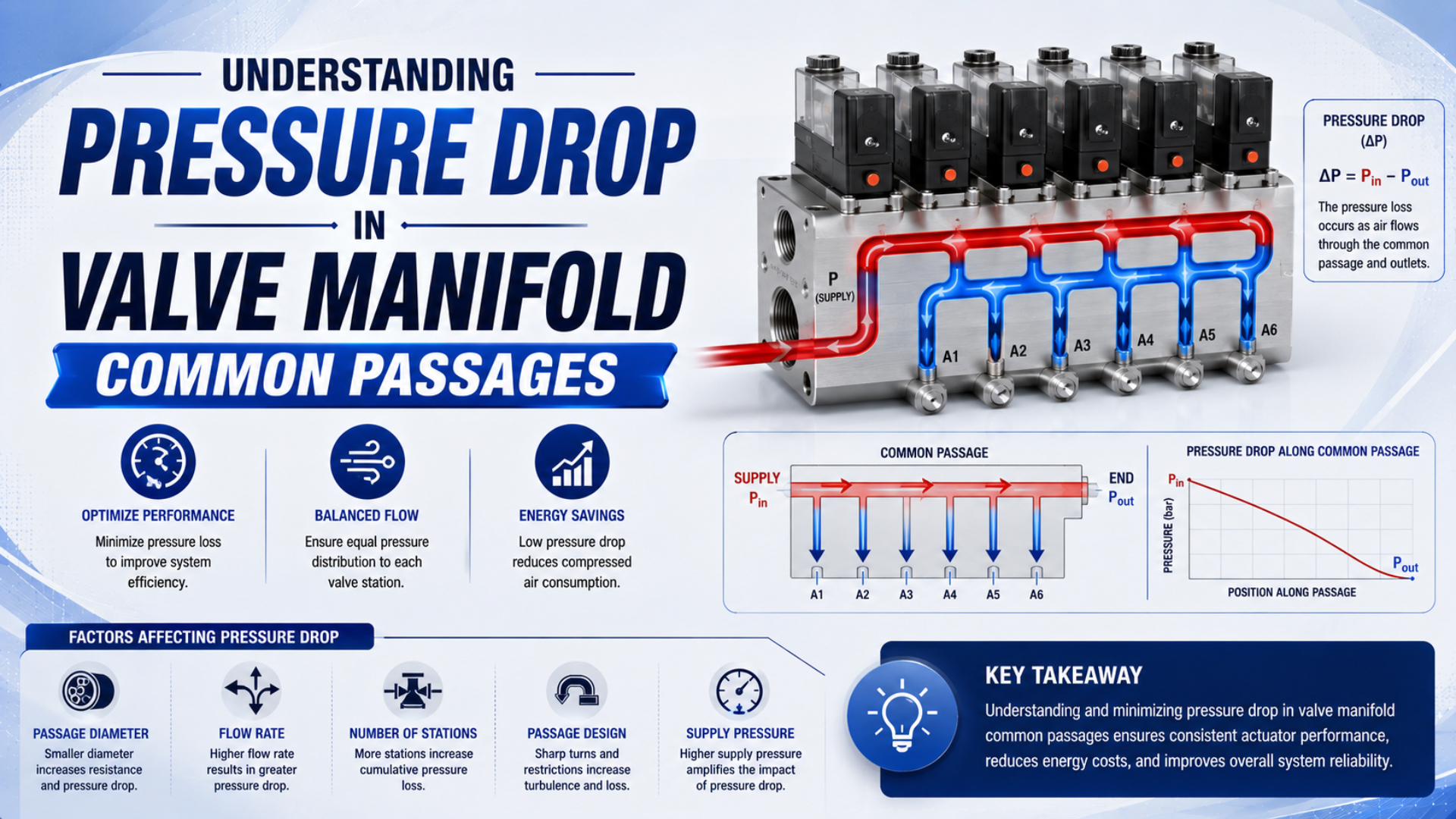
Pressure drop in a valve manifold common passage is the loss between the manifold inlet and a selected station while several valves share the same supply or exhaust gallery. It is a branch-network problem. Flow is highest near a single-ended inlet, falls after each supply branch, and combines in the opposite direction inside a shared exhaust passage.
Port thread size alone cannot predict that behavior. Start with the valves that can operate simultaneously, assign each branch its peak supply and exhaust flow, then use the manifold manufacturer’s multi-valve data or ISO 6358 component characteristics. Finally, measure dynamic pressure at the inlet, remote station, and exhaust gallery during the real machine sequence.
Key Takeaways
- SMC requires two-sided supply and exhaust above 4 stations in one VPA manifold family and warns that simultaneous operation causes pressure drop.
- Common-passage flow changes after every active branch, so one constant-flow pipe calculation is insufficient.
- Measure supply sag and exhaust backpressure separately during the worst concurrent cycle.
What Is Pressure Drop in a Manifold Common Passage?
SMC states that simultaneous operation causes pressure drop in its VPA manifold family and instructs users to supply and exhaust from both ends when the manifold has more than 4 stations (SMC VPA catalog, retrieved 2026). The common passage must therefore be evaluated as shared capacity, not as a collection of independent ports.
Manifold common passage is the internal gallery that distributes supply air or collects exhaust air across several valve stations. A supply gallery can starve remote valves when concurrent demand exceeds its available conductance. A common exhaust gallery can create backpressure when several cylinders discharge together.
The pressure loss that matters is dynamic. With all valves closed, the inlet and remote station may show nearly the same pressure because flow is negligible. When multiple valves switch, the same internal restrictions produce a larger pressure difference. The loss appears under flow. A static gauge can therefore hide the fault. Test one axis, then test the real overlap. Compare both traces.
Supply and exhaust problems can look similar at the actuator:
| Common-passage condition | What happens inside the manifold | Typical machine symptom |
|---|---|---|
| Supply gallery restriction | Pressure at remote stations falls during filling | Slow acceleration, reduced force, missed cycle time |
| Common exhaust restriction | Backpressure rises while chambers discharge | Slow return, reduced net force, jerky motion |
| One-sided feed on a long rail | Inlet-side stations see a shorter flow path | Performance varies by station position |
| Several valves switch together | Peak shared flow exceeds the tested single-valve case | Fault appears only in automatic operation |
| Pressure zones are poorly allocated | High-demand branches share limited supply or exhaust | One process disturbs another |
This article stays on the shared gallery. Use the single-valve pressure-drop guide to evaluate one active P-to-A, P-to-B, A-to-EA, or B-to-EB path. Use the system pressure-drop guide when the restriction may be in the compressor, dryer, FRL, piping, or tubing.
Why Can’t You Size the Common Passage from Port Diameter Alone?
Festo’s VTUS documentation offers standard and compact manifold blocks in 3 nominal sizes, each supporting up to 10 valve positions, plus common supply manifolds and additional supply plates (Festo VTUS, 2025). Those options show why a connection thread cannot represent the gallery, turns, valve paths, and concurrent-flow behavior behind it.
A port is only one boundary of the flow path. Two manifolds with the same external connection can have different internal gallery areas, branch geometries, station seals, supply-block locations, exhaust arrangements, and valve conductance. The selected valve function also changes which passages carry flow.
The familiar statement that pressure loss varies with the fourth power of diameter is not a universal manifold rule. It comes from restricted pipe-flow assumptions. In a valve island, flow varies by segment, local losses can be important, density changes with absolute pressure, and the limiting section may be inside the valve rather than in the rail.
Likewise, a fixed rule such as “make the common passage two or three times the valve port” ignores concurrency. One large valve may demand more flow than several small valves. Three valves may never switch together, or eight may open within the same 100 ms interval. The operating sequence belongs in the sizing input.
Treat thread size as an interface, not a capacity rating. The useful supplier data is the standard flow per valve with several valves switched in parallel, the permitted station count for each feed arrangement, and the pressure or flow curve for the assembled manifold configuration.
Build the Worst-Case Simultaneous-Flow Matrix
Festo publishes nominal-flow information for several valves switched in parallel and allows up to 10 valve positions on the referenced VTUS manifold blocks (Festo VTUS, 2025). Before calculating a passage, identify which stations overlap in time; adding the maximum flow of every installed valve can be as misleading as assuming only one operates.
Create one row for each machine state that can produce high shared demand:
| Cycle state | Active stations | Supply paths | Exhaust paths | Peak duration | Acceptance variable |
|---|---|---|---|---|---|
| Startup fill | Valves that pressurize after reset | Common P gallery to working ports | Opposite chambers to exhaust | Until chambers fill | Minimum remote supply pressure |
| Fast approach | Axes moving at maximum speed | Several P-to-A or P-to-B paths | Several returns into EA/EB | Motion interval | Stroke time and supply sag |
| Clamp or press | Force-producing branches | Lower flow after contact | Small leakage or relief flow | Dwell interval | Chamber pressure or force |
| Return stroke | Axes retracting together | Opposite supply paths | Combined exhaust flow | Motion interval | Exhaust backpressure and time |
| Fault recovery | Defined safe-state valve changes | Circuit-specific | Possible simultaneous venting | Transition interval | Safe pressure and movement |
For a one-ended supply rail, the mass flow through segment is the sum of the active downstream branch flows:
Here, is mass flow through rail segment , is the mass flow demanded by active downstream station , and is the final station. Use mass flow, or consistently referenced standard flow, when adding branches. Actual volumetric flow changes with local absolute pressure and temperature.
This matrix should use the control program, not a guessed diversity factor. For example, a packaging machine may retract three axes together even though it extends them one at a time. Check PLC timing, actuator fill demand, commanded speed, startup, and recovery. Any permitted overlap is a valid sizing case.
How Should You Calculate Common-Passage Pressure Drop?
ISO 6358-3, confirmed in 2025, calculates overall characteristics for systems of components and piping and describes both subsonic and choked compressible flow (ISO 6358-3:2014). That framework is more appropriate than applying one liquid-style square-root formula to an assembled pneumatic manifold with several branches.
Use this order of preference:
- Manufacturer parallel-operation data: Match the exact valve family, station count, supply blocks, pressure zones, and exhaust configuration.
- ISO 6358 component characteristics: Combine known conductance and critical pressure-ratio data for the relevant manifold and valve paths.
- Segment model: Divide the rail at each branch, assign concurrent flow to each segment, and include junction plus local losses.
- Dynamic test: Verify the predicted worst case on the assembled manifold under the real switching sequence.
ISO 6358-1 defines steady-state testing for pneumatic components with fixed or variable internal paths and now includes a 2026 amendment on measurement uncertainty (ISO 6358-1:2013). It does not turn a nominal port size into a flow rating. Request the manufacturer’s tested conductance, critical pressure ratio, or parallel-flow curves.
The direct measured supply loss at station is:
Here, is dynamic pressure at the manifold inlet and is dynamic pressure in the supply gallery or working path serving station . Use sensors with the same pressure reference and sufficient response to capture the switching transient.
Do not confuse standard flow with actual gallery velocity. Standard litres per minute or SCFM refer flow to specified reference conditions; velocity inside the manifold depends on actual volumetric flow at local absolute pressure and temperature. The choked-flow guide explains why pressure ratio matters at restrictive valve paths.
For early piping review, the Compressed Air Pressure Drop Calculator estimates a clean straight run from flow, length, internal diameter, pressure, and equivalent fittings. It does not model a branched manifold, station seals, valve paths, shared exhaust, or simultaneous switching. Keep it outside the final manifold acceptance calculation.
How Do You Measure Supply Sag and Exhaust Backpressure?
SMC offers common and individual exhaust configurations in the VPA family and warns that common-exhaust backpressure can cause malfunction in some cases (SMC VPA catalog, retrieved 2026). Measure at least 2 different quantities: remote supply pressure during chamber filling and common-exhaust pressure during chamber discharge.
Use synchronized pressure sensors rather than moving one gauge between tests. Run the event several times. The traces should repeat. Record:
- Supply pressure immediately before the manifold inlet
- Supply-gallery or working-port pressure at the most remote high-demand station
- Common exhaust pressure near the active station or exhaust block
- Valve command timing and the identity of every concurrent station
- Actuator position, stroke time, chamber pressure, or force relevant to acceptance
Common-exhaust backpressure relative to atmosphere is:
Here, is absolute pressure in the exhaust path serving station , and is local atmospheric pressure. If the sensor reports gauge pressure, its reading already represents backpressure relative to atmosphere. Never subtract atmospheric pressure from a gauge reading a second time.
Test at nominal and minimum allowed supply pressure. Repeat from cold startup and after thermal stabilization if switching frequency is high. Run the exact concurrent sequence, then add a controlled margin case if the machine program may change. Averages are not enough; record minimum supply pressure and peak exhaust backpressure with timestamps.
Station position is a diagnostic variable. If the same valve and actuator perform differently after being moved from the inlet end to the remote end, the common passage or feed arrangement becomes a stronger suspect. If the fault follows the valve, investigate that valve path instead.
The backpressure guide explains how exhaust pressure subtracts from useful actuator force. For modular circuit architecture, see building a reliable pneumatic circuit with modular valves.
When Should You Add Two-End Feeding, Supply Plates, or Pressure Zones?
Festo permits up to 9 pressure zones on a 16-position VTUS configuration and requires at least 2 valve positions between separators; SMC calls for two-end supply and exhaust above 4 VPA stations (Festo VTUS, 2025; SMC VPA, retrieved 2026). Use the exact family rules rather than copying either threshold to another manifold.
Choose among the configuration options by the diagnosed constraint:
| Modification | Best fit | What it changes | What it does not prove |
|---|---|---|---|
| Feed the rail from both ends | Long rail with remote-station supply sag | Shortens the highest-flow supply path | Adequate common exhaust capacity |
| Exhaust from both ends | Several stations discharge together | Divides the common exhaust path | Low supply-side pressure drop |
| Add a supply/exhaust plate | Local cluster has high peak demand | Introduces another feed or exhaust point | Correct valve sizing downstream |
| Create pressure zones | Processes require different pressures or isolation | Separates selected supply/exhaust ducts | Unlimited flow within each zone |
| Use individual exhaust | Common backpressure disturbs valves or actuators | Removes selected exhaust flows from the shared gallery | Adequate silencers and downstream exhaust piping |
| Split the valve island | Electrical or pneumatic scale exceeds one rail | Reduces shared flow and fault coupling | Correct synchronization between islands |
Do not add feeds blindly. A second inlet helps only if the upstream hose, regulator, and supply branch can deliver the combined demand. Likewise, two exhaust outlets still fail if both connect to one undersized pipe or restrictive silencer. Measure again after every change.
Pressure zones are also disturbance boundaries. They can stop a high-flow motion group from pulling down a low-flow precision group, even when both groups use the same nominal pressure. The zone design still needs an explicit supply and exhaust capacity for its own concurrency matrix.
RFQ and Acceptance-Test Checklist
CAGI recommends no more than 10% total system pressure drop from compressor discharge to point of use and 20 ft/s or lower in distribution piping (CAGI Pressure Drop Technical Brief, retrieved 2026). Those are system-level references, not automatic manifold limits; allocate the valve-island budget from actuator pressure, speed, and force requirements.
Send enough RFQ data to reproduce the worst shared-flow case:
- Exact manifold series, valve models, spool functions, station count, and blank positions
- Supply and exhaust block locations, port sizes, thread types, silencers, and downstream piping
- Pressure zones, separators, individual exhausts, and internal or external pilot configuration
- Minimum and nominal inlet pressure plus maximum permitted exhaust backpressure
- Flow demand for each active valve path with reference conditions and units
- Concurrency matrix, command timing, duty cycle, and maximum overlap duration
- Actuator bore, stroke, orientation, moving load, target speed, and required force margin
- Required manufacturer data: parallel-operation flow, ISO 6358 characteristics, or tested pressure-flow curves
Acceptance should cover more than a free-flow bench test:
- Verify the delivered configuration and every supply/exhaust option against the approved drawing.
- Instrument inlet, remote supply, common exhaust, and the relevant process variable.
- Run each worst-case concurrent state at minimum permitted inlet pressure.
- Record transient minima, peaks, settling behavior, station-to-station variation, and recovery.
- Repeat after the system reaches normal operating temperature.
- Test command loss, supply restoration, blocked or degraded exhaust, and the defined safe state when relevant.
- Store the trace and pass/fail limits with the machine documentation.
A supplier’s single-valve nominal flow proves little about a ten-station island running several actuators together. Specify the assembled manifold, feed arrangement, exhaust arrangement, and concurrency case that must pass.
Valve Manifold Pressure Drop FAQs
SMC warns that simultaneous operation causes pressure drop and requires two-sided supply and exhaust above 4 stations in the referenced VPA family (SMC VPA catalog, retrieved 2026). That threshold is product-specific, but the selection principle is general: validate the assembled manifold under the actual concurrent valve sequence.
What pressure drop is acceptable across a valve manifold?
There is no universal manifold percentage. Set the limit from the minimum pressure and maximum backpressure that still satisfy actuator speed, force, valve piloting, and process stability. CAGI’s 10% recommendation covers the complete compressor-to-use-point system, so the manifold receives only part of that total pressure budget.
Can I size a manifold from the largest valve port?
No. Port size does not reveal internal gallery area, branch turns, station seals, valve conductance, common exhaust capacity, or simultaneous demand. Use the exact manufacturer’s multi-valve data or ISO 6358 characteristics, then verify dynamic inlet, remote-station, and exhaust pressure on the assembled configuration.
Why does the last valve station receive less pressure?
With one-ended supply, the inlet segment carries the combined demand of all active downstream stations. Each segment and branch adds resistance, so a remote station may see more loss during concurrent flow. Two-end feeding or a local supply plate can shorten that shared high-flow path when the manufacturer permits it.
How do I know whether supply or exhaust is limiting the actuator?
Measure both during the same cycle. Low remote supply pressure during chamber filling indicates a supply-side restriction. Elevated exhaust gauge pressure during chamber discharge indicates backpressure. Also record the working-port pressure and actuator motion because the valve path, tubing, speed controller, or silencer may be the actual restriction.
When should I split a valve island into pressure zones?
Use zones when groups need different pressures, isolation, or protection from each other’s peak demand. Size every zone from its own concurrency matrix and provide the required supply and exhaust path. A separator alone does not add flow capacity; Festo specifies at least one supply plate or air supply for each VTUS pressure zone.
Sources and technical references
SMC: VPA4*50 Series 5 Port Air Operated Valve and Manifold, common and individual exhaust, station limits, simultaneous-operation warning, and two-end supply/exhaust instruction. Retrieved 2026-07-22.
Festo: VUWS Valves and VTUS Valve Manifold Assembly, manifold sizes, parallel-valve flow data, supply plates, pressure zones, duct separators, and exhaust guidance. Edition 2025-12.
ISO: ISO 6358-1:2013, steady-state test methods for pneumatic components using compressible fluids, including 2020 and 2026 amendments. Retrieved 2026-07-22.
ISO: ISO 6358-3:2014, method for estimating system flow characteristics from known component and piping characteristics, including subsonic and choked flow. Confirmed 2025.
CAGI: Technical Brief on Pressure Drop, total-system pressure-drop guidance, distribution-pipe velocity guidance, and pressure monitoring. Retrieved 2026-07-22.