

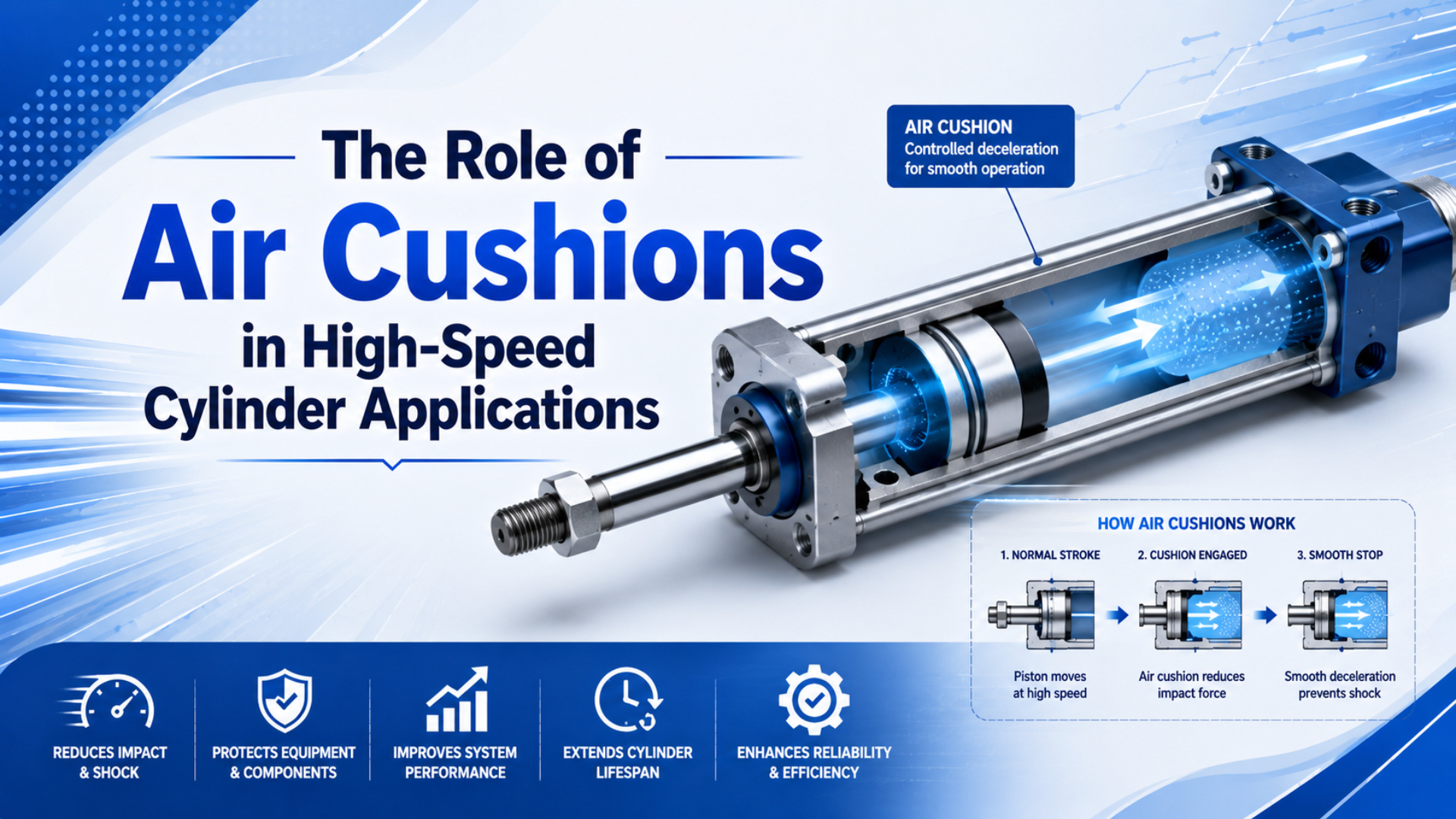
Air cushions matter most when a pneumatic cylinder reaches the end of stroke with enough speed and load to turn a normal stop into a shock event. Parker warns that piston speed at the start of cushioning is typically about 50% higher than average stroke speed, so a high-speed cylinder should be checked from cushion-entry speed, not only total stroke time (Parker-Origa, 2025, retrieved 2026-07-08).
That one detail changes the whole article. The useful question is not “Does this cylinder have cushions?” It is “Can this cushion absorb the moving energy at production speed, with the real load, through the real valve and exhaust path?”
Key Takeaways
- Check cushion-entry speed, not just average speed. Parker says it is typically about 50% higher.
- Festo separates end cushioning into 3 methods: elastic, pneumatic or servo-pneumatic, and hydraulic damping.
- Use cushion energy, pressure drop, noise, and bounce symptoms together before changing the needle screw.
Air cushions are end-of-stroke pneumatic damping features that trap exhaust air and meter it through a restricted path before the piston reaches the cap.
Cushion-entry speed is the piston speed at the moment the cushion boss enters the end-cap cushion bore, and it can be higher than the average stroke speed.
Cushion energy is the kinetic and drive energy that the air cushion, external stop, or shock absorber must absorb before final position.
Why Do Air Cushions Matter More at High Cylinder Speed?
Festo says higher speeds release more kinetic energy when a pneumatic cylinder stops, and Parker says cushion-entry speed is typically about 50% above average speed (Festo, 2022; Parker-Origa, 2025). Air cushions matter under real production load because energy rises with velocity squared.
Doubling speed does not merely double the stop problem. If the moving mass is unchanged, kinetic energy becomes four times larger. A cylinder that feels quiet at 300 mm/s can become harsh at 600 mm/s even if the load, pressure, bore, and stroke length did not change.
Use this quick split before selecting a cylinder:
| High-speed symptom | Likely cushion question | First check |
|---|---|---|
| Sharp metallic hit at one end | Cushion too open or energy too high | Entry speed and moving mass |
| Slow final crawl | Cushion too restrictive or exhaust path blocked | Needle setting, muffler, valve exhaust |
| Bounce at sensor position | Trapped air pressure is too high | Cushion screw and load variation |
| Noise spike at end of stroke | Mechanical impact still present | Sound reading and stop condition |
| Seal damage near one cap | Repeated pressure spike or side load | Alignment, guide load, cushion capacity |
For the broader foundation, keep the basic pneumatic cylinder cushioning guide separate from this high-speed check. That existing article explains what cushioning is. This one focuses on when speed makes the cushion a sizing problem.
Air Cushion Mechanics in a High-Speed Stroke
Festo lists 3 end-cushioning methods for pneumatic cylinders: elastic damping, pneumatic or servo-pneumatic damping, and hydraulic damping (Festo, 2022, retrieved 2026-07-08). In a high-speed cylinder, adjustable pneumatic damping is the common serviceable approach because trapped air becomes the brake near the final position.
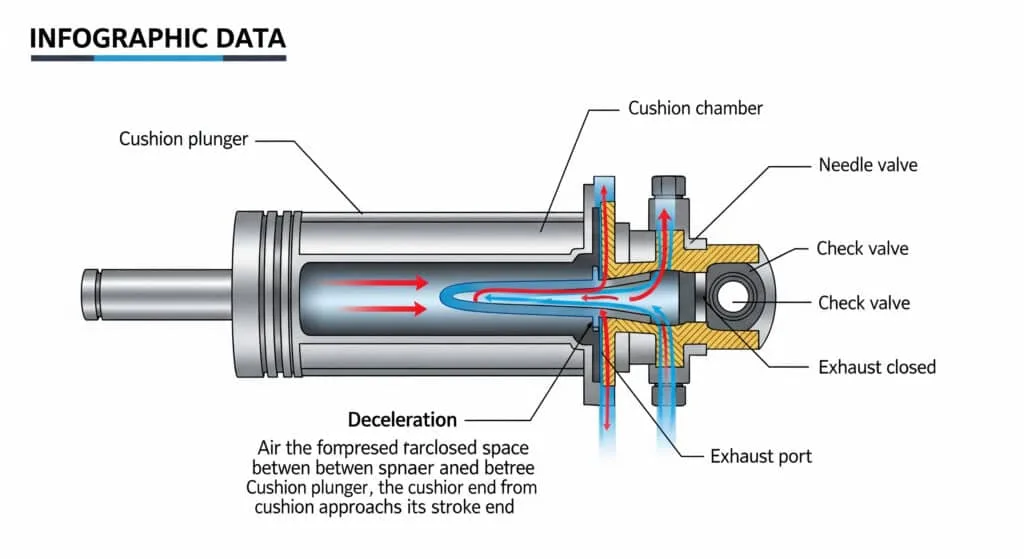
The basic sequence is simple:
- The piston travels normally through most of the stroke.
- A cushion boss or sleeve enters the end-cap cushion bore.
- Exhaust air is trapped in the end chamber.
- Air escapes through an adjustable needle path.
- Back pressure rises and slows the piston before it hits the cap.
The check valve matters too. It allows free flow in the opposite direction so the next stroke can start without dragging through the cushion restriction. If that check path is dirty or damaged, one direction may accelerate normally while the return stroke feels slow or uneven.
Which Inputs Decide Whether the Cushion Is Large Enough?
Parker’s cushioning diagram uses moving mass and maximum permissible speed at the start of cushioning, and it calls for external shock absorbers when limits are exceeded (Parker-Origa, 2025). The deciding inputs are mass, velocity, drive force, cushion stroke, and cycle rate.
The minimum worksheet should include these values:
| Input | Unit | Why it changes the cushion decision |
|---|---|---|
| Moving mass | kg | Mass sets the base kinetic energy |
| Cushion-entry speed | m/s or mm/s | Energy rises with velocity squared |
| Drive force during cushioning | N | Pressure can keep pushing during deceleration |
| Cushion stroke | mm | Shorter stopping distance raises deceleration demand |
| Cycles per minute | cycles/min | Repeated energy can heat seals and caps |
| Catalog cushion capacity | J or kg at speed | This is the manufacturer’s limit, not a guess |
The core physics is:
Kinetic energy = 0.5 x moving mass x cushion-entry speed^2That is only the starting point. In a pneumatic circuit, supply pressure may keep driving the piston while the cushion is trying to stop it. If the valve, tube, muffler, or exhaust path adds back pressure, the final 10 to 40 mm can behave differently from the clean catalog condition.
Cushion Energy Check Before You Raise Speed
AutomationDirect warns that cylinder-speed estimates are difficult because piping, fittings, ports, valves, and pressure losses affect motion, and Parker adds the 50% cushion-entry-speed warning (AutomationDirect, 2026; Parker-Origa, 2025). Check energy safely before raising speed or touching the needle screw.
Use this practical order when a line supervisor asks for more strokes per minute:
- Measure real stroke time under production load.
- Estimate average speed from stroke length divided by stroke time.
- Multiply by 1.5 as a first Parker-based cushion-entry warning factor.
- Calculate kinetic energy from moving mass and cushion-entry speed.
- Add a margin for drive force during the cushion stroke.
- Compare the result with the cylinder or shock absorber catalog limit.
- Test at low speed first, then step up while watching noise, bounce, and sensor repeatability.
In our experience, the number that is most often missing is not bore or stroke. It is moving mass at the carriage, including tooling, brackets, grippers, product, guide blocks, and any adapter plate. We found this omission most often on retrofits where the actuator model was copied but tooling had changed.
We measured one packaging-axis case where the stroke time looked acceptable, but the final stop changed after a heavier gripper was installed. The cushion screw was not the root problem. The load data was stale.
When Is Built-In Air Cushioning Not Enough?
Parker states that if maximum permissible cushion values are exceeded, additional shock absorbers must be used, and its load and moment data are based on speeds up to 0.5 m/s (Parker-Origa, 2025). Built-in cushioning is not enough outside the catalog envelope.
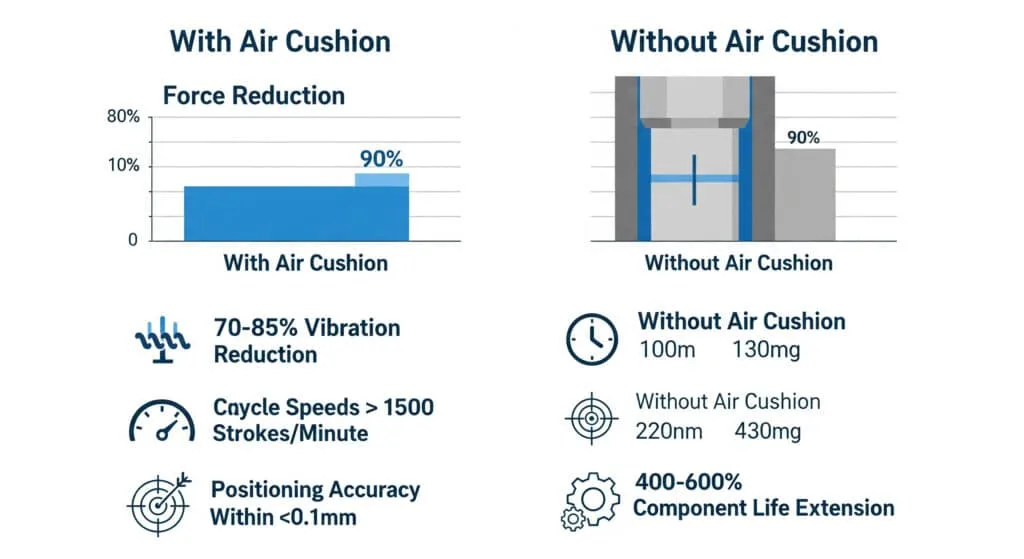
Review these boundary cases before tuning the screw harder:
| Boundary condition | Why air cushioning may fail | Better action |
|---|---|---|
| High moving mass | Trapped air cannot absorb all energy | Use external shock absorber or larger actuator |
| High entry speed | Energy rises with speed squared | Reduce velocity or change motion profile |
| Long overhung load | Cushion protects piston, not guide moment | Add guide support or stop near load center |
| Dirty exhaust muffler | Back pressure delays final movement | Clean or resize exhaust path |
| Inconsistent payload | One setting cannot fit all loads | Use controlled speed profile or external damping |
External shock absorbers should sit close to the load path when possible. A shock absorber mounted far from the center of gravity can make the cylinder quieter while still twisting the frame, carriage, or guide rail. That is not a fix. It only moves the failure.
How Do You Tune Air Cushions Without Hurting Cycle Time?
CAGI says a well-designed compressed air system should stay within 10% pressure drop from compressor discharge to point of use, while AutomationDirect warns that fast cylinders lose pressure through valves, tubing, fittings, and ports (CAGI, 2026; AutomationDirect, 2026). Tune cushions after the air path is healthy.
A good cushion setting has 3 visible traits:
- It reaches the end position without a metal hit.
- It does not rebound away from the sensor.
- It does not crawl through the final travel long enough to hurt cycle time.
When we troubleshoot a fast axis, we don’t start by closing the cushion screw until the sound disappears. That often creates a slow final inch and a new sensor fault. We first check supply pressure during motion, exhaust restriction, tube length, muffler condition, and whether the back pressure is part of the problem.
Our team found that this order prevents most false fixes: check the air path first, then tune the cushion. In other words, do not use the cushion screw to hide a blocked muffler or undersized valve.
Use this order on the machine:
- Set speed controls for a safe test speed.
- Open the cushion enough to avoid a final crawl.
- Increase damping in small increments until impact disappears.
- Watch the sensor signal and final position.
- Cycle at production speed with the real payload.
- Recheck after the muffler, valve, regulator, or tooling changes.
If the cylinder cannot stop cleanly without losing cycle time, the problem is probably sizing or circuit layout, not operator adjustment. Review pressure drop causes and pneumatic flow rate calculation before raising compressor pressure.
What Should Maintenance Teams Record After Tuning?
OSHA notes that CDC estimates 22 million workers are exposed to potentially damaging workplace noise each year, and OSHA requires hearing conservation at or above 85 dBA as an 8-hour TWA (OSHA, 2026). Maintenance records matter because a tuned air cushion can drift into a noise, impact, or sensor-repeatability issue over time.
Record enough data that another technician can restore the setting:
| Record item | Why it matters |
|---|---|
| Cylinder model, bore, stroke, and cushion type | Identifies the catalog cushion limit |
| Load mass, tooling weight, and product weight | Prevents underestimating energy |
| Stroke time and production cycle rate | Connects speed to cushion work |
| Cushion screw position by stroke direction | Makes repeat tuning possible |
| Supply pressure during motion | Catches dynamic pressure loss |
| Exhaust muffler and valve part numbers | Helps diagnose back pressure |
| End-of-stroke sound or dBA reading | Separates impact noise from exhaust noise |
| Sensor timing or PLC fault count | Shows whether tuning affects cycle stability |
For an RFQ or replacement review, include photos of the end caps, cushion screws, port side, guide load, mounting brackets, and any external stops. If the actuator is rodless or guided, add carriage mass and center-of-gravity notes. A pneumatic cylinder replacement that ignores guide load can still fail after the cushion is corrected.
For an application review, send load mass, stroke, measured extend and retract times, working pressure at the cylinder during motion, mounting orientation, tooling overhang, and photos of cushion screws, ports, guides, and stops.
FAQs About Air Cushions in High-Speed Cylinder Applications
Parker’s 50% cushion-entry-speed warning, Festo’s 3 damping methods, and OSHA’s 85 dBA hearing-conservation threshold give practical anchors for high-speed cylinder FAQs (Parker-Origa, 2025; Festo, 2022; OSHA, 2026). Use them for sizing, tuning, and noise questions without repeating the basics.
At what speed do pneumatic cylinders need air cushions?
There is no universal speed threshold. Check moving mass, cushion-entry speed, and catalog cushion capacity. Parker’s warning that cushion-entry speed is typically about 50% higher than average speed means a cylinder with a harmless-looking average speed can still overload the cushion at the end of stroke.
Does an air cushion reduce cycle time?
Not by itself. A good air cushion can allow a higher approach speed without impact, but too much restriction causes a slow final travel. If cycle time gets worse after tuning, check the exhaust path, valve flow, muffler condition, and whether the cylinder is undersized for the load.
Can I add air cushions to an existing cylinder?
Usually not as an internal feature. Internal air cushioning needs matching piston and end-cap geometry. Some applications can add external shock absorbers or stops, but a non-cushioned cylinder that is already damaging caps or seals often needs a purpose-built cushioned replacement.
Why does one stroke direction need a different cushion setting?
The moving mass, pressure side, rod area, load direction, and exhaust path can differ between extension and retraction. A vertical or offset load makes this more obvious. Tune each direction at production speed, with the real payload, instead of copying the screw position from the opposite end.
When should I use an external shock absorber instead of the built-in cushion?
Use an external shock absorber when catalog cushion limits are exceeded, the load is heavy or offset, the speed is high, or the machine still hits after correct tuning. Parker explicitly says additional shock absorbers are required when maximum permissible cushion values are exceeded.
Sources
- Festo, “Cylinder cushioning: the three most common methods”,
https://www.festo.com/gb/en/e/blog/in-practice/cylinder-cushioning-the-three-most-common-methods-id_1518838. Supports the 3 damping methods, adjustable pneumatic damping behavior, tuning variables, and regular adjustment check. Retrieved 2026-07-08. - Parker-Origa, “OSP-P Pneumatic Rodless Cylinders and Linear Guides”,
https://www.parker.com/content/dam/Parker-com/Literature/Literature-Files/pneumatic/parker_origa/BasicCylinder.pdf. Supports cushion-entry speed about 50% higher than average speed, mass and speed cushion selection, and external shock absorber limits. Retrieved 2026-07-08. - OSHA, “Occupational Noise Exposure”,
https://www.osha.gov/noise. Supports 22 million exposed workers, 85 dBA hearing-conservation level, and 90 dBA engineering or administrative control threshold. Retrieved 2026-07-08. - CAGI, “Working With Compressed Air”,
https://www.cagi.org/working-with-compressed-air/. Supports the 10% pressure-drop target and the relationship between excess operating pressure and compressor energy use. Retrieved 2026-07-08. - AutomationDirect, “Cylinder Speed”,
https://library.automationdirect.com/electro-pneumatic-systems-in-action/. Supports high-speed cylinder pressure-loss cautions, 25% to 50% extra force rule of thumb, and cushioned-cylinder recommendation for high-speed systems. Retrieved 2026-07-08. - ISO, “ISO 6358-1:2013”,
https://www.iso.org/standard/56612.html. Supports standardized steady-state testing of flow-rate characteristics for pneumatic components using compressible fluids. Retrieved 2026-07-08. - AVENTICS, “Adjustable cushioning - Advantages”,
https://www.youtube.com/watch?v=dp_X6EaR4fw. Manufacturer video demo used for the lazy-loaded embed. Retrieved 2026-07-08.