

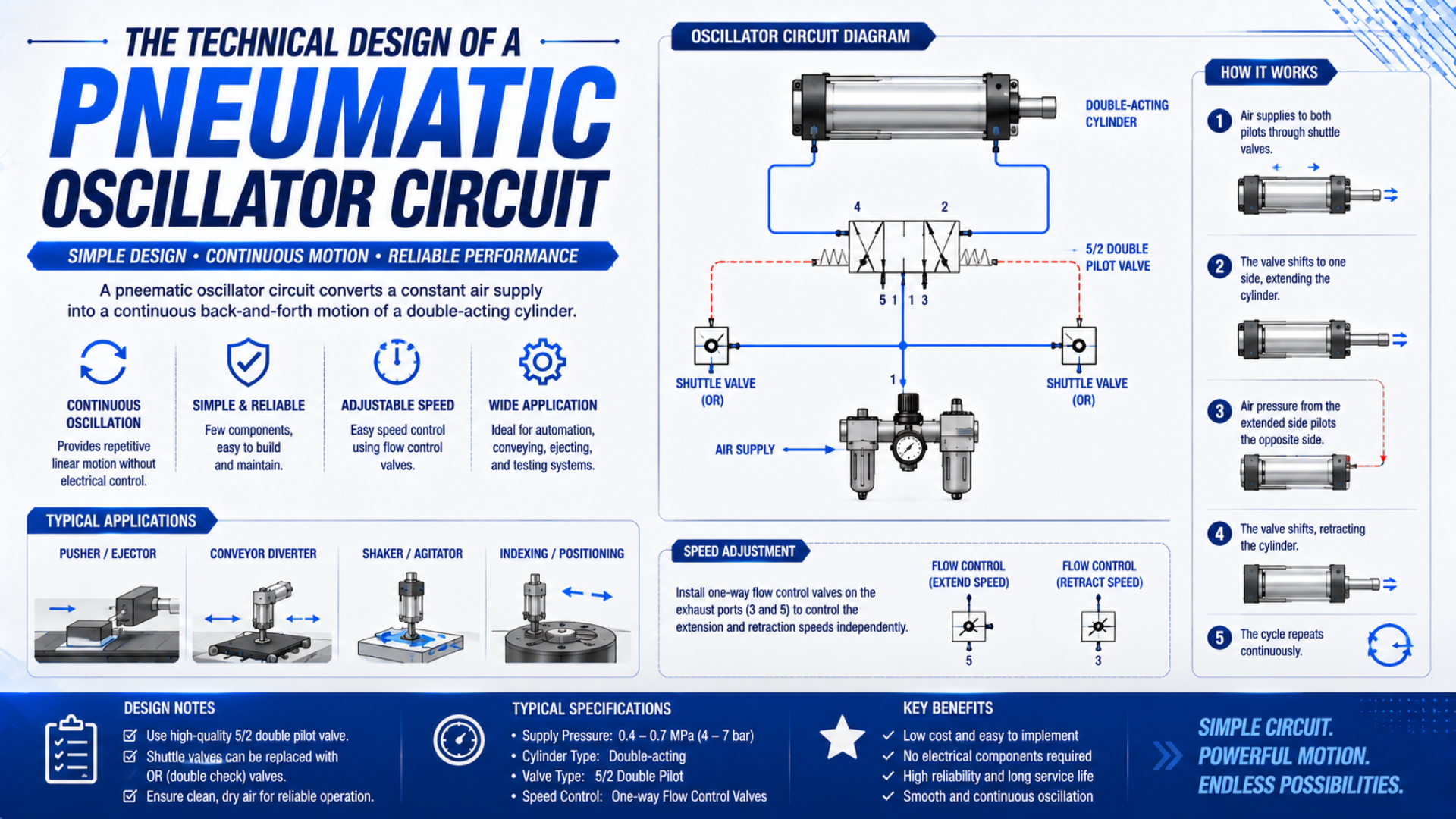
A pneumatic oscillator circuit is a control loop that creates repeating extend-and-retract motion by feeding confirmed end-position or timer signals back to a bistable directional valve. The circuit is not defined by one valve arrangement: it is defined by a state loop that can start deliberately, complete each transition, stop predictably, and recover from pressure loss without an unintended stroke.
The practical design rule is simple: prove motion before tuning time. Select the actuator and main valve for force and flow, establish unambiguous end-state signals, and only then add dwell timers or speed controls. A stable bench cycle means little if a load change can remove the pilot signal or make both pilots overlap.
What Makes a Pneumatic Oscillator Self-Sustaining?
A self-sustaining oscillator needs at least 2 stable motion states and a transition signal that returns the circuit to the first state after the second completes. Festo describes bistable valves as devices that retain their switched state until a separate actuation signal arrives, which makes them useful as pneumatic command memory (Festo).
For a double-acting cylinder, the main 5/2 valve typically stores one of two commands:
- Extend state: supply feeds the cap end while the rod end exhausts.
- Retract state: supply feeds the rod end while the cap end exhausts.
An end-of-stroke 3/2 valve, pneumatic proximity valve, or sensor-derived pilot signal requests the opposite state. When the actuator reaches the other end, the second signal switches the main valve back. That closed event chain—not “positive feedback” in the abstract—is what produces recurring motion.
A bistable valve accepts momentary commands, but it also remembers the last command. Therefore, the design must state what happens before the first start signal, after a stop, and when compressed air returns. A circuit that resumes from an unknown remembered state is not automatically ready for machine use.
Treat valve memory as stored logic, not as a convenience. The actuator may stop because supply air disappeared while the spool still retains its last state. Restoring pressure can then restore motion unless the upstream enable and restart logic deliberately prevent it.
Which Oscillator Architecture Fits the Motion Requirement?
There are 3 useful architecture classes: end-position switching, timed switching, and sensor/controller switching. A time-delay valve is optional, not universal. For example, SMC specifies a model-specific 0.5–60 s range for its VR2110, so its data cannot be generalized to every pneumatic timer or every cycle rate (SMC VR2110 manual).
| Architecture | Transition proof | Best fit | Main limitation |
|---|---|---|---|
| End-position pneumatic | Mechanical or pneumatic limit valve | Simple full-stroke shuttling | No intentional dwell unless another element is added |
| Pneumatic timer | Pressure threshold after restricted reservoir fill | Adjustable dwell without electrical control | Delay varies with the selected valve, signal pressure, temperature, and reset path |
| Sensor plus PLC or relay logic | Electrical position and timer states | Diagnostics, interlocks, recipes, and coordinated axes | Requires suitable electrical design and programmed fault handling |
The end-position arrangement is normally the better starting point when the load must actually reach each end before reversal. Add one timer after an end-position proof if the process requires dwell. A timer-only reversal can command the return stroke before a slow or obstructed actuator reaches its intended position.
Fully pneumatic control may reduce electrical hardware at the actuator, but that does not make the assembly inherently suitable for an explosive atmosphere. In the EU, equipment intended for potentially explosive atmospheres is subject to ATEX essential safety and conformity requirements; the complete installation still needs an ignition-hazard assessment and the required product marking (European Commission).
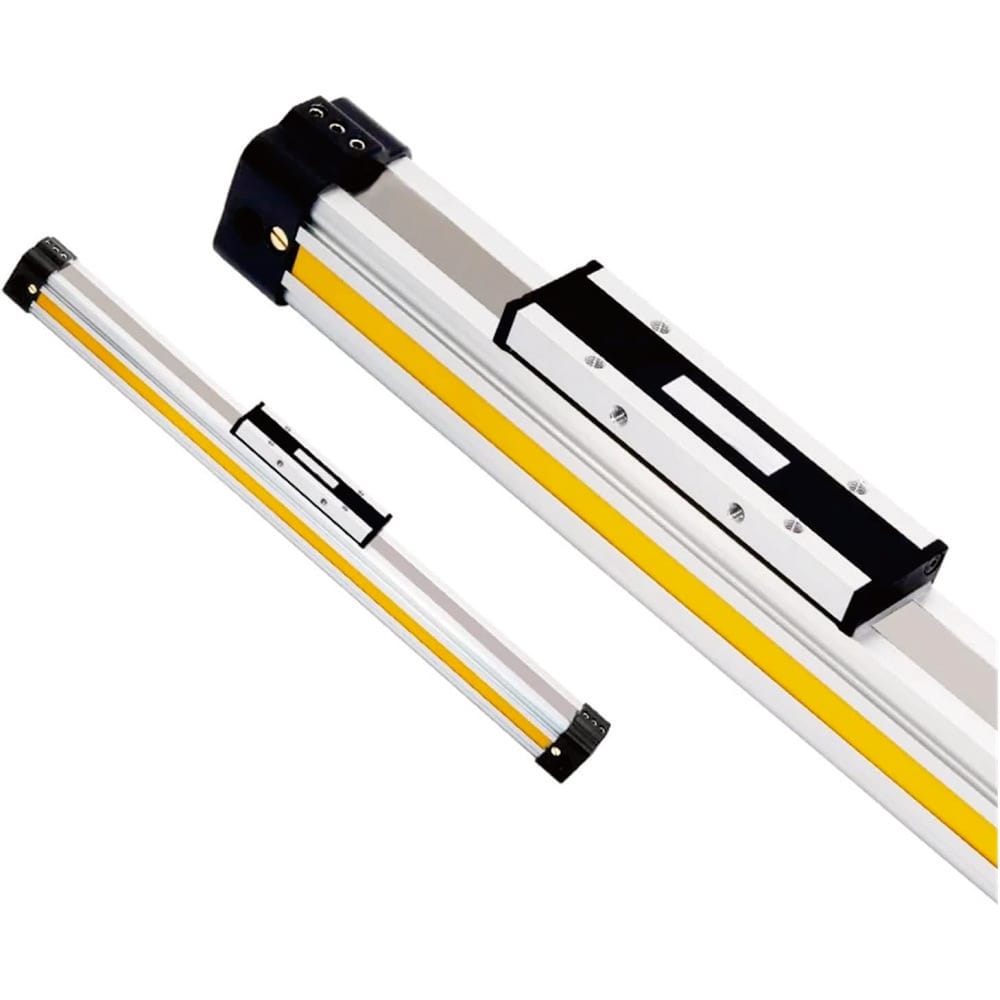
Example actuator hardware for a repeating long-stroke application. The oscillator logic, valve capacity, load guidance, and safety functions must still be engineered separately. See the OSP-P modular rodless cylinder product page for actuator details.
How Should the Oscillator State Loop Be Designed?
Write the cycle as 6 explicit events before drawing tubing: enable, extend, extended proof, reverse or dwell, retract, and retracted proof. This event model separates an autonomous loop from a finite multi-cylinder sequence. For the latter, use the dedicated sequential cylinder circuit guide rather than cross-coupling unrelated axes.
The minimum deterministic loop is:
- Enable: admit control air only when the machine permits automatic motion.
- Start: set a known initial valve state, normally from a verified home condition.
- Extend: the main valve drives the actuator outward.
- Extended proof: the end signal is accepted only after physical arrival; an optional timer adds dwell.
- Retract: the opposite pilot switches the main valve and the actuator returns.
- Retracted proof: the home signal either starts the next cycle or holds if enable has been removed.
Do not let both pilot signals remain present. The response to overlapping pilots depends on valve construction, signal pressure, and timing; “the stronger signal wins” is not a control strategy. Use short pulse signals, resettable limit valves, one-way flow logic, or explicit interlocking so that the active transition releases before the opposite request can persist. The pneumatic logic valve guide explains how AND, OR, and memory elements change signal behavior.
How Do You Calculate Oscillation Period and Frequency?
A useful period calculation contains 5 timing terms, not just reservoir fill and exhaust. Add extend travel, extended dwell, retract travel, retracted dwell, and total switching delay. Manufacturer timer data remains application-specific: SMC states that VR2110 delay changes with signal pressure and should be verified on the actual machine (SMC).
Use the measured cycle budget:
and:
where time is in seconds and frequency is in hertz. Here, should include the relevant pilot buildup, valve shift, signal release, and timer reset contributions. Do not hide these behind a nominal valve switching time if long pilot tubing controls the real response.
Worked cycle example
Suppose measured extension takes 1.2 s, extended dwell is 0.5 s, retraction takes 1.0 s, retracted dwell is 0.3 s, and the two direction changes contribute 0.2 s in total:
This is an illustrative timing budget, not a recommended universal frequency. Recalculate with the loaded machine at minimum and maximum permitted supply conditions.
For a pneumatic timer, the reservoir charging estimate is only a first screen. Threshold pressure, needle geometry, leakage, signal pressure, temperature, and reset exhaust determine the actual switch event. The VR2110 manual, for example, lists 0.25–0.8 MPa input signal pressure and warns that pressure fluctuation changes delay; use the exact selected component’s data.
Use the stroke time calculator separately for a first-pass motion estimate. Then measure both travel directions because rod area, load, cushioning, meter-out settings, and exhaust restrictions make extension and retraction unequal.
In our experience reviewing pneumatic oscillator complaints, when a circuit is described as “randomly changing frequency,” we first time the four visible intervals separately—extend, extended dwell, retract, and retracted dwell. This quickly separates a motion-flow problem from a timer problem without assuming that the delay valve is at fault.
What Must Start, Stop, Reset, and Air Loss Do?
Define 4 operating conditions before approving automatic motion: normal start, normal stop, emergency or protective stop, and supply-air loss/return. ISO 4414 covers significant hazards in pneumatic systems and requires safety principles to be applied during design, installation, adjustment, operation, and maintenance—not added after commissioning (ISO 4414).
Start from a known state
A start command should not merely admit air to a remembered cross-coupled loop. Verify the actuator’s initial position, reset any timer volumes, establish the main valve state, and then enable repeat operation. If the mechanism can be between end positions, define a homing or recovery routine that is safe for the load.
Separate a normal stop from energy isolation
A normal stop may finish the current stroke, hold position, return home, or vent working ports; the correct choice depends on the machine risk assessment. A manual exhaust valve is not automatically fail-safe because venting can allow a vertical load to fall or stored volume to move the actuator.
For servicing, OSHA 29 CFR 1910.147 includes pneumatic energy and requires potentially hazardous stored or residual energy to be relieved, disconnected, restrained, or otherwise rendered safe after isolation (OSHA). Operational controls and manual overrides do not replace an energy-isolation procedure.
Decide whether pressure return may restart motion
If automatic restart is not acceptable, interrupt and reset the enable path when pressure falls below the verified pilot operating range. Require a deliberate restart after pressure is stable. Also consider trapped pressure downstream of check valves, pilot reservoirs, and blocked-center valves; a supply gauge reading zero does not prove that every volume is de-energized.
A pneumatic oscillator has two restart memories: the main valve’s last spool state and the pressurized state of timer or pilot volumes. Both must be discharged, retained, or reinitialized intentionally. Resetting only the main valve can leave a delayed pilot pulse waiting to arrive.
Flow, Pilot Pressure, and Exhaust Verification
Verify 3 different pneumatic paths: actuator supply, actuator exhaust, and pilot/control air. ISO 6358-1 provides steady-state test methods for component flow characteristics but explicitly excludes cylinders and accumulators from that method, so a catalogue valve coefficient is evidence for one component—not a complete dynamic machine model (ISO 6358-1).
- Size the working path for loaded travel. Check the main valve, fittings, tubing, speed controls, cylinder ports, silencers, and exhaust devices as one series path. The valve pressure-drop guide shows why a valve’s nominal port size alone is insufficient.
- Protect pilot pressure during peak demand. A valve may pass actuator flow yet lose pilot authority when a shared branch sags. Measure at the pilot port during reversal, not only at the regulator with the machine idle.
- Control speed with the intended method. Meter-out control is often more stable for a conventional double-acting cylinder, but load direction and low-friction behavior matter. Compare the choices in the meter-in versus meter-out guide.
- Check exhaust backpressure. Contaminated silencers, undersized exhaust lines, or a slow timer reset can stretch one half-cycle. Temporarily bypassing a suspected restriction may be a diagnostic step only when the machine is secured and the change does not create an unsafe speed or noise exposure.
Use the exact valve’s minimum pilot pressure, flow characteristics, allowable backpressure, and simultaneous-signal behavior. A generic 5/2 symbol does not specify those performance limits. The pilot-operated valve guide provides the component-level background.
Commissioning and Troubleshooting Workflow
Commission the circuit with a 5-step evidence trail: state table, static signal test, single-cycle test, continuous loaded test, and fault test. SMC instructs users to verify actual VR2110 delay with a stopwatch and notes that reset time depends on signal-valve type, pressure, and piping length—exactly the variables that a schematic alone cannot prove (SMC).
1. Confirm each state without continuous cycling
Isolate the repeat link and command extend and retract separately. Record supply pressure, pilot pressure at both main-valve pilots, end-signal state, and the actuator’s physical position. Confirm that releasing an end valve actually vents its pilot line.
2. Run one complete cycle
Enable only one cycle. Measure extend time, end dwell, retract time, home dwell, and valve-switch intervals separately. Verify that each transition is caused by the intended signal rather than a pressure spike, manual override, or tubing movement.
3. Test continuously under representative load
Run at the permitted minimum and maximum operating pressure and with the real payload or process resistance. Watch for gradual timer drift, declining end speed, cushioning changes, and pilot overlap. Do not convert one stable no-load bench result into a lifetime or uptime claim.
4. Challenge predictable faults
Within an approved commissioning procedure, test loss of enable, blocked or missing end proof, reduced pilot pressure, interrupted supply, and pressure restoration. Confirm the defined stop and restart behavior. If position confirmation is critical, integrate suitable sensors as described in the pneumatic actuator feedback guide.
5. Diagnose by the interval that changed
| Symptom | Measure first | Likely branch to inspect |
|---|---|---|
| Both travel times increase | Dynamic pressure at main valve and cylinder | Supply restriction, regulator droop, undersized common path |
| One travel direction slows | Pressures at both cylinder ports | Directional restriction, flow control, cushion, load, seal friction |
| Dwell varies but travel is stable | Timer signal pressure and reservoir reset | Regulator fluctuation, timer needle, leakage, retained pilot volume |
| Valve does not reverse | Pilot pressure at the commanded port and opposite-port release | Missing end proof, insufficient pilot pressure, simultaneous signals |
| Cycle restarts after stop | Enable state, valve memory, trapped timer pressure | Incomplete stop/reset architecture |
Maintenance frequency should follow the component manufacturer’s instructions, environment, duty, contamination evidence, and recorded drift. Fixed daily, weekly, or quarterly replacement intervals are not transferable engineering rules.
Pneumatic Oscillator Circuit FAQs
These 5 questions cover the design decisions most likely to cause an unstable or unsafe loop. One useful product boundary is SMC’s VR2110 specification: 0.5–60 s delay and ±10% full-scale representative repeat accuracy under stated conditions. That is a component example, not a universal pneumatic oscillator capability (SMC).
Can a pneumatic oscillator run without a time-delay valve?
Yes. Two end-position signal valves can alternately pilot a bistable 5/2 main valve so the cylinder reverses only after reaching each end. Add time-delay valves only when the process needs dwell or a deliberately delayed transition. For reliable control, ensure each end signal releases and opposing pilots cannot remain active together.
How is pneumatic oscillator frequency calculated?
Add measured extension, extended dwell, retraction, retracted dwell, and switching delays to obtain the complete cycle period. Frequency is the reciprocal of that period in seconds. Avoid calculating frequency from timer settings alone because actuator flow, load, cushioning, pilot buildup, valve shift, and timer reset all contribute to the real cycle.
Why can a double-pilot oscillator stop mid-cycle?
Common causes include inadequate dynamic pilot pressure, a missing end-position signal, overlapping pilot signals, restricted exhaust, a timer that did not reset, or an actuator that never reached the switching point. Measure both pilot ports and cylinder chamber pressures during the failed transition; an idle supply gauge rarely identifies which event was lost.
Will the circuit restart when air pressure returns?
It may. A bistable main valve can retain its last state, while timer and pilot volumes may retain or rebuild pressure. If automatic restart is unacceptable, pressure loss must reset or inhibit the enable circuit and require a deliberate restart after pressure stabilizes. Define actuator behavior from every possible stopped position.
Is a pneumatic oscillator automatically safe in an explosive atmosphere?
No. Removing a local electrical actuator does not prove that the complete assembly lacks ignition sources or meets the required equipment category. Verify valve and actuator markings, materials, electrostatic and mechanical ignition risks, temperature limits, tubing, accessories, installation zone, and applicable conformity requirements through the machine’s documented hazardous-area assessment.
Engineering Conclusion
A reliable pneumatic oscillator is an air-logic state machine, not merely two valves in a loop. Start with confirmed end states and a bistable main valve; add dwell only where the process needs it. Then calculate frequency from every interval and prove dynamic flow, pilot release, stopping, isolation, pressure-loss behavior, and restart on the loaded machine.
The most valuable commissioning record is a state-and-time table showing what signal caused every transition. That evidence makes later troubleshooting faster and prevents timer adjustment from masking a restricted exhaust, weak pilot signal, or incomplete end stroke.