

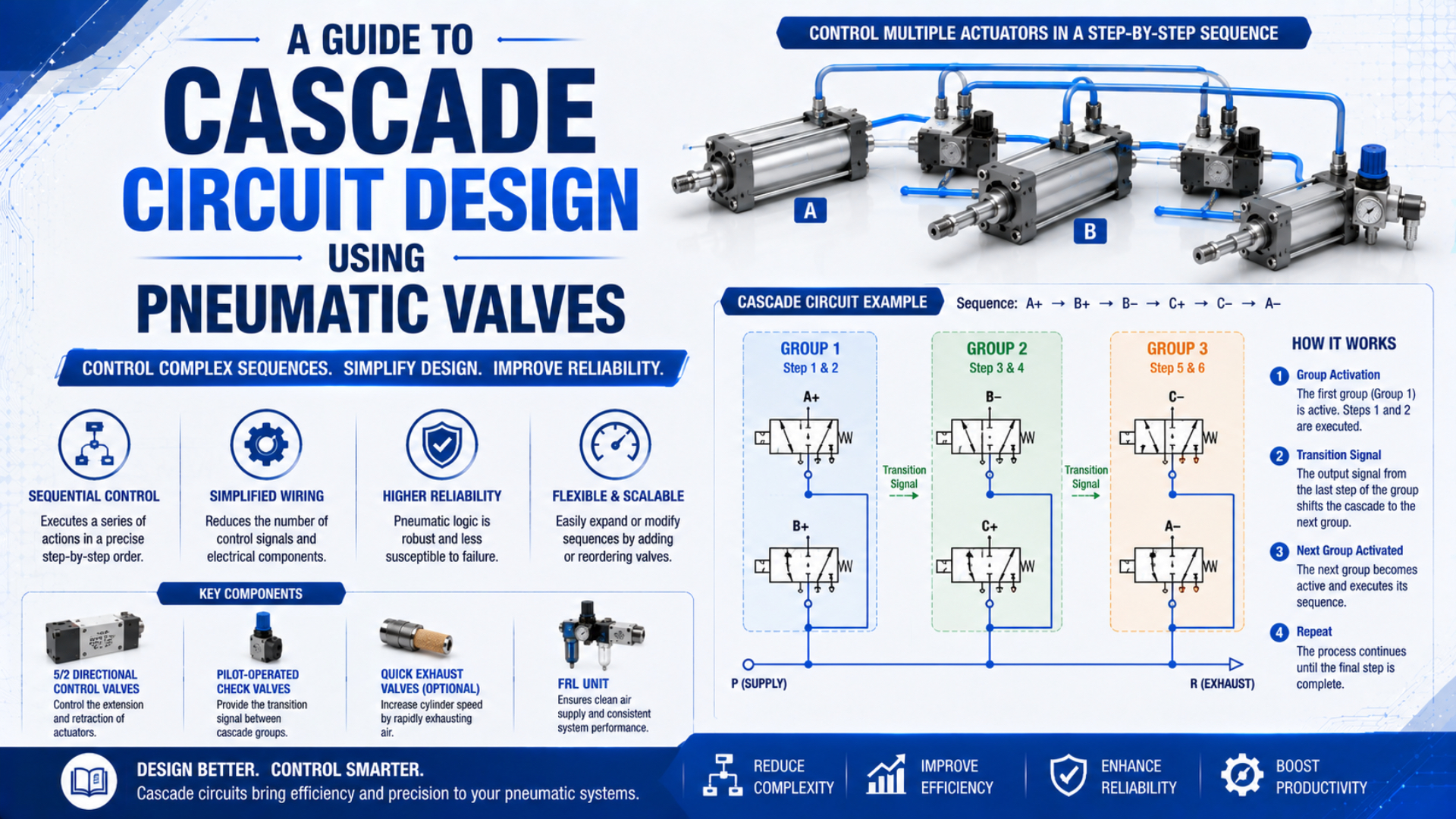
Cascade circuit design using pneumatic valves is a systematic way to run a fixed multi-cylinder sequence without a PLC. The designer divides the motion list into groups, pressurizes only one group line at a time, and combines that group permission with end-position signals. The result prevents opposing pilot commands from reaching the same directional valve together.
Festo’s 2025 industrial-pneumatics syllabus treats signal-overlap analysis, motion diagrams, and cascade grouping as separate skills. That distinction matters. A row of valves can move several cylinders, but it isn’t a dependable cascade circuit until the sequence, group boundaries, signal paths, and reset state are all defined (Festo Training Catalogue, 2025).
Key Takeaways
- Split the sequence whenever the same cylinder would appear twice in one group.
- Enable only one group pressure line at a time.
- Treat each motion command as group permission plus completion of the preceding step.
- Check pilot pressure, exhaust, stop, reset, and restart behavior on the real circuit.
This guide develops the six-motion example A+ → B+ → B− → C+ → C− → A−. Here, + means extension and − means retraction. If you first need to compare pneumatic cascade, relay, stepper, and PLC architectures, start with the broader guide to sequential cylinder circuit design.
What Does Cascade Circuit Design Actually Solve?
Festo’s advanced pneumatic-control course identifies three linked tasks: finding signal overlap, plotting motion and control diagrams, and applying the cascade grouping method. A cascade circuit solves the overlap problem by making each opposing cylinder command available in a different pressure group rather than trying to resolve two live pilot signals at the actuator valve (Festo, 2025).
A double-piloted 5/2 valve remembers its last shifted position. That behavior is useful for sequence control, but it creates a design problem: if extension and retraction pilots are pressurized together, the result depends on valve construction, signal pressure, arrival order, and residual pressure. The machine can hesitate, reverse late, or behave differently after a small timing change.
The cascade method prevents that conflict upstream. It divides the motion sequence into consecutive groups so the same actuator appears only once in each group. A group distributor then enables one group line and vents the others. End-position valves within the active group release the motions in order.
Cascade group means one consecutive block of actuator motions in which no cylinder is commanded more than once. The definition is about the command sequence, not the physical location of the cylinders and not separate working-pressure zones for the actuator ports.
This is also why cascade control isn’t the same as delay-based sequencing. A timer advances after elapsed time. A cascade circuit normally advances when a position valve or qualified process condition changes state. Flow controls still affect travel time, but they don’t own the logical order.
The practical benefit is not “precision timing.” It is exclusive command authority. One group owns the permitted pilot paths while every inactive group is deprived of control pressure. Once that rule is visible on the schematic, many intermittent sequence faults become traceable pressure-path problems rather than mysterious timing problems.
How Do You Divide a Motion Sequence into Cascade Groups?
Festo’s PN13 course treats displacement-step and displacement-time diagrams as two separate planning tools before introducing pneumatic cascade control. The step diagram establishes logical order; the time diagram shows duration. Start grouping from the ordered steps, because six motions can still require only three groups even when their stroke times are all different (Festo Training Courses, 2026).
Write every cylinder motion in order, then scan from left to right. Keep adding motions to the current group until the next motion uses a cylinder already present in that group. Start a new group before that repeated cylinder. Continue until all motions are assigned.
For the worked sequence, the grouping is:
| Sequence position | Motion | Group decision | Reason |
|---|---|---|---|
| 1 | A+ |
Group 1 | A has not appeared in Group 1 |
| 2 | B+ |
Group 1 | B has not appeared in Group 1 |
| 3 | B− |
Start Group 2 | B already appears in Group 1 |
| 4 | C+ |
Group 2 | C has not appeared in Group 2 |
| 5 | C− |
Start Group 3 | C already appears in Group 2 |
| 6 | A− |
Group 3 | A has not appeared in Group 3 |
The final assignment is therefore:
- Group 1:
A+ → B+ - Group 2:
B− → C+ - Group 3:
C− → A−
Could you create more groups? Yes, but extra groups add selector valves, tubing, exhaust paths, and diagnostic points. Use the minimum valid number unless the machine needs a deliberate pause, mode boundary, independent pressure zone, or another documented condition.
Valve and Signal Elements for the Circuit
Festo’s Tiger Classic data lists double-piloted 5/2 valves with nominal flows of 600, 1,100, and 4,500 L/min, yet the cited family requires 1.2 to 10 bar pilot pressure. Those three flow sizes illustrate why function symbols alone cannot select a valve; pilot demand and main flow must both fit the circuit (Festo Tiger Classic, 2024).
Use the schematic function first, then select a real component from its complete datasheet. A basic three-group circuit normally needs the following elements:
| Element | Job in the cascade circuit | Selection checks |
|---|---|---|
| Double-piloted 5/2 valve | Retains each double-acting cylinder’s last commanded direction | main flow, pilot pressure, leakage, switching time, porting |
| Group distributor or reversing valves | Pressurizes Z1, Z2, or Z3 while exhausting inactive group lines | number of groups, break-before-make behavior, reset state, exhaust path |
| Mechanically operated 3/2 valves or sensors | Confirm cylinder end positions and release the next step | actuation geometry, repeatability, flow, release behavior |
| Dual-pressure valve | Permits an output only when group pressure and step condition are both present | minimum input pressure, input balance, outlet capacity |
| Shuttle valve | Selects either of two valid pneumatic signals where OR logic is genuinely required | pressure range, leakage, backflow isolation, response |
| Meter-out flow controls | Set cylinder speed without becoming the sequence memory | free-flow direction, required flow, adjustment access |
| Pressure gauge or test coupling | Shows whether a group or pilot line reaches and releases its required pressure | location, range, response, safe access |
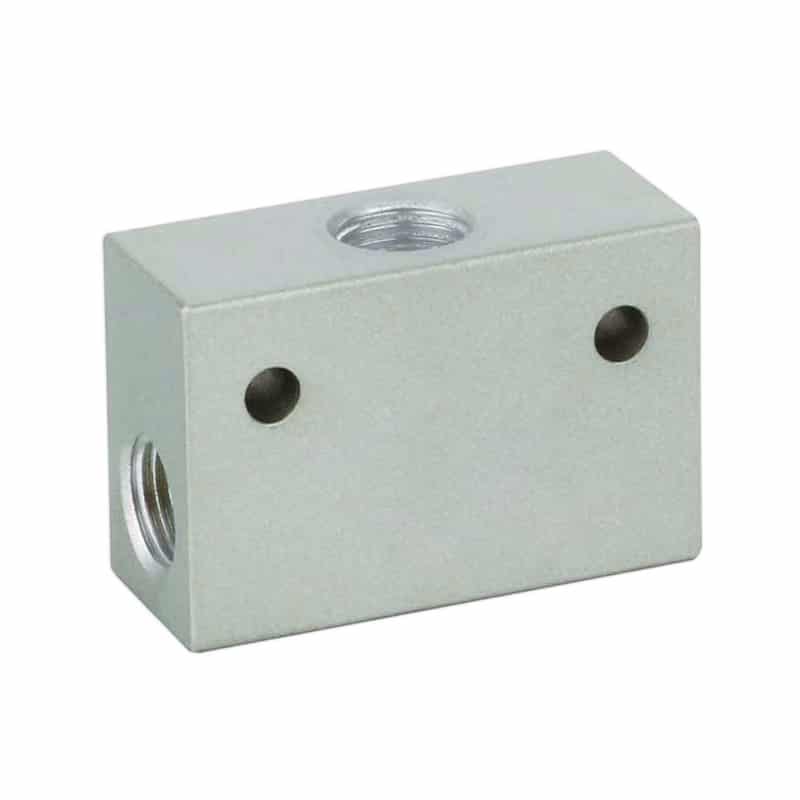
A shuttle valve selects between two pneumatic inputs. It does not prove cylinder position, add the two pressures, or retain the sequence state.
Don’t label every 3/2 valve a memory valve. A spring-return 3/2 limit valve usually creates a temporary signal. Sequence memory normally comes from a bistable directional element, a dedicated command-memory module, or a stepper module. Festo describes command-memory modules as double-pilot valves within its pneumatic stepper architecture (Festo Control Technology).
For the operating principles behind AND, OR, and memory elements, see pneumatic logic valves in control-system design. For main-spool pilot arrangements, use the separate guide to pneumatic pilot-operated valves.
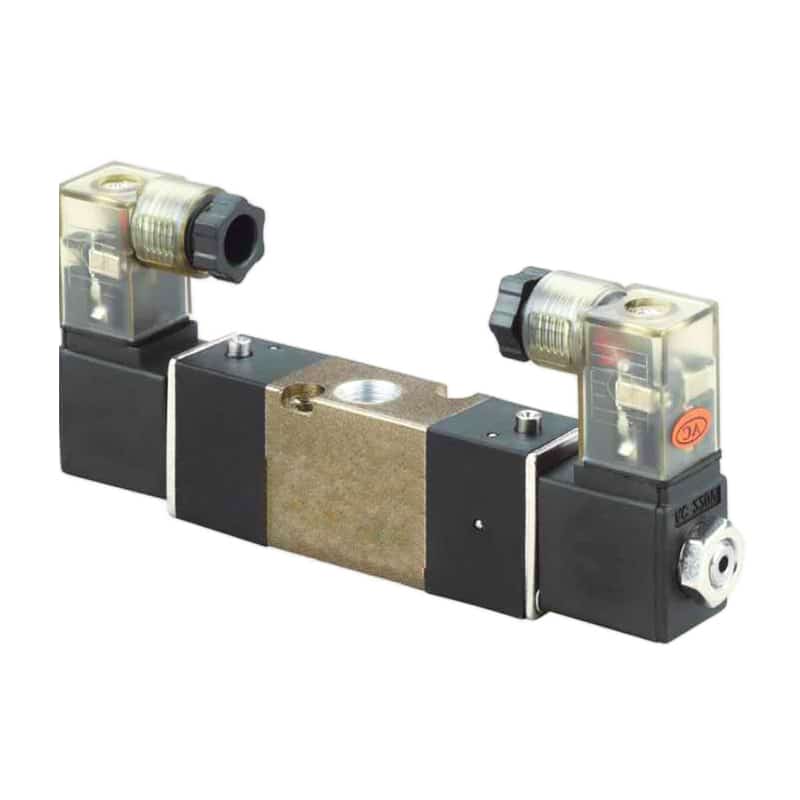
A bistable directional valve can retain its last spool state, but retained state is not the same as redundant or fail-safe control.
How Do You Build the Group-Line Logic?
SMC specifies 0.05 to 1.0 MPa operating pressure for one shuttle and AND-valve family, while the cited Festo double-pilot valves require at least 1.2 bar pilot pressure. A signal can therefore be valid for one logic element yet too weak for the final valve. Build each command path from the downstream pilot requirement backward (SMC; Festo).
Assign one line to each group: Z1, Z2, and Z3. Only the active line should carry control pressure. When Group 1 finishes, its last completion signal switches the distributor so Z1 exhausts and Z2 pressurizes. The same pattern transfers control from Z2 to Z3 and then returns the circuit to its defined ready state.
Each motion needs two permissions:
- its group line is active; and
- the preceding step’s completion condition is valid.
The worked sequence can be recorded as a signal table before drawing tubes:
| Motion command | Active group | Step condition | Transfer after completion |
|---|---|---|---|
A+ |
Z1 | cycle start and verified home state | A-extended signal enables B+ |
B+ |
Z1 | A extended | B-extended signal transfers Z1 to Z2 |
B− |
Z2 | Z2 newly active | B-retracted signal enables C+ |
C+ |
Z2 | B retracted | C-extended signal transfers Z2 to Z3 |
C− |
Z3 | Z3 newly active | C-retracted signal enables A− |
A− |
Z3 | C retracted | A-retracted signal returns to ready state |
The first motion in a newly activated group often receives its step permission from the group transfer itself. The other motions use a qualified end-position signal. Avoid routing a limit signal directly to a main valve if that would remain effective while another group is active.
Draw the release path beside every command path. When Z1 turns off, where does its trapped pilot air escape? When a limit valve releases, does a long control tube vent quickly enough? Cascade reliability depends as much on removing old commands as on creating new ones.
How Should You Draw and Check the Circuit Before Piping It?
Festo’s current PN13 outline separates two diagrams: a displacement-step diagram for logical order and a displacement-time diagram for motion duration. Use both, then add a third document, the signal table. The three views prevent a fast bench test from hiding a group error, missing completion condition, or unrealistic production timing assumption (Festo Training Courses, 2026).
Create the documents in this order:
- Motion sequence: write every actuator direction, including the required home state.
- Displacement-step diagram: show which cylinder changes position at each numbered step.
- Cascade groups: apply the no-repeat rule and mark the transfer motion at each boundary.
- Signal table: name the active group, step condition, output pilot, and next transition.
- Pneumatic schematic: draw working-air paths separately from control-air paths.
- Timing estimate: record expected stroke windows without using time as automatic proof of position.
- Fault table: define what happens when each completion signal, group transfer, or supply condition is missing.
Give every port, valve, sensor, group line, and test point a unique identifier. Mark the normal state at verified home conditions, not merely the state shown in a catalog symbol. If an end valve is already actuated at home, show that physical fact in the initial signal table.
Check the sequence by hand before connecting actuators. Apply one valid input at a time, trace the expected pressure path, and confirm that every competing pilot remains vented. Then repeat the trace for stuck-high inputs, missing inputs, reduced control pressure, and interrupted supply.
For manifold supply, pressure zones, and shared exhaust planning, see how to build a reliable pneumatic circuit with modular valves.
What Causes a Cascade Circuit to Skip or Stall?
Festo publishes reversal times of 3, 7, and 12 ms for three sizes in one double-pilot valve family, but those are component figures, not circuit times. Tube volume, logic flow, actuator travel, and exhaust restriction can dominate the machine response. Troubleshoot pressure and state at the failed step instead of trusting a catalog switching time (Festo Tiger Classic, 2024).
| Symptom | Measure first | Likely causes |
|---|---|---|
| Sequence never starts | Z1 pressure and verified home signals | distributor not reset, missing start pulse, home valve not actuated |
| One cylinder moves but the next does not | preceding end signal and downstream pilot pressure | misadjusted limit valve, weak logic output, blocked pilot tube |
| Two motions appear to compete | both pilots at the main valve | inactive group not exhausted, crossed tubing, stuck signal valve |
| Circuit skips a step | group-transfer timing and end-valve state | sensor already active, pressure spike, incorrect OR path |
| Works slowly by hand but fails at production rate | control-line pressure trace and pulse width | tube volume, restricted exhaust, marginal pilot pressure |
| Stops only when actuators move together | dynamic supply pressure | undersized branch, shared pressure drop, inadequate local flow |
| Does not return to ready state | final completion signal and distributor state | missing A-retracted proof, transfer valve not shifting, trapped pressure |
Static regulator pressure is not enough. Install temporary gauges or pressure transducers at the active group line and final pilot. Watch the signal while the working-air circuit is under peak demand. A healthy unloaded logic signal can collapse when several actuators consume air from the same undersized supply.
Field Note: In our experience, the quickest diagnostic starts at the main-valve pilot that failed to change state. Measure there first, then trace backward through the active group line and preceding completion valve. This avoids replacing a limit valve when the actual problem is low dynamic pressure or a slow exhaust path.
Blocked silencers deserve attention too. A restricted exhaust can keep an inactive line above a valve’s release threshold. If the symptom changes after a muffler is removed for a controlled test, correct the exhaust sizing or contamination problem rather than leaving the machine without noise control.
Speed controllers belong near the actuator ports and are normally arranged for stable meter-out control when the application permits it. Their job is motion control, not sequence permission. The meter-in versus meter-out guide explains that distinction.
Stop, Reset, and Air-Loss Behavior
ISO 4414:2010 is the third edition and was confirmed as current in 2021; it addresses significant pneumatic hazards across design, installation, operation, maintenance, reliability, and energy efficiency. ISO 13849-1:2023 covers pneumatic safety-related control systems but does not prescribe a machine’s required safety function or PLr. Cascade logic cannot supply those decisions by itself (ISO 4414; ISO 13849-1).
Define these events separately:
- Normal stop: whether the current step completes, pauses, or returns to a controlled state.
- Emergency stop: the validated response required by the machine risk assessment.
- Supply-air loss: what each valve, actuator, load, and clamp physically does as pressure decays.
- Control-air loss: whether group memory remains, resets, or becomes indeterminate.
- Pressure restoration: whether the circuit stays inhibited or resumes a retained command.
- Manual reset: which home conditions must be proven before Z1 can be enabled.
- Maintenance isolation: how energy is isolated, residual pressure is released, and zero-energy state is verified.
A double-piloted valve may retain its spool position while downstream pressure leaks away. It does not guarantee that a load remains held. A spring-return valve may move to a known spool state after pilot loss, but that state isn’t automatically safe for a vertical cylinder or stored mechanical energy.
Never add a general “bypass failed limit valve” instruction. A manual recovery mode needs restricted authority, maintained visibility of the hazard, defined speed and force limits where required, and machine-specific validation. Ordinary cascade components should not be presented as safety-rated merely because they implement AND logic or remove a signal.
Reset is another sequence, not a wire back to Step 1. Write its required starting positions, permitted motions, confirmation signals, and response to an interrupted reset. If those conditions aren’t explicit, restoring air can replay a retained pilot command before the machine is ready.
For safety-related pressure removal, compare the control plan with safety exhaust valve integration.
How Do You Commission the Completed Circuit?
One Festo double-pilot range lists valve reversal times from 3 to 12 ms, a fourfold spread before tubing and logic delays are added. Commissioning must therefore measure the complete pressure path and actuator response, not assume equal timing from identical symbols. Record results at minimum supply pressure and the highest intended cycle rate (Festo Tiger Classic, 2024).
Use a controlled commissioning order:
- Verify the build against the schematic. Check port numbers, tube labels, valve normal states, and exhaust routes.
- Operate each actuator manually at reduced risk. Confirm direction, end positions, cushioning, and meter-out adjustment.
- Test group selection without automatic cycling. Prove that one group line is pressurized and the others release below their effective FALSE thresholds.
- Run one step at a time. Record the command pressure, completion signal, and time for every motion.
- Run one complete cycle. Confirm all group transfers and the final return to ready.
- Repeat under production demand. Use the real load, lowest allowed supply pressure, intended cycle rate, and simultaneous air consumers.
- Inject documented faults safely. Remove one completion signal, interrupt control air, reduce supply pressure, and obstruct no exhaust unless the test method controls the resulting hazard.
- Test stop and restart behavior. Interrupt the cycle at each step and verify the specified recovery path.
Record dynamic pressure at Z1, Z2, Z3, and the affected main-valve pilots. Also record cylinder completion times and the release time of the previous signal. Those measurements create acceptance limits for maintenance. Without a baseline, “it seems slower” is all the technician has when contamination, leakage, or tube damage develops.
Before handoff, update the displacement-step diagram, signal table, schematic, valve list, tube labels, test results, and reset procedure so they describe the machine as built. A cascade circuit is easy to follow when every transition has one owner. It becomes difficult fast when undocumented field changes create a second path.
For help reviewing a group diagram, valve list, or pneumatic schematic, send the motion sequence, cylinder sizes, working pressure, valve model numbers, and required stop behavior through the technical contact page.
Cascade Circuit Design FAQs
SMC’s current shuttle and AND-valve family spans 0.05 to 1.0 MPa, a 20:1 operating-pressure range, yet the final pilot valve may have a higher minimum requirement. These answers cover the grouping method; final pressure, flow, timing, and safety decisions still come from the selected component data and machine validation (SMC).
What is the basic rule for dividing a pneumatic cascade sequence?
Read the ordered motions from left to right. Keep a motion in the current group only if that cylinder has not already appeared there. Start a new group before the repeated cylinder. For A+ B+ B− C+ C− A−, the valid minimum grouping is A+ B+, then B− C+, then C− A−.
Why can only one cascade group line be active at a time?
Exclusive group pressure prevents extension and retraction commands for the same cylinder from being enabled together. When the distributor advances, the previous group must exhaust and the next group must pressurize. If both remain above their effective switching thresholds, residual pressure can recreate the signal overlap the cascade method was intended to remove.
Does a double-piloted valve make the circuit fail-safe?
No. A double-piloted valve is bistable and normally retains its last spool state until the opposite pilot acts. It does not provide redundancy, diagnostic coverage, safe load holding, or a defined response to every energy-loss condition. ISO 13849-1 requires the complete safety-related control function to be designed and evaluated for the application.
Should a timer replace a cylinder end-position valve?
Not by default. A timer proves that time elapsed; it does not prove that the piston reached the required position. Use position or qualified process feedback for completion, then use a timer to detect an overlong motion where the machine specification requires it. Time-only sequencing needs a documented tolerance and risk justification.
Sources and technical references
- Festo, Industrial Pneumatic Control training catalogue
- Festo, PN13 Advanced Industrial Pneumatics training courses
- Festo, Tiger Classic valve technical data
- Festo, Pneumatic and electropneumatic control technology
- SMC, Shuttle and AND valve specifications
- ISO 4414:2010, Pneumatic fluid power systems and components
- ISO 13849-1:2023, Safety-related parts of control systems