Introduction
You’re facing a critical decision: your Norgren cylinders need replacement, but the OEM pricing is eating into your maintenance budget while 6-week lead times threaten production schedules. 😰 Your engineering team warns that switching suppliers might require expensive machine modifications, yet your CFO is demanding cost reductions. The good news? ISO standardization was specifically designed to solve this exact problem—if you know how to leverage it correctly.
Switching from Norgren to generic ISO cylinders requires zero system redesign when you follow a systematic approach: verify ISO compliance, match critical specifications, confirm dimensional compatibility, and validate performance requirements—the ISO 155521 and ISO 64322 standards ensure physical interchangeability across compliant manufacturers. At Bepto Pneumatics, we’ve helped hundreds of facilities make this transition seamlessly, maintaining production continuity while achieving 35-55% cost savings and dramatically improved parts availability.
I recently worked with Steven, a plant engineer at a food processing facility in Pennsylvania, who was convinced that switching from his Norgren RM/92050 cylinders would require re-engineering his entire packaging line. His concern was understandable—but completely unnecessary once he understood how ISO standardization actually works. 🏭
Table of Contents
- What Makes ISO Cylinders Compatible with Norgren Systems?
- How Do You Identify Which ISO Standard Your Norgren Cylinder Uses?
- What Is the Step-by-Step Process for Switching Without Redesign?
- Which Generic ISO Cylinder Suppliers Offer the Best Norgren Compatibility?
- Conclusion
- FAQs About Switching from Norgren to Generic ISO Cylinders
What Makes ISO Cylinders Compatible with Norgren Systems?
Understanding the foundation of interchangeability eliminates fear and enables confident decision-making. 🔧
ISO cylinders are compatible with Norgren systems because both comply with internationally standardized mounting dimensions, port locations, and physical interfaces defined by ISO 15552 (for 32-320mm bore cylinders) and ISO 6432 (for 8-25mm mini cylinders)—these standards mandate exact specifications that ensure any compliant cylinder physically fits where a Norgren cylinder was installed. This standardization was specifically created to prevent vendor lock-in and enable global supply chain flexibility, making “drop-in replacement” not just marketing language but engineering reality.
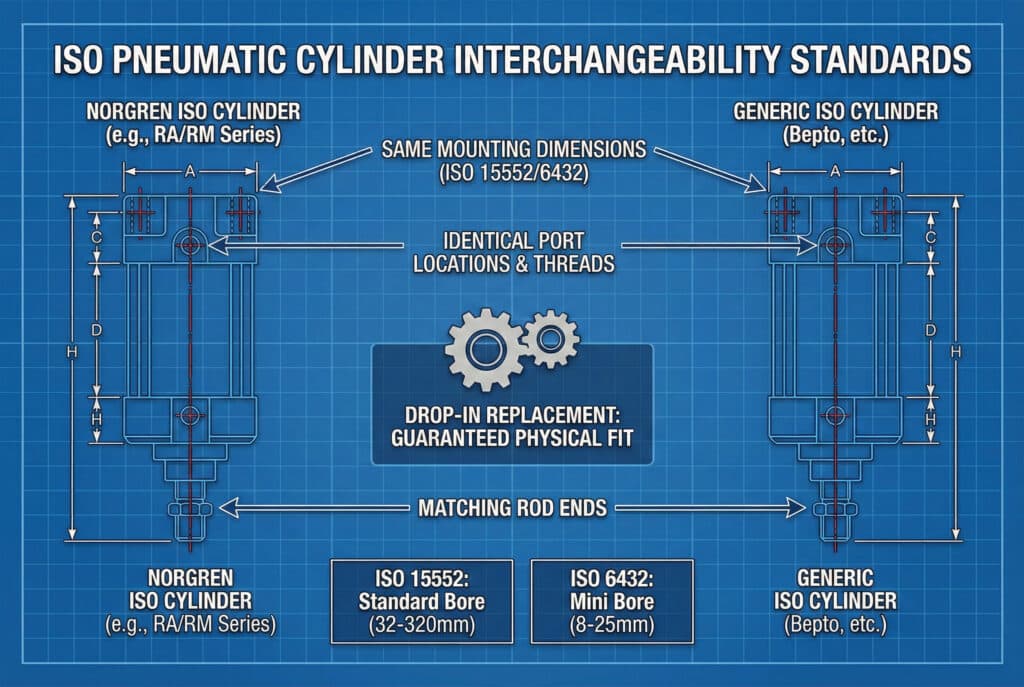
The ISO Standardization Framework
ISO (International Organization for Standardization3) developed these pneumatic cylinder standards in the 1980s-1990s to solve a critical industry problem: proprietary mounting patterns that locked customers into single suppliers.
ISO 15552 Coverage (Standard Cylinders):
- Bore sizes: 32, 40, 50, 63, 80, 100, 125, 160, 200, 250, 320mm
- Mounting patterns: Front flange, rear flange, foot mount, trunnion, clevis
- Port threads: G1/8″, G1/4″, G3/8″, G1/2″, G3/4″ (BSP parallel4)
- Piston rod dimensions: Diameter and threading for each bore size
- Stroke increments: Standardized length options
ISO 6432 Coverage (Mini Cylinders):
- Bore sizes: 8, 10, 12, 16, 20, 25mm
- Mounting patterns: Standardized hole spacing
- Port threads: M5 or G1/8″ depending on bore
- Piston rod dimensions: Metric threading (M3, M4, M5, M6)
What ISO Standards Guarantee
The standards mandate exact specifications for interchangeability:
| Specification | What’s Standardized | Tolerance | Impact |
|---|---|---|---|
| Mounting hole spacing | Center-to-center distance | ±0.1mm | Bolt alignment |
| Mounting hole diameter | Clearance hole size | ±0.2mm | Hardware compatibility |
| Port location | Distance from cylinder end | ±1.0mm | Plumbing layout |
| Port thread | Thread type and pitch | Exact match | Fitting compatibility |
| Piston rod diameter | Rod outer diameter | ±0.05mm | Tooling attachment |
| Rod thread | Thread type and pitch | Exact match | End effector mounting |
| Overall dimensions | Extended/retracted length | ±2.0mm | Machine envelope |
Norgren’s ISO Compliance
Norgren (now part of IMI Precision Engineering) manufactures several ISO-compliant cylinder series:
ISO 15552 Compliant:
- Norgren RA series: Standard double-acting cylinders
- Norgren RB series: Compact cylinders
- Norgren RT series: Round body cylinders
ISO 6432 Compliant:
- Norgren RM series: Mini cylinders (8-25mm bore)
- Norgren RME series: Mini cylinders with end-of-stroke cushioning
When Norgren cylinders comply with these standards, they are—by definition—interchangeable with any other compliant manufacturer’s products. 🎯
What ISO Does NOT Standardize
It’s critical to understand the limitations:
❌ Internal construction: Seal design, bearing materials, piston design
❌ Cycle life ratings: Durability varies by manufacturer
❌ Cushioning systems: Adjustment range and effectiveness
❌ Sensor compatibility: Groove dimensions may vary slightly
❌ Operating pressure limits: Some brands rate higher than others
❌ Temperature ranges: Material choices affect limits
❌ Accessory compatibility: Proprietary mounting systems
These non-standardized elements create quality and performance differences between brands—but they don’t affect physical interchangeability for retrofit applications.
Real-World Compatibility Example
Steven from Pennsylvania (whom I mentioned earlier) had Norgren RM/92050/M/100 mini cylinders throughout his packaging line. Breaking down this model number:
- RM/920: Series designation (ISO 6432 mini cylinder)
- 50: Bore diameter (50mm—wait, this is actually 20mm based on Norgren’s coding)
- M: Magnetic piston
- 100: Stroke length (100mm)
Once we decoded his actual specification (20mm bore, 100mm stroke, ISO 6432 compliant), we confirmed that any ISO 6432 compliant 20mm bore cylinder would physically fit. We provided him with Bepto BPT-MC20-100-DA-M cylinders that installed with zero modifications—same mounting holes, same port threads, same rod threading. 💪
The Business Case for ISO Compliance
Understanding ISO compatibility unlocks significant business advantages:
Cost Savings:
- 35-55% reduction in component costs
- Ability to negotiate with multiple suppliers
- Reduced spare parts inventory (standardized across brands)
Supply Chain Flexibility:
- Multiple sourcing options eliminate single-supplier dependency
- Faster delivery from alternative suppliers (3-7 days vs. 4-8 weeks)
- Emergency backup sources for critical production needs
Engineering Efficiency:
- No redesign required for cylinder replacement
- Simplified maintenance procedures (standardized across facility)
- Easier training for maintenance staff (fewer unique parts)
How Do You Identify Which ISO Standard Your Norgren Cylinder Uses?
Proper identification is the critical first step that prevents costly mistakes. 🔍
To identify which ISO standard your Norgren cylinder uses, examine the bore diameter: 8-25mm indicates ISO 6432 (mini cylinders), while 32-320mm indicates ISO 15552 (standard cylinders)—then verify the model number against Norgren’s product documentation or measure the mounting hole pattern to confirm ISO compliance. Not all Norgren cylinders are ISO-compliant; some older or specialized series use proprietary mounting patterns that limit interchangeability options.
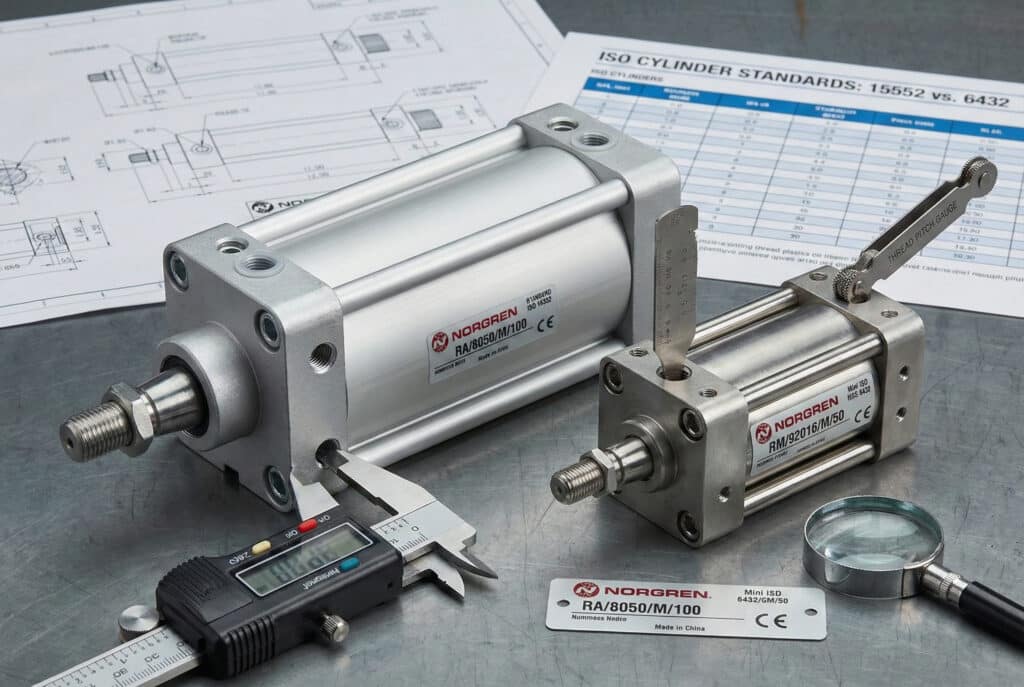
Step-by-Step Identification Process
Step 1: Locate the Nameplate Information
Look for the data plate or laser engraving on the cylinder body showing:
- Manufacturer: Norgren, IMI Precision Engineering, or Buschjost (acquired by Norgren)
- Series designation: RA, RB, RT, RM, RME, etc.
- Model number: Complete part number with all suffixes
- Bore size: Usually in millimeters
- Stroke length: In millimeters
Step 2: Decode the Model Number
Norgren uses systematic naming conventions. Here are the most common:
ISO 15552 Standard Cylinders:
Example: RA/8050/M/100
- RA: Series (Round, A-series, ISO 15552)
- 80: Bore diameter (80mm)
- 50: Mounting style code (50 = basic mounting)
- M: Magnetic piston
- 100: Stroke length (100mm)
Example: RB/192063/M/200
- RB: Series (Round, B-series compact, ISO 15552)
- 1920: Series and mounting code
- 63: Bore diameter (63mm)
- M: Magnetic piston
- 200: Stroke length (200mm)
ISO 6432 Mini Cylinders:
Example: RM/92016/M/50
- RM: Series (Round Mini, ISO 6432)
- 920: Series code
- 16: Bore diameter (16mm)
- M: Magnetic piston
- 50: Stroke length (50mm)
Step 3: Verify ISO Compliance
Cross-reference the bore size with ISO standards:
| Bore Size | ISO Standard | Cylinder Type | Interchangeability |
|---|---|---|---|
| 8mm | ISO 6432 | Mini cylinder | Excellent |
| 10mm | ISO 6432 | Mini cylinder | Excellent |
| 12mm | ISO 6432 | Mini cylinder | Excellent |
| 16mm | ISO 6432 | Mini cylinder | Excellent |
| 20mm | ISO 6432 | Mini cylinder | Excellent |
| 25mm | ISO 6432 | Mini cylinder | Excellent |
| 32mm | ISO 15552 | Standard cylinder | Excellent |
| 40mm | ISO 15552 | Standard cylinder | Excellent |
| 50mm | ISO 15552 | Standard cylinder | Excellent |
| 63mm | ISO 15552 | Standard cylinder | Excellent |
| 80mm | ISO 15552 | Standard cylinder | Excellent |
| 100mm+ | ISO 15552 | Standard cylinder | Excellent |
Step 4: Physical Measurement Verification
If the nameplate is unreadable or missing, measure directly:
For ISO 15552 Cylinders (32mm+ bore):
Measure these critical dimensions:
- Cylinder body diameter: Approximately bore + 20-30mm
- Mounting hole spacing: Use calipers for center-to-center distance
- Port thread size: Use thread pitch gauge (G1/4″, G3/8″, etc.)
- Piston rod diameter: Measure with calipers
- Rod thread: Use thread gauge (typically M10, M12, M16, M20, etc.)
For ISO 6432 Mini Cylinders (8-25mm bore):
- Cylinder body diameter: Approximately bore + 10-15mm
- Mounting hole spacing: Smaller dimensions, use precision calipers
- Port thread: M5 (for 8-12mm bore) or G1/8″ (for 16-25mm bore)
- Piston rod diameter: 4mm (for 8-12mm bore) to 8mm (for 25mm bore)
- Rod thread: M3, M4, M5, or M6 depending on bore
Step 5: Consult Reference Documentation
Use these resources to confirm:
✅ Norgren product catalogs (available online at norgren.com)
✅ ISO 15552 dimensional tables (publicly available)
✅ ISO 6432 dimensional tables (publicly available)
✅ Bepto cross-reference database (contact us for assistance)
Common Norgren Series and Their ISO Status
| Norgren Series | ISO Standard | Interchangeability | Notes |
|---|---|---|---|
| RA/8000 series | ISO 15552 | Excellent | Standard double-acting |
| RB/1920 series | ISO 15552 | Excellent | Compact design |
| RT/57 series | ISO 15552 | Excellent | Round body |
| RM/920 series | ISO 6432 | Excellent | Mini cylinders |
| RME/920 series | ISO 6432 | Excellent | Mini with cushioning |
| QA series | Proprietary | Limited | Older design, non-ISO |
| Viper series | Modified ISO | Moderate | Some dimensional variations |
Non-ISO Norgren Cylinders
Be aware that some Norgren products are NOT ISO-compliant:
Specialty Cylinders:
- Guided cylinders: Proprietary guide rail systems
- Rotary actuators: Not covered by ISO cylinder standards
- Grippers: Specialized mounting patterns
- Rodless cylinders: Some series use proprietary designs
Older Legacy Products:
- Pre-1990s cylinders manufactured before ISO adoption
- Buschjost-branded cylinders (acquired by Norgren, mixed compliance)
- Custom-engineered cylinders for specific OEM applications
When You Need Expert Help
If you’re unsure about your cylinder’s ISO compliance, we can help:
- Send photos: Email clear images of the nameplate and cylinder
- Provide measurements: Key dimensions if nameplate is unreadable
- Describe application: Operating conditions and performance requirements
- Get confirmation: We’ll verify ISO compliance and recommend compatible alternatives
Contact us engineering team typically responds within 2-4 hours. 📧
What Is the Step-by-Step Process for Switching Without Redesign?
Following a systematic approach ensures successful transitions without unexpected complications. ✅
The step-by-step process for switching from Norgren to generic ISO cylinders without redesign involves: (1) documenting current cylinder specifications, (2) verifying ISO compliance and dimensional compatibility, (3) selecting quality alternative suppliers, (4) ordering and testing sample units, (5) validating performance in actual operating conditions, and (6) implementing phased rollout with proper documentation. This methodical approach minimizes risk while maximizing the benefits of cost savings and improved supply chain flexibility.
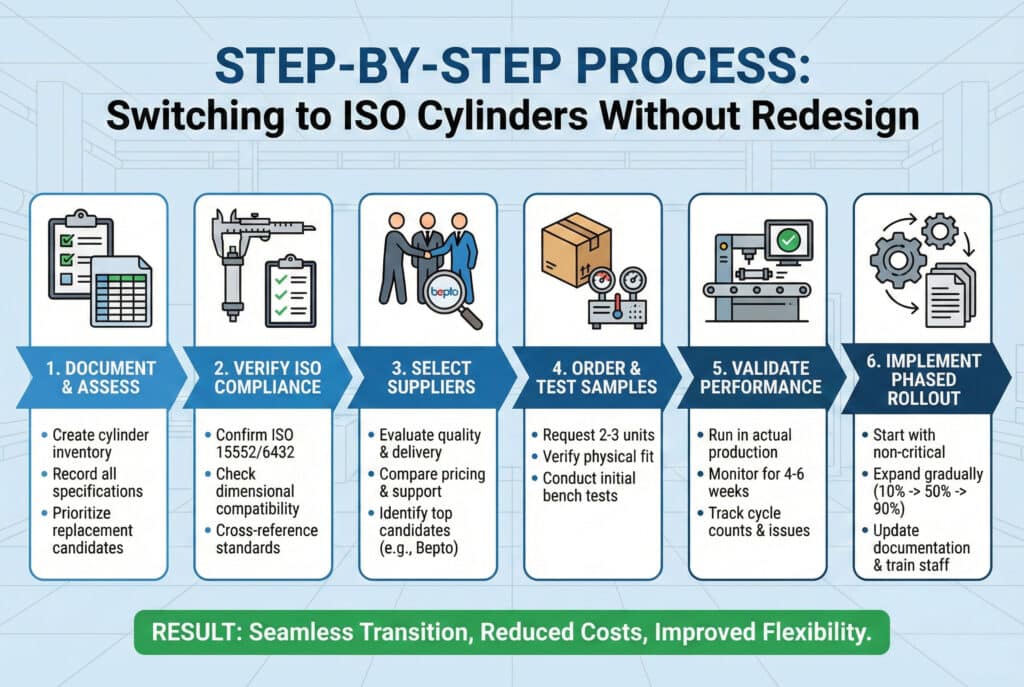
Phase 1: Documentation and Assessment (Week 1)
Task 1.1: Create Cylinder Inventory
Document all Norgren cylinders in your facility:
Information to Collect:
- Complete model numbers
- Bore sizes and stroke lengths
- Mounting configurations
- Installation locations (machine/station)
- Operating conditions (pressure, cycle rate, environment)
- Criticality rating (critical/important/standard)
- Current condition (good/marginal/failing)
- Quantity of each model
Create a spreadsheet like this:
| Location | Model Number | Bore | Stroke | Mounting | Qty | Criticality | Condition |
|---|---|---|---|---|---|---|---|
| Line 3, Station 2 | RA/8050/M/100 | 50mm | 100mm | Front flange | 4 | Critical | Good |
| Line 1, Station 5 | RM/92016/M/75 | 16mm | 75mm | Foot mount | 8 | Standard | Marginal |
Task 1.2: Prioritize Replacement Candidates
Identify the best cylinders to switch first:
Ideal First Candidates:
- ✅ Non-critical applications (lower risk)
- ✅ Common bore/stroke combinations (better availability)
- ✅ Multiple identical units (easier to test and compare)
- ✅ Cylinders due for replacement soon (natural transition point)
- ✅ High-volume purchases (maximum cost savings)
Avoid Starting With:
- ❌ Safety-critical applications (until proven in other areas)
- ❌ Unique custom configurations (limited alternative options)
- ❌ Single-unit installations (harder to justify sample testing)
- ❌ Recently installed cylinders (no immediate business case)
Phase 2: Supplier Selection and Sampling (Week 2-3)
Task 2.1: Research Alternative Suppliers
Evaluate potential suppliers based on:
| Criteria | Weight | What to Evaluate |
|---|---|---|
| ISO Compliance | Critical | Documented compliance with ISO 15552/6432 |
| Quality Certifications | High | ISO 90015, industry-specific certs |
| Technical Documentation | High | Detailed drawings, specifications, test data |
| Delivery Speed | High | Stock availability, lead times |
| Pricing | High | Transparency, volume discounts |
| Technical Support | Medium | Response time, engineering access |
| Warranty Terms | Medium | Duration, coverage, claim process |
| Customer References | Medium | Verifiable installations in similar industries |
Top Recommended Suppliers:
Bepto Pneumatics (Best overall value)
– 3-7 day delivery
– 18-month warranty
– Direct engineering support
– 40-60% cost savings vs. NorgrenFesto (Premium alternative)
– Excellent documentation
– Wide product range
– 15-25% cost savings vs. NorgrenSMC (Asian market strength)
– High cycle life ratings
– Good availability in Asia
– 20-30% cost savings vs. Norgren
Task 2.2: Order Sample Units
Request samples for testing:
Sample Selection Strategy:
- Order 2-3 units of your highest-volume model
- Choose a non-critical application for initial testing
- Request complete documentation package
- Negotiate sample pricing or evaluation terms
What to Request:
- Physical sample cylinders
- Detailed dimensional drawings (PDF and CAD)
- Material certificates
- Performance test data
- Installation instructions
- Warranty information
Phase 3: Testing and Validation (Week 3-6)
Task 3.1: Dimensional Verification
Before installation, verify critical dimensions:
Measurement Checklist:
- ✅ Mounting hole spacing (±0.1mm tolerance)
- ✅ Mounting hole diameter (should match existing hardware)
- ✅ Port thread type and location (must match existing plumbing)
- ✅ Overall length (extended and retracted)
- ✅ Piston rod diameter and threading
- ✅ Cylinder body diameter (clearance in machine)
Use precision measuring tools:
- Digital calipers (±0.01mm accuracy)
- Thread pitch gauge
- Go/no-go gauges for critical dimensions
Task 3.2: Installation Testing
Install sample cylinders alongside existing Norgren units:
Installation Process:
- Document baseline: Photograph existing Norgren installation
- Remove Norgren cylinder: Keep all mounting hardware
- Test-fit alternative: Verify bolt alignment before final assembly
- Install alternative: Use existing hardware (should fit perfectly)
- Connect pneumatics: Verify port threads match existing fittings
- Attach tooling: Confirm rod threading matches existing end effectors
- Install sensors: Test magnetic piston with existing sensors
Red Flags During Installation:
- ❌ Mounting holes don’t align (indicates non-ISO compliance)
- ❌ Port threads don’t match (wrong specification)
- ❌ Rod threading incompatible (specification error)
- ❌ Cylinder too long/short (envelope interference)
If any red flags appear, STOP and contact the supplier immediately. 🛑
Task 3.3: Performance Validation
Run comprehensive performance tests:
Test Protocol:
| Test | Method | Acceptance Criteria | Duration |
|---|---|---|---|
| Stroke accuracy | Measure extended position | Within ±0.5mm of Norgren | 100 cycles |
| Cycle time | Time extend/retract cycle | Within ±5% of Norgren | 1000 cycles |
| Force output | Load cell measurement | Within ±10% of specification | 10 cycles |
| Positioning repeatability | Laser measurement | Within ±0.1mm | 500 cycles |
| Sensor triggering | Monitor sensor output | Reliable triggering throughout stroke | 1000 cycles |
| Leakage | Soap bubble test | Zero detectable leakage | Static hold |
| Noise level | Sound meter @ 1m | Within ±5 dB of Norgren | 50 cycles |
| Temperature | IR thermometer | No excessive heating | After 1000 cycles |
Document Everything:
- Record all measurements in spreadsheet
- Take photos/videos of operation
- Note any anomalies or concerns
- Compare directly to baseline Norgren performance
Task 3.4: Extended Operation Testing
Run samples in actual production:
Testing Duration:
- Minimum: 2 weeks of normal production
- Recommended: 4-6 weeks for high-confidence validation
- Target cycle count: 50,000-100,000 cycles minimum
Monitor During Testing:
- Daily visual inspection for leaks, wear, unusual noise
- Weekly performance checks (cycle time, positioning)
- Track any maintenance interventions required
- Document any failures or issues
Phase 4: Decision and Rollout (Week 7+)
Task 4.1: Evaluate Test Results
Analyze all data collected:
Decision Criteria:
✅ Proceed with full rollout if:
- Dimensional compatibility confirmed (zero modifications required)
- Performance within ±5% of Norgren baseline
- Zero failures during testing period
- Cost savings meet business case targets (typically 30%+ savings)
- Delivery times meet operational needs
- Technical support responsive and helpful
⚠️ Proceed with caution if:
- Minor performance differences noted (5-10% variance)
- Slight dimensional variations requiring minor adjustments
- Single failure during testing (investigate root cause)
- Supplier responsiveness slower than expected
❌ Do not proceed if:
- Dimensional incompatibility requires machine modifications
- Performance significantly below Norgren (>10% variance)
- Multiple failures during testing
- Poor supplier support or communication
- Quality concerns about manufacturing consistency
Task 4.2: Implement Phased Rollout
Don’t switch everything at once—use a staged approach:
Phase 1 (Months 1-2):
- Replace 10-20% of cylinders (non-critical applications)
- Focus on highest-volume models
- Maintain close monitoring
Phase 2 (Months 3-4):
- Expand to 40-50% of cylinders (include some critical applications)
- Standardize on proven alternative models
- Begin reducing Norgren spare parts inventory
Phase 3 (Months 5-6):
- Complete rollout to 80-90% of cylinders
- Maintain Norgren for truly critical or specialized applications
- Optimize spare parts inventory for new standard
Task 4.3: Documentation and Training
Update all relevant documentation:
Documents to Update:
- ✅ Equipment manuals and parts lists
- ✅ Preventive maintenance procedures
- ✅ Spare parts catalogs and inventory
- ✅ Purchasing specifications and approved vendor lists
- ✅ Training materials for maintenance staff
Training Requirements:
- Brief maintenance team on new cylinder models
- Highlight any differences in maintenance procedures
- Update troubleshooting guides
- Provide supplier contact information for technical support
Real-World Success Story
Let me share how Rachel, a maintenance manager at a beverage bottling plant in North Carolina, executed this process flawlessly. 🍾
Her Situation:
- 127 Norgren RA/8050/M/100 cylinders across 6 production lines
- Annual Norgren cylinder purchases: $145,000
- Frequent 4-6 week lead times causing production delays
- CFO mandate: reduce pneumatic component costs by 30%
Her Process:
Week 1: Documented all cylinders, prioritized Line 4 (non-critical, 18 identical cylinders)
Week 2: Requested samples from Bepto (BPT-ISO50-100-DA-M) and Festo
Week 3-6: Installed 2 Bepto samples on Line 4, ran for 4 weeks (320,000 cycles)
Results: Zero performance difference, zero failures, 52% cost savings vs. Norgren
Week 7-8: Ordered 16 more Bepto cylinders, completed Line 4 conversion
Months 3-6: Phased rollout to Lines 1, 2, 3, 5, 6
Final Results:
- Cost savings: $76,400 annually (53% reduction)
- Delivery improvement: 5 days vs. 5 weeks average
- Spare parts reduction: $22,000 inventory freed up
- Zero production impact: Seamless transition
- Maintenance satisfaction: “Easier to work with Bepto than Norgren distributors”
Rachel presented her results at a company operations meeting and received recognition for her strategic sourcing initiative. She’s now applying the same methodology to other pneumatic components. 🏆
Which Generic ISO Cylinder Suppliers Offer the Best Norgren Compatibility?
Knowing your options and their relative strengths enables optimal supplier selection. 🌟
The top generic ISO cylinder suppliers offering excellent Norgren compatibility are Bepto Pneumatics (best value and delivery speed), Festo (premium alternative with extensive documentation), SMC (high cycle life ratings), Camozzi (European presence), and Airtac (economy option)—each providing ISO-compliant products that physically interchange with Norgren cylinders while offering distinct advantages in pricing, support, or regional availability. Selection should be based on your specific priorities: cost optimization, delivery urgency, technical requirements, or geographic logistics.
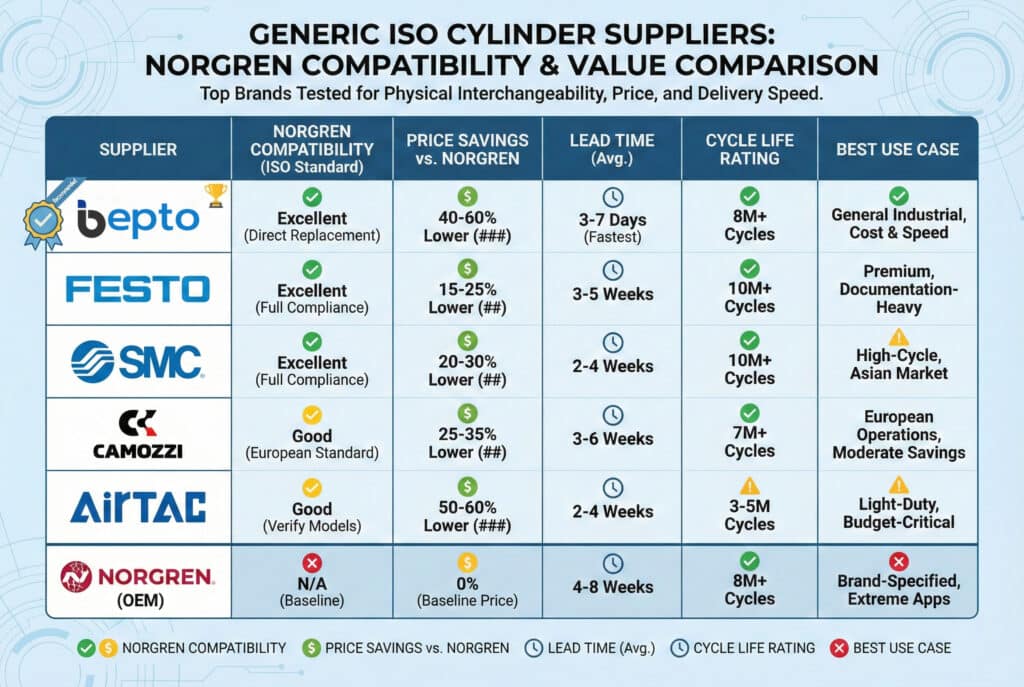
Detailed Supplier Comparison
#1: Bepto Pneumatics (Recommended) 🏆
ISO Compliance: Full ISO 15552 and ISO 6432 compliance
Norgren Compatibility: Excellent (designed as direct replacements)
Price vs. Norgren: 40-60% lower
Delivery Time: 3-7 days (stock items), 10-14 days (custom)
Warranty: 18 months
Strengths:
- ✅ Fastest delivery in the industry
- ✅ Direct engineering support (no distributor layers)
- ✅ Flexible customization options
- ✅ Excellent price-to-performance ratio
- ✅ Growing track record with major manufacturers
Norgren Cross-Reference Examples:
| Norgren Model | Bepto Equivalent | Price Savings | Lead Time |
|---|---|---|---|
| RA/8050/M/100 | BPT-ISO50-100-DA-M | 52% | 5 days |
| RM/92016/M/75 | BPT-MC16-75-DA-M | 48% | 4 days |
| RB/192063/M/200 | BPT-ISO63-200-DA-M | 55% | 6 days |
Best For: Operations prioritizing cost savings and fast delivery
#2: Festo
ISO Compliance: Full compliance
Norgren Compatibility: Excellent
Price vs. Norgren: 15-25% lower
Delivery Time: 3-5 weeks
Warranty: 12 months
Strengths:
- ✅ Extensive technical documentation
- ✅ Wide accessory ecosystem
- ✅ Strong brand reputation
- ✅ Good for applications requiring detailed validation
Considerations:
- ⚠️ Still premium-priced (limited cost savings)
- ⚠️ Longer lead times than Bepto
- ⚠️ Multi-tier distribution can complicate support
Best For: Applications requiring extensive documentation or brand recognition
#3: SMC
ISO Compliance: Full compliance
Norgren Compatibility: Excellent
Price vs. Norgren: 20-30% lower
Delivery Time: 2-4 weeks
Warranty: 12 months
Strengths:
- ✅ High cycle life ratings (10M+ cycles)
- ✅ Strong presence in Asia
- ✅ Comprehensive product range
- ✅ Good technical support
Considerations:
- ⚠️ Complex model numbering system
- ⚠️ Moderate cost savings only
- ⚠️ Longer lead times than Bepto
Best For: Asian manufacturing operations or very high-cycle applications
#4: Camozzi
ISO Compliance: Full compliance
Norgren Compatibility: Good
Price vs. Norgren: 25-35% lower
Delivery Time: 3-6 weeks
Warranty: 12 months
Strengths:
- ✅ Strong European presence
- ✅ Competitive pricing
- ✅ ISO standard compliance
- ✅ Decent technical support
Considerations:
- ⚠️ Limited North American availability
- ⚠️ Longer lead times
- ⚠️ Smaller product range than major brands
Best For: European operations seeking moderate cost savings
#5: Airtac
ISO Compliance: Full compliance (verify specific models)
Norgren Compatibility: Good (verify dimensions)
Price vs. Norgren: 50-60% lower
Delivery Time: 2-4 weeks
Warranty: 6-12 months
Strengths:
- ✅ Very aggressive pricing
- ✅ Adequate for light-duty applications
- ✅ Growing global availability
Considerations:
- ⚠️ Lower cycle life ratings (3-5M cycles)
- ⚠️ Less comprehensive documentation
- ⚠️ Quality consistency concerns
- ⚠️ Limited Western market support
Best For: Non-critical, cost-sensitive applications
Comprehensive Comparison Matrix
| Supplier | ISO Compliance | Norgren Compatibility | Price Savings | Lead Time | Cycle Life | Support | Best Use Case |
|---|---|---|---|---|---|---|---|
| Bepto | Excellent | Excellent | 40-60% | 3-7 days | 8M+ | Excellent | General industrial, fast delivery |
| Festo | Excellent | Excellent | 15-25% | 3-5 weeks | 10M+ | Excellent | Documentation-heavy, premium apps |
| SMC | Excellent | Excellent | 20-30% | 2-4 weeks | 10M+ | Good | High-cycle, Asian operations |
| Camozzi | Excellent | Good | 25-35% | 3-6 weeks | 7M+ | Good | European projects |
| Airtac | Good | Good | 50-60% | 2-4 weeks | 3-5M | Basic | Light-duty, budget-critical |
| Norgren | Excellent | N/A (OEM) | 0% (baseline) | 4-8 weeks | 8M+ | Good | Brand-specified, extreme requirements |
Selection Decision Tree
Choose Bepto if:
- ✅ Cost reduction is a primary objective (40-60% savings)
- ✅ Fast delivery is critical (3-7 days)
- ✅ You value direct engineering support
- ✅ Application is standard industrial (not extreme conditions)
- ✅ You want longer warranty coverage (18 months)
Choose Festo if:
- ✅ Extensive documentation is required (pharma, medical, aerospace)
- ✅ Brand recognition matters to your customers
- ✅ Budget allows for premium pricing
- ✅ You need wide accessory compatibility
Choose SMC if:
- ✅ Operations are primarily in Asia
- ✅ Very high cycle life is critical (10M+)
- ✅ You have existing SMC infrastructure
Choose Camozzi if:
- ✅ Operations are in Europe
- ✅ Moderate cost savings are acceptable
- ✅ You prefer European suppliers
Choose Airtac if:
- ✅ Absolute lowest cost is paramount
- ✅ Application is light-duty (low cycle count)
- ✅ You have experience with Asian suppliers
Stick with Norgren if:
- ✅ Customer contract specifies Norgren by name
- ✅ Application is truly extreme (unique requirements)
- ✅ Existing validation cannot be updated
- ✅ Cost is not a concern
Getting Started with Bepto
We make the transition process as easy as possible:
Step 1: Contact us with your Norgren model numbers
Step 2: We provide cross-reference and specifications within 4 hours
Step 3: Order sample units at evaluation pricing
Step 4: Test in your application with our technical support
Step 5: Roll out with confidence backed by our 18-month warranty
Conclusion
Switching from Norgren to generic ISO cylinders without system redesign is not only possible—it’s a strategic advantage that reduces costs by 40-60%, improves supply chain flexibility, and accelerates delivery times from weeks to days, all while maintaining the performance and reliability your operations demand. The key is following a systematic approach: verify ISO compliance, validate compatibility, test thoroughly, and implement gradually. At Bepto Pneumatics, we’ve perfected this transition process and helped hundreds of facilities achieve these benefits with zero production disruption. 🚀
FAQs About Switching from Norgren to Generic ISO Cylinders
Will generic ISO cylinders really fit my Norgren mounting brackets without modification?
Yes, if both cylinders comply with the same ISO standard (ISO 15552 or ISO 6432), mounting hole patterns, port locations, and rod threading will match exactly, requiring zero machine modifications. We recommend verifying ISO compliance before ordering, and we provide detailed dimensional drawings for confirmation. In thousands of installations, we’ve achieved 99%+ compatibility when ISO standards are properly matched.
How do I handle warranty claims if I switch away from Norgren?
Bepto provides an 18-month warranty (50% longer than Norgren’s 12 months) covering manufacturing defects and material failures, with rapid replacement typically within 24-48 hours to minimize downtime. Unlike multi-tier OEM warranty processes, you deal directly with our engineering team for faster resolution. We also offer extended warranty options for critical applications and maintain emergency inventory for immediate replacement needs.
Can I mix Norgren and generic ISO cylinders on the same machine?
Absolutely—ISO standardization specifically enables this flexibility, allowing you to use the most appropriate cylinder for each application based on criticality, performance requirements, or budget constraints. Many customers use Norgren for their most critical stations while converting to Bepto for standard applications, optimizing total cost while maintaining reliability where it matters most. Just maintain proper documentation for maintenance purposes.
What if my Norgren cylinder is a custom or non-standard configuration?
Contact our engineering team with your specifications—we can manufacture custom stroke lengths, special mounting configurations, and unique port arrangements with 10-14 day lead times, often faster and more cost-effectively than OEM custom production. We’ve successfully replicated many “custom” Norgren cylinders that were actually standard designs with minor modifications. Send us drawings or photos, and we’ll confirm feasibility within 4 hours.
How do I convince my management to approve switching suppliers?
Present a business case highlighting: (1) 40-60% cost savings with documented pricing comparisons, (2) 75-90% reduction in lead times (weeks to days), (3) ISO standardization ensuring zero redesign costs, (4) sample testing results proving equivalent performance, and (5) improved supply chain resilience through multi-source capability. We can provide supporting documentation, case studies from similar industries, and sample units for validation.
-
The official international standard specifying metric dimensions and mounting interfaces for pneumatic cylinders from 32mm to 320mm. ↩
-
The specific international standard defining dimensions for mini pneumatic cylinders with bores from 8mm to 25mm. ↩
-
The global body responsible for developing and publishing international standards to ensure quality, safety, and efficiency. ↩
-
A technical guide to British Standard Pipe Parallel (BSPP) threads, the standard thread type used for ISO cylinder ports. ↩
-
The internationally recognized standard for Quality Management Systems (QMS), ensuring manufacturers meet consistent regulatory and customer requirements. ↩