Introduction
The Problem: When pneumatic systems fail in sub-zero environments, entire production lines grind to a halt—costing companies thousands per hour. ❄️ The Agitation: Standard seals crack, lubricants freeze, and aluminum housings become brittle at cryogenic temperatures. The Solution: Proper material selection transforms pneumatic cylinders from liabilities into reliable workhorses, even at -40°C.
Here’s the direct answer: For -40°C pneumatic operation, you must use low-temperature NBR or polyurethane seals, synthetic ester-based lubricants, and anodized aluminum or stainless steel housings. Standard materials will fail catastrophically, causing costly downtime and safety hazards in cold storage, arctic drilling, and pharmaceutical freeze-drying applications.
I recently spoke with Henrik, a facility manager at a frozen food distribution center in Minnesota. His warehouse operates at -35°C, and last winter, three of his conveyor system’s pneumatic cylinders failed within a week—each failure halting operations for 6-8 hours. The culprit? Standard Buna-N seals that weren’t rated for extreme cold. This conversation reminded me why material selection isn’t just technical—it’s mission-critical. 🎯
Table of Contents
- Why Do Standard Pneumatic Components Fail at -40°C?
- What Seal Materials Work Best in Cryogenic Pneumatic Applications?
- How Does Housing Material Affect Low-Temperature Performance?
- Which Lubricants Remain Effective at Extreme Cold Temperatures?
Why Do Standard Pneumatic Components Fail at -40°C?
Most pneumatic cylinders are designed for ambient temperatures (15-60°C), making them vulnerable in cryogenic environments. 🌡️
Standard materials lose elasticity, become brittle, and experience thermal contraction at -40°C. Seals harden and crack, lubricants solidify into wax-like substances, and metal components develop stress fractures. This combination leads to air leakage, increased friction, complete seal failure, and potential safety incidents.
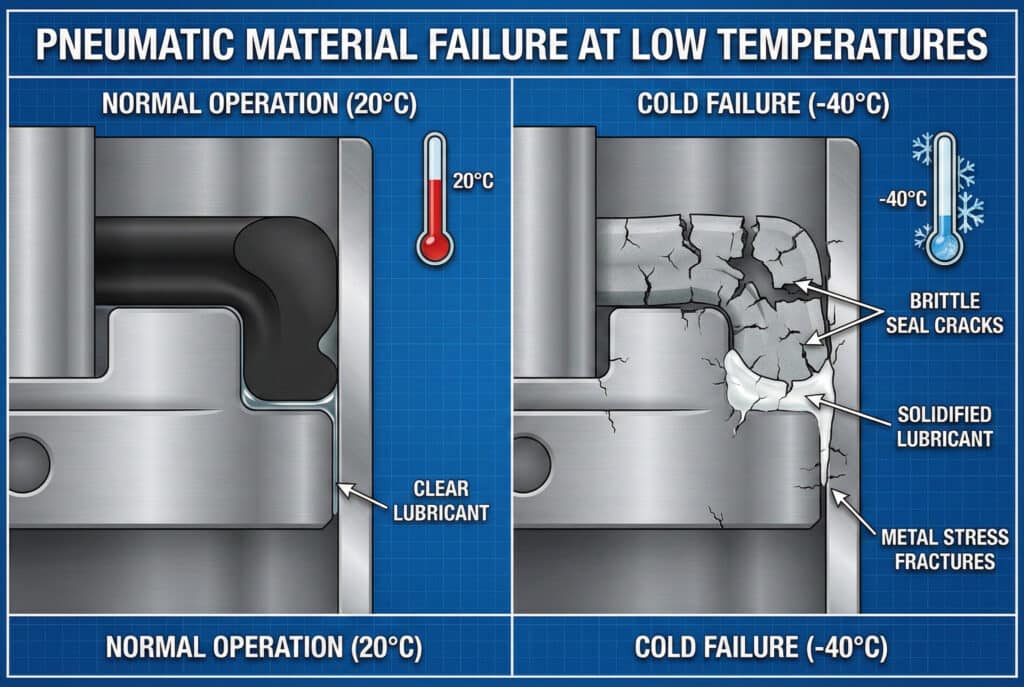
The Physics of Cold Failure
When temperatures drop below -20°C, three critical failures occur:
Glass Transition Temperature (Tg)1: Elastomers pass their Tg point and transform from flexible rubber to rigid plastic
thermal contraction2: Different materials shrink at different rates, creating gaps in seal interfaces
Viscosity Increase: Standard lubricants become 100-1000x more viscous, essentially “freezing” in place
Real-World Consequences
At our company, Bepto Pneumatics, we’ve analyzed dozens of failed cylinders from cold environments. The pattern is consistent: standard NBR seals show visible cracking along the sealing lip, petroleum-based greases separate into solid and liquid phases, and aluminum housings develop micro-fractures at mounting points.
What Seal Materials Work Best in Cryogenic Pneumatic Applications?
Seal selection is the single most critical factor in low-temperature pneumatic reliability. 🔧
low-temperature NBR3 (Nitrile) with plasticizers, polyurethane (AU/EU grades), and PTFE (Teflon) composites are the three proven seal materials for -40°C operation. Low-temp NBR offers the best cost-performance balance, polyurethane provides superior wear resistance, and PTFE delivers the widest temperature range (-200°C to +260°C) but at higher cost.
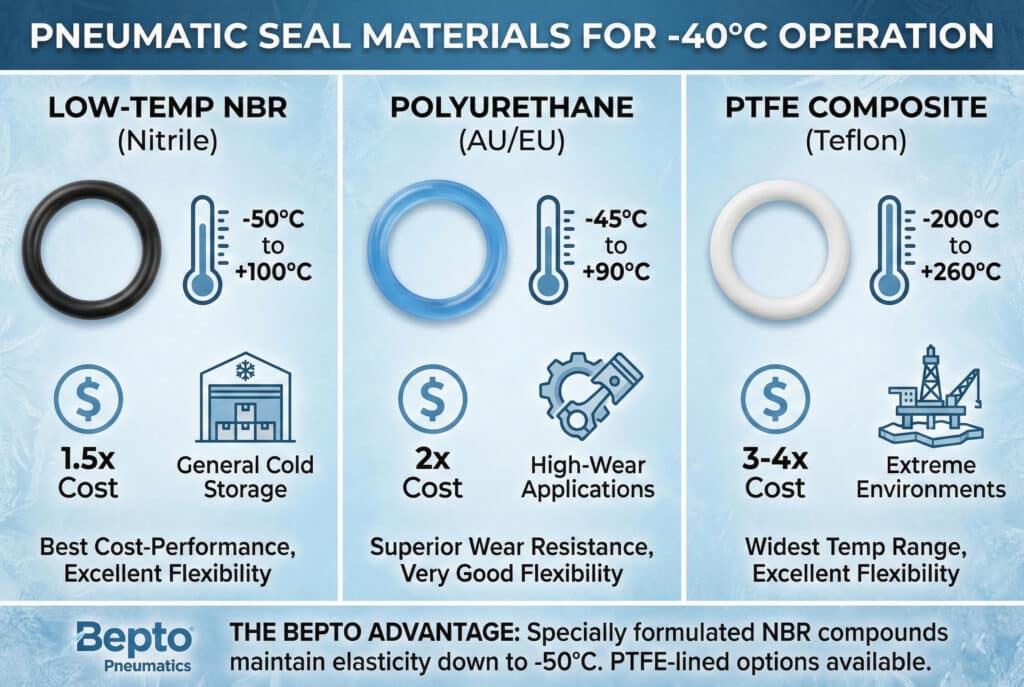
Material Comparison Table
| Seal Material | Temperature Range | Flexibility at -40°C | Cost Factor | Best Application |
|---|---|---|---|---|
| Standard NBR | -20°C to +100°C | Poor (brittle) | 1x | Not recommended |
| Low-Temp NBR | -50°C to +100°C | Excellent | 1.5x | General cold storage |
| Polyurethane (AU) | -45°C to +90°C | Very Good | 2x | High-wear applications |
| PTFE Composite | -200°C to +260°C | Excellent | 3-4x | Extreme environments |
The Bepto Advantage
We manufacture rodless cylinders specifically configured for cold environments. Our low-temperature seal kits use specially formulated NBR compounds with adipate plasticizers that maintain elasticity down to -50°C. For clients in pharmaceutical freeze-drying or arctic drilling, we offer PTFE-lined options.
Maria, who runs a cold storage logistics company in Alberta, Canada, switched to our low-temp configured cylinders last year. She told me: “We haven’t had a single seal failure since the switch, and we’re operating at -38°C daily. The 30% cost savings over OEM parts paid for the entire retrofit in four months.” 💼
How Does Housing Material Affect Low-Temperature Performance?
The cylinder body itself undergoes significant stress in cryogenic conditions that many engineers overlook. ⚙️
Anodized aluminum alloy 6061-T64 and 304/316 stainless steel are the preferred housing materials for -40°C operation. Anodized aluminum offers excellent thermal stability and corrosion resistance at lower weight and cost, while stainless steel provides superior strength and durability in the most extreme conditions, though at 3x the weight and 2x the cost.
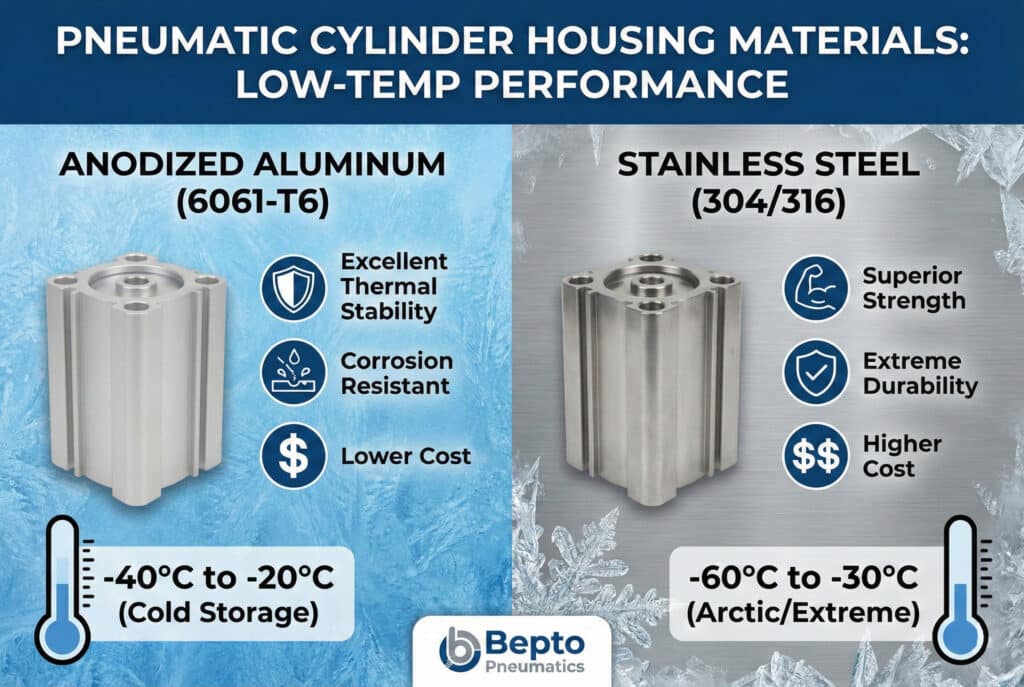
Why Standard Aluminum Fails
Standard extruded aluminum (6063 alloy) commonly used in pneumatic cylinders experiences:
- Embrittlement: Impact resistance drops by 40-60% below -30°C
- Thermal Contraction: 23 µm/m/°C shrinkage creates seal interface gaps
- Condensation Corrosion: Moisture freezing in micro-cracks accelerates failure
Material Selection Strategy
At Bepto Pneumatics, we recommend:
- Cold Storage (-40°C to -20°C): Anodized 6061-T6 aluminum with Type III hard coat
- Outdoor Arctic (-60°C to -30°C): 304 stainless steel with electropolished finish
- Pharmaceutical Clean Rooms: 316L stainless steel for FDA compliance
Which Lubricants Remain Effective at Extreme Cold Temperatures?
Even the best seals and housings will fail without proper lubrication in cold environments. 🛢️
synthetic ester-based lubricants5, perfluoropolyether (PFPE) greases, and silicone oils with pour points below -60°C are essential for -40°C pneumatic operation. Petroleum-based greases solidify into immobile wax, while synthetic esters maintain viscosity and film strength, ensuring smooth operation and preventing seal damage from dry friction.
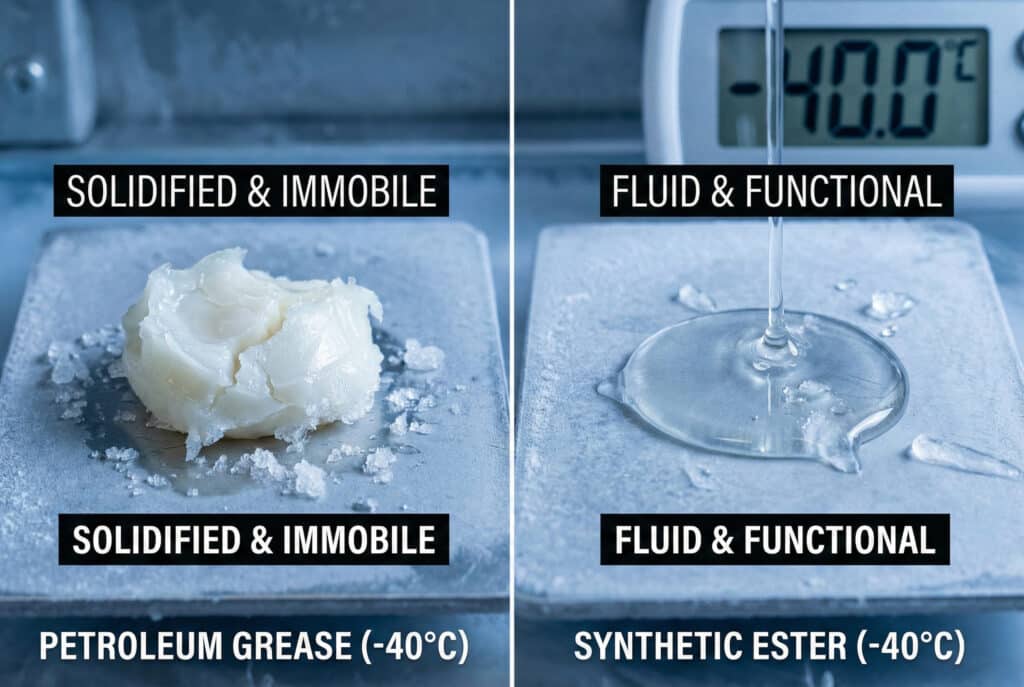
Lubricant Performance Metrics
| Lubricant Type | Pour Point | Viscosity at -40°C | Cost Factor | Seal Compatibility |
|---|---|---|---|---|
| Petroleum Grease | -10°C to -20°C | Solid/Semi-solid | 1x | Poor (wax buildup) |
| Synthetic Ester | -60°C to -70°C | 500-800 cSt | 3x | Excellent |
| PFPE (Krytox) | -75°C | 300-500 cSt | 8-10x | Excellent (inert) |
| Silicone Oil | -65°C | 200-400 cSt | 2x | Good (some swelling) |
Our Lubrication Protocol
We pre-lubricate all low-temperature cylinders with synthetic ester-based formulations that remain fluid to -65°C. For pharmaceutical and food-grade applications, we offer NSF H1-certified PFPE options.
Henrik from Minnesota (remember his frozen conveyor crisis?) switched to our pre-lubricated low-temp cylinders. He reported: “Not only did the failures stop, but our cycle times actually improved by 8% because the cylinders move more smoothly even in extreme cold.” ✅
Conclusion
Successful pneumatic operation at -40°C isn’t about finding cold-resistant components—it’s about engineering complete systems where seals, housings, and lubricants work together to overcome thermal stress, maintain flexibility, and ensure reliability when standard solutions fail catastrophically.
FAQs About Cryogenic Pneumatic Material Selection
Can I retrofit existing cylinders for low-temperature use?
Yes, but only partially—you can replace seals and re-lubricate, but housing material cannot be changed. If your existing cylinder uses 6061-T6 aluminum, a seal and lubricant upgrade will work. If it’s standard 6063 aluminum or cast iron, replacement is safer than retrofit for temperatures below -30°C.
How often should low-temperature cylinders be serviced?
Cryogenic cylinders require inspection every 6-12 months versus 18-24 months for standard units. Thermal cycling accelerates wear, and lubricant migration occurs faster in extreme cold. We recommend annual seal replacement and re-lubrication for systems operating continuously below -30°C.
Are low-temperature pneumatic cylinders more expensive?
Initial cost is 40-60% higher, but total cost of ownership is typically 30% lower due to reduced downtime. At Bepto Pneumatics, our low-temp rodless cylinders cost about 50% more than standard units, but clients report 80-90% reduction in cold-weather failures, making ROI typically under 12 months.
What’s the coldest temperature pneumatic cylinders can operate?
With proper material selection, pneumatic cylinders can function reliably down to -200°C using PTFE seals, stainless steel housings, and PFPE lubricants. However, -60°C to -80°C is the practical limit for cost-effective industrial applications. Below that, electric or hydraulic actuators often become more economical.
Do I need special air preparation for cold environments?
Absolutely—moisture in compressed air will freeze at -40°C, causing catastrophic blockages. You must use refrigerated air dryers rated to -70°C dew point or desiccant dryers. We also recommend installing inline filters with 5-micron rating to prevent ice crystal formation in valve ports.
-
Learn more about how the glass transition temperature affects the mechanical properties of polymers in cold environments. ↩
-
Explore the coefficients of thermal expansion and contraction for various industrial materials used in extreme temperatures. ↩
-
Review the material properties and performance specifications of Nitrile Butadiene Rubber designed for sub-zero temperatures. ↩
-
Access technical data sheets regarding the structural integrity and cold-weather performance of 6061-T6 aluminum. ↩
-
Understand the chemical advantages of synthetic esters over mineral oils in low-temperature lubrication systems. ↩