
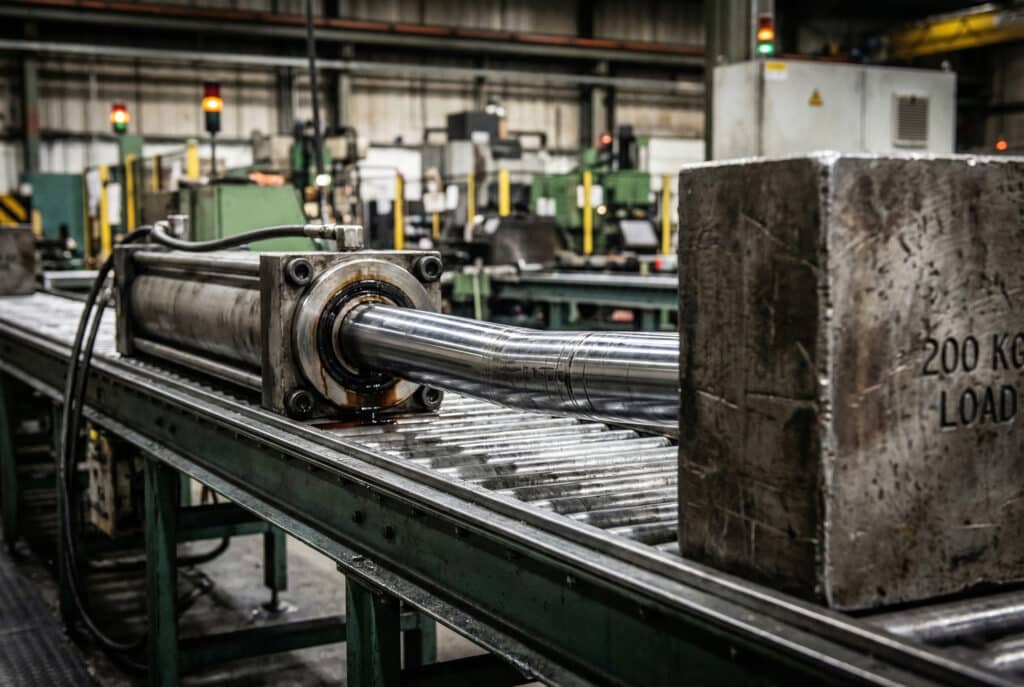
Picture this: Your horizontal cylinder extends to push a 200 kg load across a conveyor line. Midway through the stroke, the piston rod bends like a fishing pole under load. 😰 The misalignment damages seals, scores the bore, and within weeks, you’re facing a complete cylinder replacement. Rod deflection isn’t just a theoretical concern—it’s a production killer.
Piston rod deflection in horizontal extension occurs when gravity and applied loads cause the unsupported rod to bend, calculated using beam deflection formulas1 that account for rod diameter, material properties, extension length, and load weight. Excessive deflection (typically over 0.5mm per meter) causes seal wear, binding, and premature failure, making proper sizing critical for horizontal cylinder applications.
Just last week, I received a frantic call from Tom, a maintenance supervisor at a plastics molding facility in Wisconsin. His production line was down—again. Three cylinders had failed in two months, all with scored rods and blown seals. When I asked about his horizontal stroke length, he said “about 800mm.” The problem was immediately clear: rod deflection was destroying his cylinders, and his OEM supplier hadn’t even mentioned it during specification.
Table of Contents
- What Causes Piston Rod Deflection in Horizontal Applications?
- How Do You Calculate Maximum Allowable Rod Deflection?
- What Are the Solutions When Deflection Exceeds Safe Limits?
- Why Do Rodless Cylinders Eliminate Deflection Problems?
What Causes Piston Rod Deflection in Horizontal Applications? 🔍
When a piston rod extends horizontally, physics becomes your enemy—or your design guide, if you understand the forces at play.
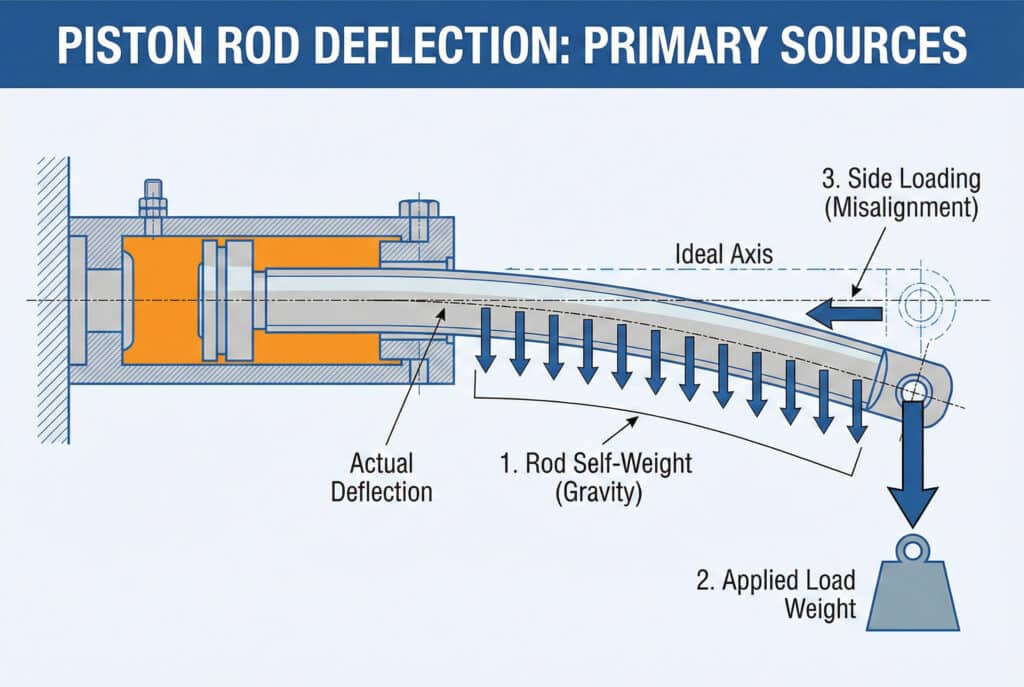
Piston rod deflection is caused by the combined effects of the rod’s own weight, the weight of the attached load, and any side loads acting perpendicular to the rod axis. These forces create a bending moment that increases exponentially with extension length, causing the unsupported rod to sag like a cantilever beam under gravity.
The Physics of Rod Bending
A horizontally extended piston rod acts as a cantilever beam2—fixed at one end (the piston) and free at the other (the load attachment point). This is the worst-case scenario for structural loading.
The deflection increases with the fourth power of the length. That means doubling your stroke length increases deflection by 16 times—not twice! This exponential relationship catches many engineers off guard.
Three Primary Deflection Sources
Understanding what contributes to rod bending helps you design around it:
- Rod Self-Weight – Even an unloaded rod sags under its own mass in horizontal orientation
- Applied Load Weight – The mass you’re pushing or pulling adds directly to deflection
- Side Loading – Off-axis forces from misalignment or process conditions multiply the problem
Material and Geometry Factors
Rod deflection depends on two material properties:
- Elastic Modulus (E) – Steel’s stiffness (typically 200 GPa for carbon steel)
- Moment of Inertia (I) – Geometric resistance to bending (proportional to diameter⁴)
This is why a small increase in rod diameter makes a massive difference. Going from 25mm to 32mm diameter increases bending resistance by 2.6 times, even though the diameter only increased by 28%.
How Do You Calculate Maximum Allowable Rod Deflection? 📐
The math isn’t complicated, but getting it right prevents thousands in damage and downtime costs.
Calculate rod deflection using the cantilever beam formula: , where F is the total force (load + rod weight), L is extension length, E is material Elastic Modulus (E)3 (200 GPa for steel), and I is the Moment of Inertia (I)4 (π × d⁴ / 64). Maximum acceptable deflection is typically 0.5mm per meter of stroke for standard cylinders.
Step-by-Step Deflection Calculation
Here’s the exact process we use at Bepto when evaluating horizontal cylinder applications:
Step 1: Calculate Moment of Inertia
For a solid circular rod:
Example: For a 25mm diameter rod:
Step 2: Determine Total Load
Add the rod weight plus your applied load:
Rod weight calculation:
Where ρ = 7850 kg/m³ for steel, g = 9.81 m/s²
Step 3: Calculate Deflection
Where E = 200 × 10⁹ Pa for steel
Real-World Example: Tom’s Wisconsin Problem
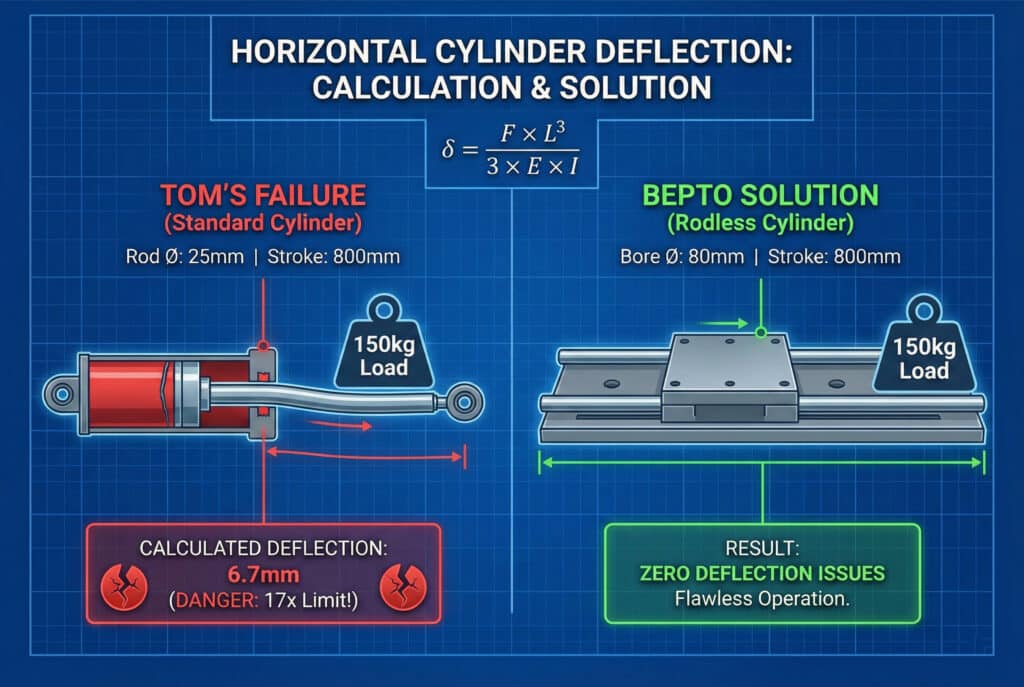
Remember Tom from Wisconsin? Here’s what we found when we analyzed his failed cylinders:
His Setup:
- Rod diameter: 25mm
- Extension length: 800mm
- Applied load: 150 kg (1,471 N)
- Rod weight: ~3 kg (29 N)
The Calculation:
- Moment of Inertia: 1.917 × 10⁻⁸ m⁴
- Total Force: 1,500 N
- Deflection: 😱
That’s 8.4mm per meter—nearly 17 times the acceptable limit! No wonder his seals were failing.
Acceptable Deflection Limits
| Application Type | Max Deflection | Typical Use Case |
|---|---|---|
| Standard Duty | 0.5 mm/m | General automation |
| Precision Work | 0.2 mm/m | Assembly, testing |
| Heavy Duty | 0.8 mm/m | Material handling (with rod support) |
| Critical Alignment | 0.1 mm/m | Measurement, inspection |
The Bepto Solution for Tom
We recommended switching to our 80mm bore rodless cylinder for his 800mm stroke application. Result: Zero deflection issues, 40% cost savings vs. OEM replacement, and delivery in 4 days. His line has been running flawlessly for three months now. 💪
What Are the Solutions When Deflection Exceeds Safe Limits? 🛠️
When your calculations show excessive deflection, you have several engineering options—each with different cost and complexity trade-offs.
The five primary solutions for excessive rod deflection are: (1) increase rod diameter by upsizing the cylinder, (2) reduce extension length through redesign, (3) add external rod support bearings or guides, (4) switch to vertical orientation if possible, or (5) replace with a rodless cylinder design that eliminates the cantilever problem entirely.
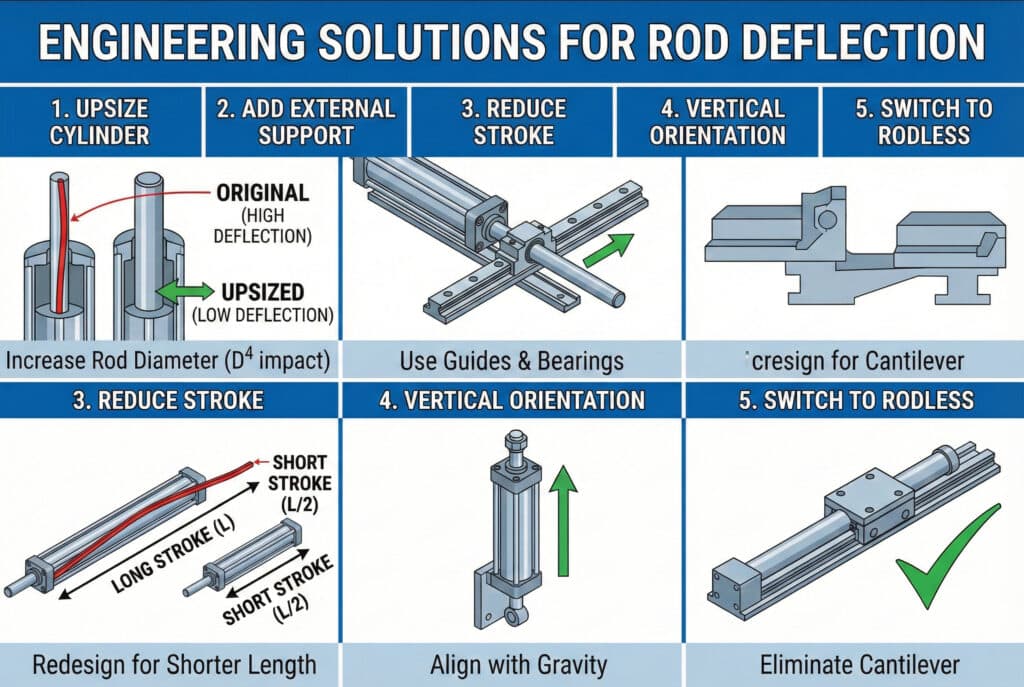
Solution #1: Upsize the Cylinder
Increasing bore size typically increases rod diameter proportionally. Remember, deflection resistance increases with the fourth power of diameter.
Diameter increase impact:
- 20mm → 25mm = 2.4× stiffer
- 25mm → 32mm = 2.6× stiffer
- 32mm → 40mm = 2.4× stiffer
The downside? Larger cylinders cost more, require more air, and take up more space.
Solution #2: Add External Rod Support
Linear bearings5 or guide rods can support the piston rod at intermediate points, dramatically reducing effective cantilever length.
Pros:
- Works with existing cylinder
- Relatively low cost
- Effective for moderate deflection issues
Cons:
- Adds mechanical complexity
- Requires precise alignment
- Additional maintenance points
- Takes up valuable machine space
Solution #3: Reduce Stroke Length
Sometimes the best solution is redesigning your machine layout to shorten the required stroke.
This isn’t always possible, but when it is, it’s highly effective. Remember: cutting stroke in half reduces deflection by 8 times.
Solution #4: Switch to Rodless Design
This is where I get excited, because it’s often the most elegant solution. 🎯
Rodless cylinders eliminate the cantilever problem entirely. Instead of a rod extending from a fixed cylinder body, the load rides on a carriage that travels along a rigid guide rail.
Comparison: Conventional vs. Rodless for Horizontal Applications
| Factor | Conventional Cylinder | Rodless Cylinder |
|---|---|---|
| Deflection at 1m stroke | 3-8mm (typical) | <0.1mm |
| Space required | 2× stroke length | 1× stroke length |
| Maximum practical stroke | 500-800mm | Up to 6,000mm |
| Side load capacity | Poor (causes binding) | Excellent (designed for it) |
| Maintenance access | Difficult (internal seals) | Easy (external carriage) |
| Cost for long strokes | Higher (requires oversizing) | Lower (no deflection penalty) |
Why Do Rodless Cylinders Eliminate Deflection Problems? 🚀
If you’re dealing with horizontal strokes over 500mm, rodless cylinders aren’t just an alternative—they’re often the only practical solution.
Rodless cylinders eliminate piston rod deflection by replacing the cantilever rod design with a rigid guide rail that supports the load carriage along its entire length. The internal piston drives the carriage through a magnetic or mechanical coupling, allowing strokes up to 6 meters with virtually zero deflection regardless of load or orientation.
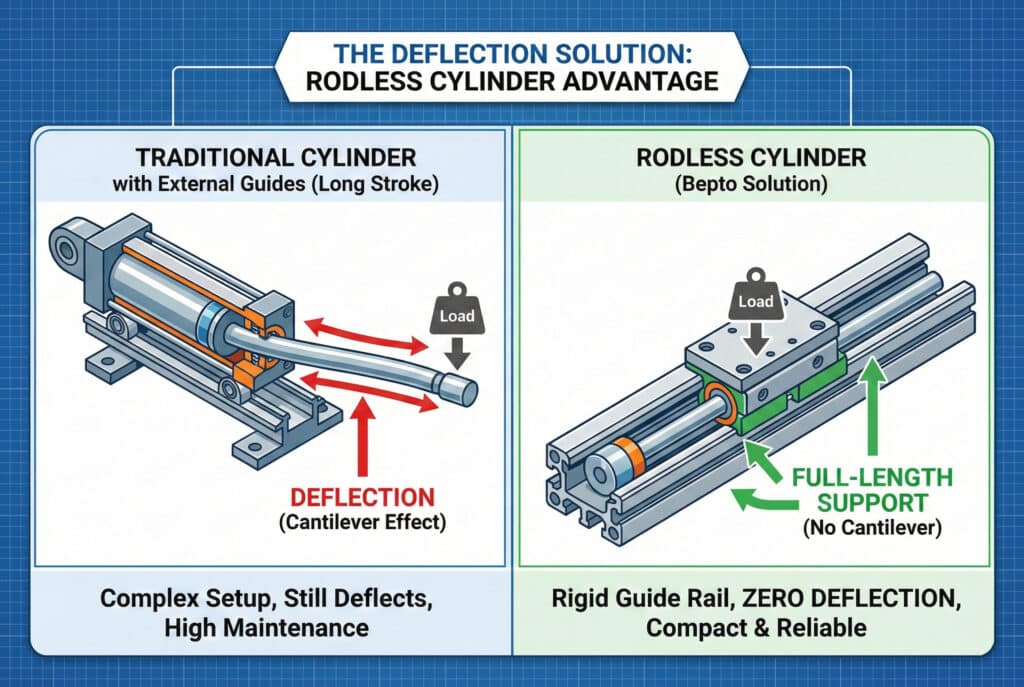
How Rodless Design Solves the Deflection Problem
The fundamental difference is structural. Instead of a slender rod extending into space, you have:
- Rigid aluminum extrusion forming the cylinder body and guide rail
- Full-length support for the load carriage via precision guide blocks
- No cantilever effect because the load is always supported
- Superior side load handling through distributed bearing surfaces
Real-World Application: Jennifer’s Packaging Line
Jennifer, a production engineer at a food packaging facility in Pennsylvania, was specifying equipment for a new line. Her application required an 1,800mm horizontal stroke to transfer product between stations.
Her OEM quote:
- 100mm bore conventional cylinder with external guide rails
- Complex mounting system
- Price: $4,200
- Lead time: 10 weeks
- Estimated deflection: 4-6mm (even with supports)
Our Bepto rodless solution:
- 80mm bore rodless cylinder with integrated guides
- Simple direct mounting
- Price: $1,850
- Delivery: 6 days
- Actual deflection: <0.2mm
She chose Bepto. Her line has been running at 120% of rated speed for five months with zero cylinder issues. She’s since specified our rodless cylinders for three additional projects. 🎉
When Rodless Makes the Most Sense
Consider rodless cylinders when you have:
✅ Horizontal strokes over 500mm – Deflection becomes critical
✅ Space constraints – Rodless takes half the space
✅ High cycle rates – Less moving mass = faster cycles
✅ Side loads present – Rodless handles them naturally
✅ Long-term reliability needs – Fewer failure modes
The Bepto Rodless Advantage
Our rodless cylinder line is specifically engineered for demanding horizontal applications:
- Guide rail hardness HRC 58-62 for wear resistance
- Precision ground rails for <0.05mm straightness per meter
- Oversized carriage bearings for maximum load capacity
- Magnetic coupling design eliminates internal wear parts
- Modular mounting for easy installation and maintenance
And of course: 35-45% lower cost than OEM equivalents with 3-7 day delivery. 📦
Conclusion
Rod deflection in horizontal cylinders isn’t optional to consider—it’s mandatory for reliable operation. Calculate your deflection, respect the limits, and choose the right solution for your stroke length. For horizontal applications over 500mm, rodless cylinders aren’t just better—they’re often the only practical choice. 🎯
FAQs About Piston Rod Deflection
Q: Can I just use a stronger material to reduce deflection?
Material strength doesn’t significantly affect deflection—stiffness (elastic modulus) does, and most metals have similar values. Chrome-plated steel, stainless steel, and aluminum all deflect about the same for a given diameter. The only practical solution is increasing diameter or changing design approach.
Q: How do I measure actual deflection on my existing cylinder?
Use a dial indicator or laser measurement system at the rod’s free end with the cylinder fully extended horizontally. Measure with and without load. If you’re seeing more than 0.5mm per meter, you’re risking seal damage and should plan for replacement or redesign.
Q: Does rod deflection affect vertical cylinder applications?
Vertical cylinders don’t experience gravity-induced deflection, but they still face side loading from misalignment or process forces. Proper mounting alignment is critical. For vertical applications over 1 meter, guide rods or rodless designs still offer advantages in precision and reliability.
Q: What’s the maximum horizontal stroke for a conventional cylinder?
Practically, 500-800mm is the limit before deflection becomes unmanageable, even with oversized rods. Beyond that, you need external supports (complex and expensive) or rodless design (simple and cost-effective). We rarely recommend conventional cylinders for horizontal strokes exceeding 600mm.
Q: How much does switching to rodless cost compared to fixing deflection issues?
For strokes over 800mm, rodless is typically 30-50% less expensive than an oversized conventional cylinder with external supports—and it arrives faster. At Bepto, our rodless cylinders often cost less than the OEM conventional cylinder alone, before you even add support hardware. Plus, you eliminate ongoing maintenance costs from deflection-related wear.
-
Learn more about the mathematical principles of beam deflection for accurate engineering calculations. ↩
-
Understand how cantilever structures respond to various loads and moments in mechanical design. ↩
-
Access a comprehensive reference table for the elastic modulus of various industrial metals and alloys. ↩
-
Explore the geometric properties that determine how different cross-sections resist bending forces. ↩
-
Compare different types of linear motion systems to find the best support for your mechanical application. ↩