Introduction
Picture this: your production line grinds to a halt because a Festo DNC cylinder has failed, and when you contact your local distributor, they quote you $3,200 with a 5-week delivery window. 😱 Meanwhile, your facility is losing $15,000 per day in production capacity, and your operations manager is demanding answers. This nightmare scenario is far more common than it should be, especially for older DNC series models that Festo no longer prioritizes in their inventory systems.
The solution lies in precision-engineered drop-in replacements that offer 100% dimensional compatibility with Festo DNC cylinders while reducing costs by 35-55% and slashing delivery times to under one week. At Bepto Pneumatics, we’ve reverse-engineered1 the complete Festo DNC series to provide manufacturers with a reliable, cost-effective alternative that requires zero machine modifications and delivers equivalent or superior performance in real-world applications.
Just last month, I worked with Jennifer, a plant engineer at a pharmaceutical packaging facility in New Jersey, who was facing exactly this crisis. Her company’s strict validation requirements meant any equipment change required extensive documentation and testing—but waiting 6 weeks for a Festo replacement simply wasn’t an option when production targets were on the line. 💊
Table of Contents
- What Makes Festo DNC Cylinders Difficult to Replace?
- How Do You Identify the Right Drop-In Replacement?
- What Are the Key Specifications for DNC Compatibility?
- Can Alternative DNC Cylinders Pass Validation Requirements?
- Conclusion
- FAQs About Festo DNC Cylinder Replacements
What Makes Festo DNC Cylinders Difficult to Replace?
Finding suitable replacements for Festo DNC series cylinders presents unique challenges that go beyond simple dimensional matching. 🔍
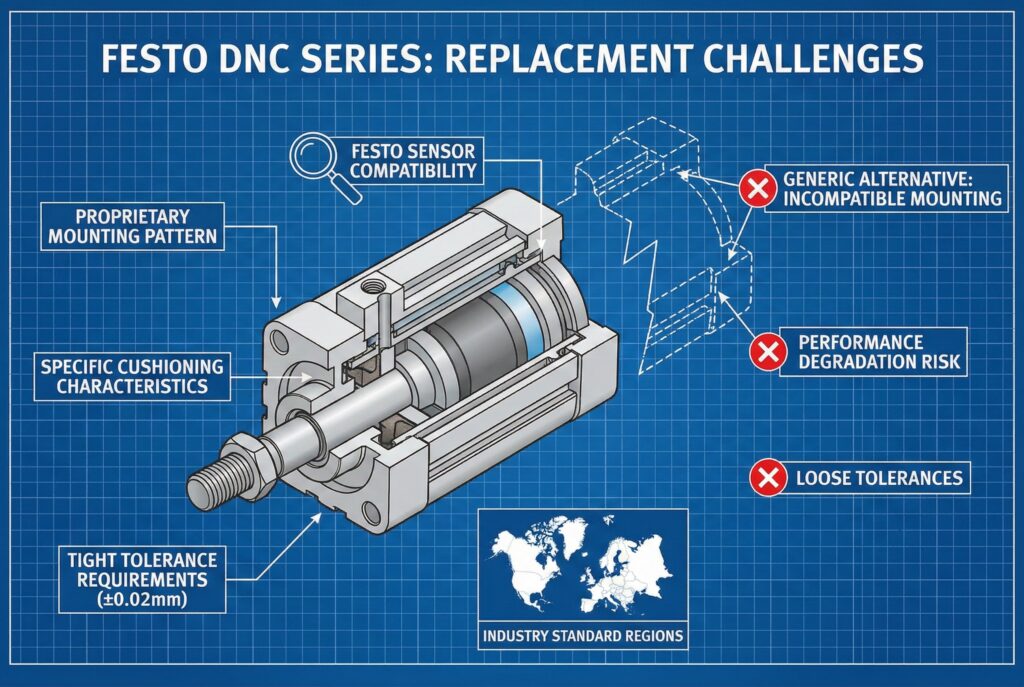
Festo DNC cylinders are challenging to replace because they feature proprietary mounting configurations, specific cushioning characteristics, and tight tolerance requirements (±0.02mm on critical dimensions) that many generic alternatives simply cannot match without causing integration issues or performance degradation. The DNC series, particularly the ISO 155522-compliant models, has become an industry standard in Europe and North America, making compatibility absolutely critical for retrofit applications.
The Festo DNC Legacy
The DNC series has been Festo’s workhorse standard cylinder line for over two decades. These cylinders are found in:
- Automotive assembly systems throughout Germany and the US 🚗
- Food processing equipment across Scandinavia
- Packaging machinery in the UK and France
- Material handling systems globally
Unique Design Characteristics
What makes the DNC series special (and challenging to replace):
| Feature | DNC Specification | Why It Matters |
|---|---|---|
| Mounting Pattern | ISO 15552 + Festo-specific variants | Non-standard holes on some models |
| Cushioning System | Adjustable pneumatic cushions both ends | Affects cycle time and noise |
| Piston Rod Threading | Metric fine pitch (M10x1.25, etc.) | Tooling compatibility |
| Port Configuration | G1/8″ or G1/4″ positioned at specific angles | Plumbing alignment |
| Sensor Groove | T-slot design for Festo SME/SMT sensors | Sensor mounting compatibility |
| Stroke Tolerance | ±0.5mm on standard strokes | Positioning accuracy |
The Supply Chain Reality
Here’s what we see happening in the market: Festo has increasingly focused on their newer product lines like the DSBC and ADN series, which means:
- Longer lead times for DNC series (especially uncommon bore/stroke combinations)
- Higher prices as older series become “legacy” products
- Reduced regional inventory at distributors
- Limited technical support for older installations
This creates a perfect storm for maintenance teams who need parts NOW, not in 6-8 weeks. ⚡
The Hidden Costs
When a Festo DNC cylinder fails, the true cost isn’t just the replacement part:
- Production downtime: $5,000-$50,000 per day depending on facility
- Expedited shipping: Often $200-$500 for air freight
- Emergency labor: Overtime for maintenance staff and contractors
- Lost customer confidence: Late deliveries damage relationships
I remember speaking with Thomas, a maintenance supervisor at an automotive tier-1 supplier in South Carolina, who calculated that a single 3-day production stoppage due to a failed DNC-63 cylinder cost his company over $180,000 in lost production, penalty clauses, and expedited shipping of the replacement. That’s when he started looking for alternatives. 💰
How Do You Identify the Right Drop-In Replacement?
Selecting the correct replacement requires systematic identification and specification matching—guesswork leads to expensive mistakes.
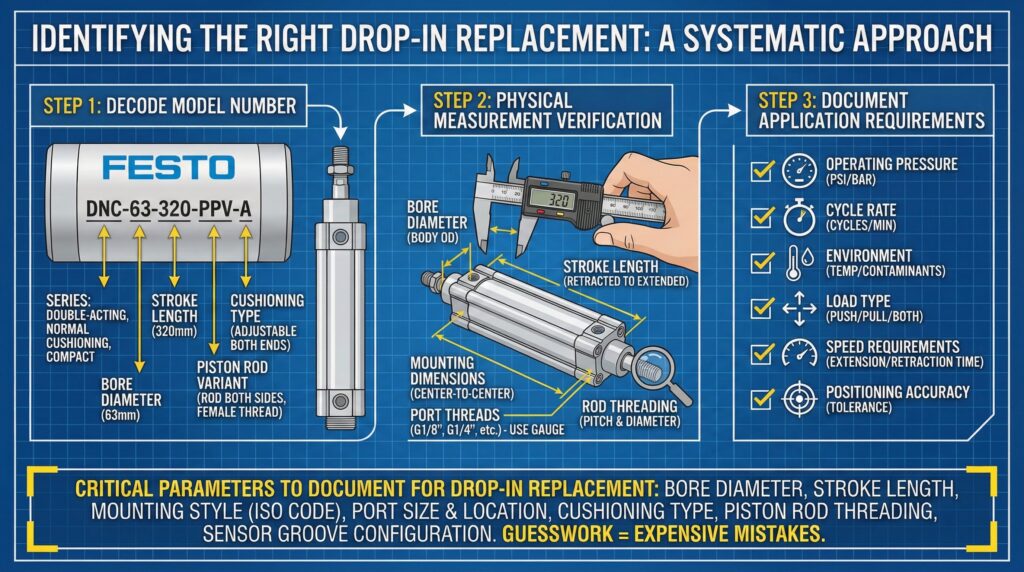
To identify the right drop-in replacement for a Festo DNC cylinder, you must document seven critical parameters: bore diameter, stroke length, mounting style (ISO code), port size and location, cushioning type, piston rod threading, and sensor groove configuration. Missing even one specification can result in a cylinder that physically fits but doesn’t function correctly or requires costly modifications to your machinery.
The Identification Process
Step 1: Decode the Model Number
Festo uses a systematic naming convention. For example: DNC-63-320-PPV-A
Breaking this down:
- DNC = Series designation (Double-acting, Normal cushioning, Compact)
- 63 = Bore diameter in millimeters
- 320 = Stroke length in millimeters
- PPV = Piston rod variant (P=piston rod both sides, V=female thread)
- A = Cushioning type (A=adjustable both ends)
Step 2: Physical Measurement Verification
Never rely solely on old documentation. Measure the actual cylinder:
- Bore diameter: Measure the cylinder body outer diameter
- Stroke length: Measure from fully retracted to fully extended
- Mounting dimensions: Measure center-to-center distances on mounting holes
- Port threads: Verify with thread gauge (G1/8″, G1/4″, etc.)
- Rod threading: Check thread pitch and diameter
Step 3: Application Requirements
Document the operating conditions:
| Parameter | What to Record | Why It Matters |
|---|---|---|
| Operating Pressure | Typical PSI/bar | Affects force output |
| Cycle Rate | Cycles per minute | Impacts seal selection |
| Environment | Temperature, contaminants | Material compatibility |
| Load Type | Pushing, pulling, both | Rod design requirements |
| Speed Requirements | Extension/retraction time | Cushioning adjustment |
| Positioning Accuracy | Required tolerance | Bearing quality needs |
The Bepto Matching System
At Bepto Pneumatics, we’ve developed a comprehensive cross-reference system for the entire Festo DNC range. Our most popular compatible models include:
- DNC-32 through DNC-125 (all standard bore sizes)
- Stroke lengths from 25mm to 2000mm
- All standard mounting variants (ISO 15552 compliant)
- Multiple piston rod configurations
Common Pitfall to Avoid
I learned this lesson early in my career: Jennifer from that New Jersey pharmaceutical plant I mentioned earlier initially tried a “compatible” cylinder from another supplier based solely on bore and stroke. What they missed was the port orientation—the replacement had ports at 90° to the original, which meant the pneumatic lines couldn’t connect without adding awkward adapters that interfered with adjacent equipment. 😤
We provided her with a Bepto DNC-63 compatible cylinder that matched EVERY specification, including the exact port positioning. It installed in 45 minutes with zero modifications required.
What Are the Key Specifications for DNC Compatibility?
Understanding which specifications are critical versus which are flexible can save you time and prevent costly mistakes. 📐
True drop-in DNC compatibility requires exact matching of five non-negotiable specifications: bore diameter (±0mm tolerance), stroke length (±1mm acceptable), mounting hole pattern (±0.1mm), port thread size and orientation (exact match), and piston rod thread specification (exact match). Secondary specifications like cushioning adjustment range and sensor groove dimensions should match but may have slight variations that don’t affect functionality.
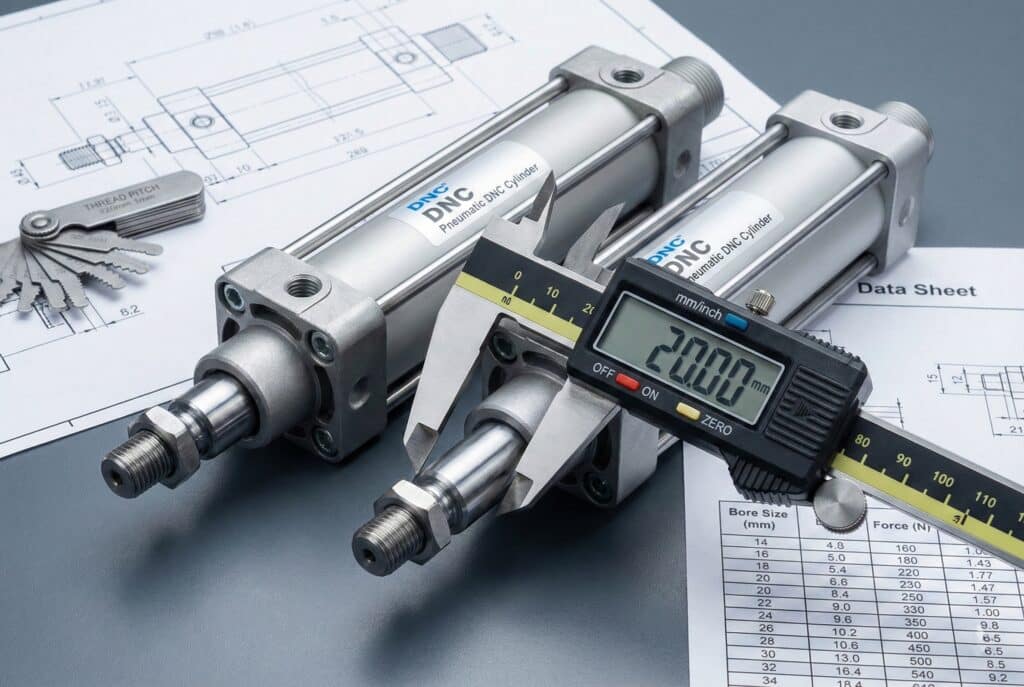
Critical Specifications (Must Match Exactly)
1. Bore Diameter
This is non-negotiable. Festo DNC series comes in standard ISO sizes:
| Bore Size | Force @ 6 bar (Push) | Force @ 6 bar (Pull) | Bepto Model |
|---|---|---|---|
| 32mm | 483 N | 402 N | BPT-DNC-32 |
| 40mm | 754 N | 628 N | BPT-DNC-40 |
| 50mm | 1,178 N | 981 N | BPT-DNC-50 |
| 63mm | 1,872 N | 1,559 N | BPT-DNC-63 |
| 80mm | 3,016 N | 2,512 N | BPT-DNC-80 |
| 100mm | 4,712 N | 3,925 N | BPT-DNC-100 |
| 125mm | 7,363 N | 6,133 N | BPT-DNC-125 |
Even a 2mm difference in bore diameter will result in significantly different force output, potentially causing application failure.
2. Mounting Configuration
Festo DNC cylinders use ISO 15552 mounting patterns, but with variations:
- Front flange mounting (code: MP1)
- Rear flange mounting (code: MP2)
- Double clevis mounting (code: MP3)
- Foot mounting (code: MP4)
- Trunnion mounting (code: MP7)
Each mounting style has specific hole patterns and dimensions that must match within ±0.1mm for proper bolt alignment.
3. Port Configuration
This is where many “compatible” cylinders fail. You need exact matching of:
- Thread type: G1/8″, G1/4″, or G3/8″ (BSP parallel)
- Port location: Distance from cylinder end
- Port orientation: Angular position (0°, 90°, 180°, 270°)
- Port depth: Thread engagement length
4. Piston Rod Specifications
The piston rod must match in:
- Diameter: 12mm, 16mm, 20mm, 25mm, etc.
- Thread type: Metric fine pitch (M10x1.25, M12x1.25, M16x1.5, etc.)
- Thread length: Minimum engagement depth
- Rod end style: Male thread, female thread, or clevis
5. Overall Dimensions
The cylinder must fit within the existing machine envelope:
- Extended length: Fully extended dimension
- Retracted length: Fully retracted dimension
- Body diameter: Clearance around cylinder
- Rod projection: Distance rod extends beyond body
Important But Flexible Specifications
These should match when possible, but slight variations are usually acceptable:
Cushioning System
Festo DNC cylinders typically feature adjustable pneumatic cushioning at both ends. Our Bepto alternatives provide:
- Adjustable cushioning range: 0-20mm (matches Festo)
- Cushioning adjustment: Slotted screw adjustment
- Cushioning effectiveness: Reduces impact force by 80-90%
Minor differences in cushioning adjustment range (±2mm) typically don’t affect functionality—you can compensate with flow control valves if needed.
Sensor Groove Compatibility
Festo uses a T-slot sensor groove. Our cylinders accept:
- Festo SME/SMT sensors (direct compatibility)
- Standard reed switch3 sensors (industry standard)
- Magneto-resistive sensors (for precision applications)
The groove dimensions match within 0.1mm, ensuring secure sensor mounting. 🔧
Real-World Validation
Let me share how Roberto, a machine builder in Barcelona, Spain, validated our compatibility. He was retrofitting a 10-year-old packaging line with 24 Festo DNC-50 cylinders that needed replacement. Rather than risk a full installation, he ordered two Bepto BPT-DNC-50 samples for testing.
His validation process:
- Physical fit test: Confirmed mounting holes aligned perfectly
- Performance test: Measured cycle times (within 0.1 seconds of original)
- Force output test: Verified push/pull forces matched specifications
- Endurance test: Ran 100,000 cycles over 2 weeks with zero issues
After successful validation, he ordered the remaining 22 cylinders and completed the retrofit in one weekend. His total savings: €18,500 compared to Festo OEM pricing. 💶
Can Alternative DNC Cylinders Pass Validation Requirements?
For regulated industries like pharmaceuticals, food processing, and medical devices, validation isn’t optional—it’s mandatory. 🏥
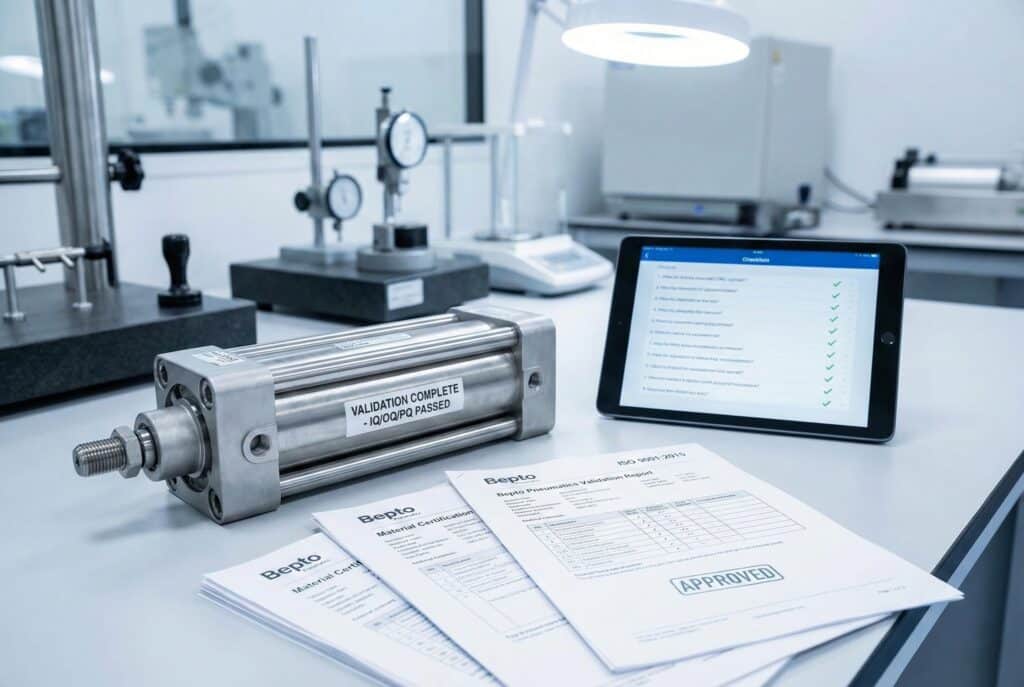
Yes, properly manufactured alternative DNC cylinders can absolutely pass validation requirements including IQ/OQ/PQ protocols4, provided they come with complete technical documentation, material certifications, and dimensional inspection reports that demonstrate equivalence to OEM specifications. At Bepto Pneumatics, we specifically support validation processes by providing the comprehensive documentation packages that quality assurance teams require.
Understanding Validation Requirements
Different industries have different validation standards:
| Industry | Key Requirements | Documentation Needed |
|---|---|---|
| Pharmaceutical | FDA 21 CFR Part 11, cGMP | Material certs, dimensional reports, change control |
| Food & Beverage | FDA Food Safety, HACCP | Material safety, cleaning validation, traceability |
| Medical Device | ISO 13485, FDA QSR | Full traceability, risk analysis, design validation |
| Automotive | IATF 16949 | PPAP documentation, FMEA, control plans |
| General Manufacturing | ISO 9001 | Dimensional reports, material certs, test data |
Documentation We Provide
For every Bepto DNC-compatible cylinder, we supply:
Technical Documentation
- Detailed dimensional drawings (PDF and CAD formats)
- Material specifications for all components
- Performance test data (pressure, force, cycle life)
- Pneumatic characteristics (flow rates, response times)
Quality Certifications
- Material certificates (aluminum alloy, steel, seal compounds)
- RoHS compliance5 documentation
- REACH compliance for EU customers
- ISO 9001:2015 certification for our manufacturing facility
Traceability Records
- Serial number tracking for individual cylinders
- Manufacturing date codes
- Batch traceability for all raw materials
- Inspection reports with actual measured dimensions
The Validation Process
When Jennifer from that New Jersey pharmaceutical facility needed to validate our cylinders, here’s how we supported her:
Phase 1: Design Qualification (DQ)
We provided complete technical specifications demonstrating equivalence to Festo DNC-63 specifications across all critical parameters.
Phase 2: Installation Qualification (IQ)
We supplied:
- Dimensional inspection reports showing all measurements within tolerance
- Material certificates confirming aluminum alloy 6063-T5 and NBR seals
- Photographic documentation of serial numbers and identification
Phase 3: Operational Qualification (OQ)
We supported her testing protocol:
- Force output verification at multiple pressures (4, 6, 8 bar)
- Cycle time measurement (matched original within 3%)
- Positioning repeatability (±0.05mm over 1000 cycles)
- Leakage testing (zero detectable leakage at rated pressure)
Phase 4: Performance Qualification (PQ)
The cylinders were run in actual production for 30 days while monitoring:
- Cycle count: 847,000 cycles completed
- Failures: Zero
- Performance drift: None detected
- Product quality impact: No change in package integrity or positioning
The entire validation was completed in 45 days, and Jennifer’s facility has since standardized on Bepto cylinders for all DNC replacements. ✅
Regulatory Compliance
Our manufacturing facility maintains:
- ISO 9001:2015 Quality Management System
- ISO 14001:2015 Environmental Management
- CE marking for European Economic Area
- RoHS and REACH compliance for material restrictions
Change Control Support
One concern in validated environments is change control. When you replace a Festo cylinder with a Bepto alternative, you need to justify the change. We provide:
- Equivalence documentation showing specification matching
- Risk assessment support (typically classified as “like-for-like” replacement)
- Change control templates to streamline your internal process
Long-Term Supply Assurance
A critical validation concern is supply continuity. We guarantee:
- Minimum 10-year product availability for all standard models
- Raw material inventory for 5+ years of production
- Drawing retention for custom configurations
- Backward compatibility commitment (no undocumented design changes)
This is actually superior to OEM suppliers who frequently discontinue older series and force customers into costly upgrades. 🛡️
Conclusion
Finding the right drop-in replacement for Festo DNC series cylinders isn’t about compromise—it’s about smart sourcing that maintains quality and performance while dramatically improving your cost structure and supply chain responsiveness. At Bepto Pneumatics, we’ve invested heavily in reverse-engineering and quality systems specifically to provide manufacturers with a reliable alternative when OEM lead times and pricing no longer make business sense. Whether you’re facing an emergency breakdown or planning a strategic component standardization, we’re here to support your success with the same technical rigor and customer commitment that has made us a trusted partner to manufacturers across four continents. 🌍
FAQs About Festo DNC Cylinder Replacements
How do I know if a Bepto cylinder will fit my specific DNC model?
Simply provide us with your complete Festo model number (e.g., DNC-63-320-PPV-A) or send us photos of the cylinder nameplate, and our engineering team will confirm compatibility within 2 hours during business hours. We maintain a comprehensive cross-reference database covering all standard DNC variants, and for unusual configurations, we can create custom solutions with detailed dimensional drawings for your approval before manufacturing.
What is the typical lead time for Bepto DNC-compatible cylinders?
Standard bore sizes (32mm-100mm) with common stroke lengths (up to 500mm) typically ship within 3-5 business days, while custom configurations require 10-14 days for manufacturing. This compares very favorably to Festo’s typical 4-8 week lead times for non-stock items. We maintain inventory of the most popular configurations and can expedite critical orders when needed.
Do Bepto cylinders work with existing Festo sensors and accessories?
Yes, our DNC-compatible cylinders feature identical T-slot sensor grooves and accept all standard Festo SME/SMT series magnetic sensors as well as industry-standard reed switches. Mounting accessories, rod clevises, and other attachments that fit Festo DNC cylinders will fit our alternatives without modification. We’ve specifically engineered compatibility with the Festo accessory ecosystem to minimize your inventory complexity.
What warranty and support do you provide?
All Bepto DNC-compatible cylinders include an 18-month warranty covering manufacturing defects and material failures, plus lifetime technical support for application questions. We provide direct access to our engineering team via phone, email, or video call, with typical response times under 4 hours. For critical applications, we can arrange advance replacement inventory at your facility to minimize any potential downtime.
Can you help with validation documentation for regulated industries?
Absolutely—we specialize in supporting validation processes for pharmaceutical, food processing, and medical device manufacturers. We provide complete documentation packages including material certificates, dimensional inspection reports, test data, and equivalence documentation. Our quality team has experience working with IQ/OQ/PQ protocols and can customize documentation to meet your specific validation requirements.
-
The process of analyzing a product’s construction to create a reproduction with matching specifications. ↩
-
The international standard defining mounting dimensions for pneumatic cylinders to ensure interchangeability. ↩
-
Sensors that detect the magnetic field of the cylinder’s piston to provide position feedback. ↩
-
A quality assurance protocol (Installation, Operational, and Performance Qualification) used to validate equipment in regulated industries. ↩
-
A directive restricting hazardous substances in electrical and electronic equipment manufacturing. ↩