

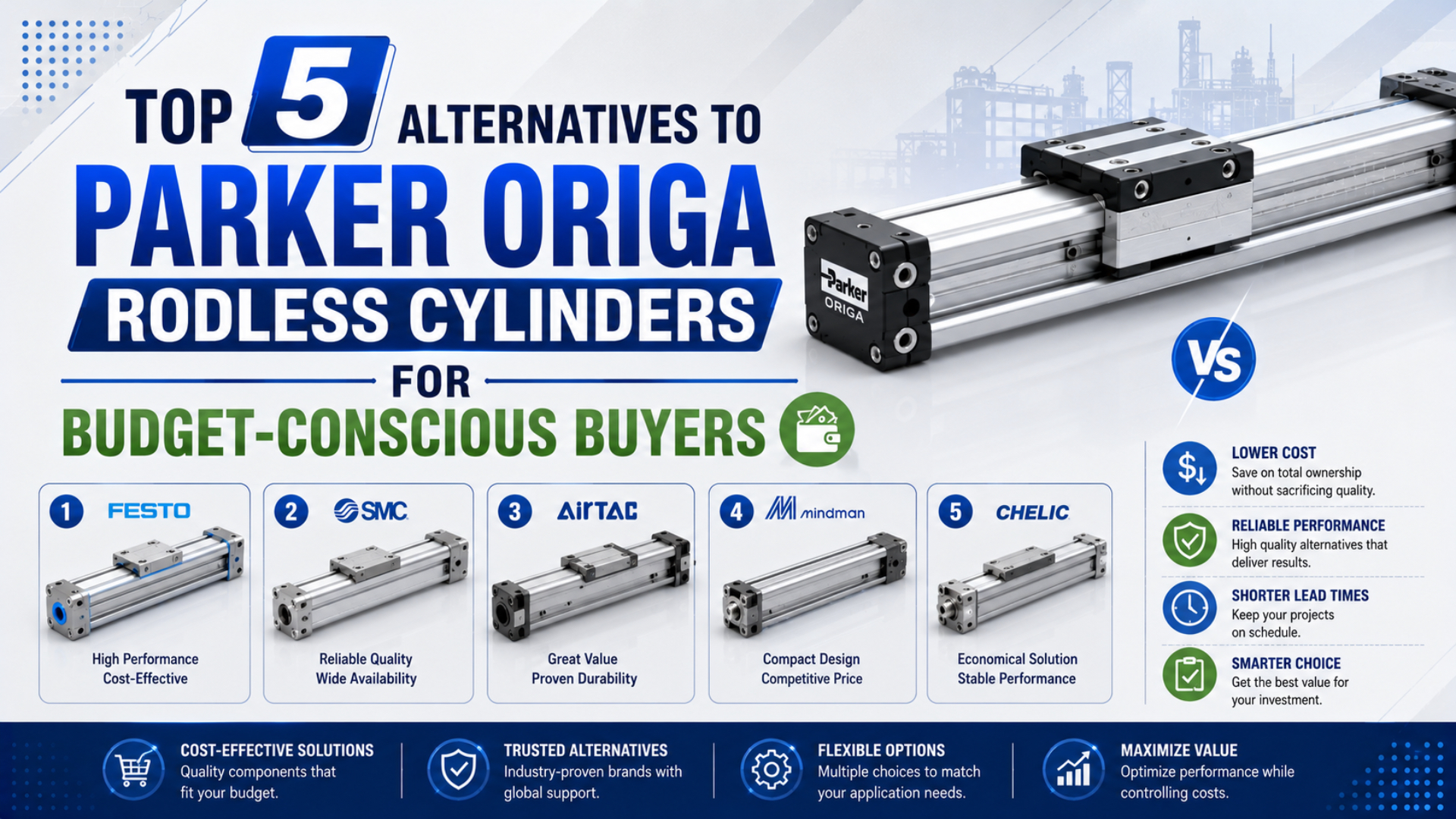
The five strongest catalog-backed Parker Origa alternatives to shortlist are Festo DGC, SMC MY1B, Camozzi Series 52, AVENTICS RTC, and IMI Norgren LINTRA Plus. None is a universal drop-in replacement for Parker Origa OSP-P. A budget-conscious buyer should first prove the mounting, carriage, load, cushioning, sensor, and service interfaces, then compare current quotes for the exact accepted configurations.
That distinction protects the machine. Parker lists OSP-P bore sizes from 10 to 80 mm, an 8 bar maximum operating pressure, and a 6,000 mm maximum standard stroke in its technical specifications (Parker OSP-P, retrieved 2026-07-26). A competing series may overlap those headline values while differing substantially at the carriage and guide.
Key Takeaways
- Treat these five families as shortlist candidates, not ranked direct replacements.
- Parker’s standard OSP-P range covers eight bore sizes and up to 8 bar.
- Compare guide moments, cushioning, ports, sensors, drawings, and service parts before price.
- Normalize each quote by configuration, quantity, destination, Incoterm, and quotation date.
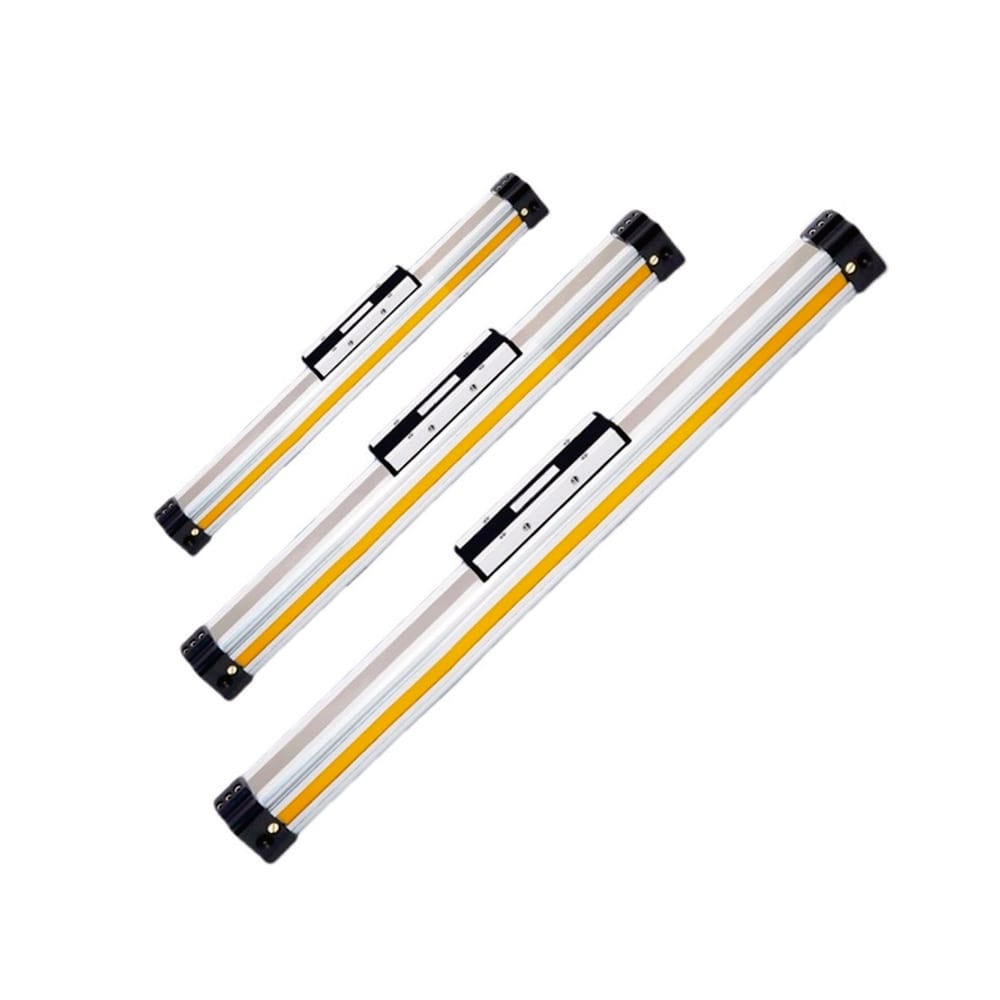
The installed OSP-P part number, guide, carriage, sensors, ports, brake, and stroke define the replacement problem. The brand name alone doesn’t.
Start With the Parker OSP-P Reference Envelope
Parker’s OSP-P technical page lists eight bore sizes, 10, 16, 25, 32, 40, 50, 63, and 80 mm, with 47 to 3,010 N force at 6 bar in its specification table. Those numbers establish a useful reference envelope, but they don’t identify the guide, brake, cushion, sensor, or mounting configuration on an installed axis (Parker, retrieved 2026-07-26).
Record the complete nameplate code before asking for an alternative. Photograph both end caps, the carriage, mounting brackets, sensor positions, port routing, and available service clearance. If the plate is unreadable, measure the assembly and compare it with the controlled Parker drawing rather than guessing from bore and stroke.
The OSP-P family is unusually broad. Parker describes modular guides, brakes, valves, magnetic switches, cleanroom and ATEX options, plus repairability. A basic cylinder and a guided or braked axis can share the OSP-P name while presenting different replacement risks. Can the proposed substitute hold a vertical load after an air or power loss? A standard actuator rating won’t answer that.
| OSP-P reference item | Published value or feature | What the buyer must identify |
|---|---|---|
| Bore | 10 to 80 mm | Exact installed bore and usable force margin |
| Standard technical stroke | Up to 6,000 mm | Exact stroke, total length, supports, and clearances |
| Maximum pressure | 8 bar | Dynamic pressure at the actuator, not only regulator pressure |
| Force at 6 bar | 47 to 3,010 N | Exact model force, friction, orientation, and acceleration |
| Guidance and control | Modular guides, brakes, valves, and switches | Every fitted option and its function |
| Service | Repairable; service information is published | Seal kit, wear items, tools, and permitted downtime |
The theoretical pressure-area relationship is a first screening check. If the architecture itself is still being selected, review the space and load-path advantages of rodless cylinders before comparing brands:
Here, is ideal piston force in newtons, is effective pressure in megapascals, and is bore diameter in millimeters. Because 1 MPa equals 1 N/mm², the units reduce directly to newtons. Real available force is lower after seal friction, pressure loss, and the required operating margin are included.
This calculation can’t approve a replacement. It only tells you whether the proposed bore is plausible. The next checks are guide capacity, moving mass, center-of-gravity offsets, stopping energy, speed, duty, and the measured pressure during motion. The rodless-cylinder TCO guide covers the broader cost decision after those engineering gates pass.
Which Five Parker Origa Alternatives Belong on the Shortlist?
The five shortlisted families cover catalog strokes from 5,000 mm for the cited SMC MY1B range to 8,500 mm for several Festo DGC and Norgren LINTRA Plus variants. That spread is useful for market screening, but each limit belongs to a particular bore and guide arrangement rather than to every selectable model (SMC; Festo; Norgren, retrieved 2026-07-26).
“Top” therefore means technically credible enough to enter a controlled comparison. It doesn’t mean cheapest everywhere, fastest to deliver, longest-lived, or dimensionally interchangeable with every OSP-P. Price and lead time change with configuration, quantity, region, stock, freight, and quotation date. The product data below comes from manufacturer documentation; commercial terms must come from current written quotes.
1. Festo DGC
Festo DGC is the broadest candidate when the application needs a choice of guide technologies. The 2026 catalog lists DGC variants with basic guidance, plain bearings, recirculating ball bearings, and a heavy-duty guide. Depending on the variant, the catalog spans 8 to 80 mm piston diameters and strokes up to 8,500 mm (Festo DGC, May 2026).
The strongest reason to shortlist DGC is guide selection, not a promise of direct fit. Festo publishes separate allowable forces and pitch, roll, and yaw moments for its variants. That gives an engineer a real basis for screening an offset load. The tradeoff is equally clear: carriage interfaces, profile dimensions, ports, sensors, and cushioning options must be compared line by line with the installed OSP-P.
Choose the DGC variant from the load case first. A basic DGC-G and a recirculating-ball DGC-KF don’t have the same guide behavior. If an external guide already controls the load, also check whether a moment compensator is needed to prevent binding from parallelism error.
2. SMC MY1B
SMC MY1B is a focused option for 25, 32, and 40 mm bores. Its catalog lists a 5,000 mm maximum manufacturable stroke, 0.1 to 0.8 MPa operating pressure, air cushioning, and a 100 to 1,000 mm/s piston-speed range for the basic specification (SMC MY1B, retrieved 2026-07-26).
MY1B deserves consideration where its bore range covers the machine and SMC support or spare parts are already established at the site. The catalog includes load-mass and allowable-moment selection charts, which are more useful than a generic “equivalent bore” statement. Strokes above 2,000 mm require a made-to-order suffix in the cited document, another reminder to compare exact order codes.
Don’t assume the MY1B slide table will accept existing tooling. Check carriage-hole locations, height from mounting surface to load plane, port thread choice, sensor hardware, side-support spacing, and cushion capacity. The catalog explicitly separates the cylinder from shock-absorber selection in its worked load example. The site’s replacement measurement guide shows the same interface discipline for a different cylinder family.
3. Camozzi Series 52
Camozzi Series 52 covers 25, 32, 40, 50, and 63 mm bores in basic, slide-bearing, and roller-bearing versions. The official data gives a 1 to 8 bar pressure range and variant-dependent maximum strokes from 5,880 to 6,000 mm; the roller version is limited to 25, 32, and 40 mm bores (Camozzi Series 52, October 2024).
Its main strength is transparent mechanical data. Camozzi publishes separate load and torque ratings for the guide versions, along with speed adjustment coefficients and dimensional tables. For example, the cited document applies different reference speeds to basic or slide-bearing versions and roller-bearing versions. A buyer can therefore challenge a proposed model against the actual offset load instead of accepting a broad compatibility label.
Series 52 isn’t Series 32. That model-name distinction matters when searching catalogs and requesting quotes. Verify whether the selected configuration uses standard or short carriage, air supply from both ends or one side, and basic, slide, or roller guidance.
4. AVENTICS RTC
AVENTICS RTC-BV is worth screening when an integrated-guide rodless cylinder fits the application. One current 25 mm RTC-BV configuration lists 309 N piston force at 6.3 bar, 8 bar maximum working pressure, 6.5 m/s maximum speed, and a 7,000 mm maximum configurable stroke (AVENTICS RTC-BV, retrieved 2026-07-26).
Those values describe that product configuration, not the entire RTC family. Use Emerson’s configurator and datasheet for the exact bore and stroke under review. The published 6.5 m/s ceiling is especially easy to misuse: maximum cylinder speed doesn’t prove that the selected cushion can stop the machine’s moving mass at that speed.
RTC belongs on the list because the official product record exposes force, pressure, cushioning energy, speed, port, guide, and environmental data together. It still requires a fresh dimensional overlay against OSP-P, including end clearance, carriage height, mounting features, and sensor switching positions.
5. IMI Norgren LINTRA Plus
IMI Norgren LINTRA Plus spans 16, 20, 25, 32, 40, 50, 63, and 80 mm bores at 1 to 8 bar. Its August 2025 technical document lists maximum strokes of 8,500 mm for 16 to 40 mm bores, 8,000 mm for 50 and 63 mm, and 5,500 mm for 80 mm (Norgren LINTRA Plus, August 2025).
Three guide arrangements make LINTRA Plus useful for different load paths: internal guide, external adjustable guide, and precision roller guide. Norgren publishes corresponding force and moment tables, support-distance guidance, and a warning that additional shock absorbers are needed when the permitted dynamic-energy values are exceeded.
This is a strong catalog comparison candidate, particularly across a wide bore range. It is not evidence of OSP-P interchangeability. Norgren’s document states interchangeability with its own earlier M/46000 series, not with Parker Origa. That exact wording prevents an easy but costly inference.
What Do the Catalogs Actually Let You Compare?
Across the cited catalogs, maximum standard or manufacturable stroke ranges from 5,000 to 8,500 mm, while four of the five families publish an 8 bar upper pressure figure in the evidence used here. These overlaps support a shortlist, but they don’t normalize guide design, cushion energy, mounting, or service access (Parker; SMC; Camozzi; Norgren, retrieved 2026-07-26).
| Product family | Official evidence used for screening | Guide choices highlighted by manufacturer | Immediate mismatch risk |
|---|---|---|---|
| Parker OSP-P reference | 10 to 80 mm; 6,000 mm standard technical stroke; 8 bar | Modular guides and brakes | Installed option code may be incomplete |
| Festo DGC | 8 to 80 mm across variants; several variants to 8,500 mm | Basic, plain, ball, heavy-duty | Variant changes the allowable load envelope |
| SMC MY1B | 25, 32, 40 mm; up to 5,000 mm; 0.1 to 0.8 MPa | Basic integrated guide with published moment charts | Limited bore range and distinct carriage geometry |
| Camozzi Series 52 | 25 to 63 mm; up to 5,880 to 6,000 mm; 1 to 8 bar | Basic, slide, roller | Roller version isn’t offered at 50 or 63 mm |
| AVENTICS RTC-BV | Representative 25 mm record: up to 7,000 mm; 8 bar | Integrated guide | Exact-family limits need configuration-specific review |
| Norgren LINTRA Plus | 16 to 80 mm; bore-dependent 5,500 to 8,500 mm; 1 to 8 bar | Internal, external adjustable, roller | Published interchange applies to Norgren M/46000 |
The useful comparison isn’t “Which catalog has the largest number?” It is “Which catalog exposes the limits that govern this machine?” A 7,000 mm stroke option has little value if its carriage moment falls short. Conversely, a shorter catalog ceiling doesn’t matter when the machine needs only 900 mm and the candidate fits every interface.
Retrofit Compatibility Has Eight Separate Gates
Parker’s own product warning assigns final selection and testing responsibility to the user, even though the standard OSP-P table supplies 6,000 mm stroke and 8 bar limits. That warning captures the retrofit problem: a catalog can describe options, but only a controlled comparison can establish whether one exact configuration is safe and sufficient for the machine (Parker, retrieved 2026-07-26).
Pass these gates in order:
- Identity gate: Verify the complete installed Parker order code, revision, stroke, and all added guide, brake, valve, and sensor modules.
- Envelope gate: Overlay the supplier’s controlled drawing with the machine model. Check overall length, end clearance, profile section, and maintenance access.
- Mounting gate: Compare bolt pattern, locating features, carriage holes, thread depths, mounting-surface flatness, and support spacing.
- Load gate: Calculate moving mass, gravity direction, acceleration, and pitch, roll, and yaw moments from the actual center of gravity.
- Motion gate: Check speed, cycle rate, stopping energy, cushion limits, external shock absorbers, overtravel, and hard-stop position.
- Pneumatic gate: Verify port thread, effective flow path, valve and tubing capacity, exhaust restriction, and dynamic pressure at the actuator.
- Control gate: Match sensor technology, voltage, output logic, connector, switching location, cable exit, and PLC timing.
- Environment and service gate: Confirm temperature, dust, washdown, corrosion, cleanroom or ATEX requirements, lubrication, repair method, and local spare parts.
From our replacement-analysis work, we’ve found that the most useful supplier response is a marked deviation schedule rather than an unqualified “equivalent” statement. That experience doesn’t establish product performance. It does make missing evidence visible before a sample reaches the machine.
A dimension-by-dimension overlay is more informative than a “drop-in” label, but it still isn’t enough. Dimensional compatibility proves fit. Load, motion, controls, environment, and service evidence prove function. Keeping those approvals separate makes a deviation visible instead of burying it inside a supplier’s general compatibility statement.
Camozzi’s Series 52 catalog provides a practical example of combined-load screening:
In this equation, and are applied loads in the catalog’s defined directions, while , , and are the applied moments. Each denominator is the corresponding maximum for the exact model, guide, speed condition, and reference point. A result no greater than 1 passes this catalog interaction check; it doesn’t waive cushion, deflection, mounting, or life review (Camozzi, 2024).
Why not compare each load with its maximum separately? Several moderate loads can interact and exhaust the guide capacity even when no individual ratio reaches 1. SMC likewise sums guide load factors in its MY1B selection example and advises changing speed, bore, or series when the total exceeds 1 (SMC MY1B, retrieved 2026-07-26).
How Should a Budget-Conscious Buyer Compare Quotes?
NIST reports that more than half of a manufacturer’s spending occurs in the supply chain on average, and its TCO guidance includes freight, tariffs, longer lead times, inventory, management overhead, and lost-sales risk. A rodless-cylinder comparison should therefore normalize delivered and ownership costs only after the technical candidates pass (NIST, updated 2025).
Send every supplier the same RFQ package:
- Original Parker order code, nameplate photograph, and controlled drawing revision
- Required stroke, orientation, moving mass, center-of-gravity offsets, speed, cycle rate, and stopping method
- Measured minimum pressure at the actuator during its highest-flow movement
- Mounting and carriage drawings with locating features and tolerances identified
- Port, tube, valve, sensor, connector, PLC, and environmental requirements
- Required documents, inspection records, service kit, warranty terms, and change-notification expectations
- Quantity, delivery destination, Incoterm, requested delivery date, and quotation validity
Measure pressure at the actuator during motion, not only at the regulator. The article on pneumatic pressure-drop troubleshooting explains why valves, fittings, tubing, and exhaust restrictions can reduce dynamic pressure even when the static gauge looks acceptable.
Then separate the decision into three columns. Column one is technical acceptance: pass, conditional pass with documented changes, or fail. Column two is delivered acquisition cost. Column three is ownership exposure, including engineering changes, sample testing, inventory, service labor, emergency freight, and the site’s approved downtime consequence.
Don’t ask suppliers to quote “an OSP-P32 equivalent.” That phrase hides the variables most likely to create rework. Ask them to complete a deviation schedule against the exact installed part. A blank row means “not yet answered,” not “same.” This small procurement change turns compatibility from a sales adjective into a reviewable engineering record.
In our experience, quote comparisons improve when engineering approves a configuration code before purchasing sees the commercial ranking. This process observation isn’t a reliability claim. It simply prevents a low preliminary price from becoming the assumed technical winner while drawings, sensors, cushions, or guide data remain unresolved.
Use this quote-normalization table:
| Comparison row | Required normalization |
|---|---|
| Product | Complete manufacturer and order code |
| Configuration | Bore, stroke, guide, carriage, cushion, brake, sensors, mounts, and accessories |
| Commercial basis | Quantity, currency, Incoterm, destination, tax treatment, and quote date |
| Timing | Stock status, production lead time, transit assumption, and committed ship date |
| Engineering change | Brackets, machining, tubing, wiring, PLC changes, guarding, and documentation |
| Qualification | Sample price, inspection, trial labor, test duration, and acceptance criteria |
| Service | Seal and wear kits, tools, instructions, local stock, and repair turnaround |
| Risk | Warranty exclusions, return freight, change notification, and second-source plan |
What if a technically accepted candidate costs more on the first quote? It may still have lower total cost when it shortens a validated service procedure or reduces inventory. The reverse is also true. A low unit price can lose quickly when it requires new brackets, a different sensor inventory, additional shock absorbers, or repeat commissioning.
When Is Staying With Parker the Better Decision?
Parker publishes an 8,000 km service-life claim for OSP-P and offers modular guide, brake, cleanroom, ATEX, temperature, and service options. Those capabilities can justify remaining with the established configuration when revalidation cost, safety risk, contract language, or option complexity outweighs any acquisition-price difference (Parker OSP-P, retrieved 2026-07-26).
Keep Parker as the preferred path when:
- The customer specification, validation file, approved-vendor list, or warranty names Parker or the exact OSP-P code.
- A brake or guided axis performs a safety-related holding function that the proposed substitute hasn’t independently validated.
- The application uses an OSP-P cleanroom, ATEX, special-temperature, high-speed, low-speed, or other option without matching evidence.
- Machine access leaves no practical room for a bracket, port, sensor, or overall-length change.
- Production cannot provide a guarded test window or a defined rollback plan.
- Existing spares, training, repair tools, and service agreements make the installed platform cheaper over the selected evaluation period.
Staying with Parker isn’t a failure to source competitively. It is the right result whenever the evidence shows that changing creates more cost or risk than it removes. A second source can still be developed offline through drawing review and sample testing without turning an emergency repair into an uncontrolled field experiment.
The Final Selection Rule
The five candidate families publish enough technical data to support a serious shortlist, with bore coverage from 8 mm in some Festo DGC variants to 80 mm in Parker, Festo, and Norgren ranges. The winning alternative is the lowest-risk accepted configuration at the best normalized cost, not the cylinder with the lowest unqualified unit quote (Parker; Festo; Norgren, retrieved 2026-07-26).
The sequence is simple: identify, overlay, calculate, test, then price. Reject any candidate whose supplier won’t provide a controlled drawing, configuration-specific load data, cushion or shock-absorber limits, sensor details, and written commercial terms. If two candidates pass, compare them on the same quantity, delivery basis, evaluation period, and risk assumptions.
That process may select Festo, SMC, Camozzi, AVENTICS, Norgren, or the original Parker assembly. It can also conclude that none of the quoted alternatives is ready. That is useful information. It prevents a procurement saving from becoming an engineering change discovered during production restart.
Parker Origa Alternative FAQs
Parker’s standard OSP-P specification spans eight bore sizes and up to 6,000 mm stroke, while the five shortlisted families overlap only parts of that envelope. These FAQs keep the decision tied to the exact configuration rather than to a brand-level replacement claim (Parker, retrieved 2026-07-26).
Is any rodless cylinder a direct replacement for every Parker Origa OSP-P?
No. OSP-P combines eight bore sizes with optional guides, brakes, valves, sensors, and application variants. A substitute becomes a direct replacement only after its controlled drawing and configuration-specific ratings match the installed interfaces, load, motion, controls, environment, and service requirements. Similar bore and stroke values alone don’t establish interchangeability.
Which Parker Origa alternative has the longest catalog stroke?
There isn’t one universal answer across every bore and guide. The cited Festo DGC catalog lists several variants up to 8,500 mm, and Norgren lists up to 8,500 mm for 16 to 40 mm bores. Parker separately lists 6,000 mm in its standard technical specification. Verify the exact configuration before comparing limits.
Can equal bore and pressure prove equal force?
They can produce the same ideal pressure-area result, but they don’t prove equal usable force. Seal friction, dynamic pressure loss, guide drag, orientation, acceleration, and safety margin change the available output. Parker and Festo both list 754 N at 6 bar for representative 40 mm configurations, yet their guide and mounting envelopes remain different.
What information should I send with a replacement RFQ?
Send the complete Parker code, photographs, controlled mounting and carriage drawings, stroke, orientation, moving mass, center-of-gravity offsets, speed, cycle rate, dynamic pressure, ports, valve and tube data, sensors, environment, stopping method, required documents, quantity, destination, Incoterm, and delivery need. Ask the supplier to return a written deviation schedule.
Should I choose the lowest quoted rodless cylinder?
Only after it passes every technical gate. NIST’s TCO guidance includes freight, tariffs, lead time, inventory, management overhead, and lost-sales risk beyond purchase price. Add bracket work, sensors, testing, spare parts, service labor, and site-approved downtime exposure. Compare the lowest normalized cost among accepted configurations, not all incoming quotations.
Sources and technical references
Catalog values were retrieved on 2026-07-26. Product ranges and commercial terms can change, so use the current configuration-specific drawing, catalog, and written quotation for final approval.