

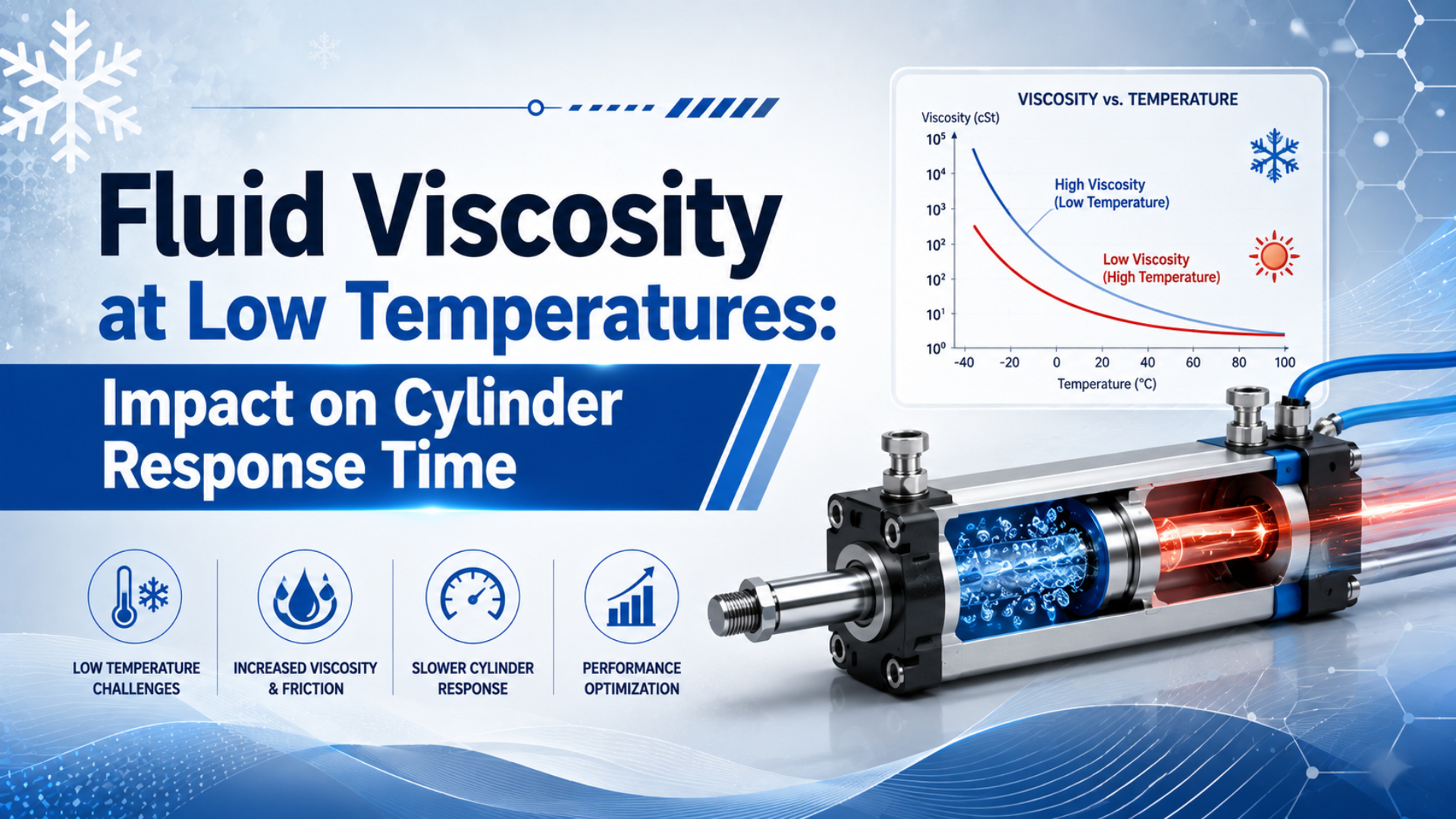
Fluid viscosity at low temperatures is not one property with one direction of change. Colder air has lower dynamic viscosity, while cylinder grease can become more resistant to motion. Low temperature also reduces elastomer flexibility, allows moisture to freeze, and raises the static force that pressure must overcome before the piston moves.
That distinction changes the troubleshooting path. Replacing a valve or increasing pressure because “cold air is thicker” can hide the symptom without correcting the seal, lubricant, water, or flow-path problem. A useful test separates valve shifting, pressure buildup, first motion, travel, and end-position confirmation instead of reporting one unexplained cycle time.
Publisher and author information is available on About Us. Send technical corrections or application questions through Contact.
Key Takeaways
- NASA’s Sutherland equation gives about 10.9% lower air dynamic viscosity at -20°C than at +20°C.
- Cold grease, seal stiffness, moisture, ice, valve mechanics, and load can still lengthen cylinder response.
- Compare synchronized command, pressure, and position traces at stabilized warm and cold conditions.
Does Air Become More Viscous as Temperature Falls?
No. Applying NASA’s Sutherland equation to air gives a dynamic-viscosity ratio of about 0.891 at -20°C relative to +20°C, a decrease of roughly 10.9%. The equation predicts higher gas dynamic viscosity as absolute temperature rises, so cold-cylinder delay cannot be attributed to an increase in air dynamic viscosity alone (NASA).
Sutherland’s relationship can be written as:
is dynamic viscosity at absolute temperature . is the reference viscosity at absolute temperature , and is the Sutherland constant expressed in the same temperature units. This ideal-gas correlation describes molecular viscosity. It does not model grease, seal friction, condensation, valve clearances, or cylinder breakaway.
The source of confusion is the word “viscosity.” Dynamic viscosity is a fluid’s resistance to shear and is represented by . Kinematic viscosity also includes density . Lubricating grease has its own temperature-dependent rheology. These properties are not interchangeable, and none by itself predicts a pneumatic actuator’s command-to-motion delay.
From our analysis of the NASA correlation and published manufacturer limits, the apparent paradox is diagnostically useful: if the cylinder slows while air dynamic viscosity falls, another temperature-sensitive mechanism must dominate. That points the investigation toward lubrication, seal recovery, water, mechanical binding, valve behavior, or the available pressure-flow path instead of a generic “thicker air” explanation.
What Actually Slows a Pneumatic Cylinder in Cold Conditions?
Festo identifies standard cylinder variants for temperatures down to -20°C and dedicated T1/T3 versions down to -40°C. Its low-temperature configuration uses a special PUR seal and low-temperature grease, directly showing that seal elasticity and lubrication, rather than rising air viscosity, control much of the cold operating limit (Festo).
Several effects can occur together:
| Cold-sensitive mechanism | What changes | Likely response signature |
|---|---|---|
| Lubricant rheology | Grease thickens and sliding resistance rises | Longer delay before first motion, then sudden breakaway |
| Seal elasticity | Dynamic lips recover more slowly and may seal or slide differently | Higher breakaway pressure, leakage, stick-slip, direction-dependent delay |
| Moisture and ice | Water condenses or freezes at restrictions, exhausts, rods, or seals | Intermittent restriction, blocked exhaust, surface damage, unstable timing |
| Valve mechanics | Spool, poppet, pilot seals, grease, and clearances react to temperature | Command-to-port-pressure delay increases |
| Supply and exhaust path | Density, pressure ratio, tube volume, fittings, silencers, and icing affect mass flow | Port pressure rises or decays more slowly |
| Load and alignment | Cold contraction or guide misalignment raises mechanical resistance | One direction worsens, pressure rises without proportional motion |
Parker’s O-Ring Handbook explains that cooled elastomers lose elasticity and can become hard and glass-like at sufficiently low temperature. It also treats TR10 testing as evidence for functional low-temperature behavior, while warning that material-family guidance cannot replace application-specific seal design (Parker, pp. 85-86).
For a deeper material review, use the separate guide to cylinder seal temperature and compound selection. This article stays focused on response timing and fault isolation.
Define Cylinder Response Time Before You Measure It
ISO 12238:2023 specifies shifting-time tests for electrically or pneumatically operated directional valves with two or three positions. Its measurement boundary is the valve, not the complete actuator. A cold-cylinder test therefore needs named start and finish events before warm and cold results can be compared (ISO 12238:2023).
For a command-to-end-position measurement, the total timing budget can be represented as:
covers controller output, wiring, and coil-current buildup. ends when the flow path shifts. covers pressure development at the actuator, while ends at first piston motion. and cover the moving stroke and final deceleration. Some events overlap, so use the expression as a diagnostic budget, not a universal summation standard.
The article on cylinder response time and dead volume explains the controlled-volume side in more detail. For the valve-only boundary, see the guide to pneumatic solenoid-valve response-time measurement.
How Should You Separate a Cold-Start Delay?
SMC’s cold-resistant CQ2 example is rated for -40°C to 70°C and a piston-speed range of 50 to 500 mm/s, while using low-temperature NBR and cold-resistant grease. Those limits belong to that configuration, but they demonstrate that temperature, material, lubrication, and speed must be evaluated together (SMC).
Start with the interval that changes most between the stabilized reference and cold tests:
- Command-to-valve shift grows: check controller voltage, coil current, connector condition, pilot pressure, exhaust, and the valve’s approved temperature range.
- Valve shift is stable but port pressure responds slowly: inspect tube ID and length, fittings, silencers, speed controls, frozen moisture, valve flow capacity, and dynamic supply pressure.
- Pressure rises normally but the piston waits, then jumps: suspect cold grease, seal friction, guide binding, side load, or a changing external load.
- First motion is normal but travel takes longer: compare dynamic chamber pressures, exhaust restriction, payload, meter-out setting, and cushioning.
- Motion is normal but the end signal is late: inspect sensor temperature rating, switching position, mounting, cable, controller filtering, and final cushion travel.
The breakaway force balance helps interpret the third pattern:
and are the measured absolute or gauge chamber pressures used consistently with their reference, and are effective piston areas, and includes gravity and process resistance in the chosen direction. Breakaway delay is the interval during which pressure changes but static resistance still prevents piston motion. Do not infer from one gauge when the opposite chamber is unmeasured.
Normalize each timing interval to its warm baseline instead of comparing only total cycle time. If command-to-pressure remains unchanged while pressure-to-motion doubles, the evidence points away from air-path viscosity and toward breakaway resistance. If pressure buildup doubles first, investigate the valve-to-cylinder flow path before replacing seals.
How Do You Run a Temperature-Controlled Response Test?
SMC requires dry air for its -40°C cold-resistant cylinder example so moisture does not freeze, while ISO 8573-1 classifies compressed-air contamination by particles, water, and oil. A valid cold-response test must therefore record air quality and actual component temperature, not ambient temperature alone (SMC; ISO 8573-1).
Use this measurement sequence:
- Define the timing boundary. State whether the result is command-to-first-motion, command-to-end-sensor, or another named interval.
- Identify the approved temperature envelope. Record the exact cylinder, seal option, lubricant, valve, sensors, tubing, fittings, silencers, and accessories.
- Instrument the event. Capture the controller command, coil current where relevant, pressure at both cylinder ports, and piston position on one time base.
- Measure component temperature. Record the valve body, cylinder barrel, end caps, gland or rodless seal region, and local air. For placement guidance, use the high-cycle cylinder thermal-analysis guide.
- Stabilize by evidence. Wait until the selected component temperatures and repeated timing traces stop drifting within the test acceptance band. A universal soak time is not defensible.
- Run enough cycles for repeatability. Report individual results or distribution, not only one best cycle or an unexplained average.
- Change one factor at a time. Warm the valve, dry the air, reduce load, or substitute an approved lubricant only under a controlled and safe test plan.
Compare cold-start and warmed-running behavior. A cylinder may be slow only on the first stroke because grease shear and seal motion change after cycling. That is different from a delay that grows as ice accumulates or as exhaust restriction increases. Record the direction of travel too; single-rod effective areas and gravity can make extension and retraction respond differently.
Corrective Actions in Engineering Order
Parker describes low-temperature P1F cylinder seals as validated for continuous operation down to -40°C and pairs them with specifically formulated grease. This model-specific construction supports a disciplined correction order: first select qualified hardware, then control water and installation conditions, and only then tune timing or pressure (Parker).
- Stay inside the complete assembly rating. Check cylinder, valve, seals, grease, switches, cable, fittings, tube, silencers, shock absorbers, and mounting hardware. A low-temperature seal kit does not upgrade every accessory.
- Use the specified seal and lubricant combination. Do not substitute grease by generic viscosity grade or polymer family. Compatibility, base oil, thickener, seal compound, speed, and manufacturer approval matter.
- Control water at the coldest point. Verify pressure dew point and liquid-water control against the component and process requirements. The guide to pressure dew point in pneumatic systems covers this boundary.
- Protect exhaust and moving surfaces. Prevent ice, washdown residue, frozen product, or crystals from blocking silencers or damaging the rod, wiper, and seals.
- Reduce unnecessary controlled volume and restriction. Place the correctly sized valve where the application allows, use adequate tube ID, and inspect fittings, speed controls, and silencers.
- Correct alignment and load. Thermal contraction can expose marginal guidance or side loading. A pressure increase is not a substitute for mechanical correction.
- Use heating only as an engineered subsystem. Apply approved enclosures, trace heating, or conditioned air with temperature control, over-temperature protection, condensation review, and safe maintenance access.
- Adjust controller timing last. A longer timeout can prevent nuisance faults, but it does not remove freezing, seal damage, inadequate flow, or an out-of-range component.
For valve selection below freezing, consult the dedicated guide to low-temperature pneumatic valves. Product-specific temperature limits and pilot requirements remain decisive.
Why Must Air Dryness Be Checked Before Pressure?
ISO 8573-1 defines compressed-air purity classes for three primary contaminant groups: particles, water, and oil. In a cold system, the water category deserves early attention because added pressure does not remove liquid water or ice, and a higher pressure ratio can create a larger temperature drop during expansion (ISO 8573-1).
Increasing regulator pressure may shorten one delayed stroke by building force faster, but it can also increase impact energy, air consumption, seal loading, and risk at a blocked or frozen restriction. It may move the symptom from “late motion” to “sudden motion.” Confirm that the machine, actuator, valve, tubing, tooling, and guards are rated for any pressure change.
Check these conditions before changing the setpoint:
- dynamic pressure at both cylinder ports during the failed event;
- pressure dew point relative to the coldest exposed surface;
- liquid water, frost, or ice at filters, low points, exhausts, rods, and silencers;
- breakaway pressure compared with warm operation;
- valve and cylinder temperature ratings;
- load, alignment, guide friction, and cushion behavior.
If water is present, correct separation, drainage, drying, routing, or thermal protection according to the plant and component requirements. Do not heat one short section without reviewing whether water will condense or freeze farther downstream.
Low-Temperature Cylinder FAQs
SMC’s cold-resistant CQ2 example combines a -40°C to 70°C ambient range with dedicated low-temperature NBR, cold-resistant grease, dry-air instructions, and a 50 to 500 mm/s piston-speed range. This combination shows why low-temperature response cannot be assigned to one fluid property or one universal threshold (SMC).
Does cold air have higher dynamic viscosity than warm air?
No. For air in the ordinary pneumatic temperature range, Sutherland’s equation predicts lower dynamic viscosity at lower absolute temperature. The formula gives about 10.9% lower dynamic viscosity at -20°C than at +20°C. A cold cylinder can still slow because grease, seals, water, valve mechanics, load, and mass-flow conditions change.
Why does a cold cylinder wait and then jump forward?
Chamber pressure can keep rising while thickened lubricant, seal friction, load, or binding holds the piston. Once available pneumatic force exceeds breakaway resistance, stored pressure accelerates the mass. Measure both chamber pressures and piston position together; do not diagnose the event from a regulator gauge or end sensor alone.
Is a standard cylinder safe to use at -20°C?
Only when the exact cylinder configuration and every accessory are rated for that service. Festo says almost all of its referenced variants are suitable down to -20°C, but that statement applies to its identified product range. Verify the current supplier data for seals, grease, switches, tubing, fittings, moisture, speed, and load.
How dry must compressed air be for sub-zero operation?
Use the pressure-dew-point and contamination requirement published for the selected components and process. SMC’s cold-resistant example explicitly requires dry air to prevent moisture freezing, while ISO 8573-1 supplies the classification framework. Ambient relative humidity alone does not establish dryness at the coldest pressurized or expanding point in the circuit.
Will a larger valve always restore cold cylinder response time?
No. A larger valve can help when verified mass-flow capacity is the limiting interval, but it cannot correct cold seal friction, unsuitable grease, ice, mechanical binding, an overloaded axis, or a delayed sensor. Compare valve-shift, port-pressure, first-motion, and travel intervals before changing hardware, then verify low-temperature and flow ratings for the selected valve.
Sources and technical references
- NASA, Viscosity, Sutherland equation for air dynamic viscosity. Retrieved 2026-07-22.
- ISO 12238:2023, directional-control-valve shifting-time measurement boundary. Retrieved 2026-07-22.
- ISO 8573-1:2010, compressed-air purity classes for particles, water, and oil. Retrieved 2026-07-22.
- Festo, Pneumatic Cylinders and Extreme Temperatures, low-temperature seals, grease, ice, and named cylinder variants. Retrieved 2026-07-22.
- SMC, CQ2 Cold-Resistant Cylinder Specification, -40°C to 70°C range, low-temperature NBR, grease, dry-air warning, and piston-speed range. Retrieved 2026-07-22.
- Parker, O-Ring Handbook, low-temperature elasticity and TR10 context. Retrieved 2026-07-22.
- Parker, Pneumatic Actuator Products, P1F low-temperature seals and grease. Retrieved 2026-07-22.