

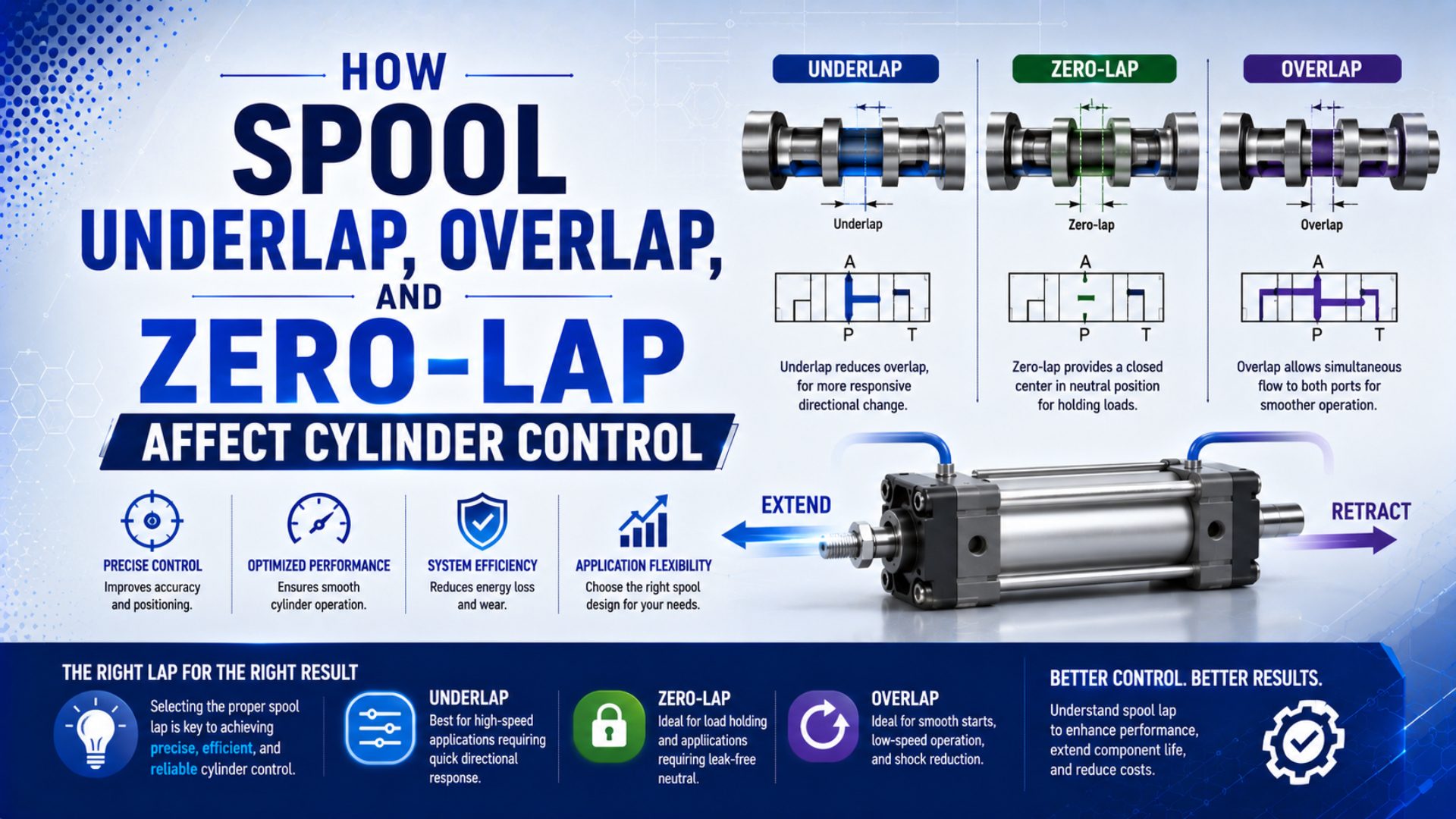
Spool underlap, overlap, and zero-lap describe how a valve’s metering edges line up near the neutral spool position. Underlap leaves an initial opening, positive overlap requires travel before an edge opens, and zero-lap places the ideal opening threshold at neutral. Those geometries influence leakage and small-signal flow, but they do not determine cylinder behavior by themselves.
Engineers must also assess the valve’s port map, spool drive, feedback, flow capacity, pressure conditions, tubing, cylinder friction, load, and controller. This distinction matters most around neutral, where a lap-related diagnosis can otherwise hide proportional-valve deadband or a fault elsewhere in the pneumatic axis.
Key Takeaways
- Three lap conditions describe edge geometry, not complete valve functions.
- Underlap adds neutral-region opening, while positive overlap requires spool travel before the selected edge uncovers.
- Zero-lap cannot make pneumatic switching instantaneous.
- A nominally closed center can still leak through the valve, cylinder, or connections; hazardous loads need a separately validated holding function.
What Does Spool Lap Actually Describe?
Moog identifies three control-edge conditions: positive overlap, null cut or zero overlap, and underlap or negative overlap. Its guide defines overlap by the spool travel required before a control edge opens, which is more useful than treating the whole land and port as one simple width comparison (Moog, Electro-Hydraulic Valves: A Technical Look, accessed 2026).
Spool lap is the signed geometric relationship between a named spool control edge and its corresponding port edge at a defined neutral position. This relationship identifies whether that path is initially open, aligned, or covered. State the sign convention and reference stroke because catalogs do not always report lap in the same units. Directional spools contain several lands, grooves, and metering edges. Each relevant edge controls a particular path, such as supply to work port or work port to exhaust. Every lap value therefore belongs to a named edge pair and a defined neutral datum. Individual valves can use different effective cuts at separate edges or an intentionally asymmetric characteristic.
Use this sign convention when discussing one metering edge:
- Positive lap or overlap: the edge remains covered at neutral, so spool movement is required before that path opens.
- Zero-lap or null cut: the port and control edges ideally meet at the neutral datum. The geometric model has neither an intended initial opening nor a covered-travel interval, although real clearance and tolerance remain.
- Negative lap or underlap: the control edge has passed the port edge before the spool reaches its neutral datum. A finite opening already exists, which changes the neutral flow curve and can raise small-signal gain for that path.
Lap cannot identify the connected ports. That requires the valve’s circuit symbol, neutral port map, and manufacturer flow data.
Spool Lap and Valve Center Function Are Separate Specifications
Festo’s 2025 MPYE data sheet lists a 5/3 closed mid-position, a position-controlled spool, five nominal sizes, and separate analogue command options. These are distinct fields because the valve symbol defines neutral port connections while the metering geometry and electronics define how the valve moves into and away from that condition (Festo MPYE, 2025).
Center condition answers a circuit question: what nominal connections exist when the commanded valve is centered? Depending on its design, a 5/3 valve may block work ports, connect them to exhaust, connect them to supply, or use another defined arrangement. Spool lap answers a local transition question: how far does a particular edge move before it begins to open?
This prevents three common specification errors:
- Underlap does not automatically mean an open-center valve. The full spool cut determines the connected ports.
- Positive overlap does not prove leak-tight blocking. The covered metering edge is only one boundary; radial clearance, seals, pilot paths, contamination, wear, fittings, and the cylinder still contribute to leakage.
- Zero-lap does not create a line-to-line electrical switch. It describes an ideal mechanical threshold at selected edges. Solenoid current rise, spool inertia, electronics, air volume, pressure development, breakaway friction, load, and feedback still determine when the cylinder moves.
For a closer look at nominal port connections, compare the three-position valve center conditions. For actual intermediate stopping, the 5-way, 3-position cylinder holding guide explains why a closed center cannot guarantee zero drift.
Treat lap and center condition as two axes in the valve specification. A circuit symbol without a neutral flow curve is incomplete for fine control, while a lap label without a port map is incomplete for circuit behavior. Request both.
How Does Underlap Change Cylinder Response Near Neutral?
Moog’s fluid-power guide states that an underlapped control edge is not fully closed at neutral, while its application note describes underlap as a way to change null-region flow and pressure gain. Those principles explain the geometry, but hydraulic percentages or damping claims should not be transferred directly to compressed-air cylinders (Moog null-cutting note, 2004).
At a named metering edge, underlap creates usable opening before the spool crosses the nominal center. This raises small-signal flow gain and removes an intentional covered-travel interval at that edge. In a proportional pneumatic axis, the controller can therefore influence chamber mass flow with smaller spool movements around neutral. That does not guarantee smooth cylinder motion. Airflow through the valve still depends on upstream and downstream absolute pressure, the effective opening area, temperature, and whether the restriction is choked. Cylinder acceleration then depends on chamber pressure, piston area, load, friction, air volume, and exhaust conductance.
Underlap can also increase neutral-region consumption or cross-port flow when the complete spool cut provides a path. The correct acceptance metric is measured neutral flow at stated supply and downstream pressures, not the word “underlap.” If the valve has multiple metering edges, ask whether the quoted cut applies symmetrically to supply and exhaust edges.
For closed-loop positioning, underlap may reduce a geometric dead zone while increasing the controller’s sensitivity to small command errors, bias, or noise. It can be useful, but only when the valve’s neutral flow curve matches the loop design. The pneumatic servo positioning limits remain a system-level question.
What Does Positive Overlap Improve, and What Does It Sacrifice?
Moog documents positive-overlap examples from 3% to 20% of nominal stroke in hydraulic servo and proportional valves. Moog links greater overlap with lower mid-position leakage but also with more travel before actuator response. Those figures illustrate a trade-off, not a pneumatic selection range, because medium, pressure, spool design, and test definitions differ (Moog technical guide, accessed 2026).
Positive overlap intentionally covers the selected edge at neutral. Before flow begins, the command must move the spool across that covered region. This creates a geometric neutral dead zone in command-to-opening behavior unless spool electronics compensate for it. Practical advantages can include lower neutral flow through the relevant edges and a less sensitive neutral region. Costs can include delayed onset of metering, a steeper change in effective opening after the edge uncovers, and a nonlinearity that the outer position or velocity controller must cross in both directions.
Do not convert overlap distance into a fixed time delay. Time depends on how quickly the spool reaches the opening threshold. Solenoid force, spring force, pressure forces, current control, feedback, filtering, temperature, contamination, and command slew all matter. The same geometric overlap can produce different command-to-flow behavior in two valve families.
Overlap cannot lock a cylinder. Even with a nominally closed center, air may migrate through valve clearances, cylinder seals, tubing connections, or accessories. A vertical or hazardous load needs an application-specific holding and safety strategy, not a larger lap assumption.
Why Zero-Lap Is Not Instantaneous Cylinder Control
Moog defines zero overlap as aligned control edges with no intended null-region dead band in its valve context. Festo, however, specifies 0.4% maximum spool-travel hysteresis and model-dependent 70 to 115 Hz limit frequency for one pneumatic MPYE family. Geometry, hysteresis, and dynamic response remain separate specifications (Moog, 2004; Festo, 2025).
Ideally, a zero-lap edge begins opening as soon as the spool leaves neutral. Real hardware still has manufacturing tolerance, radial clearance, friction, magnetic effects, sensor resolution, calibration error, wear, contamination, and thermal change. “Zero-lap” should therefore be read as a nominal cut, not proof of zero measured dead zone or zero leakage. Nor does immediate geometric opening mean immediate cylinder movement. First the electrical command becomes current. Then the spool accelerates, airflow changes, chamber pressure develops, net force exceeds breakaway friction and load, and the mass begins moving. Each step has its own delay and bandwidth.
Spool feedback closes only the inner loop. That inner sensor does not measure cylinder position unless an outer loop and displacement sensor are also present. The spool position feedback guide separates those two feedback boundaries.
Zero-lap isn’t automatically the best choice. Designers often select it when they need high small-signal responsiveness around neutral and can manage leakage, tolerance, and control-loop sensitivity. Switching applications, slow clamps, and servo axes have different acceptance criteria.
How Do Lap Choices Affect the Complete Cylinder Axis?
Festo’s MPYE family covers 100 to 2,000 L/min nominal flow and 70 to 115 Hz limit frequency across its listed sizes. That spread shows why lap cannot predict cylinder speed or settling on its own. Valve capacity, dynamic response, pressure ratio, chamber volume, load, and feedback must be evaluated together (Festo MPYE, 2025).
| Selection question | Underlap tendency | Zero-lap tendency | Positive-overlap tendency | What must be verified |
|---|---|---|---|---|
| Opening near neutral | Finite initial opening at the named edge | Opening begins at the nominal datum | Travel required before opening | Measured command-to-flow curve |
| Neutral-region flow | Can be higher | Depends on clearance and cut accuracy | Can be lower at the controlled edge | Leakage or neutral flow at stated pressures |
| Small-command sensitivity | Higher | High near the ideal datum | Lower inside the covered region | Gain, resolution, noise, and stability |
| Geometric dead zone | No covered interval at that edge | Ideally minimized | Intentional covered interval | Thresholds in both directions |
| Cylinder holding | Not established by lap | Not established by lap | Not established by lap | Complete leakage path and holding device |
| Dynamic cylinder response | System-dependent | System-dependent | System-dependent | Loaded step and reversal tests |
Two valves with the same nominal lap can behave differently if one is oversized. Oversized hardware can deliver a large flow change immediately after a control edge opens, making low-speed control harder even if its geometric dead zone is small. Valve sizing and lap must therefore be reviewed together, but they answer different questions. Cylinder mechanics can dominate too. Seal breakaway friction may hide a small airflow change until chamber pressure rises enough to move the load. Long tubing can delay pressure response. Changing external loads can shift the command required for the same velocity. If the machine hunts near neutral, inspect the full control chain before changing spool cut or PID tuning.
A Commissioning Test for Lap-Related Behavior
Festo’s safety guidance warns that a pneumatically stopped cylinder can move after stopping because individual components leak. The same guidance treats mechanical clamping as a separate channel in servopneumatic safety architecture. Neutral testing must therefore characterize control behavior without presenting trapped air or spool overlap as a safety-rated holding method (Festo safety guidance, accessed 2026).
Test from the valve outward:
- Confirm the valve. Record its complete model code and spool option.
- Stabilize the conditions. Warm the valve, fix supply pressure, document downstream pressure, use the specified air quality, and record temperature.
- Measure neutral flow safely. With suitable downstream plumbing, test each relevant supply-to-work, work-to-exhaust, and cross-port path. State both port pressures, instrument range, detection limit, medium, and flow direction.
- Map opening thresholds. Ramp both ways while recording command, coil current, spool feedback when available, and port flow or pressure.
- Run small steps and reversals. Separate a displacement dead zone from electrical delay, spool travel time, hysteresis, noise, controller filtering, and the instrument’s own threshold.
- Connect the cylinder. Record both chamber pressures, cylinder position, velocity, payload, orientation, guides, external forces, supply pressure at the valve, and exhaust condition on one time base.
- Repeat the operating envelope. Include minimum permitted supply pressure, maximum load, thermal equilibrium, realistic cycle rate, start-up, relevant mounting orientation, simultaneous air consumers, and the expected air-quality controls. Recheck any condition that changes the neutral curve.
- Validate holding separately. Prove the function required by the risk assessment.
In our experience, the fastest fault separation comes from plotting command, spool position, both chamber pressures, and cylinder position together. If the spool crosses neutral but flow does not change, inspect the metering boundary. If flow changes but the piston stays still, breakaway friction, load, or trapped volume has become the dominant limit.
Ask for curves, not adjectives.
The RFQ should specify neutral leakage or flow, overlap or underlap definition, tolerances, command-to-spool and command-to-flow plots, hysteresis, threshold, repeatability, frequency response, fail position, air-quality requirement, and the exact conditions behind each value.
Name the boundary first.
A useful acceptance criterion specifies command-to-spool, command-to-flow, or command-to-cylinder response. “Zero-lap precision” names none of them. Requiring the input, output, direction, pressure, load, and detection threshold turns a marketing label into a testable specification.
Spool Lap FAQs: What Should Engineers Verify?
Three lap labels describe metering-edge geometry, while a complete pneumatic axis contains at least five response layers from electrical command to load holding. These five answers keep procurement and troubleshooting focused on measurable boundaries instead of assuming that one lap term predicts leakage, positioning accuracy, response time, or safety performance (Festo MPYE, 2025).
Can the valve symbol tell me whether a spool is underlapped or overlapped?
Usually not. The symbol identifies nominal port connections and switching positions, not the dimensional cut or neutral flow curve of each metering edge. Check the model-specific data sheet or ask the manufacturer for lap, neutral leakage, threshold, and command-to-flow information under stated pressure conditions.
Does positive overlap stop a cylinder from drifting?
No. Positive overlap can reduce flow through selected neutral edges, but radial clearance, valve seals, pilot paths, cylinder seals, fittings, and trapped-air compliance still affect drift. Festo notes that pneumatically stopped cylinders can move as components leak. Hazardous loads need a separately validated holding and safety method.
Is zero-lap always best for servo-pneumatic positioning?
No. Zero-lap can minimize intentional geometric dead zone, but the useful choice depends on flow gain, leakage, valve sizing, feedback, load, friction, pressure ratio, controller bandwidth, and stability. Compare measured curves and loaded axis tests. Do not transfer hydraulic spool-cut percentages directly into a pneumatic specification.
Can spool lap be adjusted in the field?
Usually not on a standard production valve. Lap is established by the spool, sleeve or body geometry, assembly datum, and factory calibration. Some specialized valves or electronics provide null or gain adjustments, but those controls do not physically recut every metering edge. Follow the exact manufacturer’s adjustment and validation procedure.
What data should an RFQ request for spool lap?
Request the complete model code, center function, edge-specific lap definition, tolerance, neutral leakage or flow, bidirectional opening thresholds, hysteresis, repeatability, command and feedback ranges, frequency response, pressure and air-quality conditions, and fail position. Add a loaded cylinder acceptance test when machine motion is the final controlled output.
Sources and Technical References
These five manufacturer references separate spool-edge geometry, pneumatic valve function, complete-axis dynamics, and holding safety. Moog’s documents concern electro-hydraulic valves, so this article uses them only for general spool-metering principles and does not transfer their pressure levels, leakage rates, or percentage recommendations to pneumatic hardware.
- Moog, Electro-Hydraulic Valves: A Technical Look. Retrieved 2026-07-22.
- Moog, Customized Null Cutting and Optimized Performance, 2004. Retrieved 2026-07-22.
- Festo, Proportional Directional Control Valve MPYE, 2025/03. Retrieved 2026-07-22.
- Festo, Safety Engineering Guidelines: Stopping with Non-Return Valves. Retrieved 2026-07-22.
- Festo, Safety Function for Servopneumatics. Retrieved 2026-07-22.