

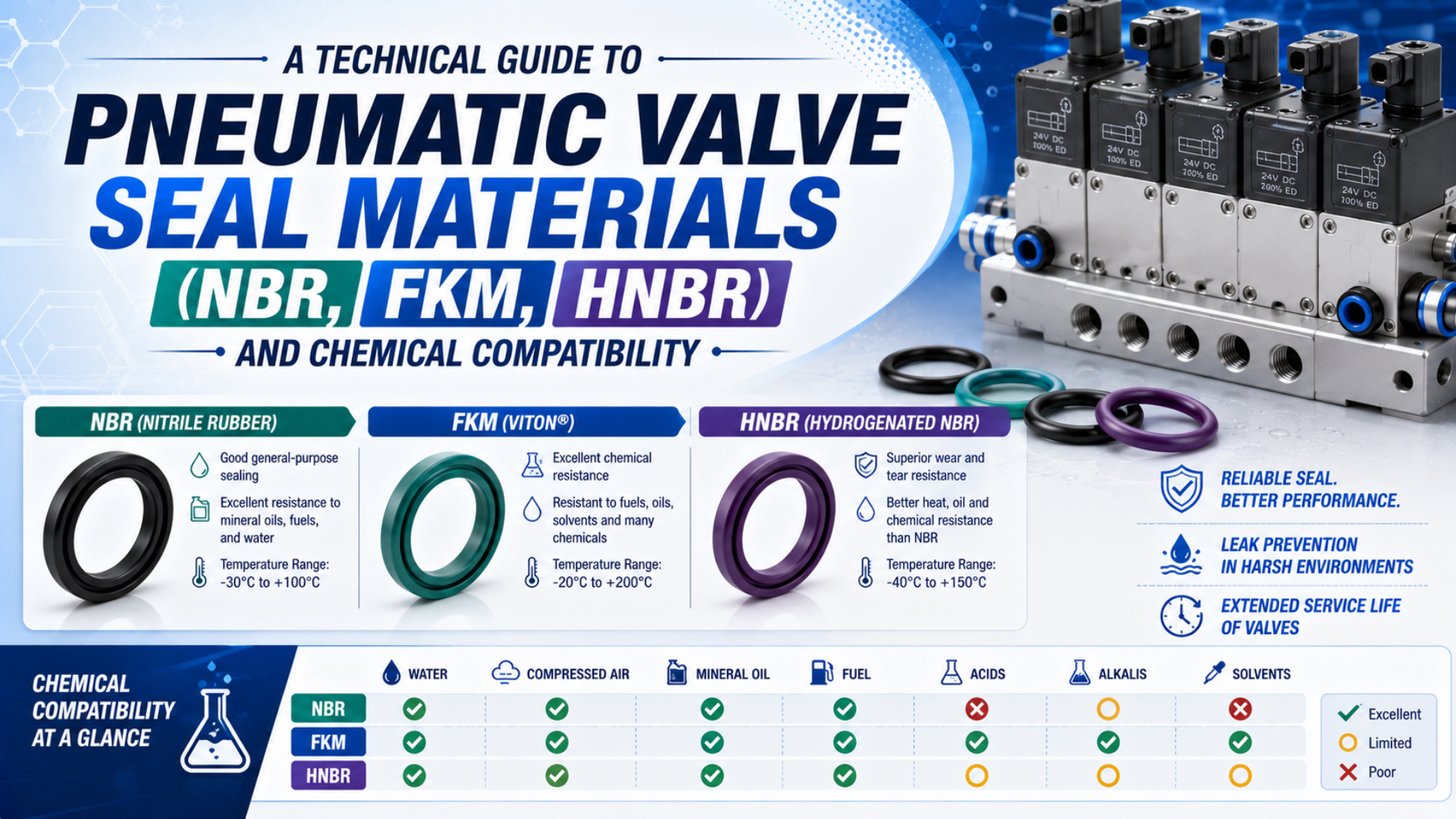
Choose a pneumatic valve seal by approving an exact compound for an exact valve position and exposure, not by declaring NBR, HNBR, or FKM universally best. The decision must include the service medium, concentration, temperature, contact time, pressure, motion, lubricant, and required evidence. A polymer-family name is only the start of that record.
This distinction prevents two common mistakes. One material can survive the main fluid yet fail after contact with secondary substances such as assembly grease plus compressor oil carryover, condensate and washdown chemicals. The same valve may use dynamic spool seals together with pilot seals and static body O-rings that do not share the same duty.
Pneumatic valve seal material means the specified polymer compound and seal form used at a defined location in a valve; compound means the supplier-controlled formulation, including the base polymer, cure system, fillers, plasticizers, processing aids, colorants, and hardness.
Key Takeaways
- NBR, HNBR, and FKM identify material families, not approved compounds.
- Record 8 operating inputs before consulting a compatibility chart.
- Temperature tables are screening data, not valve ratings.
- Validate the exact seal, lubricant, hardware, and duty before release.
What Do NBR, HNBR, and FKM Actually Specify?
ISO 1629:2025 is the fifth edition of the international nomenclature standard for rubber abbreviations. It defines symbols from polymer-chain chemistry, making NBR, HNBR, and FKM useful family names without defining one hardness, cure system, additive package, color, or finished-valve performance for each family (ISO 1629:2025, retrieved July 22, 2026).
NBR is nitrile butadiene rubber. Its acrylonitrile content affects oil resistance and low-temperature flexibility, while the cure system and additives change aging, compression set, friction, and extraction behavior. Two black NBR seals can therefore behave differently in the same valve.
HNBR is hydrogenated nitrile butadiene rubber. Hydrogenation reduces unsaturation in the NBR backbone, which generally improves heat, ozone, and aging resistance. That change does not make every HNBR compound compatible with every solvent, cleaner, lubricant, or steam cycle.
FKM identifies a fluoroelastomer family. Viton™ is a Chemours trademark for several FKM product families, not a generic name for every FKM compound. Chemours separates A, B, F, ETP, and low-temperature variants because their fluid resistance, cure systems, compression set, and cold flexibility differ (Chemours Viton Selection Guide, retrieved July 22, 2026).
Color cannot prove chemistry.
Suppliers may color a compound for identification, but no universal rule makes black NBR, green HNBR, or brown FKM; put the manufacturer, compound code, hardness, seal profile, and batch traceability on the approval record.
Polymer-family identity answers one question: which chemistry formed the starting point? A purchasing specification must answer three more: which compound was molded, which seal geometry was supplied, and where in the valve will it operate?
Valve Seal Positions Create Different Loads
SMC’s VXA21/22 catalog offers NBR, FKM, and EPDM choices across air, water, oil, and vacuum configurations. It also specifies grease for sliding and vacuum-service parts, showing why approval must follow the exact valve option (SMC VXA21/22, retrieved July 22, 2026).
A material-family name alone cannot approve the whole valve.
Dynamic spool seals slide repeatedly and must retain acceptable friction, wear, and leakage throughout the switching cycle. A poppet or diaphragm flexes or seats instead, while static body O-rings mainly depend on squeeze, compression set, media exposure, and joint geometry; pilot seals may see a different pressure, lubricant, and air supply from the main flow path.
| Valve seal position | Primary duty | Questions that control material approval |
|---|---|---|
| Dynamic spool seal | Separate ports while sliding | Friction, wear, grease retention, particles, switching frequency, leakage |
| Poppet or seat seal | Close against a seat | Contact stress, rebound, indentation, particles, pressure differential |
| Pilot piston or armature seal | Operate the pilot stage | Pilot pressure, exhaust path, temperature, lubricant, response time |
| Static body O-ring | Seal a fixed joint | Squeeze, groove fill, compression set, medium, assembly damage |
| External enclosure seal | Exclude washdown and dust | Cleaner, temperature, spray pressure, enclosure design, aging |
An air valve can still face several chemicals. Compressor lubricant, pipe-cleaning residue, thread sealant, factory grease, condensed water, and airborne process vapor may reach internal seals. External manifold seals may see alkaline foam, acid rinse, disinfectant, or hot wash water. Trace the exposure route before choosing the material.
Valve approval must cover the whole system.
Changing one seal material can move the failure elsewhere. A chemically resistant spool seal does not protect an incompatible pilot seal or grease, and the plastic retainer, coil encapsulation and body coating remain separate checks; approve the wetted and exposed bill of materials, not an isolated O-ring.
For dry-air service, the related guide on unlubricated air and spool valve seals explains why a non-lube valve may still depend on factory-applied grease. If slow shifting is the symptom, separate material friction from the internal pilot-pressure problem.
How Do NBR, HNBR, and FKM Compare in Valve Service?
Trelleborg’s March 2026 static-seal guide lists normal screening ranges of -30°C to +100°C for NBR, -30°C to +140°C for HNBR, and -20°C to +200°C for FKM. These are family-level screening values, not pneumatic-valve ratings (Trelleborg Static Seals, 2026; retrieved July 22, 2026). Keep that boundary clear.
Temperature tables only build a shortlist.
Those figures describe material-family tendencies in a static-seal guide. They are not permission to operate a pneumatic valve at those temperatures. The valve manufacturer may set a narrower range because its grease and coil insulation work alongside plastic parts, mechanical clearances, pilot performance and dynamic friction.
| Material family | Why it enters a valve shortlist | Limits that require compound-level review |
|---|---|---|
| NBR | Mineral oils and greases, common industrial-air service, broad availability | Heat, ozone, weathering, polar solvents, cleaner exposure, cold flexibility |
| HNBR | Higher heat and aging resistance than many standard NBR compounds, good mechanical properties | Exact chemical, cold start, hardness, dynamic friction, cost and availability |
| FKM | Heat, oil, fuel, ozone and many hydrocarbon exposures | Amines, high-pH chemicals, some ketones and steam duties, low temperature, FKM type |
NBR is often the practical starting point for ordinary compressed air, but “ordinary” must be defined. A compressor-oil change, solvent vapor at the intake, or an added airline lubricator can change internal exposure. Confirm the exact valve’s approved air quality and lubricant rules. HNBR can extend a nitrile-based shortlist where heat, ozone, or aging is the concern. Do not assume it automatically covers every FKM application. Its chemical behavior still depends on acrylonitrile content and hydrogenation level as well as the cure system, fillers and actual service medium.
FKM earns consideration when heat or certain hydrocarbons challenge NBR. It is not a universal chemical upgrade. It can also have poorer low-temperature sealing than a suitable nitrile compound, and one FKM family may behave very differently from another in steam, caustics, amines, or oxygenated solvents.
The low-temperature pneumatic valve guide covers cold-start clearance, grease, coil, and moisture limits that a seal table cannot resolve. For high-cycle machines, combine the material review with the high-frequency valve selection method. The checks remain separate.
Why Can a Chemical Compatibility Chart Reject FKM?
Chemours compares nine Viton™ types in its fluid-resistance table. Conventional A, B, and F types are marked not recommended for amines and high-pH caustics, while ETP-S receives the strongest rating in that class. “FKM” is therefore too broad for final approval (Chemours, retrieved July 22, 2026).
A chart rating is the result of a defined material-medium pairing under stated assumptions. That rating may represent a base polymer family, a proprietary compound, a static O-ring, or an immersion specimen. The letter or number says little unless the chart also identifies concentration, temperature, duration, test method, and acceptance criteria. Parker’s O-Ring Handbook uses five outcomes: satisfactory, fair, doubtful, unsatisfactory, and insufficient data. It also notes that a fair rating is usually acceptable only for static service. That limitation matters for a spool seal that slides thousands or millions of times (Parker O-Ring Handbook, retrieved July 22, 2026).
Charts screen; tests approve.
Build the compatibility record from these eight inputs:
- Medium: exact chemical or commercial product and current safety data sheet.
- Concentration: normal, maximum, dilution method, mixture, and residue.
- Temperature: cold start, continuous, peak, cleaning, shutdown, and soak.
- Contact time: continuous, intermittent, splash, vapor, purge, and dwell.
- Pressure: normal, differential, trapped, vacuum, surge, and decompression.
- Motion: static, reciprocating, seating, switching frequency, and dormant time.
- Lubricant: factory grease, airline oil, compressor carryover, and assembly aid.
- Evidence: exact compound data, chart conditions, compliance documents, and tests.
Mixtures require special care. A chart row for pure cleaner A does not approve cleaner A mixed with product residue, compressor oil, corrosion inhibitor, or rinse chemical B. Temperature and evaporation can also raise concentration at the seal. If the process formulation changes, reopen the approval. Use chart disagreements as diagnostic information. Different ratings may reflect compound or cure differences. Hardness, temperature, exposure time and the measured property can also change the outcome. Do not average the ratings. Identify which test is closest to the real valve and ask the seal or valve manufacturer to close the remaining gap.
From our analysis of the SMC, Parker, Chemours, and Trelleborg documents, the recurring approval gap is not a missing material-family name. Missing identity at the compound, seal-position, exposure-condition, and complete-valve levels creates the real uncertainty. That distinction matters.
For external cleaning, review the manifold enclosure and connectors together with cable entries and drainage. An IP rating describes ingress protection under a defined enclosure test; it does not certify elastomer compatibility with a detergent. The IP65, IP67, and IP69K manifold guide keeps those two approvals separate. Keep them separate.
Compound-Level Testing for the Exact Valve
ASTM D471-16a(2021) covers six groups of post-immersion changes, including mass, volume, dimensions, extracted matter, tensile properties, elongation, and hardness. ASTM also warns that accelerated immersion may not correlate directly with finished-part performance because service conditions vary widely (ASTM D471, 2021; retrieved July 22, 2026).
ISO 1817:2024 likewise evaluates rubber resistance by measuring properties before and after immersion in service or reference liquids. Neither standard supplies one universal acceptable swell percentage for every valve. The responsible engineer must set acceptance limits for the actual seal geometry, groove, friction, leakage, and duty (ISO 1817:2024, retrieved July 22, 2026).
Use a staged validation plan:
- Document review: confirm the valve part number, seal position, compound code, hardness, cure system, lubricant, material certificate, and regulatory declarations.
- Material screening: expose traceable specimens to the actual fluid, concentration, temperature, duration, and sequence. Measure relevant dimensional and property changes against an unused control.
- Installed static test: place the real seal in representative hardware and measure leakage or sealing recovery after pressure, temperature, and dwell exposure.
- Dynamic valve test: cycle the complete valve at the required pressure, switching frequency, temperature, lubricant condition, and contamination level. Measure shifting, leakage, friction symptoms, and wear.
- Post-test examination: compare the tested seal with retained material for swelling, shrinkage, softening, hardening, cracks, extrusion, deposits, and surface damage.
Test conditions must follow the valve.
Define pass and fail criteria before testing. A specimen can change color without losing function, while a small dimensional change can raise spool friction enough to delay shifting. Measurements must connect the material change to the valve’s job. ASTM D1414-22 provides procedures for O-ring physical properties and aging changes. It can support quality control for O-rings, but it should not be described as a universal steam-resistance approval (ASTM D1414, 2022; retrieved July 22, 2026). When failure could affect safety or contamination control or stop production, test an assembled sample from the intended supplier and revision. Laboratory immersion ranks materials. It does not reproduce the combined effect of pilot passages and seal squeeze plus surface finish, grease distribution, debris, coil heating and manufacturing tolerances.
What Must the RFQ and Maintenance Record Contain?
SMC’s VXA21/22 selection table maps at least five service cases, including air, water, oil, vacuum, and other combinations, to specific seal and body options. An RFQ needs that same part-number precision (SMC VXA21/22, retrieved July 22, 2026).
Do not ask only for “FKM seals” or “chemical-resistant valves.”
Give the supplier enough information to review the complete boundary:
- valve manufacturer, series, full part number, revision, function, and port size;
- seal position, seal form, compound code, hardness, cure system, and color only as an identifier;
- main medium, pilot medium, concentration, mixture, contaminants, and safety data sheets;
- continuous and peak pressure, differential pressure, vacuum, temperature, and exposure time;
- switching frequency, annual cycles, dwell, leakage limit, response requirement, and failure state;
- factory grease, permitted airline lubrication, compressor lubricant, and cleaning chemicals;
- body, spool, seat, spring, retainer, diaphragm, coating, tubing, and fitting compatibility;
- required food-contact, potable-water, oxygen, medical, semiconductor, or customer-specific evidence;
- sample approval, test method, acceptance limits, change notification, and batch traceability.
Do not compare cost with a universal NBR-to-HNBR-to-FKM multiplier because price depends on compound, geometry, quantity, tooling, certification, valve option, and availability. First remove candidates that fail safety, compatibility, or functional gates. Then compare qualified options using valve price, validation cost, replacement labor, downtime exposure, inventory, and lead time.
Failure evidence should be preserved.
Maintenance evidence is part of material selection. Photograph the seal before cleaning, record its position, compare it with an unused sample, and preserve the lot number. Swelling, permanent set, one-sided wear, an installation cut and chemical softening point to different corrective actions.
Use precise inspection language. Blistering, embrittlement, glazing, nibbling, delamination, chalking, pitting, tackiness, tearing, flattening, abrasion, scoring, crazing, and lubricant starvation describe different evidence. Fretting, galling, scuffing, spalling, gouging, leaching, blooming, crystallization, whitening, and unusual odor can reveal damage outside the elastomer. Avoid the generic label “worn out.”
| Observed condition | Mechanisms to investigate | What not to assume |
|---|---|---|
| Swollen or sticky seal | Fluid absorption, additive extraction, incompatible grease | A harder material will solve the chemistry |
| Hard or cracked surface | Heat, oxidation, ozone, chemical attack, cold flexing | FKM is automatically the correct replacement |
| Flat permanent set | Heat, wrong squeeze, long dwell, compound aging | Leakage proves chemical incompatibility |
| One-sided wear | Misalignment, side force, surface damage, uneven pressure | The polymer family caused the wear |
| Slow or incomplete shift | Pilot pressure, exhaust, voltage, friction, debris, swelling | The seal material is the only cause |
| External washdown leak | Enclosure joint, fastener, cable entry, seal chemistry | A higher IP rating changes chemical resistance |
If chemical exposure extends beyond the valve, link this record to the broader actuator chemical-compatibility review. A compatible valve does not qualify the cylinder, tubing, fittings, sensors, or exhaust components automatically.
FAQs About Pneumatic Valve Seal Materials
21 CFR 177.2600 sets two extraction stages for repeated-use rubber articles in aqueous-food contact. The limits are 20 mg per square inch during the first 7 hours and 1 mg per square inch during the next 2 hours (eCFR, retrieved July 22, 2026).
The finished article and intended use matter, not only its polymer-family name.
Is Viton the same as FKM?
No. FKM is an industry material-family designation, while Viton™ is a Chemours trademark covering several fluoroelastomer product families and grades. A valve specification should state the supplier, compound code, hardness, cure system, and approved operating conditions. Writing “Viton” alone does not identify every property needed for approval.
Can FKM directly replace an NBR valve seal?
Not safely without checking the exact valve. FKM may change low-temperature behavior, friction, compression set, swell, hardness, and lubricant compatibility. Confirm that the manufacturer offers the FKM option for that part number, then verify the medium, grease, pressure, temperature, leakage, pilot function, and switching duty.
Can seal color identify NBR, HNBR, or FKM?
No universal color code identifies these families. Manufacturers may use black, green, brown, blue, or another color for internal compound control, and different families can share a color. Treat color as a visual clue only. Use packaging, part markings, certificates, compound codes, and batch records for identification.
Does an FDA-compliant HNBR compound make the whole valve food-safe?
No. Food-contact compliance depends on the finished rubber article, permitted ingredients, extraction limits, intended food, contact conditions, and the rest of the valve’s wetted materials. Request the exact compound declaration and finished-part evidence. Also verify lubricant, body, coating, cleaning cycle, hygienic design, and traceability.
What evidence should I request before approving a valve seal compound?
Request the valve part number, seal position, supplier compound code, hardness, cure system, temperature and media data, compatibility-chart conditions, lubricant approval, regulatory declarations, change-control policy, and batch traceability. For uncertain or critical service, add actual-fluid immersion results and complete-valve leakage and cycling tests with predefined acceptance limits.
Sources and technical references
- ISO 1629:2025, Rubber and latices - Nomenclature, published 2025; retrieved July 22, 2026.
- ISO 1817:2024, Determination of the effect of liquids, published 2024; retrieved July 22, 2026.
- ASTM D471-16a(2021), Rubber Property - Effect of Liquids, active 2021 version; retrieved July 22, 2026.
- ASTM D1414-22, Standard Test Methods for Rubber O-Rings, published 2022; retrieved July 22, 2026.
- Trelleborg Static Seals - O-Rings, March 2026 edition; retrieved July 22, 2026.
- Parker O-Ring Handbook, retrieved July 22, 2026.
- Chemours Viton™ Fluoroelastomer Selection Guide, retrieved July 22, 2026.
- SMC VXA21/22 Direct Air Operated 2-Port Valve Catalog, retrieved July 22, 2026.
- 21 CFR 177.2600, Rubber Articles Intended for Repeated Use, retrieved July 22, 2026.