

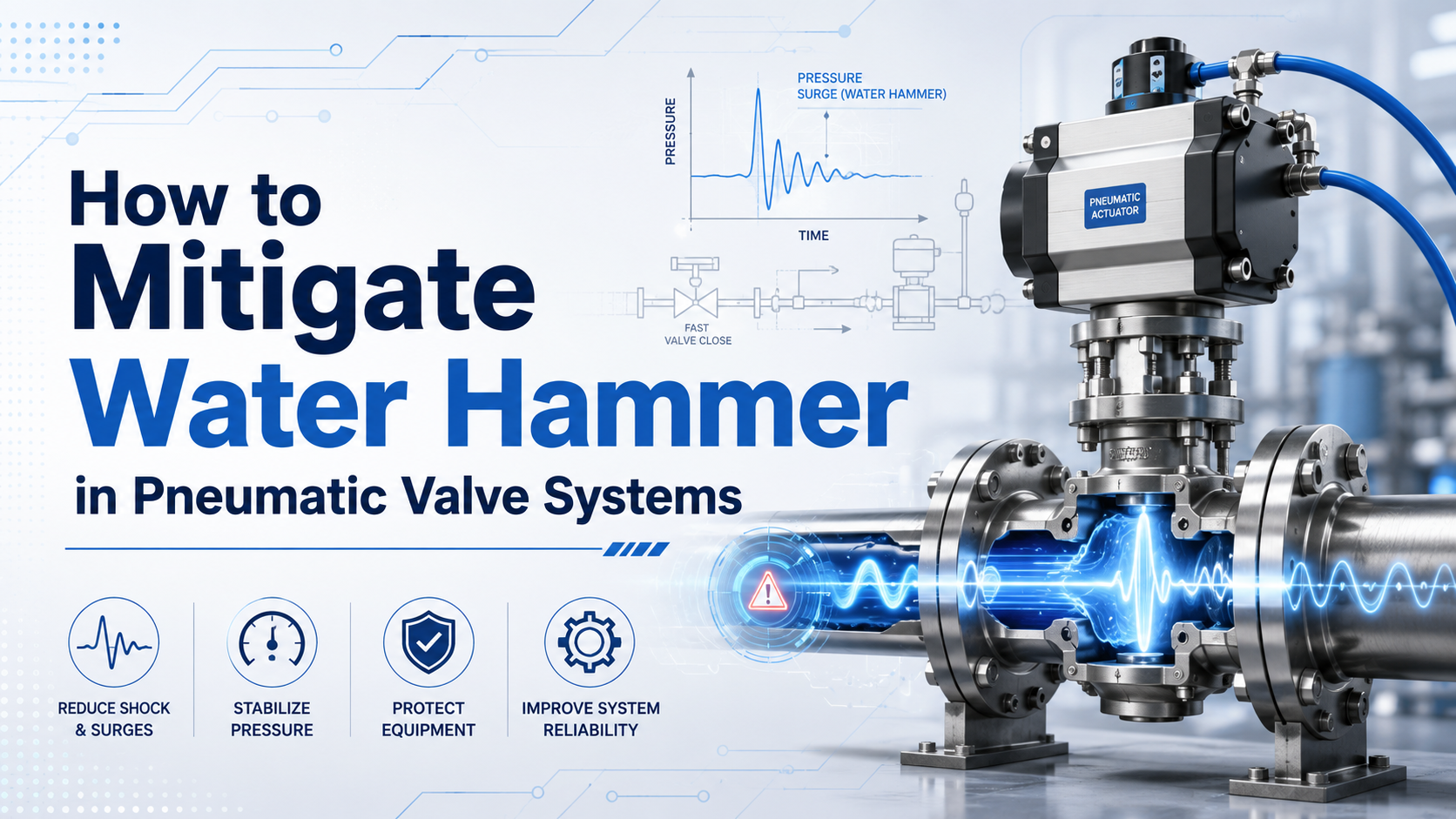
Water hammer in a pneumatic valve system should be treated as a symptom, not a diagnosis. A bang at valve changeover may come from a compressed-air pressure transient, exhaust back pressure, a cylinder striking its end cap, or liquid condensate moving through a low point. Each mechanism needs a different correction.
The safest approach is to record pressure on both sides of the suspected restriction while observing valve command, cylinder position, and exhaust behavior. Then reduce the rate of energy release at the location that created the event. Don’t select a relief valve, receiver, or larger directional valve from the noise alone.
Key Takeaways
- Separate four fault types before changing hardware: air-pressure transient, exhaust restriction, mechanical end impact, and condensate movement.
- ISO 4414 covers significant pneumatic-system hazards and remains current after its 2021 confirmation.
- Measure dynamic pressure at the valve and actuator. A healthy static gauge can hide the actual restriction.
- Control acceleration, exhaust flow, and cushioning as a coordinated circuit.
The location and timing of the first pressure change are more useful than the loudest sound. A supply-side spike that begins at valve switching points toward filling and valve conductance. A chamber-pressure rise just before the piston reaches the end points toward cushioning or exhaust restriction. A bang after drainage or a cold start makes condensate more plausible.
Is It Really Water Hammer?
ISO 4414:2010 addresses significant hazards in pneumatic fluid-power systems and applies to their design, construction, modification, adjustment, and maintenance. It was confirmed in 2021 and remains current (ISO 4414). That scope supports a system-level diagnosis instead of treating every pressure event as classic liquid water hammer.
Classic water hammer is a hydraulic transient caused by a rapid velocity change in a liquid column. Compressed air behaves differently because it is compressible and because pneumatic circuits contain valves, changing chamber volumes, exhaust restrictions, and moving loads. The phrase “pneumatic water hammer” is common shop language, but pneumatic pressure transient is usually the more precise term when no liquid slug is present.
Use this four-way classification before choosing a remedy:
| Observed event | Likely mechanism | Best first measurement | Typical correction path |
|---|---|---|---|
| Pressure changes immediately with valve command | rapid filling or valve-switching transient | valve inlet and working-port pressure | review valve conductance, fill rate, tubing volume, and switching sequence |
| Pressure rises in the exhausting chamber | exhaust back pressure | cylinder exhaust port and valve exhaust pressure | inspect muffler, manifold exhaust, meter-out control, and hose routing |
| Bang occurs at the physical end of stroke | moving mass exceeds available cushioning | speed and remaining cushion stroke | reduce speed or energy; verify cushion or shock-absorber capacity |
| Event follows drainage, freeze-up, or wet-air symptoms | condensate moving through the circuit | dew point, drains, low points, separator condition | correct air treatment and drainage before tuning motion |
One system can have more than one row at the same time. For example, an oversized valve can accelerate a cylinder rapidly while a clogged exhaust silencer raises back pressure. Fixing only the silencer may expose an end-impact problem that was already present.
Diagnosing a Pneumatic Pressure Transient
OSHA’s hazardous-energy rule applies to pneumatic energy, and 29 CFR 1910.147(d)(5) requires stored or residual energy to be relieved, disconnected, restrained, or otherwise rendered safe before servicing (OSHA). Instrument installation and sensor relocation therefore belong inside the machine’s energy-control procedure, not an improvised live adjustment.
After safe installation, measure pressure during the event rather than relying on the regulator gauge. A useful test records these signals on the same time base:
- valve command or spool feedback
- pressure at the valve supply port
- pressure at the active cylinder port
- pressure in the exhausting chamber or common exhaust gallery
- cylinder position or end-of-stroke sensor state
Place sensors close to the suspected restriction. A long test hose adds volume and can distort a fast event. Use transducers, fittings, pressure ratings, and acquisition settings suitable for the expected circuit pressure and event duration. The required sampling rate must come from the transient you need to resolve, not a universal rule of thumb.
Run a controlled comparison. Lower the commanded speed, remove a known exhaust restriction where safe, or operate one valve station at a time. Change only one variable per test. If the pressure event moves or disappears with that change, the result is more informative than a single peak value.
The pneumatic back-pressure guide explains why a common exhaust, silencer, or undersized return path can affect several actuators. For steady line-loss screening, use the calculator below, but don’t treat its result as a prediction of transient peak pressure.
Which Valve and Flow-Control Changes Reduce the Shock?
SMC’s AS-R/AS-Q technical guide compares two circuit arrangements and warns that meter-out control can permit sudden extension when compressed air is absent or too low on the exhaust side (SMC AS-R/AS-Q guide). Valve size, speed-control method, and restart state must therefore be reviewed together.
Start by checking the valve’s actual flow data, not its thread size. Port size does not reveal the smallest spool passage, manifold gallery, fitting bore, or muffler restriction. Compare the required transient flow with the manufacturer’s Cv, Kv, sonic conductance, or tested flow curve. The Cv valve-sizing guide and the sonic-conductance guide cover those two rating methods.
Then control how each actuator chamber fills and exhausts:
- Use meter-out control when the load and circuit require stable exhaust-side restraint, while checking the restart condition.
- Consider meter-in control only after evaluating load direction, inertia, external forces, and cushioning behavior.
- Use a soft-start or progressive-pressure function when a safe restart requires controlled repressurization.
- Sequence high-demand valve stations instead of filling several large volumes at the same instant.
- Avoid replacing a correctly sized valve with a larger one merely to make the cylinder faster.
The comparison in meter-in versus meter-out flow control is especially relevant when a vertical or overrunning load can accelerate independently of the supplied airflow.
Could a longer switching time solve everything? No. It may reduce one excitation, but it won’t clear a blocked silencer, absorb excess moving energy, drain condensate, or make an unsafe restart sequence acceptable. Confirm the mechanism before specifying a slower valve or adding an external restrictor.
When Does Exhaust Back Pressure Become the Main Problem?
SMC’s JASV product combines a quick-exhaust valve and a metering valve for high-speed cylinder actuation, which shows that local exhaust and speed control are separate functions that sometimes need coordination (SMC JASV). A quick-exhaust valve is a circuit element, not a universal cure for pneumatic shock.
Exhaust back pressure is likely when pressure remains in the nominally exhausting chamber, motion changes when a silencer is removed, or several manifold stations interfere through a common exhaust. Check the entire route: cylinder port, flow controller, tube, directional valve, manifold gallery, silencer, and enclosure vent.
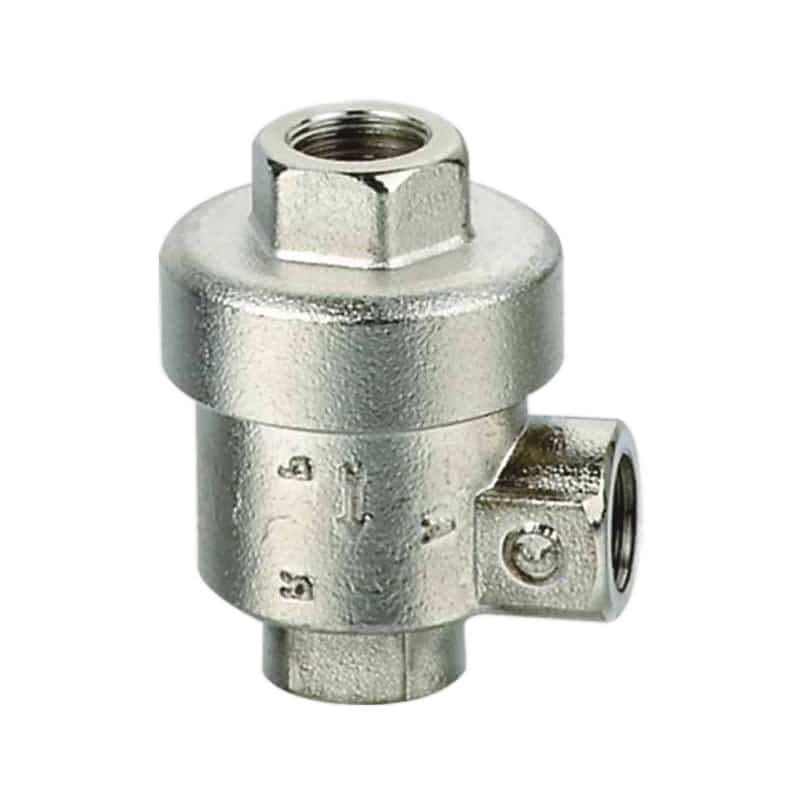
A quick-exhaust valve can reduce the distance between the actuator and atmosphere. It can also make decompression faster and raise cylinder speed. If the moving mass then reaches the end cap with more kinetic energy, the audible impact may get worse even though chamber back pressure falls. Recheck speed and cushioning after installation.
Use this decision sequence:
- Measure exhaust-port pressure during motion.
- Inspect the silencer for contamination and rated flow.
- Check whether multiple valves share an undersized exhaust gallery.
- Confirm flow-controller orientation and adjustment.
- Evaluate a local quick exhaust only after steps 1 through 4.
- Retest cylinder speed, end impact, and safe depressurization behavior.
The quick-exhaust valve guide explains placement and pilot behavior in more detail.
How Do You Stop End-of-Stroke Impact?
A current Festo ADNGF-80-25 cylinder datasheet lists an 8 J permissible end-position impact energy and a 7.5 mm cushioning length for that exact configuration (Festo datasheet). Those values are model-specific, but they illustrate why cushioning must be checked against moving mass, speed, and the selected cylinder.
Cylinder impact energy grows with the square of speed:
kinetic energy = 0.5 x moving mass x speed^2Doubling speed produces four times the kinetic energy before other effects are considered. That relationship explains why a modest valve or flow-control adjustment can change end impact dramatically. It also explains why a pressure relief valve isn’t a substitute for properly sized cushioning.
Follow the cylinder manufacturer’s adjustment method. For adjustable pneumatic cushioning, begin from a conservative speed and tune one end at a time. Confirm that the piston completes the stroke without bouncing, stalling, or striking an external stop. Heavy or high-speed loads may require an external shock absorber or a different actuator size rather than more restriction at the cushion screw.
Use the cylinder cushioning guide to separate adjustable air cushioning, elastomer bumpers, and external shock absorbers.
Can Condensate Create a Real Liquid-Slug Event?
ISO 8573-1:2010 classifies compressed-air purity for three principal contaminant groups: particles, water, and oil (ISO 8573-1). Water is therefore a specified compressed-air contaminant, not merely a maintenance nuisance. Liquid can collect when air cools below its pressure dew point or when drains and separators fail.
Condensate changes the diagnostic branch. Water pooled in a low point, hose, manifold, or receiver connection can move when a valve opens. That event isn’t equivalent to a dry-air pressure transient, and tuning a speed controller won’t remove its source.
Inspect these locations:
- aftercooler, separator, dryer, filter, and automatic drain
- low points and dead legs in distribution piping
- downward branches without effective drainage
- cold zones where compressed air loses temperature
- valve exhausts showing water, ice, or recurring corrosion
Record the required pressure dew point at the point of use and compare it with the lowest temperature the downstream system can reach. The relevant target depends on the process and environment. The ISO compressed-air quality guide explains how particle, water, and oil requirements are written without guessing a universal class.
Don’t open a pressurized drain or fitting to prove water is present. Isolate the system, release stored pneumatic energy, verify the zero-energy state, and follow the equipment manufacturer’s drainage procedure.
A Safe Mitigation Workflow
OSHA 29 CFR 1910.147 requires verification that isolation and de-energization have been accomplished before servicing begins, while ISO 4414 covers pneumatic-system design, adjustment, and maintenance hazards (OSHA; ISO 4414). A technically correct valve change still needs controlled isolation, commissioning, and documented acceptance.
Use the following workflow:
- Define the event. Record when the bang, pressure change, or erratic motion occurs relative to the valve command and stroke.
- Make measurement safe. Isolate energy before installing rated transducers, fittings, or temporary test lines.
- Capture dynamic data. Measure supply, working-port, chamber, and exhaust pressures on one time base.
- Classify the mechanism. Choose air transient, exhaust back pressure, end impact, condensate, or a combination.
- Apply one targeted change. Adjust flow control, clear an exhaust restriction, revise sequencing, correct cushioning, or repair drainage.
- Retest the full operating envelope. Include the actual load, minimum and maximum supply conditions, restart, emergency stop, and simultaneous valve demand.
- Freeze the accepted setup. Record valve model, flow-control turns or setting, muffler type, cushion setting, pressure traces, and inspection interval.
A successful fix should remove the mechanism, not just reduce the sound. Acoustic improvement without pressure and motion verification can hide a slower but still damaging end impact, an unstable exhaust condition, or stored energy that remains after shutdown.
Frequently Asked Questions
Can water hammer occur in a pneumatic system with no liquid water?
A dry compressed-air circuit can produce pressure transients, rapid decompression, exhaust back pressure, and mechanical impacts. Calling all of them “water hammer” is convenient but imprecise. Confirm whether liquid is present, then use synchronized pressure and motion data to identify the actual mechanism before choosing hardware.
Will a larger directional valve prevent pneumatic water hammer?
Not automatically. A larger effective flow path may reduce steady restriction, but it can also fill an actuator faster and increase acceleration. Compare required flow with Cv, Kv, or sonic-conductance data, then verify chamber pressure, cylinder speed, load behavior, exhaust capacity, and cushioning under real operating conditions.
Does a quick-exhaust valve eliminate pressure shock?
A quick-exhaust valve can reduce exhaust-path length and chamber back pressure. It can also increase actuator speed and decompression rate. Measure the existing exhaust restriction first, install the device close to the actuator only when justified, and then retest speed, end impact, noise, and safe exhaust behavior.
Can an air receiver absorb pneumatic pressure transients?
A receiver can buffer supply demand when it is correctly sized and located, but it isn’t a universal transient suppressor. It may have little effect on a local exhaust restriction or cylinder impact. Model the relevant volume and flow path, verify applicable receiver safety requirements, and measure the circuit after installation.
What should maintenance inspect after repeated banging begins?
Check dynamic pressure at the valve and actuator, muffler contamination, common exhaust back pressure, speed-controller orientation, cylinder cushioning, loose mounts, drains, separators, and low points. Before opening the circuit, follow the site’s energy-control procedure and verify that stored pneumatic and mechanical energy has been made safe.
Sources
- ISO 4414:2010, Pneumatic fluid power, general rules and safety requirements
- ISO 8573-1:2010, Compressed air contaminants and purity classes
- OSHA 29 CFR 1910.147 hazardous-energy guidance
- SMC AS-R/AS-Q meter-in and meter-out technical guide
- SMC JASV speed-exhaust controller
- Festo ADNGF cylinder technical data