

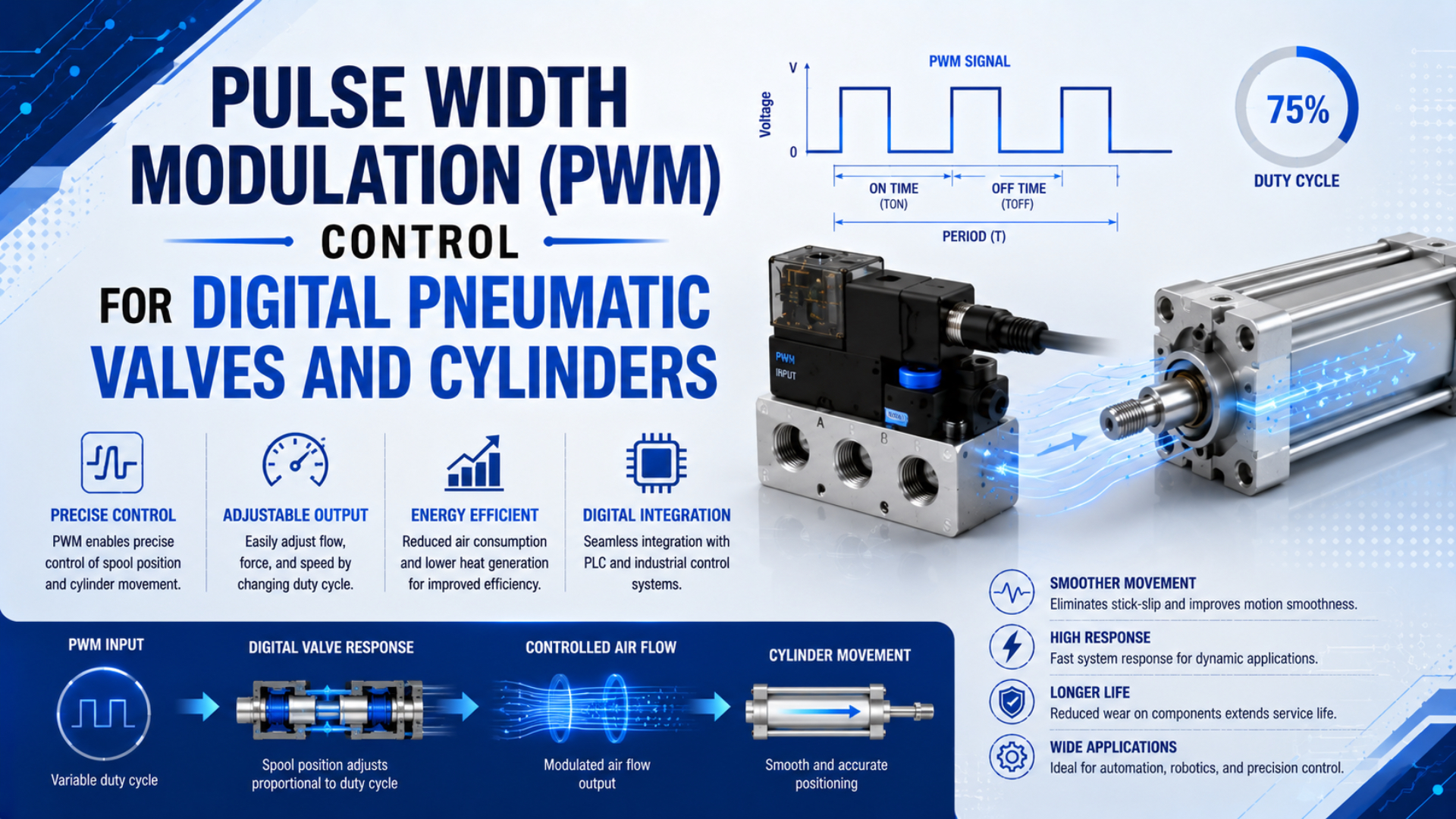
PWM control for pneumatic valves uses timed electrical pulses, but the pulses can serve two different purposes. A current controller may switch coil current while the valve remains mechanically open. Alternatively, a fast on-off valve may physically open and close every PWM period to regulate mean flow or pressure. Confusing those modes leads to overheated coils, unusable duty-cycle ranges, or premature valve wear.
SMC lists maximum operating frequencies of 5 or 10 Hz for the cited two-position SY valve models. Festo lists 500 or 1000 Hz for selected MHJ9 fast-switching valves under stated electrical, pressure, mounting, and temperature conditions. PWM frequency is therefore a model-specific engineering limit, not a generic 50-200 Hz setting (SMC SY catalog; Festo MHJ9 datasheet).
Key Takeaways
- First decide whether PWM regulates coil current or mechanically cycles the air path.
- The commanded duty cycle is not automatically the valve-position duty cycle or the flow percentage.
- Opening and closing times set the usable duty-cycle window at each frequency.
- Confirm driver current, voltage clamp, coil temperature, valve life, pressure, and feedback before continuous operation.
- Prove speed, force, position, and air consumption with synchronized measurements on the released circuit.
What Does PWM Actually Control in a Pneumatic Valve?
Texas Instruments’ DRV110 applies peak current, holds it for a set time, and then regulates a lower hold current with PWM while the enable signal remains high. That sequence controls solenoid current and heat; it does not command the valve to open and close on every internal PWM cycle (TI DRV110 datasheet).
Coil-current PWM is an electrical power-control method. The driver supplies enough current to pull in the armature or shift the pilot stage, then reduces current to the level needed to keep the valve actuated. The switching occurs inside the current-control loop. The mechanical valve normally stays in one commanded state until the enable signal changes.
Mechanical valve PWM commands a compatible on-off valve to open and close during every control period. Varying the open portion changes mean mass flow or chamber-pressure evolution. This is the mode used when a set of digital valves replaces some functions of a proportional valve.
The distinction determines what the duty cycle means:
| PWM location | What switches every PWM cycle | Main objective | Primary limits |
|---|---|---|---|
| Solenoid current driver | MOSFET and coil current | Reduce hold power and coil temperature | Peak current, hold current, inductance, clamp, driver rating |
| Mechanical on-off control | Poppet, plunger, or spool plus air path | Regulate mean flow or chamber pressure | Opening time, closing time, rated frequency, life, pressure, temperature |
| PLC command to smart valve | Valve electronics interpret a digital input | Model-specific power or flow function | Exact input specification and manufacturer configuration |
Do not infer the mode from the word “PWM” alone. Read the valve and driver documentation. A PLC pulse train connected to an ordinary directional valve is not equivalent to the internal current PWM of a peak-and-hold driver, and neither is automatically equivalent to a proportional valve command.
For basic coil, pilot, spool, and port behavior, use the separate pneumatic solenoid valve guide. This article stays with PWM timing, electrical drive, and cylinder response.
Why Is There No Universal PWM Frequency?
SMC specifies 10 Hz maximum for the cited SY3000 two-position valves and 5 Hz for the larger SY5000, SY7000, and SY9000 versions. Festo’s purpose-built MHJ9 variants list 500 or 1000 Hz, with sub-millisecond switching data for selected conditions. The correct frequency begins with the exact part number (SMC; Festo).
PWM duty cycle and frequency are defined by the on-time , off-time , and period :
For a valve that must reach both end states during each period, the commanded times need to exceed the verified opening and closing times:
The corresponding first-pass usable range is:
These boundaries are screening values, not final calibration. Opening delay, armature travel, pilot-pressure buildup, poppet motion, and flow establishment can be different. Closing has its own delay and travel time. A 2023 pneumatic pressure-control study distinguished command duty cycle from effective poppet duty cycle and showed that asymmetric valve dynamics change mean-flow performance (de Carvalho et al.).
Frequency selection is a three-way timing problem. The period must be long enough for useful valve motion, short enough for the controlled chamber to average the pulses, and separated from machine resonances or sampling artifacts. Raising frequency can reduce pressure ripple while simultaneously shrinking the usable duty-cycle window and increasing switching count.
Festo also states that the attainable maximum frequency falls as valve or ambient temperature rises. Its quoted values require the specified cable electronics and operating conditions. A datasheet maximum is therefore not a recommended continuous setting for every manifold, pressure, mounting arrangement, or ambient temperature.
How Does Duty Cycle Affect Flow, Pressure, Speed, and Force?
A 2019 electro-pneumatic force-control experiment used four on-off valves and built its duty-cycle-to-flow relationship from measured pressure difference and flow-meter data. That approach is more defensible than assuming a 60% command produces 60% flow, because the transfer function contains valve dead time, pressure ratio, and nonlinear compressible flow (Energies study).
The mean mass flow over one period is:
Only under restrictive conditions does this reduce to a simple duty-cycle multiplier. The valve must reach repeatable states, opening and closing delays must be negligible or compensated, and upstream and downstream pressures must remain sufficiently stable within the period. Pneumatic cylinder chambers rarely satisfy all of those conditions across an entire stroke.
Pressure changes as chamber volume, mass, temperature, piston position, load, and exhaust state change. Speed then depends on net force and the complete supply and exhaust path. A lower PWM duty cycle can reduce pressure buildup during motion, so it can affect available accelerating force as well as speed. Full theoretical force is recovered only if the chamber eventually reaches the required pressure and the opposing chamber exhausts adequately.
| Quantity | Why duty cycle alone cannot predict it | Required measurement |
|---|---|---|
| Mean mass flow | Valve dynamics and pressure ratio reshape every pulse | Upstream pressure, downstream pressure, temperature, calibrated flow |
| Chamber pressure | Volume and net mass flow change with piston position | Both cylinder-port pressures synchronized with position |
| Cylinder speed | Net force, load, friction, flow capacity, and exhaust interact | Position-derived velocity plus pressure traces |
| Output force | Filling pressure and exhaust back pressure both act on piston areas | Both chamber pressures, areas, acceleration, external load |
| Air consumption | Pulse flow and full-stroke filling are not the same calculation | Metered free-air consumption over identical production cycles |
ISO 6358-1 defines steady-state tests for pneumatic component flow characteristics. It does not apply its method to cylinders or accumulators that exchange energy with the fluid. Use the selected valve’s ISO 6358 data as an input, then validate the assembled PWM circuit dynamically (ISO 6358-1:2013).
The pneumatic flow-control sizing guide covers valve and air-path capacity. The separate air-compressibility control guide explains why a chamber does not respond like an incompressible averaging element.
Which Valve Circuit and Feedback Signals Are Required?
A 2022 soft-actuator study used one 3/2 on-off valve, a receiver, and pressure feedback at 40 Hz. A separate 2019 force-tracking system used four on-off valves and measured the duty-cycle, pressure-difference, and flow relationship. Those are specific control architectures, not proof that one PWM output can position every double-acting cylinder (Frontiers; Energies).
Choose the air-path topology from the controlled variable and safe state:
- One 3/2 valve: suitable for charging and venting one compliant volume when its de-energized state provides the required exhaust behavior.
- Two 3/2 valves per chamber: supply and exhaust can be commanded separately, but software must prevent unintended simultaneous paths.
- Four on-off valves: separate fill and exhaust control for both cylinder chambers supports more control modes at the cost of wiring, switching, and fault complexity.
- One 5/2 valve: changes direction but normally does not provide independent fill and exhaust pulse control for each chamber.
- One 5/3 valve: adds a center state, but center-closed does not guarantee rigid position holding because air compresses and leakage remains.
Open-loop PWM can shape a repeatable stroke when load, supply, friction, and temperature remain controlled. Closed-loop speed, pressure, force, or position control needs a sensor for the actual controlled quantity. A valve command confirms only that the controller issued a pulse.
Define fault behavior before tuning. Determine what happens on controller reset, lost sensor, stuck valve, broken wire, low pilot pressure, blocked exhaust, and emergency stop. PWM must not bypass the machine’s approved safety architecture or turn a directional valve into an unverified load-holding device.
Solenoid Driver and Voltage-Clamp Requirements
TI’s DRV110 regulates a peak current for a configured keep time before reducing to a hold current. In a separate solenoid-driver comparison, TI measured about 10 ms de-actuation with freewheeling and about 3.5 ms with a higher-voltage clamp in its example hardware. Suppression choice therefore affects release timing (DRV110; TI solenoid-driver note).
The PLC or microcontroller should not drive a valve coil directly unless its output is explicitly rated for that load and switching method. Verify:
- coil voltage tolerance and cold/hot resistance;
- peak, hold, inrush, and average current;
- transistor output current, voltage, switching rate, and thermal limits;
- galvanic isolation and shared-reference requirements;
- MOSFET voltage, current, switching loss, and safe operating area;
- cable length, connector rating, EMC, and grounding;
- suppression or clamp voltage against both the driver and coil insulation rating;
- valve-specific polarity, LED, power-saving, and surge-suppressor electronics.
A diode placed directly across a DC coil provides a low-voltage freewheel path. That protects the switch, but the low recirculation voltage makes current decay slowly. A TVS, Zener, active clamp, or driver recirculation mode can release the armature faster by allowing a higher controlled voltage. Higher clamp voltage also raises semiconductor and insulation stress. Use the valve and driver manufacturers’ approved circuit rather than selecting the clamp from speed alone.
Coil-current PWM needs current feedback or a validated driver design. Coil resistance rises with temperature, supply voltage varies, and inductance changes with armature position. A raw voltage duty cycle cannot guarantee the same pull-in or hold current across those states.
For a smart valve with built-in surge suppression or power-saving electronics, do not add another external clamp until the manufacturer confirms compatibility. The SMC SY catalog, for example, shows that response time differs between suppression options on the tested models. Wiring changes can alter the very release time the control strategy depends on.
What Does PWM Switching Do to Valve Life and Temperature?
Festo links the MHJ9’s permissible ambient temperature to switching frequency and requires its specified connecting cable electronics for the published values. SMC publishes maximum operating frequency by SY model and valve position count. Neither source supports deriving continuous PWM life from a generic “millions of cycles” statement (Festo; SMC).
When a mechanical valve completes one open-close actuation per PWM period, the idealized operating hours represented by a rated cycle count are:
This is a scheduling calculation, not a service-life prediction. If a hypothetical valve were rated for 10 million cycles and mechanically switched continuously at 50 Hz, the arithmetic gives about 55.6 hours. Actual qualification must use the manufacturer’s cycle definition, pressure, temperature, filtration, lubrication, mounting, electrical drive, and failure criteria.
High-frequency capability and long application life are different specifications. A valve may follow a short burst at high frequency yet be unsuitable for continuous production PWM. Conversely, a long-life directional valve can still have response times and frequency limits that make its effective duty-cycle window too narrow for useful modulation.
Record coil or housing temperature at stabilized duty, not only during a short bench test. Check individual and manifold mounting because neighboring energized coils change heat rejection. Repeat at the highest ambient and fluid temperature allowed by the machine specification.
Air consumption also needs an A/B measurement. Compare identical production work: same payload, travel, cycle count, pressure requirement, standby state, product rate, and acceptable motion. A lower duty cycle alone is not evidence of energy savings, and a conventional meter-out speed controller does not continuously bleed air when the cylinder is stopped.
A Commissioning Method for PWM-Controlled Cylinders
The 2023 pressure-control study required on-time to exceed valve opening time and off-time to exceed closing time before defining a usable duty-cycle range. Its effective poppet duty cycle also depended on opening and closing asymmetry. Commissioning should therefore begin with valve motion and pressure data, not a universal 50% command (de Carvalho et al.).
Use this sequence:
- Identify every part. Record the complete valve, coil, connector, suppressor, driver, manifold, cylinder, sensor, and controller output codes.
- Verify safety and static function. Confirm the de-energized air path, emergency behavior, load restraint, supply isolation, and manual override before repetitive switching.
- Measure single transitions. Record command, coil current, valve-state evidence, cylinder-port pressure, and position during one opening and one closing event.
- Establish minimum pulses. Increase on-time and off-time from safe values until the valve reaches repeatable states under the required pressure and temperature.
- Choose a conservative frequency. Keep the command within the model’s maximum frequency and thermal limits while preserving a usable duty-cycle range.
- Map duty cycle in both directions. Measure flow or chamber-pressure change instead of assuming linearity. Record dead zones and hysteresis.
- Close the loop if required. Tune pressure, speed, force, or position feedback using the measured transfer map and stated sampling rate.
- Run the complete duty. Verify temperature, switching count, supply pressure, exhaust pressure, motion ripple, position, force margin, leakage, and air consumption.
- Test faults. Simulate permitted sensor, valve, air-supply, and controller faults under the machine safety procedure.
In our experience, the most revealing commissioning trace puts command, coil current, both cylinder-port pressures, and position on one time base. It separates an electrical pulse that never moved the valve from a valve pulse that moved air but failed to overcome load, friction, exhaust restriction, or chamber compressibility.
Write acceptance criteria before tuning. Useful criteria include maximum coil temperature, pressure ripple, velocity variation, first-motion delay, endpoint behavior, stopping error, switching count per production cycle, free-air use per accepted part, and fault-state motion.
Do not use the Air Consumption Calculator to claim PWM savings from duty cycle. It can estimate conventional geometric cylinder demand, but measured pulse flow is needed for the PWM comparison. This distinction is why no calculator card interrupts this control-focused article.
When Should You Use PWM Instead of a Proportional Valve?
The 2019 force-control experiment obtained its reported results with four on-off valves, measured flow data, pressure feedback, and a fitted control method. That complete system is materially different from adding PWM to one standard directional valve. PWM becomes attractive when compatible fast valves and adequate feedback justify the engineering effort (Energies).
| Application need | Mechanical PWM with on-off valves | Proportional valve | Conventional flow control |
|---|---|---|---|
| Fixed end-to-end cylinder speed | Usually unnecessary | Usually unnecessary | Often the simplest choice |
| Recipe-based speed profile | Possible with rated valve and validation | Direct variable command | Manual or limited adjustment |
| Chamber-pressure control | Possible with fill/exhaust topology and feedback | Common solution with feedback | Not designed for active pressure control |
| Intermediate positioning | Requires feedback, suitable topology, and tuning | Requires feedback and tuning | Generally unsuitable |
| Very high switching demand | Requires purpose-built fast valve | Valve dependent | Not applicable |
| Lowest software complexity | Poor fit | Better when controller interface is supported | Best fit for fixed adjustment |
| Known fail-safe air path | Must be designed across all digital valves | Must be designed for selected valve | Determined by directional circuit |
Choose PWM when the valve is explicitly rated for the switching duty, the controller can generate and supervise the pulses, and measured performance justifies the added switching. Choose a proportional valve when a continuous command, wider controllable flow range, integrated electronics, or simpler tuning is more valuable. Use the proportional flow-control valve guide for that architecture.
For a simple fixed-speed cylinder, meter-out flow control may remain the better answer. PWM should solve a defined pressure, speed, force, or position problem. It should not be added merely because the PLC has a pulse output.
Publisher details and a route for technical corrections are available through About Us and Contact.
PWM Pneumatic Valve and Cylinder FAQs
SMC’s cited standard SY models list 5-10 Hz maximum operating frequencies, while Festo’s dedicated MHJ9 fast-switching variants list 500-1000 Hz under specified conditions. These answers therefore use model-specific response, driver, pressure, temperature, and life data rather than recommending one frequency for every pneumatic valve (SMC; Festo).
Can any standard pneumatic solenoid valve be controlled with PWM?
No. Coil-current PWM may be possible with a validated peak-and-hold driver, but mechanical PWM requires a valve rated for the commanded switching frequency, duty, pressure, temperature, mounting, and life. Built-in electronics can also reject or reinterpret pulses. Confirm the complete valve and connector code before testing.
What PWM frequency should I use for a pneumatic cylinder?
Start from the exact valve’s maximum frequency and measured opening and closing times, not a generic number. Select a period that preserves usable on-time and off-time, gives acceptable chamber ripple, avoids relevant resonance, and stays within thermal and life limits. Validate the final value on the assembled circuit.
Does a 50% duty cycle produce 50% valve flow?
Not necessarily. Command duty cycle differs from effective poppet duty when opening and closing delays are significant or asymmetric. Compressible flow also changes with upstream and downstream pressure. Build a measured duty-cycle-to-flow or duty-cycle-to-pressure map over the application range before using duty cycle as a control variable.
Can PWM hold a pneumatic cylinder at mid-stroke?
PWM alone cannot guarantee position holding. Intermediate positioning needs a suitable fill and exhaust topology, position feedback, a controller, and verified load behavior. Air compressibility, leakage, seal friction, supply changes, and external forces remain active. Use a mechanical lock or safety-rated solution when loss of position creates risk.
Does PWM always reduce compressed-air consumption?
No. Savings depend on the previous circuit, required motion, pressure profile, exhaust strategy, leakage, valve losses, and accepted production output. Compare metered free-air use over identical work cycles. A lower electrical duty cycle is not a direct measurement of pneumatic energy or compressor electricity.
Sources and technical references
- Texas Instruments, DRV110 Solenoid Current Controller Datasheet, peak-and-hold current plus PWM current regulation; retrieved 2026-07-23.
- Texas Instruments, “Using Motor Drivers to Drive Solenoids”, freewheeling, voltage clamping, current decay, and de-actuation timing; retrieved 2026-07-23.
- SMC, SY3000/5000/7000/9000 5-Port Solenoid Valve Catalog, model-specific operating frequency and response time; retrieved 2026-07-23.
- Festo, MHJ9 and MHJ10 Fast-Switching Valve Datasheet, switching time, frequency, driver, pressure, mounting, and temperature conditions; retrieved 2026-07-23.
- de Carvalho et al., “Pneumatic Pressure Control Using On-off Valves with Pulse Width Modulation”, Chemical Engineering & Technology 46(1), 21-28, 2023; retrieved 2026-07-23.
- Qian et al., “An Electro-Pneumatic Force Tracking System Using Fuzzy Logic Based Volume Flow Control”, Energies 12(20), 4011, 2019; retrieved 2026-07-23.
- Skorina et al., “Model-Based Nonlinear Feedback Controllers for Pressure Control of Soft Pneumatic Actuators Using On/Off Valves”, Frontiers in Robotics and AI 9, 2022; retrieved 2026-07-23.
- ISO 6358-1:2013, steady-state flow-rate testing of pneumatic components using compressible fluids, including 2020 and 2026 amendments; retrieved 2026-07-23.