

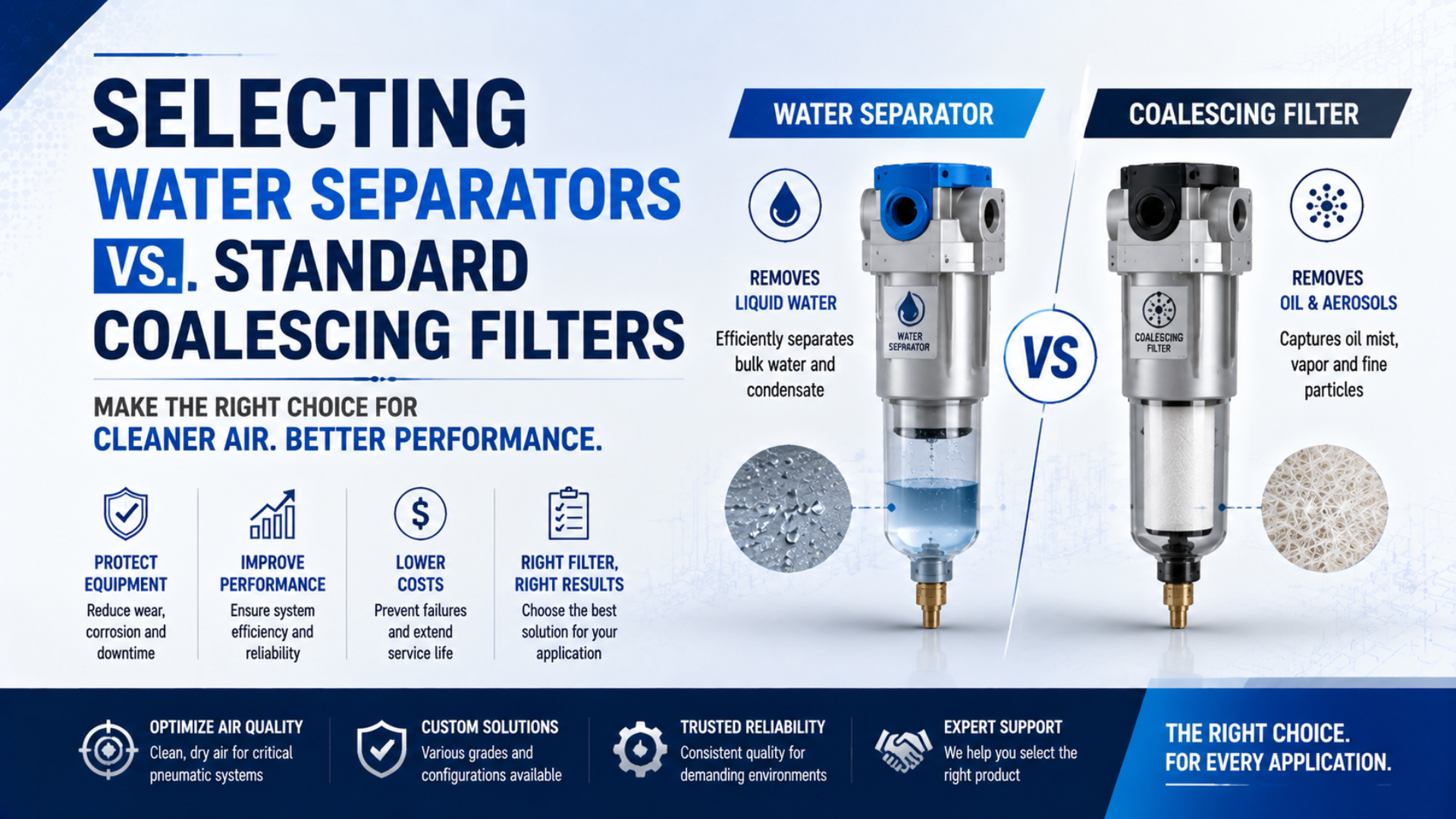
A water separator removes bulk liquid carried in a compressed-air stream. A coalescing filter captures much smaller liquid aerosols by collecting droplets in fibrous media, merging them, and draining the resulting liquid. Neither device removes water vapor. That job belongs to a refrigerated, membrane, or adsorption dryer selected for the required pressure dew point.
The useful selection question is therefore not “Which filter is better?” Identify whether the problem is bulk liquid, aerosol, vapor, or solid particles. Then compare the exact model’s flow rating, pressure correction, differential pressure, test conditions, drain, element life, and installation requirements. Port size or a nominal micron label cannot make that decision alone.
Key Takeaways
- ISO 8573-1 separates compressed-air purity into 3 main groups: particles, water, and oil.
- Water separators target bulk liquid; coalescing filters target liquid aerosols; dryers control water vapor.
- Use model-specific rated flow, wet pressure drop, efficiency conditions, drain capacity, and service instructions.
- Verify air quality and dynamic pressure at the point the application must meet them.
Bulk liquid means accumulated droplets or slugs that can drain by gravity after separation. Aerosol means fine liquid droplets suspended in the air stream. Vapor is the gaseous phase and passes through ordinary separators and coalescing media. These boundaries matter more than the product name printed on a bowl.
What Is the Difference Between a Water Separator and a Coalescing Filter?
ISO 8573-1:2010 is a 9-page standard that classifies compressed-air purity by 3 main contaminant groups: particles, water, and oil (ISO). A water separator and a coalescing filter address different physical forms within those groups, so neither component alone proves that a complete purity target has been met.
A centrifugal or directional-change water separator accelerates the air and drives heavier liquid droplets toward a collection surface. The separated liquid falls into a bowl or sump and leaves through a drain. Some products use a dedicated internal element as part of that separation geometry; “separator” does not always mean “no element.”
A coalescing filter passes air through fine media. Liquid aerosols collide with fibers by interception, inertial impaction, and diffusion. Small droplets merge, move through a drainage layer, and fall into the bowl. The media can also capture solid particles, which is why dirty inlet air can increase differential pressure and shorten service life.
| Selection point | Water separator | Coalescing filter |
|---|---|---|
| Primary target | Bulk condensed liquid water or oil | Fine water and oil aerosols |
| Separation method | Centrifugal, inertial, directional, or separator-element design | Fibrous coalescing and drainage media |
| Water vapor removal | No | No |
| Solid-particle duty | Only if the exact design includes that function | Captures some solids, but upstream particulate control may be required |
| Main service item | Drain, bowl, separator element where fitted | Drain, bowl, coalescing element, differential-pressure indication |
| Selection data | Efficiency test conditions, flow correction, pressure drop, liquid capacity | Aerosol performance, inlet challenge, rated flow, wet pressure drop, oil carryover |
The SMC AMG catalog makes the model boundary visible. Its 99% water-removal figure is stated for 0.7 MPa inlet pressure, 25°C air, 100% relative humidity, 15 g/m³ liquid-water content, and each model’s rated flow (SMC AMG catalog). It is a conditioned product result, not a universal separator efficiency.
For a deeper explanation of the fibrous mechanism, use the dedicated guide to how coalescing filters improve compressed-air quality.
Which Contaminant Are You Trying to Remove?
SMC lists the AMG water separator at 99% water-droplet removal under specified inlet conditions, while its 10-AMD micro-mist separator lists 0.01 μm filtration with 99.9% efficiency (SMC AMG; SMC 10-AMD). The numbers describe two product families and two different contamination duties.
Start with evidence from the system. A wet receiver drain, water slugs at a low point, fine oil mist on a test membrane, high pressure dew point, and rust scale in a filter bowl are not the same failure. One symptom can also create another: condensed water may corrode pipework, and the resulting rust becomes a particle problem.
Use the following first-pass map:
| Observed or measured problem | Primary equipment to evaluate | Boundary to remember |
|---|---|---|
| Bulk condensate after an aftercooler, receiver, or pipe low point | Water separator with suitable drain | Efficiency and re-entrainment depend on flow, pressure, geometry, and drain function |
| Fine oil or water aerosol | Coalescing filter | Check rated challenge, carryover, wet pressure drop, and upstream particle loading |
| Pressure dew point too high | Dryer | Separators and coalescing filters do not remove water vapor |
| Rust, scale, dust, or desiccant fines | Particulate filter | Nominal and absolute ratings are not interchangeable |
| Oil vapor or odor | Adsorption stage | Coalescing media targets droplets, not all gaseous hydrocarbon |
The same water can cross three equipment boundaries as the air cools. It may leave a compressor as vapor, condense into aerosol-sized droplets, and collect as bulk liquid at a receiver or low point. Naming the equipment before identifying the phase can move the symptom without controlling the cause.
For vapor diagnosis, see why pressure dew point matters. For particles, compare absolute and nominal micron ratings.
Where Should Each Component Sit in the Treatment Train?
CAGI’s compressed-air treatment chapter shows different layouts for refrigerated and regenerative desiccant dryers; one layout places a high-efficiency coalescing filter before the desiccant bed and a particulate filter after it (CAGI). The correct sequence depends on dryer type, inlet contamination, and the required outlet condition.
A common starting point is compressor, aftercooler, receiver with drain, bulk liquid separation, drying, filtration, distribution, and point-of-use treatment. It is not a universal bill of materials. Some dryers integrate separation. Some require coalescing prefiltration. Desiccant dryers may need an afterfilter for desiccant dust. Final oil-vapor adsorption belongs after liquid-aerosol control.
Parker states that water vapor passes through water separators and coalescing filters and must be removed by a dryer (Parker compressed-air guide). That is why adding more bowl filters cannot correct an inadequate pressure dew point.
Where should the purity requirement be checked? ISO 8573-1 applies independently of the location where air is specified or measured. Name that point in the specification. A compressor-room sample cannot prove the condition after a wet outdoor branch, old steel pipe, local lubricator, or contaminated hose.
For the complete air-preparation context, see how FRL and treatment units support pneumatic reliability.
How Should Flow and Pressure Drop Be Compared?
One Parker AAPX010 high-efficiency coalescing filter is rated at 36 m³/h at 7 barg and lists 111 mbar initial saturated differential pressure at 100% flow (Parker). Those numbers apply to that configured model and condition. They show why port size alone cannot establish capacity or pressure loss.
Use the peak simultaneous demand at the filter, not the compressor’s average delivery and not the sum of nameplate flows that never occur together. Correct the manufacturer’s rated flow for the minimum inlet pressure expected during production. Then read the relevant separator-efficiency and differential-pressure curves at that corrected operating point.
Record both clean or initial wet pressure drop and the service trigger. CAGI explains that a coalescing element’s normal reference is its wet pressure drop after the media has become saturated by design; a rising pressure drop is commonly associated with accumulated particulate matter, especially when upstream particle control is inadequate (CAGI).
Check these fields side by side:
| Datasheet field | Why it matters |
|---|---|
| Rated flow and reference pressure | Establishes the published operating point |
| Minimum operating pressure | Determines drain operation and flow correction |
| Initial dry and initial saturated pressure drop | Prevents comparison of unlike reference states |
| Separation or filtration test conditions | Defines inlet challenge, flow, temperature, and stated result |
| Maximum recommended differential pressure | Sets a model-specific service or inspection boundary |
| Drain type and discharge capacity | Determines whether collected liquid actually leaves the system |
| Housing and bowl limits | Controls pressure, temperature, chemical, and safety compatibility |
A separator can show a low average pressure drop and still be undersized for a short actuator event. Log pressure immediately upstream and downstream during peak machine demand. A synchronized trace separates restriction at the treatment unit from supply sag elsewhere in the branch.
For the pipe and fittings outside the filter element, use the compressed-air pressure-drop calculator. The tool does not replace the manufacturer’s filter curve.
Drains and Elements Change the Maintenance Plan
SMC’s AMG catalog specifies element service at 2 years or when pressure drop reaches 0.1 MPa, whichever boundary applies first (SMC). Parker lists a 12-month change interval for one OIL-X coalescing range (Parker OIL-X catalog). These are product-family instructions, not universal schedules.
A water separator still needs maintenance. Inspect the bowl, separator element where fitted, seals, drain, level, and discharge route. A failed automatic drain can let collected liquid rise into the air stream. An open or leaking drain wastes compressed air. A blocked discharge line can make a working separator look ineffective.
A coalescing filter adds media condition to that list. Track installation date, differential pressure at comparable flow, drain operation, downstream carryover, and the supplier’s calendar-life rule. Replace an element using the exact manufacturer’s time, pressure-drop, contamination, and integrity instructions. Do not extend service merely because the bowl looks clean.
Establish a healthy baseline after commissioning:
- inlet and outlet pressure during the same peak-flow event;
- differential pressure at a stated flow and pressure;
- drain cycling and discharged liquid condition;
- pressure dew point where moisture control matters;
- downstream particle, water, or oil result at the specified acceptance point;
- installed model, element grade, direction of flow, and service date.
If differential pressure rises rapidly, investigate solid-particle loading and upstream contamination rather than assuming the element is “saturated with water.” CAGI notes that coalescing media is designed to operate wet and drain coalesced liquid; particle loading is a separate restriction mechanism.
When Do You Need Both Components?
Parker’s purification guide assigns the water separator to bulk condensed liquid and the coalescing filter to aerosol control, while CAGI publishes multi-stage layouts combining these devices with dryers and particulate filters (Parker; CAGI). Use both when the measured inlet includes significant bulk liquid and the outlet requires controlled liquid-aerosol carryover.
Typical reasons to evaluate both include:
- an aftercooler or wet receiver produces bulk condensate before a coalescing stage;
- a distribution section cools enough to create liquid upstream of sensitive equipment;
- a coalescing filter or dryer supplier requires bulk-liquid protection for its stated performance;
- the application has both a liquid-water containment problem and a defined oil-aerosol target;
- variable seasonal load makes upstream liquid carryover credible even when normal operation looks dry.
Do not add both by habit. A refrigerated dryer may include its own separator, and the correct external arrangement depends on its manual. A desiccant dryer generally needs coalescing protection upstream and particulate control downstream, but the grades and locations remain supplier-specific.
Conversely, do not describe a water separator as sufficient for “oil-free air.” It can remove bulk liquid oil in designs intended for that duty, but fine aerosol and oil vapor are different phases. The coalescing-filter guide for low-oil applications explains the additional verification boundary.
What Should Buyers Put in the RFQ?
Parker’s current OIL-X catalog requires separator and filter flow to be corrected for the minimum operating inlet pressure, and it publishes separate dry and saturated pressure-drop values (Parker). An RFQ should therefore specify the operating event and required result, not only a port size, bowl type, or micron label.
Send the supplier:
| RFQ field | Information to provide |
|---|---|
| Contaminant | Bulk liquid, water aerosol, oil aerosol, water vapor, oil vapor, or solid particles |
| Required outlet condition | ISO 8573-1 particle:water:oil target or another controlled acceptance limit |
| Acceptance point | Compressor room, dryer outlet, branch header, machine inlet, or process point |
| Flow | Normal, peak, simultaneous demand, units, and duration of the peak |
| Pressure | Normal inlet, minimum dynamic inlet, maximum, and required downstream pressure |
| Temperature | Inlet air and ambient range |
| Existing treatment | Compressor type, aftercooler, receiver, dryer, prefilters, drains, and pipe material |
| Liquid load | Observed carryover, drain history, seasonal condition, or measured challenge |
| Required evidence | Flow correction, efficiency conditions, initial wet pressure drop, carryover, and test standard |
| Maintenance | Drain type, service access, element life rule, differential-pressure indication, spares |
| Safety and materials | Bowl guard, pressure and temperature limits, chemicals, condensate-disposal requirements |
Ask for the complete configured part number and the performance curve, not a family brochure alone. Two housings with the same connection can have different media, drain thresholds, pressure limits, flow corrections, and carryover results.
Which result closes the purchase decision? Define a commissioning check before ordering. At minimum, verify correct flow direction, drain function, peak-flow pressure drop, absence of bulk carryover, and the specified air-quality result at the named point.
The strongest RFQ separates a contamination requirement from a protection requirement. “Meet the stated oil-aerosol limit” is an outlet-performance requirement. “Protect the dryer from bulk liquid” is an equipment-protection requirement. They may select different stages even when both are sold as filters.
For a broader written purity target, use the guide to ISO compressed-air quality standards.
Water Separator vs. Coalescing Filter FAQs
ISO 8573-1 classifies compressed-air purity through 3 main groups: particles, water, and oil, independent of the point where air is specified or measured (ISO). These 5 answers distinguish bulk liquid, aerosol, vapor, treatment order, and maintenance so one component is not credited with the whole system’s result.
Can a coalescing filter remove water?
Yes, it can remove fine liquid-water droplets and aerosols within its stated test conditions. It cannot remove water vapor or set pressure dew point. ISO 8573-1 treats water as 1 of 3 main contaminant groups, so the complete requirement may also need bulk separation, drying, drainage, and point-of-use verification.
Can a water separator remove oil aerosol?
Do not assume it can. A separator may remove bulk liquid oil when its design and test data cover that duty, but fine oil aerosol needs coalescing media and oil vapor needs adsorption. SMC’s AMG 99% claim is specifically a water-droplet result under defined inlet conditions, not a universal oil-aerosol rating.
Do I still need a water separator if I have a dryer?
It depends on dryer design, inlet liquid load, integrated separation, pipe cooling, and the equipment manual. A dryer controls vapor, while a separator controls bulk liquid. Treat those as 2 different duties. Add an external separator when measured carryover or the dryer supplier’s required treatment sequence justifies it.
Which comes first, a water separator or a coalescing filter?
When bulk liquid and aerosol control are both required, the bulk-liquid separator is commonly upstream to protect coalescing media. The full sequence is still conditional. CAGI publishes different layouts for refrigerated and desiccant dryers, so follow the selected dryer’s prefilter, coalescing, afterfilter, and drain requirements.
When should a coalescing-filter element be replaced?
Follow the exact manufacturer’s calendar, differential-pressure, contamination, and integrity limits. Parker lists 12 months for one OIL-X range, while other products use different intervals or pressure triggers. Record the installed grade, comparable-flow pressure drop, drain condition, downstream result, and service date rather than applying one universal threshold.
Conclusion
ISO 8573-1 divides compressed-air purity into 3 principal groups, but equipment selection must also distinguish each contaminant’s phase (ISO). Choose a water separator for qualified bulk-liquid duty, a coalescing filter for qualified aerosol duty, and a dryer for the required water-vapor or pressure-dew-point control.
Use the full treatment chain to make the decision. Confirm minimum dynamic pressure, peak flow, model-specific curves, wet pressure drop, drain behavior, element instructions, and the acceptance point. When both components are justified, stage them according to the dryer and filter manufacturers’ documented requirements rather than a generic sequence diagram.