

High-speed pneumatic cylinders should be specified as complete motion systems, not as a bore, stroke, and catalog speed. Parker notes that cushion-entry speed can be about 50% higher than average stroke speed, while AutomationDirect warns that valve, tubing, fitting, port, and exhaust losses make actual speed difficult to predict (Parker P1F, retrieved 2026-07-10; AutomationDirect, retrieved 2026-07-10).
The safest specification therefore defines the motion profile, moving mass, available dynamic pressure, air-path capacity, guide loads, stopping energy, environment, and acceptance test. It also tells the supplier which values are measured, which are calculated, and which must be proven on the machine.
Key Takeaways
- Parker warns that cushion-entry speed can be about 50% above average speed; specify it with stroke time, acceleration, and moving mass (Parker P1F, retrieved 2026-07-10).
- Size the valve, tubing, fittings, FRL, and exhaust as one path; verify dynamic cylinder-port pressure.
- Put stop energy, sensor timing, temperature, and production-rate testing in the RFQ.
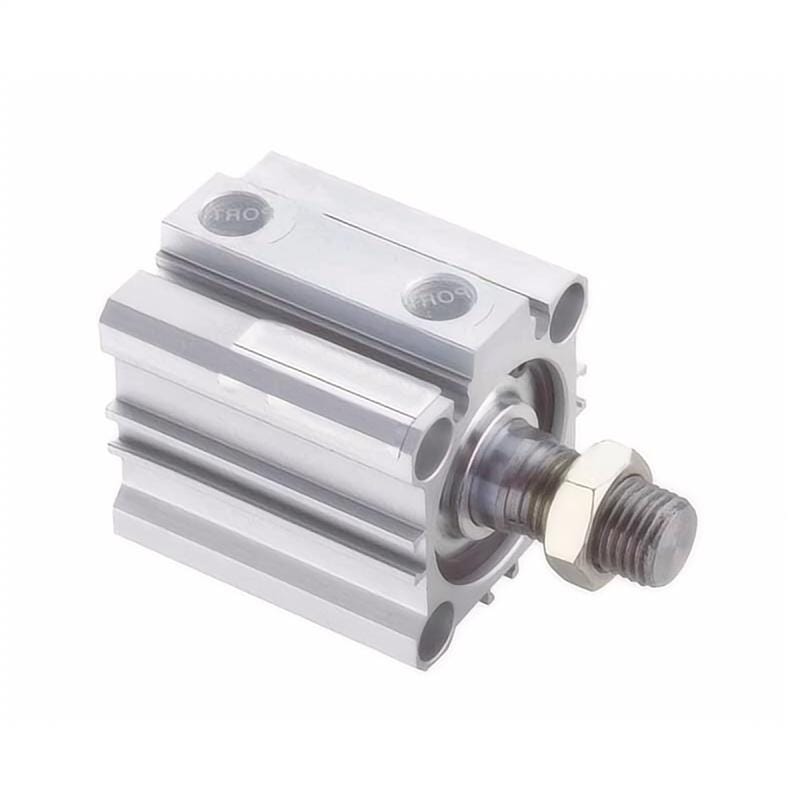
The retained image shows a CQ2 series compact pneumatic cylinder. It illustrates the component being selected, not proof that one cylinder style suits every high-speed application.
Motion profile is the timed sequence of acceleration, travel, deceleration, dwell, and return that the actuator must complete.
Dynamic pressure is the pressure available at the cylinder port while air is flowing and the load is moving.
Cushion-entry speed is the piston speed when the end-cushioning phase begins, not the average speed across the full stroke.
What Makes High-Speed Pneumatic Cylinders Different?
High speed becomes a specification problem when airflow, acceleration, or stopping capacity limits stroke time. SMC rates one CXS high-speed series at up to 1,500 mm/s for 6 to 20 mm bores and 1,000 mm/s for 25 and 32 mm bores. These are product-specific limits, not a universal threshold (SMC CXS High-Speed Type, retrieved 2026-07-10).
Write the requirement as a motion profile:
| Required input | Specify this | Do not substitute this |
|---|---|---|
| Stroke | Usable travel and any overtravel | Nominal machine pitch alone |
| Extend time | Command-to-position time under load | Unloaded bench speed |
| Retract time | Separate return requirement | Assumption that both directions match |
| Dwell | Time at each end position | Average cycle time only |
| Cycle rate | Peak sustained and short-burst rate | Daily average production |
| Moving mass | Tooling, bracket, product, coupler, carriage | Product weight alone |
| Orientation | Horizontal, vertical, or inclined | Generic load force |
| End condition | Stop method and allowable rebound | “Cushioned” without an energy check |
The phrase “1 m/s cylinder” is incomplete because the same average speed can come from very different strokes. A 50 mm stroke completed in 50 ms and a 500 mm stroke completed in 500 ms both average 1 m/s, but their acceleration windows, valve response, tubing volume, sensor timing, and stopping distance are not interchangeable.
Define high speed by the production event that must happen. Include the valve command time, time to break static friction, travel time, cushion phase, sensor confirmation, and permitted timing variation. This prevents a supplier from confirming only the catalog piston-speed range while leaving the machine cycle unresolved.
Which Motion and Load Inputs Must Be Fixed First?
Fix moving mass, external force, orientation, acceleration time, guide arrangement, and side load before choosing bore. Parker’s OSP-P load and moment values are based on piston speed no higher than 0.5 m/s, so a faster application needs explicit review rather than a copied static load table (Parker OSP-P, retrieved 2026-07-10).
Use a force balance for each direction:
required cylinder force = process force + acceleration force + friction + gravity component
acceleration force = total moving mass x acceleration
theoretical cylinder force = effective piston area x dynamic pressure
Theoretical force is not available force. Friction, back pressure, pressure drop, misalignment, and load variation consume margin. The detailed method belongs in the existing pressure-and-area force calculation guide, while this checklist records the inputs that a supplier needs.
Record all loads that the cylinder assembly must carry:
- Axial process force in extension and retraction
- Moving mass, including tooling and product
- External side load and overturning moments
- Gravity load and loss-of-air behavior on vertical axes
- Hose drag, cable carrier force, and seal friction where relevant
- Impact or process disturbance during travel
- Load variation across every product format
Use one weighed or calculated moving-assembly value. Include tool plates, grippers, adapters, sensors, cable carriers, and the part. Also separate static regulator pressure from dynamic cylinder-port pressure: the first confirms the setting, while the second shows whether force remains available during motion.
If the piston rod would carry a transverse load, stop treating the cylinder as the guide. Add an external linear guide, use a guided actuator, or redesign the linkage so the rod transmits axial force. This is especially important when faster acceleration raises inertial moments at the tooling plate.
Can the Valve, Tubing, and FRL Deliver the Required Flow?
Flow must fill one chamber and exhaust the other within the allowed stroke time while preserving force. CAGI says a well-designed plant air system should have no more than 10% pressure drop from compressor discharge to point of use, while AutomationDirect warns that fittings, valves, tubing, and ports all change actual speed (CAGI, retrieved 2026-07-10).
Calculate chamber free-air demand first, but do not stop there. Use absolute pressure in consumption calculations; NIST lists 1 standard atmosphere as 14.6959 psi and provides pressure and gas-flow conversion references (NIST, retrieved 2026-07-10). The complete air path is:
plant header -> branch line -> isolation and soft-start valve -> filter -> regulator
-> directional valve supply -> valve working port -> tube and fittings -> cylinder port
-> opposite tube -> valve exhaust -> muffler or quick exhaustFor the actual volume and pressure-ratio equations, use the pneumatic flow-rate calculation guide. Then record the following in the cylinder RFQ:
| Air-path input | What the supplier needs |
|---|---|
| Minimum dynamic supply pressure | Pressure measured while the cylinder moves |
| Valve model and flow rating | Cv, ISO flow value, or manufacturer flow curve |
| Tube inside diameter and length | Each direction, from valve to cylinder |
| Fittings | Quantity, thread size, and restrictive elbows or speed controllers |
| FRL model | Rated flow and pressure-drop curve at the required demand |
| Exhaust hardware | Muffler, manifold exhaust, or quick-exhaust arrangement |
| Simultaneous demand | Other actuators moving in the same time window |
Do not raise plant pressure to hide an undersized local circuit. First measure the pressure drop, find the restriction, and review the pressure-drop troubleshooting guide and pneumatic valve Cv sizing guide.
How Do You Check Cushioning and Stop Energy?
Check the moving energy at the start of cushioning, not only the average speed over the full stroke. Parker states that cushion-entry speed is typically about 50% higher than average speed and tells users to add external shock absorbers when the permissible cushioning values are exceeded (Parker OSP-P, retrieved 2026-07-10).
The minimum kinetic-energy check is:
kinetic energy = 0.5 x total moving mass x cushion-entry speed^2This proves why speed is dangerous to guess. At unchanged mass, doubling speed produces four times the kinetic energy. Tripling speed produces nine times the energy. The cylinder’s drive force may continue adding energy through the cushion stroke, so use the manufacturer’s complete cushion-sizing method instead of treating kinetic energy as the final catalog comparison.
Specify the stop architecture before ordering:
| Stop method | Appropriate use | Required proof |
|---|---|---|
| Elastic bumper | Low energy and low repetition within catalog limits | Rated speed, mass, and cycle life |
| Adjustable pneumatic cushion | Variable load or speed inside the cushion diagram | Entry speed, mass, setting range, no rebound |
| Self-adjusting pneumatic cushion | Repeated motion within the manufacturer’s mapped range | Approved mass-speed envelope |
| External hydraulic shock absorber | Built-in cushion capacity exceeded or precise stop energy needed | Energy per stroke and energy per hour |
| External mechanical stop | Position is defined outside the cylinder | Stop strength plus separate energy absorber |
Parker’s P1D cushioning data also make the test conditions explicit: its diagrams assume low load, equilibrium speed, a correctly adjusted screw, and 6 bar at the port. At a high relative load that creates more than 1 bar pressure drop, Parker instructs users to reduce the permissible mass by a factor of 2.5 or reduce speed by a factor of 1.5 relative to the diagram maximum (Parker P1D, retrieved 2026-07-10). Apply that only to the stated Parker selection method, not as a universal derating rule.
For adjustment procedure and failure symptoms, use the separate high-speed air-cushion guide and the foundational pneumatic cylinder cushioning guide.
Which Mounting, Guides, and Sensors Belong in the Specification?
Mounting, guidance, and sensing must survive the same acceleration and deceleration that define the cylinder. Parker bases the cited OSP-P load and moment values on speeds up to 0.5 m/s. Above that condition, verify the guide, bracket, tooling stiffness, and sensor timing for the actual motion profile (Parker OSP-P, retrieved 2026-07-10).
Use this review sequence:
- Choose fixed or pivot mounting from the real motion geometry.
- Keep rod force axial through the full stroke.
- Add a guide when the tooling creates side load or moment.
- Check rod buckling on long compression strokes.
- Check bracket stiffness at acceleration and stopping.
- Define sensor type, position, response time, and repeatability.
- Define the PLC timeout and fault response if position is not confirmed.
A magnetic piston switch confirms that a magnet reached the sensing zone. It does not prove that the tooling is mechanically seated, that pressure has recovered, or that a bouncing load is stable. For critical clamp or transfer functions, decide whether you also need pressure confirmation, an external position sensor, or a mechanical part-present check.
Specify cable bend radius, connector orientation, ingress protection, weld-field immunity, washdown exposure, and switch replacement access. At short stroke times, include total detection latency from switch response through input filtering and PLC scan to the next output command.
How Should Temperature and Duty Cycle Be Validated?
Temperature and duty should be measured at sustained production rate. The cited SMC CXS high-speed example specifies -10 to 60°C for ambient and fluid temperature. Treat that as a boundary for that exact series, not a universal cooling rule, and record the temperature trend under the worst approved duty (SMC CXS High-Speed Type, retrieved 2026-07-10).
Record these limits:
| Environmental input | RFQ requirement | Acceptance evidence |
|---|---|---|
| Ambient temperature | Minimum and maximum around the actuator | Logged during the production test |
| Compressed-air temperature | Maximum at point of use | Measured during peak demand |
| Cylinder temperature | Allowed surface or seal-area limit | Stabilized trend, not one spot reading |
| Duty profile | Sustained rate and burst duration | Timed run at worst production recipe |
| Air quality | Filtration, dew point, and lubrication policy | FRL setup and maintenance record |
| Contamination | Dust, coolant, washdown, chemicals | Material and sealing compatibility review |
Use the cylinder manufacturer’s temperature range as a boundary, not proof of indefinite life at the boundary. SMC’s cited high-speed CXS example lists an ambient and fluid temperature range of -10 to 60°C. Festo’s current DSBC product page identifies ISO 8573-1 compressed-air quality class [7:4:4] for that product (Festo DSBC, retrieved 2026-07-10). Neither value should be copied to another cylinder without its own data sheet.
Temperature trend is more useful than a single temperature limit during commissioning. If the actuator temperature is still climbing at the end of a short test, the test has not reached a stable duty condition. Continue only within safe component limits and record time, cycle count, ambient temperature, and point-of-use pressure with every reading.
For seal, lubricant, and environment selection, continue with the high-temperature pneumatic cylinder guide. The specification should state whether lubrication is prohibited, optional, or mandatory. If downstream components are designed for non-lubricated air, do not add an oil mist as an unapproved remedy for heat or wear.
High-Speed Pneumatic Cylinder RFQ Checklist
Send suppliers the same operating data. SMC’s cited high-speed series changes its maximum from 1,500 mm/s on 6 to 20 mm bores to 1,000 mm/s on 25 and 32 mm bores. The RFQ must therefore identify the exact bore, load, air path, and stop method (SMC CXS High-Speed Type, retrieved 2026-07-10).
Application and motion
- Machine function and failure consequence
- Cylinder type and preferred standard, if required
- Bore, stroke, rod orientation, and mounting envelope
- Extend time, retract time, dwell, and peak cycle rate
- Sustained run duration and short-burst duration
- Required end-position repeatability and allowable rebound
- Emergency-stop behavior and safe state after air loss
Load and mechanics
- Total moving mass, including tooling and product
- Process force in both directions
- Horizontal, vertical, or inclined orientation
- Side load and overturning moments at the actuator interface
- Acceleration and deceleration target or full motion profile
- External guide model, spacing, preload, and rated moments
- External stop or shock absorber model and mounting position
Air supply and control
- Minimum and maximum dynamic pressure at point of use
- Valve model, flow rating, response time, and center condition
- Tube ID and length for both cylinder ports
- Fitting sizes, flow controls, mufflers, and quick-exhaust valves
- Filter and regulator model with flow curve
- Required air quality and lubrication policy
- Other actuators sharing the same peak-demand window
Environment and life
- Ambient and compressed-air temperature range
- Dust, moisture, coolant, chemicals, washdown, or cleanroom limits
- Required ingress protection and corrosion resistance
- Target cycle life and permitted maintenance interval
- Approved seal, grease, scraper, and rod material
- Sensor type, electrical output, connector, and cable requirement
Supplier evidence
- Catalog speed limit for the exact bore and stroke
- Moving-mass and cushion-entry-speed approval
- Cushion energy or approved mass-speed diagram
- Required valve flow and recommended tube size
- Maximum permissible side load and moments
- Temperature and air-quality limits
- Maintenance instructions and wear-part availability
- Exceptions, assumptions, and required derating clearly listed
An RFQ should make unsupported substitutions visible. If a supplier proposes a different bore, seal, tube size, or cushion, the response should explain which requirement caused the change and how it will be verified.
Commissioning and Acceptance Test Plan
Acceptance testing should prove repeatable motion at the worst approved case, not one unloaded stroke. Parker warns that cushion-entry speed can be about 50% higher than average speed. Test the heaviest approved load at production rate while recording pressure, timing, temperature, sensor state, noise, and rebound (Parker P1F, retrieved 2026-07-10).
Use this order:
- Verify mounting torque, rod alignment, guide freedom, and mechanical clearances.
- Confirm regulated static pressure and safe exhaust behavior.
- Jog at reduced flow with the production tooling installed.
- Adjust meter-out flow controls and cushions according to the manufacturer.
- Record dynamic pressure at the cylinder port during both directions.
- Record stroke time, cushion phase, rebound, and sensor confirmation.
- Run the heaviest load at the maximum approved production rate.
- Continue until temperature and timing are stable or the approved test duration is reached.
- Repeat with the lightest load if cushion behavior changes with product format.
- Save the final pressure, flow-control, cushion, PLC timeout, and sensor settings.
| Acceptance item | Pass criterion to define before test |
|---|---|
| Extend and retract time | Maximum time plus permitted variation |
| Dynamic pressure | Minimum pressure at each cylinder port during motion |
| End-of-stroke behavior | No hard impact, unacceptable bounce, or false sensor transition |
| Temperature | Within exact cylinder, valve, seal, and sensor limits with stable trend |
| Air leakage | No audible or measured leak above the agreed threshold |
| Position confirmation | Correct state within the PLC timeout on every tested cycle |
| Fasteners and guides | No loosening, binding, abnormal play, or wear debris |
| Recovery | Supply pressure recovers before the next simultaneous demand event |
If the cylinder is fast only when unloaded, or if pressure falls as the rate increases, return to the air-path and force calculations. If the stroke time is stable but the end stop is harsh, return to cushion-entry speed and stop energy. Do not hide either fault by changing the PLC timeout.
FAQs About High-Speed Pneumatic Cylinder Specification
These answers separate universal physics from product-specific limits. SMC’s cited high-speed series lists 1,500 mm/s for smaller bores and 1,000 mm/s for 25 and 32 mm bores, while Parker warns that cushion-entry speed can be about 50% above average. Neither value is a universal cylinder limit (SMC CXS High-Speed Type, retrieved 2026-07-10).
What is the maximum speed of a pneumatic cylinder?
There is no universal maximum. The limit depends on the exact cylinder series, bore, stroke, moving mass, guide loads, valve flow, tubing, cushioning, and duty. SMC rates one cited high-speed series up to 1,500 mm/s for smaller bores, but that value applies only to the specified product and conditions.
Should I size the cylinder from force or speed first?
Start with the load and motion profile together. Bore must provide force at the minimum dynamic pressure, while valve, tubing, and exhaust capacity must deliver the required stroke time. A larger bore adds force but also increases chamber volume and air demand, so force and speed must be iterated rather than selected independently.
Is catalog piston speed enough to approve a high-speed application?
No. Catalog piston speed does not prove that the built-in cushion can stop your moving mass, that the guide can carry your moments, or that the air circuit can maintain pressure. Require separate checks for the speed range, load envelope, cushion-entry energy, dynamic pressure, and sustained duty.
When should I use an external shock absorber?
Use one when the manufacturer’s built-in cushion limit is exceeded, the external machine stop defines final position, or the application needs a controlled energy absorber independent of cylinder adjustment. Size it from energy per stroke, impact speed, moving mass, drive force, cycle rate, and energy per hour using its own manufacturer data.
How do I verify a high-speed cylinder after installation?
Measure stroke time, dynamic pressure at the cylinder, end-of-stroke behavior, sensor confirmation, and temperature under the heaviest approved load and peak sustained rate. Repeat with the lightest load if cushion response changes. Save the final settings and acceptance data as the maintenance baseline.
Conclusion
A high-speed cylinder specification should end as a testable agreement. CAGI’s 10% plant pressure-drop target and Parker’s 50% cushion-entry warning show why catalog bore, stroke, and average speed are insufficient. Define the moving mass, dynamic pressure, air path, guidance, stopping method, environment, and production-rate evidence (CAGI, retrieved 2026-07-10).
Do not approve the actuator from bore, stroke, and catalog speed alone. Approve the motion profile, dynamic force margin, air path, cushion or shock absorber, mechanical guidance, environment, sensors, and acceptance test as one system. That is the practical checklist that turns a fast prototype stroke into repeatable industrial motion.
Use the manufacturer and industry sources below as the evidence boundary for high-speed cylinder specification. Product-specific limits are labeled so they are not treated as universal rules; for application review, collect bore, stroke, load, speed, cushion, pressure, mounting, and stop data before requesting support.
Source details and retrieval notes
- Parker P1F Pneumatic Cylinders catalog. Technical selection data covering cylinder speed, valve flow, tube sizing, and the warning that cushion-entry speed may be about 50% higher than average speed. Retrieved 2026-07-10. https://www.parker.com/content/dam/Parker-com/Literature/Literature-Files/pneumatic/cat/english/0980-P1F-Pneumatic-Cylinders.pdf
- Parker OSP-P Linear Drive System catalog. Technical limits for load, moments, cushion-entry speed, moving mass, and use of external shock absorbers when cushion limits are exceeded. Retrieved 2026-07-10. https://www.parker.com/content/dam/Parker-com/Literature/Pneumatics-Division-Europe/PDE-Documents/Cylinders/Parker_Pneumatic_OSP-P_Linear_Drive_System_Catalogue---PA4P011GB.pdf
- Parker P1D Pneumatic Cylinders catalog. Cushion diagram conditions and product-specific derating instructions for high relative load and pressure drop. Retrieved 2026-07-10. https://www.parker.com/content/dam/Parker-com/Literature/Literature-Files/pneumatic/Literature/Actuator-Cylinder/PDE2600FordTCUK_P1D_w-rod-lock.pdf
- SMC CXS High-Speed Type, made-to-order specification. Product-specific maximum piston speeds, temperature range, port changes, and kinetic-energy statements for the cited series. Retrieved 2026-07-10. https://ca01.smcworld.com/catalog/BEST-Guide-en/pdf/AirCylinder-OM2_en.pdf
- AutomationDirect Cylinder Speed. Manufacturer engineering guidance on pressure losses, valve and tube sizing, flow controls, and practical speed testing. Retrieved 2026-07-10. https://library.automationdirect.com/electro-pneumatic-systems-in-action/
- AutomationDirect Air Consumption. Cylinder air-consumption method based on cylinder volume, cycle time, and inlet pressure. Retrieved 2026-07-10. https://library.automationdirect.com/pneumatic-system/
- CAGI Working With Compressed Air. Industry guidance on sources of pressure drop and the 10% compressor-to-point-of-use design target. Retrieved 2026-07-10. https://www.cagi.org/working-with-compressed-air/
- Festo DSBC product page. Product-specific compressed-air quality, operating, and cushioning data used only as an example of why air quality must be checked against the exact cylinder. Retrieved 2026-07-10. https://www.festo.com/gb/en/a/2102633
- NIST Pressure and Gas Flow Unit Conversions. Official reference for standard atmosphere and pressure-unit conversions used in free-air calculations. Retrieved 2026-07-10. https://www.nist.gov/pml/owm/metric-si/unit-conversion/pressure-and-gas-flow-unit-conversions