When your long-stroke automation system exhibits unpredictable delays and timing variations that throw off your entire production sequence, you’re experiencing the effects of transient pressure response lag—a phenomenon that can add 200-500ms of unpredictable delay to each cycle. This invisible timing killer frustrates engineers who design based on steady-state calculations but encounter real-world dynamic behavior. ⏱️
Transient pressure response lag occurs when pressure changes at the valve take time to propagate through the air volume and reach the cylinder piston, with lag time determined by air compressibility1, system volume, flow restrictions, and the speed of pressure wave propagation through the pneumatic circuit.
Last week, I worked with Kevin, a systems integrator in Detroit, whose 2-meter stroke cylinders were causing synchronization issues in his automotive assembly line, with timing variations of up to 400ms that were rejecting expensive components.
Table of Contents
- What Causes Transient Pressure Response Lag in Pneumatic Systems?
- How Do You Measure and Quantify Pressure Lag Time?
- Why Are Long-Stroke Cylinders More Susceptible to Lag?
- What Methods Can Minimize Transient Response Lag?
What Causes Transient Pressure Response Lag in Pneumatic Systems?
Understanding the physics behind pressure wave propagation is essential for predicting system response times. 🌊
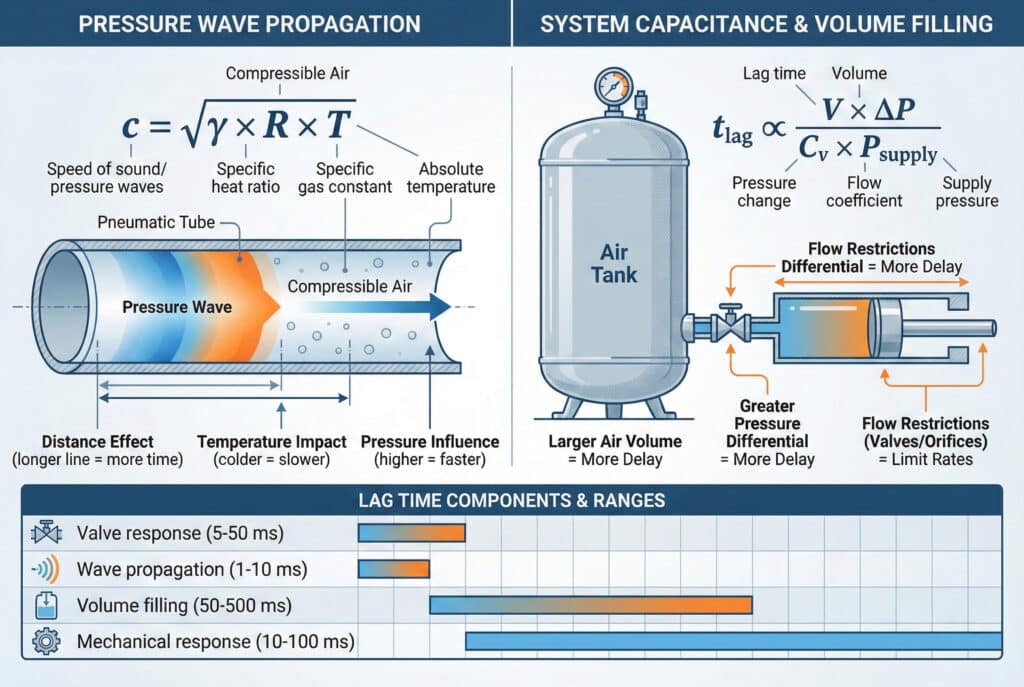
Transient pressure response lag results from the finite speed of pressure wave propagation2 through compressible air (approximately 343 m/s at standard conditions), combined with system capacitance3 effects where large air volumes must be pressurized or depressurized before motion begins.
Fundamental Physics of Pressure Propagation
The speed of pressure waves in air is governed by:
Where:
- = Speed of sound/pressure waves (m/s)
- = Specific heat ratio (1.4 for air)
- = Specific gas constant (287 J/kg·K for air)
- = Absolute temperature (K)
Primary Lag Contributors
Wave Propagation Delay:
- Distance Effect: Longer pneumatic lines increase propagation time
- Temperature Impact: Colder air reduces wave speed
- Pressure Influence: Higher pressures slightly increase wave speed
System Capacitance:
- Air Volume: Larger volumes require more air mass transfer
- Pressure Differential: Greater pressure changes need more time
- Flow Restrictions: Orifices and valves limit filling/emptying rates
Lag Time Components
| Component | Typical Range | Primary Factor |
|---|---|---|
| Valve response | 5-50 ms | Valve technology |
| Wave propagation | 1-10 ms | Line length |
| Volume filling | 50-500 ms | System capacitance |
| Mechanical response | 10-100 ms | Load inertia |
System Volume Impact
The relationship between volume and lag time follows:
Where larger volumes () and pressure changes () increase lag, while higher flow coefficients () and supply pressures reduce it.
How Do You Measure and Quantify Pressure Lag Time?
Accurate measurement of transient response requires proper instrumentation and analysis techniques. 📊
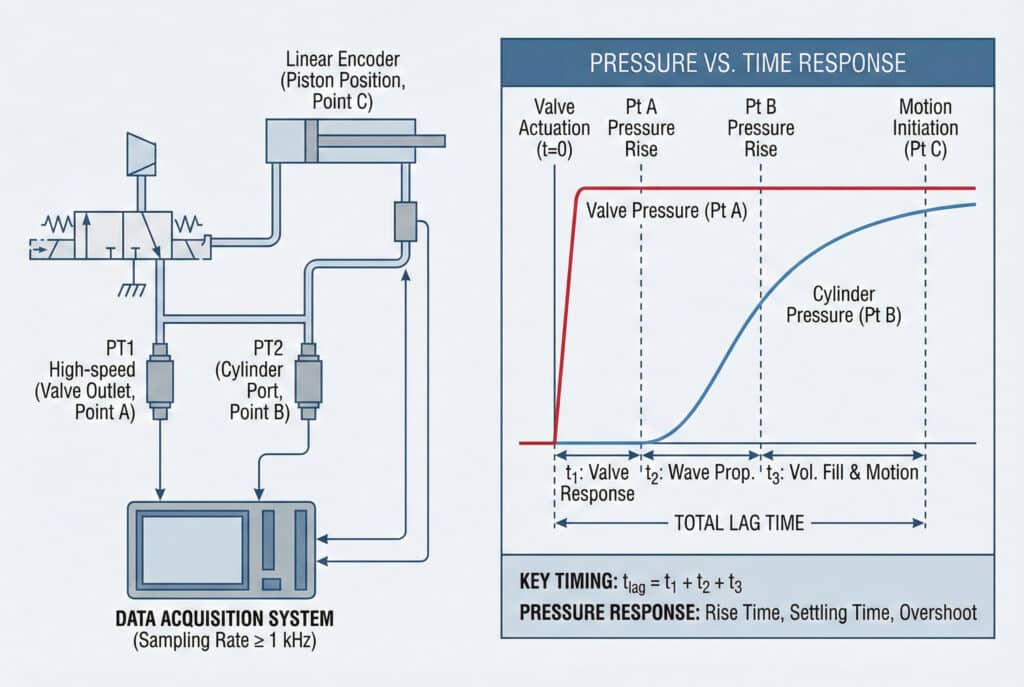
Measure pressure lag time using high-speed pressure transducers4 positioned at the valve outlet and cylinder port, recording pressure vs. time data at sampling rates of 1-10 kHz to capture the complete transient response from valve actuation to cylinder motion initiation.
Measurement Setup Requirements
Essential Instrumentation:
- Pressure Transducers: Response time <1ms, accuracy ±0.1%
- Data Acquisition: Sampling rate ≥1 kHz
- Position Sensors: Linear encoders or LVDTs for motion detection
- Valve Control: Precise timing control for test repeatability
Measurement Points:
- Point A: Valve outlet (reference timing)
- Point B: Cylinder port (arrival timing)
- Point C: Piston position (motion initiation)
Analysis Methodology
Key Timing Parameters:
- t₁: Valve actuation to outlet pressure change
- t₂: Outlet pressure change to cylinder port pressure change
- t₃: Cylinder port pressure change to motion initiation
- Total lag: t₁ + t₂ + t₃
Pressure Response Characteristics:
- Rise Time: 10-90% pressure change duration
- Settling Time: Time to reach ±2% of final pressure
- Overshoot: Peak pressure above steady-state value
Data Analysis Techniques
| Analysis Method | Application | Accuracy |
|---|---|---|
| Step Response | Standard lag measurement | ±5 ms |
| Frequency Response | Dynamic system characterization | ±2 ms |
| Statistical Analysis | Variation quantification | ±1 ms |
Case Study: Kevin’s Automotive Line
When we measured Kevin’s 2-meter stroke system:
- Valve response: 15 ms
- Wave propagation: 8 ms (2.7m total line length)
- Volume filling: 285 ms (large cylinder chamber)
- Motion initiation: 45 ms (high inertia load)
- Total measured lag: 353 ms
This explained his 400ms timing variations when combined with pressure supply fluctuations.
Why Are Long-Stroke Cylinders More Susceptible to Lag?
Long-stroke cylinders present unique challenges that amplify transient response issues. 📏
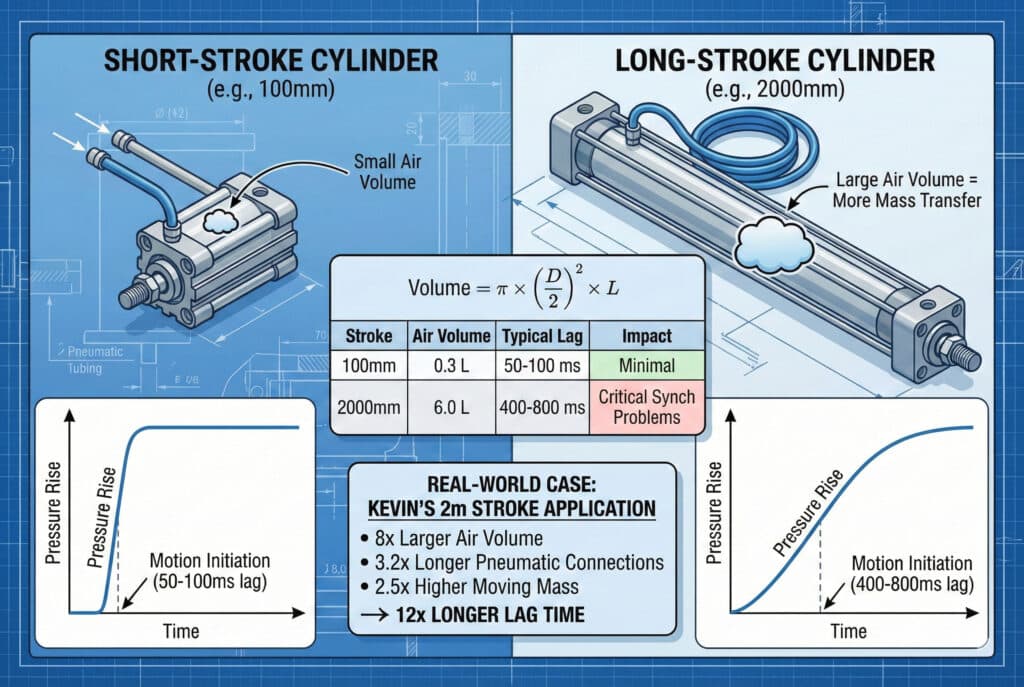
Long-stroke cylinders exhibit greater lag susceptibility due to larger internal air volumes requiring more air mass transfer, longer pneumatic connections increasing propagation delays, and higher moving masses creating greater inertial resistance to motion initiation.
Volume-to-Stroke Relationship
For a cylinder with bore diameter D and stroke length L:
The air volume scales linearly with stroke length, directly impacting lag time.
Stroke Length Impact Analysis
| Stroke Length | Air Volume | Typical Lag | Application Impact |
|---|---|---|---|
| 100 mm | 0.3 L | 50-100 ms | Minimal impact |
| 500 mm | 1.5 L | 150-300 ms | Noticeable delay |
| 1000 mm | 3.0 L | 250-500 ms | Significant timing issues |
| 2000 mm | 6.0 L | 400-800 ms | Critical synchronization problems |
Compounding Factors in Long-Stroke Systems
Pneumatic Line Length:
- Increased Distance: Longer strokes often require longer supply lines
- Multiple Connections: More fittings and potential restrictions
- Pressure Drop: Greater cumulative pressure losses
Mechanical Considerations:
- Higher Inertia: Longer cylinders often move heavier loads
- Structural Compliance: Longer systems may have mechanical flex
- Mounting Challenges: Support requirements affect response
Dynamic Behavior Differences
Long-stroke cylinders exhibit different dynamic characteristics:
Pressure Wave Reflections:
- Standing Waves: Can occur in long air columns
- Resonance Effects: Natural frequencies may coincide with operating frequencies
- Pressure Oscillations: Can cause hunting or instability
Non-Uniform Pressure Distribution:
- Pressure Gradients: Along the cylinder length during transients
- Local Accelerations: Different response at various stroke positions
- End Effects: Different behavior at stroke extremes
Real-World Case: Automotive Assembly
In Kevin’s application, we discovered that his 2-meter stroke cylinders had:
- 8x larger air volume than equivalent 250mm stroke cylinders
- 3.2x longer pneumatic connections due to machine layout
- 2.5x higher moving mass from extended tooling
- Combined effect: 12x longer lag time than short-stroke alternatives
What Methods Can Minimize Transient Response Lag?
Reducing transient response lag requires systematic approaches targeting each lag component. 🚀
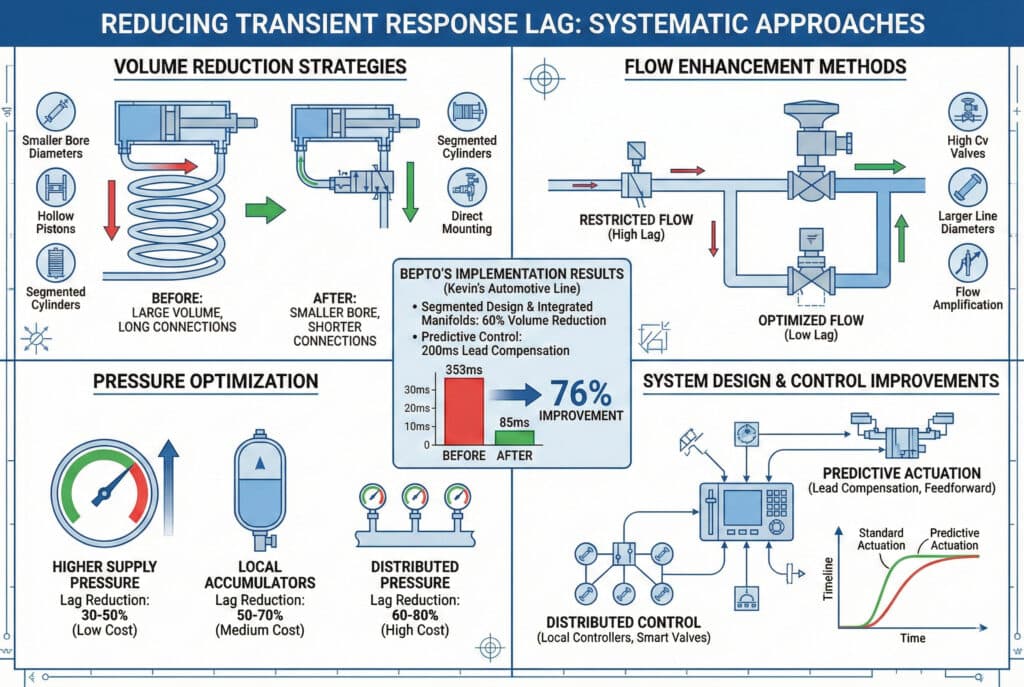
Minimize transient response lag through volume reduction (smaller bore cylinders, shorter connections), flow enhancement (larger valves, reduced restrictions), pressure optimization (higher supply pressure, accumulators), and system design improvements (distributed control, predictive actuation).
Volume Reduction Strategies
Cylinder Design Optimization:
- Smaller Bore Diameters: Reduce air volume while maintaining force
- Hollow Pistons: Minimize internal air volume
- Segmented Cylinders: Multiple shorter cylinders instead of one long cylinder
Connection Minimization:
- Direct Mounting: Valves mounted directly to cylinder
- Integrated Manifolds: Eliminate intermediate connections
- Optimized Routing: Shortest practical pneumatic paths
Flow Enhancement Methods
Valve Selection:
- High Cv Valves: Faster volume filling/emptying
- Fast Response Valves: Reduced valve actuation time
- Multiple Valves: Parallel flow paths for large volumes
System Design:
- Larger Line Diameters: Reduced flow restrictions
- Minimal Fittings: Each connection adds restriction
- Flow Amplification: Pilot-operated systems for large flows
Pressure System Optimization
| Method | Lag Reduction | Implementation Cost |
|---|---|---|
| Higher supply pressure | 30-50% | Low |
| Local accumulators | 50-70% | Medium |
| Distributed pressure | 60-80% | High |
| Predictive control | 70-90% | Very High |
Advanced Control Techniques
Predictive Actuation:
- Lead Compensation: Actuate valves before motion required
- Feedforward control5: Anticipate system response based on models
- Adaptive Timing: Learn and adjust for system variations
Distributed Control:
- Local Controllers: Reduce communication delays
- Smart Valves: Integrated control and actuation
- Edge Computing: Real-time response optimization
Bepto’s Lag Minimization Solutions
At Bepto Pneumatics, we’ve developed specialized approaches for long-stroke applications:
Design Innovations:
- Segmented Rodless Cylinders: Multiple shorter sections with coordinated control
- Integrated Valve Manifolds: Minimize connection volumes
- Optimized Port Geometry: Enhanced flow characteristics
Control Integration:
- Predictive Algorithms: Compensate for known lag characteristics
- Adaptive Systems: Self-tuning for varying conditions
- Distributed Sensing: Multiple position feedback points
Implementation Results
For Kevin’s automotive assembly line, we implemented:
- Segmented cylinder design: Reduced effective volume by 60%
- Integrated valve manifolds: Eliminated 40% of connection volume
- Predictive control: 200ms lead compensation
- Result: Reduced lag from 353ms to 85ms (76% improvement)
Cost-Benefit Analysis
| Solution Category | Lag Reduction | Cost Factor | ROI Timeline |
|---|---|---|---|
| Design optimization | 40-60% | 1.2-1.5x | 6-12 months |
| Flow enhancement | 30-50% | 1.1-1.3x | 3-6 months |
| Advanced control | 60-80% | 2.0-3.0x | 12-24 months |
The key to success lies in understanding that transient response lag is not just a timing issue—it’s a fundamental system characteristic that must be engineered from the ground up for optimal performance. 🎯
FAQs About Transient Pressure Response Lag
What’s the typical lag time for different cylinder stroke lengths?
Lag time generally scales with stroke length: 50-100ms for 100mm strokes, 150-300ms for 500mm strokes, and 400-800ms for 2000mm strokes. However, system design, valve selection, and operating pressure significantly influence these values.
How does operating pressure affect transient response lag?
Higher operating pressure reduces lag time by increasing the driving force for air flow and reducing the relative pressure change needed. Doubling supply pressure typically reduces lag by 30-40%, but the relationship is not linear due to choked flow limitations.
Can you eliminate transient response lag completely?
Complete elimination is impossible due to the finite speed of pressure wave propagation and air compressibility. However, lag can be reduced to negligible levels (10-20ms) through proper system design, or compensated through predictive control techniques.
Why do some cylinders seem to have inconsistent lag times?
Lag time variations result from supply pressure fluctuations, temperature changes affecting air density, valve response variations, and system loading differences. These factors can cause ±20-50% variation in lag time from cycle to cycle.
Do rodless cylinders have different lag characteristics than rod cylinders?
Rodless cylinders can have better lag characteristics due to design flexibility allowing optimized internal volumes and integrated valve mounting. However, they may also have larger internal volumes in some designs, so the net effect depends on specific implementation and application requirements.
-
Learn more about how air compressibility impacts the efficiency and response of pneumatic circuits. ↩
-
Explore technical studies on the speed and behavior of pressure wave propagation in industrial piping. ↩
-
Understand the role of system capacitance in managing air mass transfer and pressure stability. ↩
-
Review the technical standards for high-precision pressure transducers used in industrial diagnostics. ↩
-
Discover how feedforward control strategies can anticipate and compensate for system delays. ↩