Introduction
The Problem: Your underwater ROV’s pneumatic gripper works flawlessly at 10 meters depth, but at 30 meters it suddenly loses grip force and begins leaking air bubbles. 🌊 The Agitation: What you’re witnessing is catastrophic seal failure caused by external water pressure overwhelming seal geometry—a failure mode that standard pneumatic cylinders are never designed to handle. The Solution: Understanding how external pressure affects seal mechanics and implementing depth-rated designs transforms vulnerable components into reliable subsea actuators capable of operating at 50+ meters depth.
Here’s the direct answer: External water pressure creates a reverse pressure differential1 across cylinder seals, causing seal extrusion2, compression set3, and loss of sealing contact. Standard pneumatic seals fail at 2-3 bar external pressure (20-30m depth), while depth-rated designs using backup rings, pressure-balanced housings, and specialized elastomers can operate reliably to 10+ bar (100m+ depth). The critical factor is maintaining positive internal pressure differential of at least 2 bar above ambient water pressure.
Two months ago, I received an emergency call from Marcus, an engineer at an offshore aquaculture facility in Norway. His automated fish feeding system used pneumatic cylinders to operate underwater gates at 25 meters depth. After just three weeks of operation, five cylinders had failed—seals extruded, internal components corroded, and system pressure dropping to unusable levels. The water temperature was only 8°C, and he was using “marine-grade” cylinders that should have been suitable. This is a classic case of misunderstanding how external pressure fundamentally changes seal dynamics. 🐟
Table of Contents
- How Does External Water Pressure Affect Pneumatic Seal Performance?
- What Are the Critical Failure Modes at Different Depths?
- Which Seal Designs and Materials Work for Subsea Applications?
- How Do You Calculate Safe Operating Depth for Pneumatic Cylinders?
How Does External Water Pressure Affect Pneumatic Seal Performance?
Understanding the physics of external pressure is essential before selecting subsea pneumatic components. 🔬
External water pressure creates three critical effects on cylinder seals: reverse pressure differential forcing seals away from sealing surfaces, hydrostatic compression4 reducing seal cross-section by 5-15%, and pressure-driven water intrusion through microscopic gaps. At 10m depth (2 bar external), standard seals experience 2 bar force pushing them inward—opposite to their design direction. At 30m depth (4 bar), this reverse force exceeds most seal retention capabilities, causing extrusion into clearance gaps and catastrophic leakage.
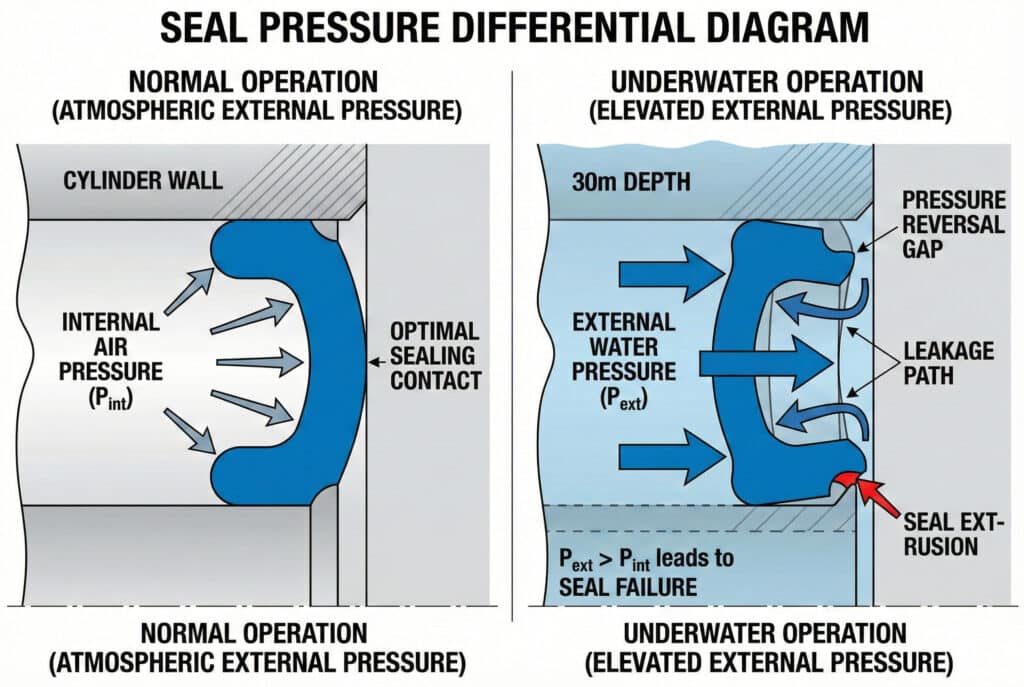
The Physics of Pressure Reversal
Standard pneumatic seals are designed for internal pressure energization:
- Normal Operation (Atmospheric External Pressure): Internal air pressure pushes seals outward against cylinder walls, creating tight sealing contact
- Underwater Operation (Elevated External Pressure): External water pressure pushes seals inward, away from sealing surfaces
- Critical Threshold: When external pressure exceeds internal pressure, seals lose all sealing force
Pressure Calculation Fundamentals
Depth-to-Pressure Conversion:
- Fresh Water: 1 bar per 10 meters depth
- Salt Water: 1 bar per 10.2 meters depth (slightly denser)
- Total Pressure: Atmospheric (1 bar) + Hydrostatic pressure
Examples:
- 10m depth: 2 bar absolute (1 bar hydrostatic + 1 bar atmospheric)
- 30m depth: 4 bar absolute
- 50m depth: 6 bar absolute
- 100m depth: 11 bar absolute
Why Standard Cylinders Fail Underwater
At Bepto Pneumatics, we’ve analyzed dozens of failed underwater cylinders. The failure progression is consistent:
Stage 1 (0-20m depth): Seals begin experiencing reverse pressure, slight performance degradation
Stage 2 (20-30m depth): Seal extrusion begins in clearance gaps, minor leakage appears
Stage 3 (30-40m depth): Catastrophic seal failure, rapid air loss, water intrusion
Stage 4 (40+ m depth): Complete seal destruction, internal corrosion, permanent damage
Real-World Pressure Effects
Consider a standard 50mm bore cylinder with 6 bar internal operating pressure:
| Depth | External Pressure | Net Differential | Seal Status | Performance |
|---|---|---|---|---|
| 0m (Surface) | 1 bar | +5 bar (internal) | Optimal | 100% |
| 10m | 2 bar | +4 bar (internal) | Good | 95% |
| 20m | 3 bar | +3 bar (internal) | Marginal | 80% |
| 30m | 4 bar | +2 bar (internal) | Critical | 50% |
| 40m | 5 bar | +1 bar (internal) | Failing | 20% |
| 50m | 6 bar | 0 bar (neutral) | Failed | 0% |
Notice that at 50m depth, internal and external pressures equalize—the seal has zero sealing force! 💧
What Are the Critical Failure Modes at Different Depths?
Different depth ranges produce distinct failure mechanisms that require specific countermeasures. ⚠️
Four primary failure modes occur at increasing depths: seal extrusion (20-40m) where seals squeeze into clearance gaps causing permanent deformation, O-ring compression set (30-50m) where sustained pressure permanently reduces seal cross-section by 15-30%, water intrusion and corrosion (all depths) where even minor leakage causes internal component degradation, and pressure imbalance buckling (50+ m) where external pressure physically deforms cylinder bodies. Each failure mode requires specific design modifications to prevent.
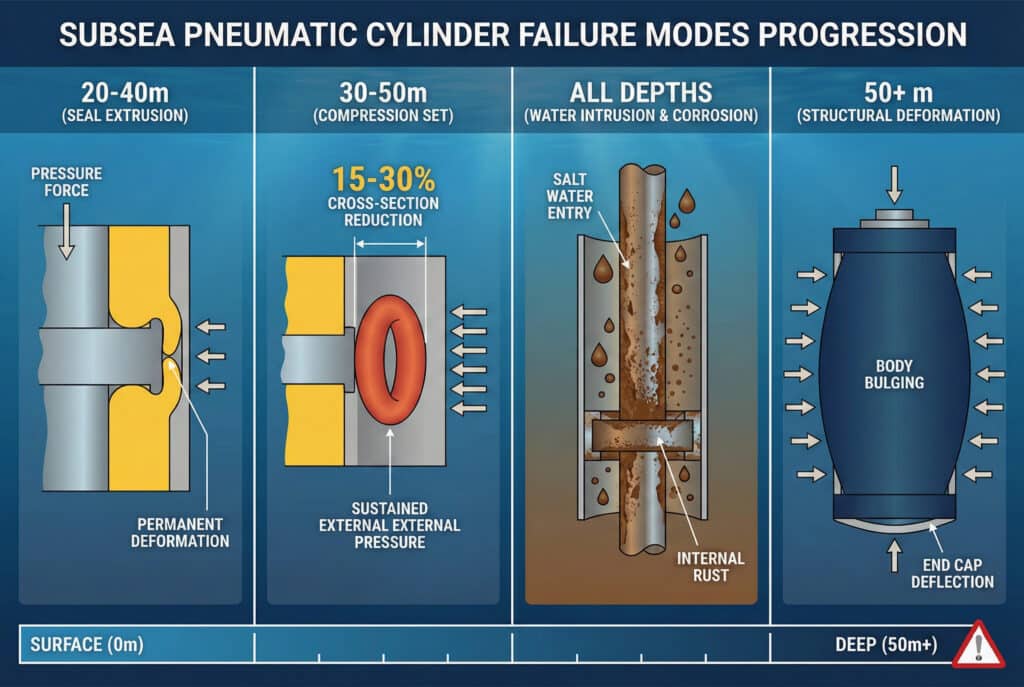
Failure Mode 1: Seal Extrusion (Shallow to Medium Depth)
Depth Range: 20-40 meters (3-5 bar external)
Mechanism: External pressure forces seal material into the clearance gap between piston and cylinder wall. Standard clearances of 0.15-0.25mm become extrusion pathways.
Symptoms:
- Visible seal material protruding from gland
- Increased friction and sticking
- Progressive air leakage
- Permanent seal damage after single deep excursion
Prevention:
- Backup rings (PTFE or nylon) to support seal
- Reduced clearances (0.05-0.10mm)
- Harder durometer seals (85-95 Shore A vs. standard 70-80)
Failure Mode 2: Compression Set (Medium Depth)
Depth Range: 30-50 meters (4-6 bar external)
Mechanism: Sustained hydrostatic pressure compresses seal cross-section. Elastomers don’t fully recover, losing 15-30% of original height after extended exposure.
Symptoms:
- Gradual performance degradation over days/weeks
- Increasing leakage rates
- Loss of sealing force even at surface
- Permanent seal deformation
Prevention:
- Low-compression-set materials (fluorocarbon, EPDM)
- Oversized seal cross-sections (20% larger than standard)
- Pressure cycling limits (avoid continuous deep exposure)
Failure Mode 3: Water Intrusion and Corrosion (All Depths)
Depth Range: All depths (accelerates with depth)
Mechanism: Even microscopic seal leakage allows water entry. Salt water causes rapid corrosion of internal steel components, aluminum oxidation, and lubricant contamination.
Symptoms:
- Brown/orange air discharge (rust particles)
- Increasing friction and binding
- Pitting visible on rod surfaces
- Complete seizure after weeks of exposure
Prevention:
- Stainless steel internal components (316L minimum)
- Corrosion-resistant coatings (hard anodizing, nickel plating)
- Water-resistant lubricants (synthetic, not petroleum-based)
- Sealed bearing designs preventing water pathways
Failure Mode 4: Structural Deformation (Deep Depth)
Depth Range: 50+ meters (6+ bar external)
Mechanism: External pressure exceeds structural design limits, causing cylinder body deformation, end cap deflection, and bearing housing distortion.
Symptoms:
- Binding and increased friction
- Visible cylinder body bulging
- End cap gasket failure
- Catastrophic structural failure
Prevention:
- Thicker wall cylinders (3-5mm vs. standard 2-3mm)
- Internal pressure compensation systems
- Pressure-balanced housing designs
- Material upgrades (aluminum to stainless steel)
Marcus’s Failure Analysis
Remember Marcus from the Norwegian aquaculture facility? When we examined his failed cylinders, we found:
- Primary Failure: Seal extrusion at 25m depth (3.5 bar external)
- Secondary Failure: Water intrusion causing internal corrosion within 72 hours
- Root Cause: Standard NBR seals without backup rings, operating at only 5 bar internal pressure (1.5 bar differential—insufficient)
His “marine-grade” cylinders were simply corrosion-resistant materials, not pressure-rated for external loading. 🔍
Which Seal Designs and Materials Work for Subsea Applications?
Successful underwater operation requires fundamentally different seal architecture and material selection. 🛠️
Depth-rated pneumatic seals use three key technologies: backup rings (PTFE or polyamide) preventing extrusion by filling clearance gaps, tandem seal configurations with dual sealing elements providing redundancy, and pressure-energized designs where external pressure actually improves sealing force. Material selection must prioritize low compression set (fluorocarbon FKM5, EPDM), water resistance (no NBR standard grades), and low-temperature performance for cold water applications. These specialized seals cost 3-5x more but provide 10-20x longer service life in subsea environments.
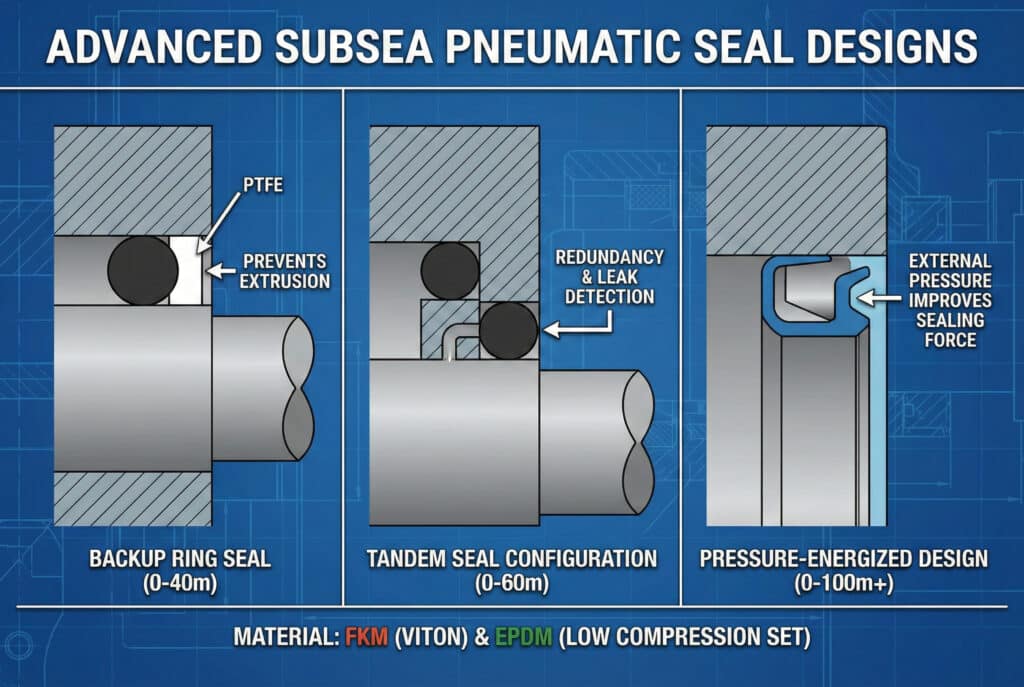
Seal Design Architectures
Standard Seal (Surface Use Only)
Configuration: Single O-ring in rectangular gland
- Depth Rating: 0-10m maximum
- Failure Depth: 20-30m
- Cost Factor: 1.0x (baseline)
Backup Ring Seal (Shallow Subsea)
Configuration: O-ring + PTFE backup ring
- Depth Rating: 0-40m
- Failure Depth: 50-60m
- Cost Factor: 2.5x
- Improvement: Prevents extrusion, extends depth capability 2-3x
Tandem Seal (Medium Subsea)
Configuration: Two O-rings in series with pressure vent between
- Depth Rating: 0-60m
- Failure Depth: 80-100m
- Cost Factor: 3.5x
- Improvement: Redundancy, gradual failure mode, leak detection capability
Pressure-Balanced Seal (Deep Subsea)
Configuration: Specialized profile that uses external pressure for sealing
- Depth Rating: 0-100m+
- Failure Depth: 150m+
- Cost Factor: 5.0x
- Improvement: Performance improves with depth, professional ROV-grade
Material Selection Matrix
| Material | Compression Set | Water Resistance | Temperature Range | Depth Rating | Cost Factor |
|---|---|---|---|---|---|
| NBR (Standard) | Poor (25-35%) | Poor (swells) | -20°C to +80°C | 10m max | 1.0x |
| NBR (Low-Temp) | Fair (20-25%) | Poor (swells) | -40°C to +80°C | 15m max | 1.3x |
| EPDM | Excellent (10-15%) | Excellent | -40°C to +120°C | 50m | 2.0x |
| FKM (Viton) | Excellent (8-12%) | Excellent | -20°C to +200°C | 80m | 3.5x |
| FFKM (Kalrez) | Outstanding (5-8%) | Outstanding | -15°C to +250°C | 100m+ | 8.0x |
The Bepto Subsea Solution
At Bepto Pneumatics, we’ve developed a specialized subsea cylinder series with integrated depth-rated features:
Shallow Water Series (0-30m):
- EPDM seals with polyamide backup rings
- Hard-anodized aluminum bodies (Type III, 50+ micron)
- 316 stainless steel rods and internal components
- Synthetic ester lubrication
- Cost Premium: +60% vs. standard
Deep Water Series (0-60m):
- FKM tandem seals with PTFE backup rings
- 316L stainless steel bodies and components
- Pressure-balanced end caps
- Water-resistant bearing systems
- Cost Premium: +120% vs. standard
Professional ROV Series (0-100m):
- FFKM pressure-energized seals
- Titanium rod options for weight reduction
- Integrated pressure compensation
- Subsea connector compatibility
- Cost Premium: +250% vs. standard
Material Compatibility Considerations
Don’t forget about chemical compatibility in marine environments:
- Salt Water: Highly corrosive, requires stainless steel (316L minimum)
- Fresh Water: Less corrosive but still requires protection
- Chlorinated Water: Pools and treatment facilities—avoid standard NBR
- Biological Contamination: Algae, bacteria—use smooth surfaces, frequent cleaning
How Do You Calculate Safe Operating Depth for Pneumatic Cylinders?
Engineering subsea pneumatic systems requires systematic pressure analysis and safety factor application. 📐
Safe operating depth calculation follows this formula: Maximum Depth (meters) = [(Internal Operating Pressure – Minimum Differential Pressure) / 0.1] – 10, where Internal Operating Pressure is in bar and Minimum Differential Pressure is 2 bar for standard seals or 1 bar for pressure-balanced designs. Always apply a 50% safety factor for dynamic applications and 30% for static applications. This ensures seals maintain adequate sealing force throughout the entire operating cycle, accounting for pressure drops during actuation.
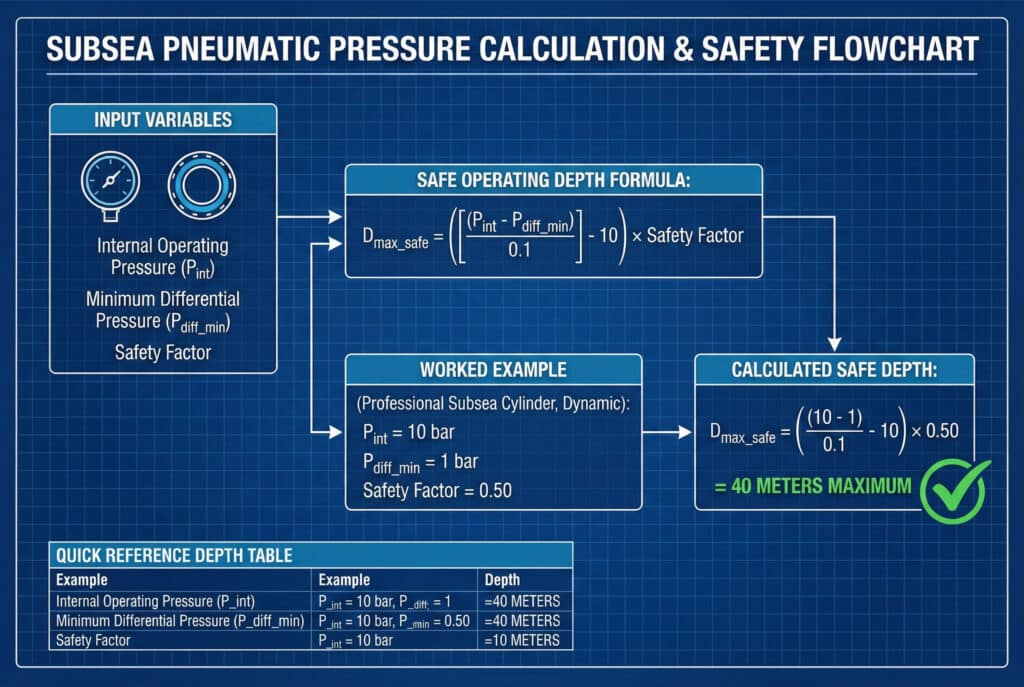
Step-by-Step Calculation Method
Step 1: Determine Internal Operating Pressure
P_internal = Your system’s regulated air pressure (typically 4-8 bar)
Step 2: Define Minimum Differential Pressure
P_differential_min = Required pressure difference for seal function
- Standard seals: 2 bar minimum
- Backup ring seals: 1.5 bar minimum
- Pressure-balanced seals: 1 bar minimum
Step 3: Calculate Theoretical Maximum Depth
D_max_theory = [(P_internal – P_differential_min) / 0.1] – 10
Step 4: Apply Safety Factor
D_max_safe = D_max_theory × Safety Factor
- Static applications: 0.70 (30% reduction)
- Dynamic applications: 0.50 (50% reduction)
- Critical applications: 0.40 (60% reduction)
Worked Examples
Example 1: Standard Industrial Cylinder
- Internal pressure: 6 bar
- Seal type: Standard O-ring (2 bar differential required)
- Application: Dynamic (safety factor 0.50)
Calculation:
- D_max_theory = [(6 – 2) / 0.1] – 10 = 40 – 10 = 30 meters
- D_max_safe = 30 × 0.50 = 15 meters maximum
Example 2: Backup Ring Equipped Cylinder
- Internal pressure: 7 bar
- Seal type: O-ring + backup ring (1.5 bar differential required)
- Application: Static (safety factor 0.70)
Calculation:
- D_max_theory = [(7 – 1.5) / 0.1] – 10 = 55 – 10 = 45 meters
- D_max_safe = 45 × 0.70 = 31.5 meters maximum
Example 3: Professional Subsea Cylinder
- Internal pressure: 10 bar
- Seal type: Pressure-balanced (1 bar differential required)
- Application: Dynamic (safety factor 0.50)
Calculation:
- D_max_theory = [(10 – 1) / 0.1] – 10 = 90 – 10 = 80 meters
- D_max_safe = 80 × 0.50 = 40 meters maximum
Quick Reference Depth Table
| Internal Pressure | Seal Type | Safe Dynamic Depth | Safe Static Depth |
|---|---|---|---|
| 4 bar | Standard | 5m | 8m |
| 6 bar | Standard | 15m | 21m |
| 6 bar | Backup Ring | 18m | 25m |
| 8 bar | Standard | 25m | 35m |
| 8 bar | Backup Ring | 28m | 39m |
| 10 bar | Backup Ring | 38m | 53m |
| 10 bar | Pressure-Balanced | 40m | 56m |
Marcus’s Corrected System Design
After our analysis, we redesigned Marcus’s aquaculture system:
Original Specification:
- 5 bar internal pressure
- Standard seals
- Theoretical depth: 20m
- Actual operating depth: 25m ❌ UNSAFE
Corrected Specification:
- 8 bar internal pressure (increased regulator setting)
- EPDM seals with backup rings (1.5 bar differential)
- Theoretical depth: 55m
- Safe dynamic depth: 27.5m
- Operating depth: 25m ✅ SAFE with 10% margin
Results after 9 months:
- Zero seal failures
- Consistent performance
- Maintenance interval: Extended from 3 weeks to 8 months
- ROI: Achieved in 4 months through elimination of emergency replacements
He told me: “I never understood that external pressure was the opposite of internal pressure from a seal perspective. Once we got the differential pressure right and used proper seals, the problems completely disappeared.” 🎯
Additional Design Considerations
Beyond depth calculations, consider:
- Pressure Drop During Actuation: Internal pressure drops 0.5-1.5 bar during cylinder extension—ensure differential remains positive at minimum pressure
- Temperature Effects: Cold water increases air density, slightly improving performance; warm water reduces viscosity
- Cycle Rate: Rapid cycling generates heat, potentially affecting seal performance
- Contamination: Silt, sand, and biological growth accelerate seal wear—use protective boots
- Maintenance Access: Underwater seal replacement is extremely difficult—design for surface servicing
Conclusion
Underwater pneumatic operation isn’t simply about corrosion resistance—it’s about understanding how external pressure fundamentally reverses seal loading conditions. By calculating proper pressure differentials, selecting depth-rated seal designs, and applying appropriate safety factors, pneumatic cylinders can operate reliably at 50+ meters depth, providing cost-effective actuation for subsea applications where hydraulics would be prohibitively expensive. 🌊
FAQs About Underwater Depth Ratings
Can I increase internal pressure to operate deeper without changing seals?
Yes, but only to the pressure rating of your cylinder body and components—most standard cylinders are rated to 10 bar maximum, limiting practical depth to 40-50m even with perfect seals. Increasing internal pressure is the most cost-effective depth extension method if your cylinder is rated for it. However, verify that all components (end caps, ports, fittings) can handle the increased pressure. At Bepto Pneumatics, our subsea cylinders are rated to 12-15 bar specifically to enable deeper operation.
What happens if a seal fails at depth—is it dangerous?
Seal failure at depth causes rapid air loss and potential implosion if the cylinder is large, but typically results in loss of function rather than violent failure. The main dangers are: loss of gripper/actuator control (dropped objects), rapid ascent of buoyant equipment, and water intrusion causing permanent damage. Always use redundant systems for critical subsea operations and implement pressure monitoring with automatic surface recall on pressure loss.
Do I need special air preparation for underwater pneumatics?
Absolutely—moisture in compressed air will condense at depth and temperature, causing ice formation in cold water and corrosion acceleration. Use refrigerated air dryers rated to -40°C dew point minimum, plus inline filters with 5-micron rating and automatic drain traps. We also recommend adding corrosion inhibitor additives to the air supply for long-term subsea installations.
How often should subsea cylinders be serviced?
Subsea cylinders require inspection every 3-6 months versus 12-18 months for surface cylinders, with complete seal replacement annually regardless of condition. The harsh environment accelerates wear even when seals appear functional. At Bepto Pneumatics, we recommend bringing subsea cylinders to the surface monthly for visual inspection and pressure testing, with full rebuild every 12 months or 50,000 cycles, whichever comes first.
Are rodless cylinders suitable for underwater use?
Rodless cylinders are actually superior for subsea applications due to the sealed carriage design that naturally resists water intrusion—our Bepto subsea rodless cylinders operate reliably to 60m depth. The magnetic coupling or cable-driven designs eliminate the rod seal penetration that’s the primary water entry point in traditional cylinders. The carriage seals experience less pressure differential and benefit from the enclosed guide rail design. For long-stroke underwater applications, rodless designs offer better depth ratings and longer service life than rod-style cylinders. 🚀
-
Learn how pressure direction changes affect seal energization and overall system integrity. ↩
-
Discover the mechanics behind seal material migration into clearance gaps and how to prevent it. ↩
-
Understand the standard measurement of an elastomer’s ability to return to its original thickness after prolonged stress. ↩
-
Explore how extreme water depth physically alters the volume and cross-section of sealing materials. ↩
-
Compare the technical specifications of fluorocarbon elastomers for high-performance subsea environments. ↩