מבוא
It’s 2:00 AM when your phone rings. Your single-source pneumatic supplier just experienced a factory fire, and they can’t fulfill orders for the next three months. Your production lines need cylinders in two weeks, or you’ll miss delivery commitments worth millions. You’re scrambling to find alternative suppliers who can meet your specifications, but nobody has stock, and custom orders take 8-10 weeks. This nightmare could have been avoided with a proper dual-sourcing strategy. 😰
Effective dual-sourcing for pneumatic components involves maintaining qualified relationships with two or more suppliers, implementing strategic volume splits (typically 70/30 or 60/40), establishing clear qualification criteria and performance metrics, maintaining interchangeable specifications across suppliers, and balancing cost optimization with supply chain resilience1 to protect against disruptions.
I remember the call I got from Richard, a supply chain director at an automotive tier-1 supplier in Michigan. His single-source pneumatic cylinder supplier in Europe couldn’t ship due to port strikes. He needed 200 rodless cylinders in three weeks or face $50,000/day in line-down penalties. Because we’d already established a qualified secondary relationship six months earlier, we ramped up production immediately and saved his contract. That’s the power of dual-sourcing done right. 💪
תוכן העניינים
- What Are the Key Risks of Single-Source Pneumatic Procurement?
- How Do You Select and Qualify Secondary Suppliers?
- What’s the Optimal Volume Split Between Suppliers?
- How Do You Manage and Maintain Multiple Supplier Relationships?
What Are the Key Risks of Single-Source Pneumatic Procurement?
Understanding vulnerability is the first step toward building resilience in your supply chain. 🎯
Single-source procurement exposes you to catastrophic risks including supply disruptions from natural disasters or operational failures, quality issues with no alternative source, price increases without competitive pressure, capacity constraints during demand surges, geopolitical risks and trade disruptions, and complete dependency on one supplier’s financial stability and business continuity.
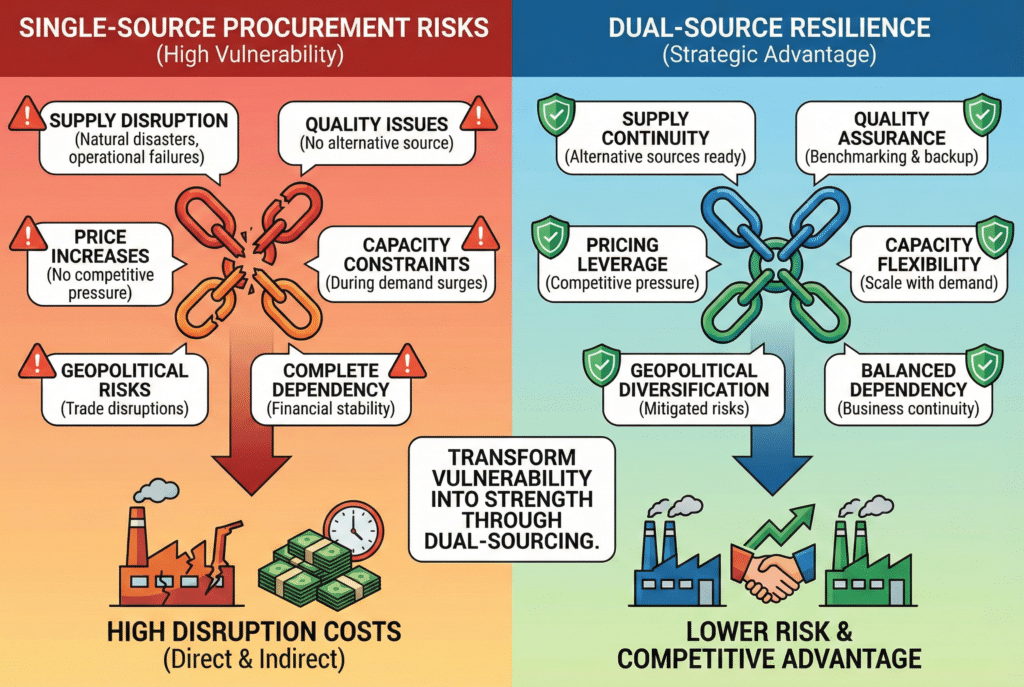
The Hidden Costs of Supply Disruption
Let me break down what a supply chain failure actually costs:
עלויות ישירות:
- Production downtime ($10,000-$100,000+ per day depending on your operation)
- Expedited shipping for emergency alternatives (300-500% of normal freight)
- Premium pricing for rush orders (20-50% markup)
- Overtime labor to recover lost production
עלויות עקיפות:
- Lost customer confidence and potential contract penalties
- Damaged reputation in your market
- Emergency sourcing time (engineering, procurement, quality teams diverted)
- Inventory carrying costs for safety stock built after the crisis
Real-World Disruption Scenarios
These aren’t theoretical—I’ve seen each of these happen to single-source buyers:
Natural Disasters and Force Majeure
- 2011 Japan earthquake2: Disrupted pneumatic component supply chains globally for 6+ months
- 2020 COVID-19: Factory shutdowns and logistics chaos worldwide
- 2021 Texas freeze: Chemical plants offline, affecting seal and polymer materials
- Ongoing geopolitical tensions: Trade restrictions, tariffs, port congestion
Supplier-Specific Risks
- Financial instability: Supplier bankruptcy or acquisition
- Quality failures: Product recalls or certification issues
- Capacity constraints: Can’t scale with your growth
- Labor disputes: Strikes, workforce shortages
- Technology obsolescence: Can’t keep up with your innovation needs
The Competitive Disadvantage
Single-sourcing also creates business risks beyond supply continuity:
No pricing leverage: Your supplier knows you’re captive—why offer competitive pricing?
Innovation stagnation: Without competitive pressure, suppliers become complacent about improvements.
Inflexible terms: Payment terms, lead times, and service levels favor the supplier, not you.
I worked with Angela, a procurement manager at a packaging machinery company in California, who was paying 40% above market rates because her single-source cylinder supplier knew she had no alternatives. Within six months of implementing dual-sourcing with Bepto Pneumatics as her secondary supplier, her primary supplier “suddenly” became more competitive. Funny how that works. 📉
Industry-Specific Risk Factors
| תעשייה | Primary Risk | Impact of Disruption | Dual-Sourcing Priority |
|---|---|---|---|
| רכב | JIT production3, line-down costs | $50K-$200K per hour | קריטי |
| מזון ומשקאות | Perishable products, seasonal demand | Lost production + spoilage | גבוה |
| תרופות | Regulatory compliance, validation | Compliance issues + revenue loss | גבוה |
| ייצור כללי | Customer commitments, reputation | Delayed deliveries, penalties | בינוני-גבוה |
| Machine Building | Project timelines, custom orders | Project delays, contract penalties | מתון |
How Do You Select and Qualify Secondary Suppliers?
Your secondary supplier must be truly qualified—not just a name on a list for audit purposes. 🔍
Secondary supplier selection requires evaluating technical capability to meet your specifications, quality certifications and manufacturing standards (תקן ISO 90014 minimum), production capacity to scale during emergencies, geographic diversification to avoid common risks, financial stability for long-term viability, cultural fit and communication compatibility, and willingness to maintain qualified status with regular smaller orders.
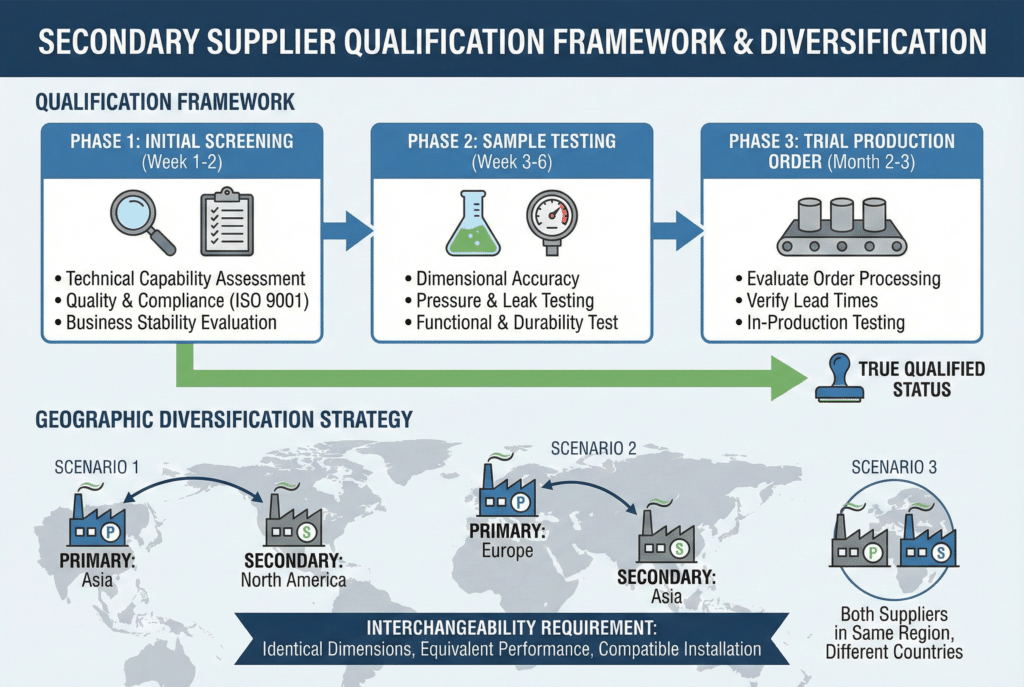
The Qualification Framework
Don’t just pick a backup supplier from a directory—use a systematic approach:
Phase 1: Initial Screening (Week 1-2)
Technical capability assessment:
- Can they manufacture your specific pneumatic components?
- Do they have experience with similar applications?
- What’s their technical support capability?
- Can they provide engineering assistance if needed?
Quality and compliance verification:
- ISO 9001 certification (verify authenticity)
- Industry-specific certifications if required
- Quality metrics and defect rates
- Testing and inspection capabilities
Business stability evaluation:
- Years in business and financial health
- Customer references from similar industries
- Production capacity and scalability
- Geographic location and supply chain diversity
Phase 2: Sample Testing (Week 3-6)
Request samples and conduct thorough evaluation:
- Dimensional accuracy verification
- Pressure and leak testing
- Functional performance under load
- Durability and cycle testing
- Material analysis if critical
Success criteria: Secondary supplier samples must meet or exceed your primary supplier’s quality standards. No compromises. ✅
Phase 3: Trial Production Order (Month 2-3)
Place a small production order (50-200 units):
- Evaluate order processing and communication
- Verify lead time commitments
- Assess packaging and shipping quality
- Test components in actual production environment
- Monitor for any field failures
Geographic Diversification Strategy
Smart dual-sourcing includes geographic risk mitigation:
Scenario 1: Primary supplier in Asia, Secondary in North America
- Protects against regional disruptions
- Reduces lead time for emergency orders
- Balances cost (Asia) with responsiveness (North America)
Scenario 2: Primary supplier in Europe, Secondary in Asia
- Currency diversification
- Different regulatory environments
- Complementary time zones for support
Scenario 3: Both suppliers in same region, different countries
- Similar lead times and logistics
- מורכבות מופחתת
- Still protects against country-specific issues
At Bepto Pneumatics, we serve as the Asian secondary source for many North American and European companies whose primary suppliers are domestic. We provide the cost advantage and capacity they need, with reliable trans-Pacific logistics they can count on. 🌏
The Interchangeability Requirement
This is critical and often overlooked:
Your secondary supplier’s components must be functionally interchangeable with your primary supplier’s products.
That means:
- Identical or compatible mounting dimensions
- Equivalent performance specifications
- Interchangeable spare parts where possible
- Similar installation procedures
- Compatible with existing documentation
I helped Steven, a maintenance engineer at a beverage bottling plant in Georgia, Force Majeure5 establish dual-sourcing for his rodless cylinders. We reverse-engineered his primary supplier’s specifications and provided dimensionally identical replacements. His maintenance team can swap between suppliers without retraining, retooling, or redesigning—that’s true interchangeability. 🔧
What’s the Optimal Volume Split Between Suppliers?
The right split balances cost efficiency with supply chain resilience—there’s no one-size-fits-all answer. ⚖️
Most effective dual-sourcing strategies use a 70/30 or 60/40 volume split, allocating majority volume to the primary supplier for best pricing while maintaining meaningful secondary supplier engagement through regular orders that keep them qualified, capable, and motivated—with flexibility to shift volumes based on performance, capacity, or market conditions.
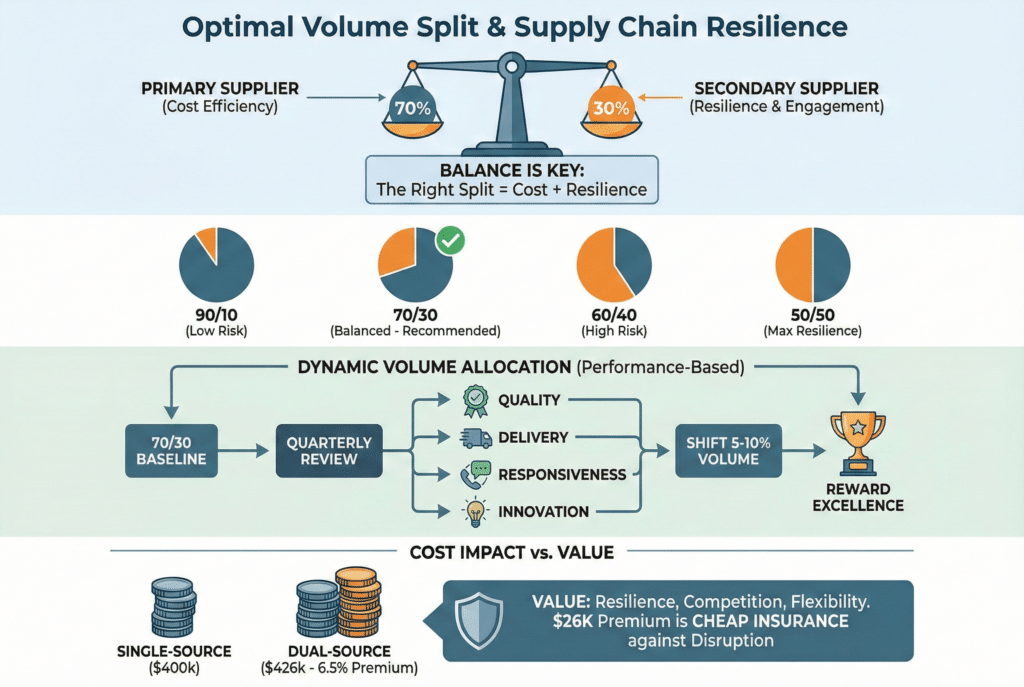
Common Volume Split Models
| Split Ratio | הכי מתאים ל | יתרונות | חסרונות |
|---|---|---|---|
| 90/10 | Low-risk items, cost-focused | Maximum volume discounts | Secondary supplier may not stay engaged |
| 70/30 | Balanced approach | Good pricing + real backup capability | Most popular and effective |
| 60/40 | High-risk items, critical components | Strong competition, true redundancy | Slightly higher total cost |
| 50/50 | Maximum resilience needed | Complete redundancy, strong competition | Loses some volume pricing advantage |
Dynamic Volume Allocation
The smartest buyers don’t use fixed splits—they adjust based on performance:
Performance-based allocation:
- Start with 70/30 baseline
- Shift 5-10% volume quarterly based on metrics:
- On-time delivery performance
- Quality/defect rates
- Responsiveness to issues
- Innovation and improvement initiatives
- Pricing competitiveness
This creates healthy competition and rewards excellence. 🏆
The Minimum Viable Volume
Your secondary supplier needs enough volume to stay engaged:
Too little volume (<10%):
- You’re not a priority customer
- They won’t invest in understanding your needs
- Capacity may not be available when you need it
- Pricing won’t be competitive
Appropriate volume (20-40%):
- You’re a valued customer worth supporting
- They maintain tooling and expertise for your products
- Capacity is reserved for your needs
- Competitive pricing reflects your importance
I worked with Karen, a buyer at a pharmaceutical equipment manufacturer in New Jersey, who initially gave us only 5% of her cylinder volume. When she needed to surge production, we couldn’t prioritize her small orders. We restructured to 30% volume with quarterly commitments—now when she needs capacity, we’re ready. That’s how partnerships work. 🤝
ניתוח השפעת העלויות
Let’s look at real numbers:
Scenario: 1,000 pneumatic cylinders annually
Single-source pricing:
- 1,000 units @ $400/unit = $400,000
- Volume discount: 45% off list
- Total cost: $400,000
Dual-source pricing (70/30 split):
- Primary: 700 units @ $420/unit = $294,000 (40% discount, less volume)
- Secondary: 300 units @ $440/unit = $132,000 (35% discount, less volume)
- Total cost: $426,000
- Additional cost: $26,000 (6.5% premium)
But consider the value:
- Supply chain resilience: Priceless when disruption hits
- Competitive pressure: Keeps both suppliers sharp
- Capacity flexibility: Can scale with either supplier
- Risk mitigation: $26K is cheap insurance against $100K+ disruption costs
Seasonal and Project-Based Splits
Some buyers use variable splits based on business cycles:
Steady-state operations: 70/30 split for routine replenishment
Peak season: 60/40 or even 50/50 to maximize capacity
New product launches: 50/50 to test both suppliers’ responsiveness
Cost reduction initiatives: Shift 10-20% to better performer as leverage
How Do You Manage and Maintain Multiple Supplier Relationships?
Dual-sourcing only works if you actively manage both relationships—passive backup suppliers fail when you need them. 📊
Effective multi-supplier management requires establishing clear performance metrics and scorecards, conducting regular business reviews (quarterly minimum), maintaining consistent communication and forecasting with both suppliers, ensuring both suppliers stay qualified through ongoing orders, creating documented escalation procedures, and treating both suppliers as strategic partners rather than transactional vendors.

The Supplier Scorecard System
Measure what matters and share results with both suppliers:
Key Performance Indicators (KPIs):
| מטרי | יעד | משקל | תדירות המדידה |
|---|---|---|---|
| משלוח בזמן | ≥95% | 30% | חודשי |
| Quality (defect rate) | ≤0.5% | 30% | חודשי |
| Lead time compliance | ±3 days | 15% | Per order |
| Responsiveness | <24 hours | 10% | Per inquiry |
| תמיכה טכנית | Customer satisfaction ≥4/5 | 10% | Quarterly survey |
| שיפור מתמיד | Active participation | 5% | סקירה רבעונית |
Quarterly scoring: Calculate composite scores and share with both suppliers. This creates transparency and healthy competition.
The Quarterly Business Review
Don’t just order and forget—maintain active relationships:
QBR agenda template:
Performance review (30 minutes)
- Scorecard results vs. targets
- Trend analysis (improving or declining?)
- Specific examples of excellence or issues
Operational updates (20 minutes)
- Upcoming volume forecasts (next 6-12 months)
- New product introductions or changes
- Capacity requirements and constraints
Strategic discussion (20 minutes)
- Cost reduction opportunities
- Quality improvement initiatives
- Innovation and new technology
- Market trends and competitive intelligence
Action items and commitments (10 minutes)
- Documented next steps with owners and deadlines
- Follow-up on previous action items
At Bepto Pneumatics, I personally conduct QBRs with strategic dual-source partners. It’s not delegated to account managers—I want to understand your business and ensure we’re delivering value. 💼
Communication and Forecasting
Both suppliers need visibility to serve you effectively:
Monthly forecasting:
- Rolling 6-month forecast updated monthly
- Identify seasonal peaks and valleys
- Flag potential surges or reductions
- Share with both suppliers simultaneously
Transparent allocation:
- Don’t play suppliers against each other with false information
- Be honest about your dual-sourcing strategy
- Explain how you allocate volume
- Set clear expectations about performance-based shifts
The Emergency Escalation Protocol
Document and communicate how to handle crises:
Tier 1: Routine issues (quality defect, minor delay)
- Contact: Account manager or quality team
- Response time: 24 hours
- Resolution target: 3-5 days
Tier 2: Significant issues (major quality problem, substantial delay)
- Contact: Operations manager or plant manager
- Response time: 4 hours
- Resolution target: 24-48 hours
Tier 3: Critical emergency (production stoppage, urgent need)
- Contact: Executive level (like me at Bepto Pneumatics)
- Response time: Immediate
- Resolution target: Same day action plan
Make sure both suppliers have your escalation contacts too—communication flows both ways.
Avoiding the “Squeeze Play”
Here’s what NOT to do in dual-sourcing:
❌ Playing suppliers against each other dishonestly: “Supplier B offered me $300, can you beat it?” (when they didn’t)
❌ Keeping secondary supplier in the dark: Only contacting them when you need emergency help
❌ Constantly threatening to shift volume: Using allocation as a weapon rather than performance tool
❌ Sharing proprietary information: Disclosing one supplier’s innovations to the other
✅ Instead, build genuine partnerships:
- Be transparent about your strategy
- Reward performance with volume
- Respect both suppliers’ business needs
- Create win-win scenarios
I’ve seen buyers destroy good supplier relationships with aggressive tactics. Short-term gains, long-term losses. At Bepto Pneumatics, we value customers who treat us as partners—and we reciprocate with priority service, competitive pricing, and genuine commitment to their success. 🤝
Technology and Systems Integration
Make dual-sourcing operationally efficient:
Standardized part numbering:
- Create internal part numbers that map to both suppliers
- Maintain cross-reference tables
- Enable easy substitution in your ERP/MRP system
Supplier portals:
- Give both suppliers access to forecasts and orders
- Enable real-time order status visibility
- Streamline communication
Quality management integration:
- Both suppliers report to same quality system
- Consistent documentation and corrective action processes
- Unified performance tracking
סיכום
Dual-sourcing isn’t about spending more—it’s about investing wisely in supply chain resilience, competitive dynamics, and business continuity that protects your operations when single-source relationships inevitably face disruptions. 🎯
FAQs About Dual-Sourcing Pneumatic Components
מתי עליי ליישם אספקה כפולה עבור רכיבים פנאומטיים?
יש ליישם אספקה כפולה כאשר שיבוש באספקה ממקור יחיד יעלה יותר מפי 10 מהעלות הנוספת של תחזוקת ספק משני, עבור רכיבים חיוניים לייצור, כאשר ההוצאה השנתית עולה על $50,000, או כאשר זמני האספקה עולים על 6 שבועות. לדוגמה, אם תחזוקת ספק משני עולה $20,000 בשנה, אך עצירת קו ייצור אחד עולה $50,000+ ליום, מקור כפול הוא ביטוח חיוני. ב-Bepto Pneumatics, אנו עוזרים ללקוחות להעריך את ניתוח העלות-תועלת הזה באופן אובייקטיבי.
כמה זמן לוקח לאשר ספק משני כראוי?
הסמכת ספק משני נאותה דורשת בדרך כלל 3-6 חודשים, כולל הערכה ראשונית, בדיקת דוגמאות, הזמנות ייצור ניסיוניות ואימות בשטח, לפני הקצאת נפח ייצור משמעותי. Rushing this process increases risk—I’ve seen buyers designate “qualified” backups without proper testing, only to discover incompatibility or quality issues during an emergency. Invest the time upfront to ensure your secondary supplier is truly ready when you need them.
Can dual-sourcing actually reduce costs, or does it always cost more?
Dual-sourcing can reduce total costs through competitive pressure (5-15% price reductions), improved service levels, innovation competition, and avoiding catastrophic disruption costs that far exceed the incremental expense of maintaining two suppliers. I’ve seen primary suppliers suddenly become more competitive on pricing and service when they know a qualified alternative exists. The 5-10% premium for split volumes is often offset by improved overall supplier performance.
Should my secondary supplier be in a different geographic region?
Geographic diversification is highly recommended—having suppliers in different regions protects against regional disruptions (natural disasters, port strikes, geopolitical issues) and provides time zone advantages for support, though it may increase logistics complexity. Many of our Bepto Pneumatics dual-source customers have primary suppliers in North America or Europe and use us as their Asian secondary source—providing cost advantages, capacity diversity, and protection against regional supply chain disruptions.
How does Bepto Pneumatics support dual-sourcing strategies?
We specialize in serving as the qualified secondary supplier for companies with OEM or regional primary suppliers, offering competitive pricing at 20-40% volumes, maintaining rapid response capability for surge capacity, providing interchangeable specifications to match primary suppliers, and treating secondary-source customers as strategic partners with dedicated support. We understand that secondary doesn’t mean second-priority—when you need us, you REALLY need us, and we’re ready. Many customers start with us as secondary and eventually shift to 50/50 or even primary based on our performance. Let’s discuss how we can strengthen your supply chain resilience. 📞
-
Gain insights into the core strategies and frameworks for building a resilient industrial supply chain. ↩
-
Read about the historical impact of the 2011 Japan earthquake on global manufacturing supply chains. ↩
-
Explore the principles of Just-In-Time (JIT) production and its impact on manufacturing efficiency and risk. ↩
-
Understand the significance of ISO 9001 certification in ensuring consistent quality management systems. ↩
-
Learn about the legal implications of Force Majeure clauses in industrial procurement and supply contracts. ↩