

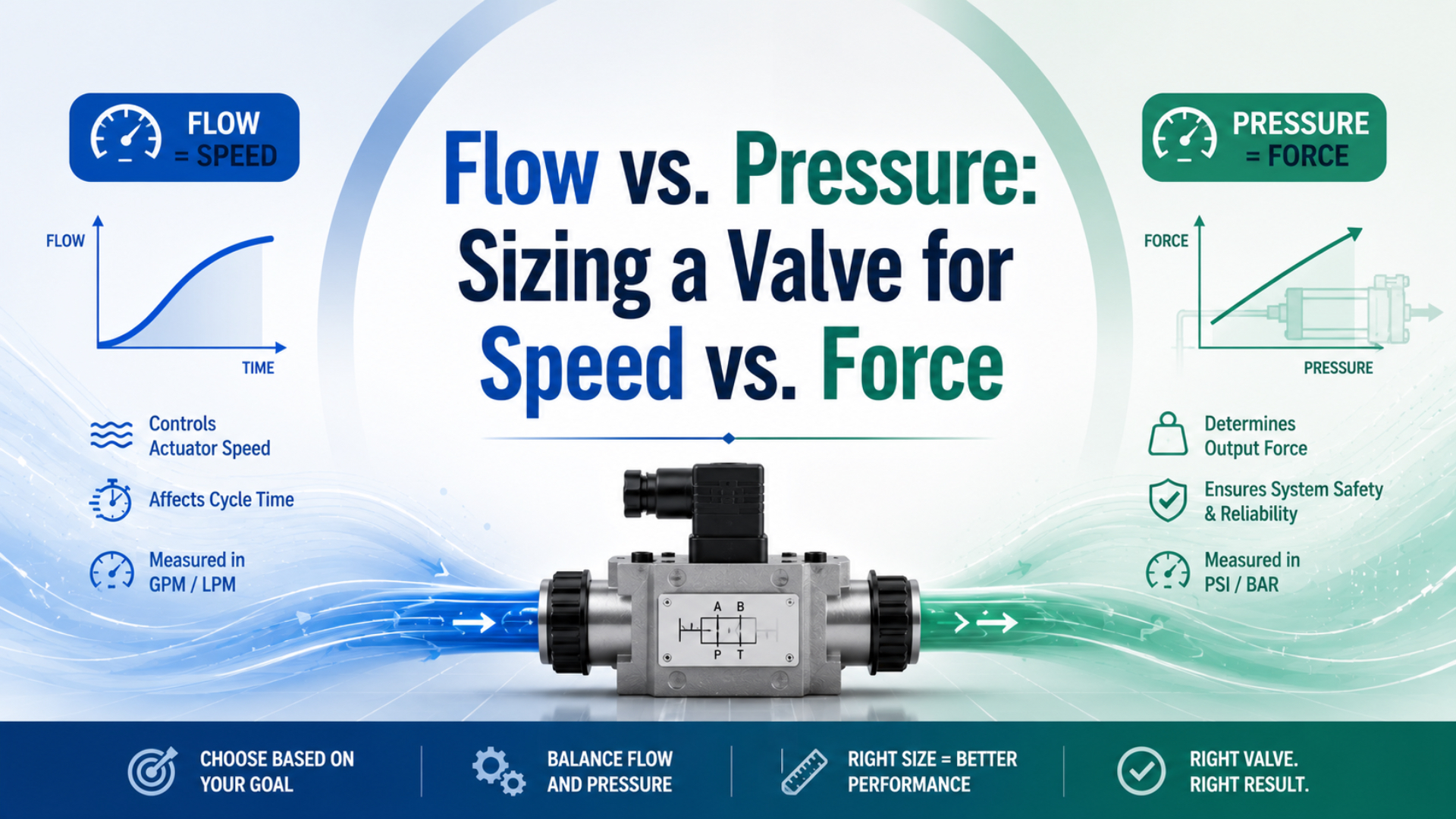
Size pressure-area margin for force, then size the valve and complete air path for speed; neither calculation replaces the other. At 6 bar, Parker lists 754 N outward and 633 N return force for one 40/16 mm single-rod cylinder (Parker Hannifin, P1F ISO 15552 Pneumatic Cylinders, retrieved 2026). Order matters.
That example doesn’t turn pressure and flow into interchangeable settings. Load and available pressure establish the minimum cylinder area. Bore, stroke, target time, pressure conditions, tubing, fittings, directional-valve paths, flow controls, and exhaust components then establish the required flow capacity. A large valve cannot repair an undersized cylinder. Raising pressure cannot remove a clogged silencer or narrow tube.
Pressure and flow solve different problems.
Key Takeaways
- Parker lists 754 N outward and 633 N return at 6 bar for one 40/16 mm cylinder.
- Choose cylinder bore from load and minimum dynamic pressure first.
- Calculate extension and retraction flow separately because piston area, annular area, chamber volume, and directional-valve paths all differ.
- Validate loaded stroke times and all three dynamic pressures.
Why Must Force and Speed Be Sized as Two Separate Limits?
Parker’s cylinder-valve guidance uses four sequential steps: collect load, maximum velocity, and minimum pressure; size the cylinder; size the valve or manifold; then specify the model. Force establishes bore first, while speed establishes the airflow path second (Parker Hannifin, Pneumatic Actuator Products, retrieved 2026).
Standstill makes the distinction obvious. A closed valve can hold upstream pressure with zero useful flow. Once the valve opens, airflow creates pressure loss through every restriction. During motion, the cylinder must retain enough chamber-pressure difference to accelerate and move the load while the path passes enough air to fill and exhaust the changing volumes.
| Design question | Primary variables | Component selected | Production proof |
|---|---|---|---|
| Can the cylinder start and sustain motion? | Load, direction, chamber pressures, piston area, rod area, friction | Cylinder bore and pressure range | Pressure at both ports while moving |
| Can it finish the stroke on time? | Bore, stroke, target time, valve rating, tube ID, exhaust capacity | Valve and complete air path | Loaded extension and retraction time |
| Can it stop without damage? | Moving mass, speed, cushion energy, orientation | Cushion, shock absorber, control strategy | End-of-stroke speed and impact |
One gauge cannot prove both gates.
From our analysis of Parker’s separate cylinder and valve sizing stages, force and speed work best as two pass-fail gates, not as opposite ends of one adjustment. A design can pass the force gate at rest and still fail during motion because pressure collapses across the flow path. It can also pass the speed gate unloaded and stall when production load raises the chamber-pressure requirement.
Force gate is the check that available chamber-pressure difference and effective area can overcome resistance. Speed gate is the separate check that supply and exhaust paths can move the required air within the target time. Passing either gate doesn’t prove the other one.
How Should Pressure Be Converted Into Usable Cylinder Force?
At 6 bar, Parker’s P1F catalog lists 754 N theoretical outward force and 633 N return force for a 40/16 mm single-rod cylinder. Rod area creates the gap (Parker Hannifin, P1F ISO 15552 Pneumatic Cylinders, retrieved 2026).
For extension of a double-acting single-rod cylinder, use the static force balance:
Here, is cap-end chamber pressure, is full piston area, is rod-end chamber pressure, is rod-side annular area, and covers seal friction, external friction, gravity, and other opposing loads. Use consistent pressure and area units. For retraction, exchange the active and opposing chamber terms.
Calculate the full piston and annular areas as follows:
is piston diameter and is rod diameter. These equations estimate static capacity. Acceleration adds an inertial term, breakaway friction can exceed running friction, and exhaust restriction can raise the opposing pressure. Regulator setpoint therefore cannot substitute for or measured at the cylinder ports during motion.
Measure the two ports.
Use the Cylinder Force Calculator to compare extension and retraction estimates from bore, rod diameter, working pressure, friction allowance, and safety factor. The guide to effective piston area explains why single-rod cylinders produce unequal theoretical forces. Don’t raise pressure to compensate for an unknown restriction. First confirm the cylinder, valve, tubing, fittings, regulator, and flow controls are rated for the proposed pressure. Then measure both chambers. The pressure-differential force guide covers this two-port interpretation in more detail.
How Much Flow Does the Target Stroke Time Require?
Parker’s valve-sizing example combines 8.30 square inches of area, a 12-inch stroke, a 6.4 compression factor at 80 PSI, a 0.048 pressure-drop constant, and one second. Its method returns Cv 1.06, tying stroke time and pressure conditions to valve capacity (Parker, retrieved 2026).
First estimate the moving chamber’s geometric displacement rate:
is the average chamber-condition volume rate, is the active piston or annular area, is stroke, and is the allowed stroke time. It is not a normal- or standard-condition flow rating. Converting it for a catalog method requires absolute chamber pressure, temperature, the stated reference condition, and the manufacturer’s prescribed calculation.
This is a first-pass average, not a transient simulation. It omits tubing dead volume, leakage, changing chamber pressure, acceleration, cushion throttling, valve switching delay, and the difference between average flow and peak flow. Use separate calculations for extension and retraction because the active areas and required forces differ.
Now check the actual valve path.
The calculated demand is only the start. Match it to the valve manufacturer’s pneumatic method at the actual upstream and downstream pressure range. Then confirm the directional valve’s supply and exhaust ratings, not just its best flow path. The full pneumatic flow-control valve sizing guide covers detailed Cv, Kv, ISO conductance, meter-out orientation, and commissioning methods without repeating them here.
Why Isn’t Port Size a Reliable Flow Rating?
ISO 6358-1:2013 defines steady-state gas-flow tests for fixed or variable pneumatic component paths and remains current. A 2026 amendment addresses measurement uncertainty. Cylinders and feedback components such as regulators fall outside its scope. Its valve data therefore describe the tested component, not complete actuator speed (ISO, ISO 6358-1:2013, confirmed 2022; amended 2026).
Port thread identifies the connection interface. Threads mislead. The internal restriction may be a spool passage or seat. It may instead be a manifold gallery, fitting bore or exhaust path. Two G1/4 valves can have different Cv values or sonic conductance. Their critical pressure ratios and direction-specific ratings may also differ. A reducer or push-in fitting can then become the narrowest section even when the valve itself is adequate.
| Catalog information | What it supports | What it cannot prove alone |
|---|---|---|
| Port size | Mechanical connection and fitting choice | Internal conductance or cylinder speed |
| Cv or Kv | Capacity comparison within a stated sizing method | Gas flow without pressure and reference conditions |
| ISO 6358 conductance data | Compressible-flow calculation for the tested component | Complete tube, actuator, regulator, and exhaust behavior |
| Rated normal flow | Model comparison at published test conditions | Flow at a different pressure ratio or temperature |
The thread isn’t the restriction.
Parker’s engineering catalog also requires Cv, valve series, flow-path configuration, and actuation method before the exact model is selected. That sequence is a useful procurement check. Ask for the rating of every working path from 3/2 through 5/3 functions, including exhaust. The article on port size versus internal orifice size shows why connection size alone can hide the controlling restriction.
We found during source comparison that every catalog flow number belongs to a boundary. Record the component and flow direction first. Add upstream and downstream absolute pressure, gas, temperature, and reference condition. If one field is missing, the number may still compare models under the same catalog method, but it shouldn’t be treated as guaranteed cylinder speed.
Where Does Pressure Disappear During a Fast Stroke?
CAGI recommends no more than 10% pressure drop from compressor discharge to the point of use. A cylinder branch can spend part of that allowance across its filter, regulator, tubing, fittings, directional valve, flow control, and exhaust before pressure reaches the moving piston (CAGI, Frequently Asked Questions - Pressure Drop, retrieved 2026).
Pressure doesn’t disappear while air is static. It falls across restrictions when flow begins. Higher demanded flow increases velocity and usually increases loss. The actuator then receives less pressure exactly when it needs both flow for speed and pressure difference for force. Increasing the compressor setpoint may hide the symptom, but it doesn’t identify the bottleneck.
Dynamic pressure is the pressure measured at a defined point while the circuit passes its production flow. It can differ sharply from a static gauge reading because filters, regulators, valves, tubing, fittings, speed controls, and silencers develop losses only while air is moving.
Test the exhaust too.
The exhaust side matters as much as the supply side. During extension, rod-end backpressure acts against cap-end force. That backpressure counts. A closed meter-out controller, small muffler, contaminated silencer, or restricted valve exhaust can reduce both speed and net force. The backpressure guide explains this penalty, while the silencer-clogging analysis covers a common exhaust-side failure. Use one gauge at the valve inlet and temporary gauges at both cylinder ports. Record them during the slow or stalled stroke, not only at rest. Healthy valve-inlet pressure with low active-port pressure points toward the valve or supply path. High opposing-port pressure points toward meter-out, exhaust, or silencer restriction. Use sensors fast enough to capture the pressure dip; a slow display can average away the event that actually limits the stroke.
A Two-Gate Valve Selection Workflow
Calculated valve capacity is not a finished selection. After capacity, Parker’s catalog still requires four product decisions: valve series, port size, flow-path configuration, and actuation method. The workflow below adds loaded commissioning to those catalog choices (Parker, Engineering Data, retrieved 2026).
- Define the mechanical duty. Record load magnitude, direction, gravity, external friction, stroke, orientation, required extension and retraction times, end-of-stroke energy, and the minimum supply pressure available during the worst production cycle.
- Choose the cylinder from the force gate. Calculate both directions with opposing chamber pressure and resistance. Select a standard bore that retains documented margin at the minimum dynamic pressure, not merely at the nominal regulator setting.
- Calculate flow for each stroke. Use piston area for extension and annular area for retraction. Include pressure-reference conversion, tubing volume, switching delay, and cushion time where they materially affect the target.
- Choose valve function before valve size. Confirm 3/2, 5/2, or 5/3 function, normal state, fail state, actuation, voltage, manual override, pilot arrangement, and whether a center condition traps, exhausts, or pressurizes the cylinder ports.
- Check the complete flow path. Compare supply and exhaust ratings, tube ID and length, fitting bores, manifold galleries, filter-regulator capacity, quick couplers, flow controls, silencers, and cylinder ports at the required operating points.
- Validate under production conditions. Time both directions with the real load. Log inlet and two chamber pressures. Test the slowest supply condition, simultaneous air demand, expected temperature range, and adjusted cushions.
Then compare the failure pattern.
| Observation | Most useful first check | Why |
|---|---|---|
| Adequate static force, slow in both directions | Valve inlet pressure during motion | Common supply, regulator, or valve restriction can limit both paths |
| Fast unloaded, stalls or slows under load | Both cylinder-port pressures | Dynamic pressure difference may be too small for the load |
| One direction is much slower | Direction-specific valve, flow control, and exhaust path | Supply and exhaust Cv can differ by path |
| Larger valve gives little improvement | Tube, fitting, cylinder port, cushion, or silencer | Another restriction has become dominant |
| Speed changes when another machine cycles | Header and point-of-use pressure trace | Shared demand can remove the assumed pressure margin |
Do you know the required valve flow but not the catalog coefficient? Use the Cv Flow Calculator for a defined pressure-drop case, then return to the manufacturer’s compressed-air curves or ISO 6358 data. Don’t mix a liquid Cv shortcut with a gas conductance value from another test method.
Commissioning and RFQ Acceptance Tests
AutomationDirect’s theoretical speed table offers 2%, 5%, and 10% valve pressure-drop cases, then warns that those values cover the valve only and omit tubing, fittings, orifices, load, and practical speed limits. That warning defines the acceptance strategy: calculate first, then test the assembled circuit (AutomationDirect, Cylinder Speed, retrieved 2026).
Write the RFQ around operating points rather than one maximum number:
- Cylinder duty: bore, rod, stroke, mounting, load, orientation, moving mass, cushion, and required time in each direction.
- Pressure boundary: minimum inlet pressure during the worst shared-demand event, maximum permitted supply pressure, regulator droop, cylinder rating, pressure-reference assumptions, and allowable point-of-use loss while the actuator accelerates, travels, cushions, and returns.
- Flow boundary: required normal flow by direction, reference condition, accepted rating method, supply path, exhaust path, and possible choked-flow region.
- Circuit hardware: valve function and center condition, manifold galleries, every tube ID and length, fitting bores, quick disconnects, meter-out controllers, silencers, pilot source and exhaust, cylinder ports, cushions, and any device sharing the branch supply.
- Electrical and safety: voltage, connector, response requirement, manual override, power-loss state, lockout provisions, restart behavior, and applicable machine risk controls.
- Evidence: exact part number, current data sheet, flow curves, pressure rating, temperature range, seal materials, and configuration-specific approvals.
Make the pass criteria numeric.
For commissioning, record a repeatable test matrix:
| Test | Record | Pass condition |
|---|---|---|
| Static force check | Both chamber pressures and applied load | Required holding or starting condition is met without exceeding ratings |
| Loaded extension | Valve inlet, cap port, rod port, stroke time | Time and pressure-difference limits pass |
| Loaded retraction | Same three pressures and return time | Return requirement passes with annular area considered |
| Shared-demand test | Header pressure and stroke time while other users cycle | Machine remains inside its production limit |
| Flow-control range | Stroke time at documented settings | Required adjustment range is stable and repeatable |
| Exhaust restriction check | Opposing-port pressure and muffler condition | Backpressure remains within the design limit |
In our experience reviewing valve RFQs, the acceptance endpoint should be written before the valve is selected. If the requirement is stroke time, measure stroke time. If it is clamp force, measure force or both chamber pressures with known geometry. Maximum flow, nominal pressure, and port size support the design, but none is the machine-level acceptance result. That’s the point.
Flow vs. Pressure Valve Sizing FAQs
Parker lists 754 N outward and 633 N return at 6 bar for one 40/16 mm cylinder; the unequal values show why force and flow belong to separate sizing gates (Parker P1F, retrieved 2026).
Does a larger pneumatic valve increase cylinder force?
Not directly. A larger valve can reduce flow restriction and preserve more pressure at the cylinder during motion, but theoretical force still comes from chamber-pressure difference and effective area. If the existing valve already maintains adequate port pressure, increasing Cv may produce little force change. Measure both cylinder ports before changing valve size.
Can higher supply pressure fix a slow pneumatic cylinder?
It can temporarily increase the pressure margin, but it doesn’t remove a narrow tube, undersized fitting, restricted exhaust, or clogged silencer. CAGI caps recommended point-of-use loss at 10%. Find the dynamic loss first, then confirm every component’s pressure rating before changing the regulator setting.
Can I select a pneumatic valve from port size alone?
No. Port size identifies the connection, not the internal flow path. ISO 6358 characterizes pneumatic component flow under defined gas test conditions, while valve catalogs may publish Cv, conductance, or rated normal flow. Compare the working supply and exhaust paths at the actual pressure ratio instead of assuming every G1/4 valve performs alike.
Why do extension and retraction need separate calculations?
A single-rod cylinder has full piston area for extension and smaller annular area for retraction. Parker’s 40/16 mm example at 6 bar lists 754 N theoretical outward force and 633 N return force. Chamber volume, flow demand, opposing pressure, valve path, and load direction also differ. Calculate and test both strokes.
What safety factor should I use for valve and cylinder sizing?
There is no universal percentage that fits every circuit. Set margin from minimum dynamic pressure, load uncertainty, friction, acceleration, temperature, shared demand, wear, failure consequence, and the manufacturer’s guidance. Document the assumptions, choose the next suitable standard size, then prove loaded force and stroke time without exceeding component ratings.
Sources and technical references
- Parker Hannifin, Pneumatic Valve Products Engineering Data, Catalog 0600P-13, cylinder-area, stroke-time, pressure-factor, allowed-drop, and Cv 1.06 worked example. Retrieved 2026-07-22.
- Parker Hannifin, P1F ISO 15552 Pneumatic Cylinders Technical Catalogue, theoretical extension and retraction force plus normal-air consumption tables. Retrieved 2026-07-22.
- Parker Hannifin, Pneumatic Actuator Products, four-step cylinder-valve sizing sequence. Retrieved 2026-07-22.
- ISO, ISO 6358-1:2013, steady-state compressible-flow characteristics, scope limitations, 2020 effective-conductance amendment, and 2026 measurement-uncertainty amendment. Retrieved 2026-07-22.
- CAGI, Frequently Asked Questions - Pressure Drop, point-of-use pressure-drop guidance and distribution-loss considerations. Retrieved 2026-07-22.
- AutomationDirect, Cylinder Speed, valve pressure-drop cases, practical circuit-loss limits, and loaded speed checks. Retrieved 2026-07-22.