

Introduction
Your proportional pressure control system should be delivering smooth, precise force—but instead, you’re getting erratic behavior, position drift, and inconsistent performance that’s driving your quality team crazy. 😤 You’ve calibrated the valve, checked the sensors, and verified the controller settings, yet the problem persists. The hidden culprit? Hysteresis loops that are sabotaging your control precision.
Hysteresis in proportional pressure control refers to the difference in system response between increasing and decreasing pressure commands, creating a loop-shaped graph where the output pressure lags behind the input signal—resulting in dead zones, positioning errors, and force control inaccuracies that can reach 5-10% of full scale. Understanding and minimizing hysteresis is essential for achieving the precise force control that modern manufacturing demands.
I’ve diagnosed hundreds of proportional control issues over my career, and hysteresis is consistently misunderstood. Last month, I helped a medical device manufacturer in Massachusetts solve what they thought was a “defective valve” problem—it turned out to be textbook hysteresis that we eliminated with proper system design.
Table of Contents
- What Causes Hysteresis in Proportional Pressure Control Systems?
- How Do You Measure and Visualize Hysteresis Loops?
- What Are the Practical Consequences of Hysteresis in Cylinder Applications?
- How Can You Minimize Hysteresis in Rodless Cylinder Force Control?
What Causes Hysteresis in Proportional Pressure Control Systems?
Hysteresis isn’t a single problem—it’s the cumulative effect of multiple physical phenomena in your pneumatic system. 🔬
Hysteresis in proportional pressure control stems from four primary sources: valve spool friction and magnetic hysteresis in the solenoid, seal friction in the cylinder that varies with direction, air compressibility creating pressure/volume phase lag, and mechanical backlash in linkages and fittings—each contributing 1-3% hysteresis that compounds throughout the system. The result is a control loop that “remembers” where it came from, responding differently to the same command depending on whether you’re increasing or decreasing pressure.

The Physics Behind the Problem
Valve-Related Hysteresis
Proportional valves use electromagnetic force to position a spool against a spring. The solenoid coil itself exhibits magnetic hysteresis1—the magnetic field strength lags behind the applied current due to magnetic domain alignment in the core material. Additionally, the spool experiences friction against the valve body, creating a “stiction2” effect where it requires more force to start moving than to keep moving.
Cylinder Seal Friction
Pneumatic seals create asymmetric friction forces. Static friction (breakaway) is higher than dynamic friction, and the friction force changes direction depending on motion direction. This means your cylinder resists pressure changes differently when extending versus retracting—a classic source of hysteresis.
Pneumatic Compressibility Effects
Air is compressible, which introduces a time lag between pressure command and actual force delivery. When you increase pressure, the air must compress before force rises. When you decrease pressure, the air must expand. This compression/expansion cycle creates a phase lag that manifests as hysteresis in the pressure-force relationship.
Mechanical Backlash
Any looseness in fittings, connections, or mechanical linkages allows the system to “take up slack” differently depending on direction of motion. Even 0.1mm of backlash can translate to significant hysteresis in force control applications.
Hysteresis Magnitude by Source
| Hysteresis Source | Typical Contribution | Mitigation Difficulty |
|---|---|---|
| Valve Spool Friction | 2-4% of full scale | Medium |
| Solenoid Magnetic Hysteresis | 1-2% of full scale | Low (inherent to design) |
| Cylinder Seal Friction | 3-6% of full scale | High |
| Air Compressibility | 1-3% of full scale | Medium |
| Mechanical Backlash | 1-5% of full scale | High |
| Total System Hysteresis | 5-15% of full scale | Requires system approach |
Real-World Impact Story
Jennifer, a controls engineer at an automotive parts supplier in Michigan, was struggling with a press-fit operation that required precise force control. Her proportional pressure system would command 500N, but actual force varied between 475N and 525N depending on whether the previous cycle had been higher or lower pressure. This 10% hysteresis was causing assembly defects. When we analyzed her system, we found excessive seal friction in her standard cylinders combined with valve hysteresis. By switching to Bepto low-friction rodless cylinders and upgrading to a better valve, we reduced total hysteresis to under 3%—well within her quality requirements. ✅
How Do You Measure and Visualize Hysteresis Loops?
You can’t fix what you can’t see—and visualizing hysteresis requires systematic measurement and plotting. 📊
To measure hysteresis, you slowly ramp the pressure command from minimum to maximum while recording actual output pressure, then ramp back down to minimum while continuing to record, creating an X-Y plot with command signal on the horizontal axis and actual pressure on the vertical axis—the resulting loop shape reveals both the magnitude and character of your hysteresis. The width of the loop at any given point represents the hysteresis error at that pressure level.

Step-by-Step Measurement Protocol
Equipment Required
- Proportional pressure valve with analog input
- Precision pressure transducer (0.1% accuracy or better)
- Data acquisition system3 or PLC with analog I/O
- Signal generator or programmable controller
- Calibrated force sensor (if measuring force directly)
Test Procedure
- Set up data logging: Record both command signal (voltage or current) and actual pressure at 10Hz minimum
- Start at zero pressure: Allow system to stabilize for 30 seconds
- Ramp up slowly: Increase command signal from 0% to 100% over 60 seconds
- Hold at maximum: Maintain 100% command for 10 seconds
- Ramp down slowly: Decrease command signal from 100% to 0% over 60 seconds
- Hold at minimum: Maintain 0% command for 10 seconds
- Repeat 3-5 cycles: Ensure consistent, repeatable results
Interpreting the Hysteresis Loop
When you plot command vs. actual pressure, you’ll see a loop shape:
- Narrow loop: Low hysteresis (good performance)
- Wide loop: High hysteresis (poor performance)
- Consistent loop shape: Predictable, compensatable behavior
- Irregular loop: Multiple sources of hysteresis, difficult to compensate
Key Metrics to Extract
Maximum hysteresis: The widest horizontal distance between the ascending and descending curves, typically expressed as a percentage of full scale.
Dead band: The range of command signal change that produces no output change, usually at direction reversal points.
Linearity: How closely the center line between ascending and descending curves follows a straight line.
Typical Hysteresis Loop Characteristics
| System Quality | Max Hysteresis | Dead Band | Linearity |
|---|---|---|---|
| Poor (Standard Components) | 10-15% | 5-8% | ±5% |
| Average (Quality Components) | 5-8% | 2-4% | ±3% |
| Good (Premium Components) | 2-4% | 1-2% | ±2% |
| Excellent (Optimized System) | <2% | <1% | ±1% |
Bepto’s Testing Advantage
At Bepto, we conduct hysteresis testing on our rodless cylinders as part of our quality assurance process. We can provide actual measured hysteresis data for your specific application conditions—not just theoretical specifications. This allows you to predict real-world performance before committing to a design. 🎯
What Are the Practical Consequences of Hysteresis in Cylinder Applications?
Hysteresis isn’t just a theoretical concern—it directly impacts your production quality and efficiency. ⚠️
Hysteresis in proportional pressure control causes three critical problems: positioning errors where the cylinder stops at different locations depending on approach direction (±2-5mm typical), force control inaccuracies that lead to assembly defects or product damage (±5-10% force variation), and control instability where the system hunts or oscillates around the setpoint, wasting energy and reducing component life. These issues compound in multi-axis systems where hysteresis in one axis affects others.

Impact on Different Application Types
Precision Assembly Operations
In press-fit, snap-fit, or adhesive bonding applications, force consistency is critical. A 10% force variation due to hysteresis can mean the difference between a good joint and a defective one. I’ve seen hysteresis-related force variation cause:
- Bearing press-fits that are either too loose or too tight
- Snap-fit assemblies that don’t fully engage
- Adhesive bonds with inconsistent pressure, leading to weak joints
- Component damage from excessive force on some cycles
Material Testing and Quality Control
Testing equipment requires repeatable force application. Hysteresis creates apparent material property variations that are actually measurement artifacts. This leads to:
- False reject rates in quality inspection
- Inconsistent test results requiring multiple samples
- Difficulty establishing reliable control limits
- Disputes with customers over material specifications
Soft-Touch Handling
Applications handling delicate products (electronics, food, medical devices) require gentle, consistent force. Hysteresis causes:
- Product damage on some cycles when force overshoots
- Incomplete operations when force undershoots
- Increased cycle time due to conservative force settings
- Higher scrap rates and customer complaints
The Economic Impact
Let’s quantify what hysteresis actually costs:
| Impact Area | Cost Factor | Typical Annual Cost (Medium Facility) |
|---|---|---|
| Increased Scrap Rate | +2-5% defects | $15,000 – $50,000 |
| Slower Cycle Times | +10-15% time | $25,000 – $75,000 |
| Additional Testing/Rework | Labor + materials | $10,000 – $30,000 |
| Customer Returns | Warranty claims | $5,000 – $100,000+ |
| Total Annual Cost | $55,000 – $255,000 |
A Case Study from the Field
Robert manages a packaging machinery company in Ontario that builds custom cartoning equipment. His machines use proportional pressure control to gently close carton flaps without crushing the contents. He was experiencing a 7% rejection rate due to either crushed cartons (too much force) or open flaps (too little force). The root cause was 12% hysteresis in his pneumatic system—the force varied dramatically depending on the previous cycle’s pressure level.
We replaced his standard cylinders with Bepto low-friction rodless cylinders and optimized his valve selection. The hysteresis dropped from 12% to under 3%, and his rejection rate fell to less than 1%. The payback period on the upgrade was under four months. 💰
Control System Challenges
Hysteresis makes closed-loop control difficult:
- PID tuning4 becomes impossible: Gains that work in one direction cause instability in the other
- Feedforward control fails: The system doesn’t respond predictably to calculated commands
- Adaptive control struggles: The system appears to have time-varying parameters
- Model-based control requires complex models: Simple linear models don’t capture hysteresis behavior
How Can You Minimize Hysteresis in Rodless Cylinder Force Control?
Reducing hysteresis requires a systematic approach addressing every component in the force control chain. 🔧
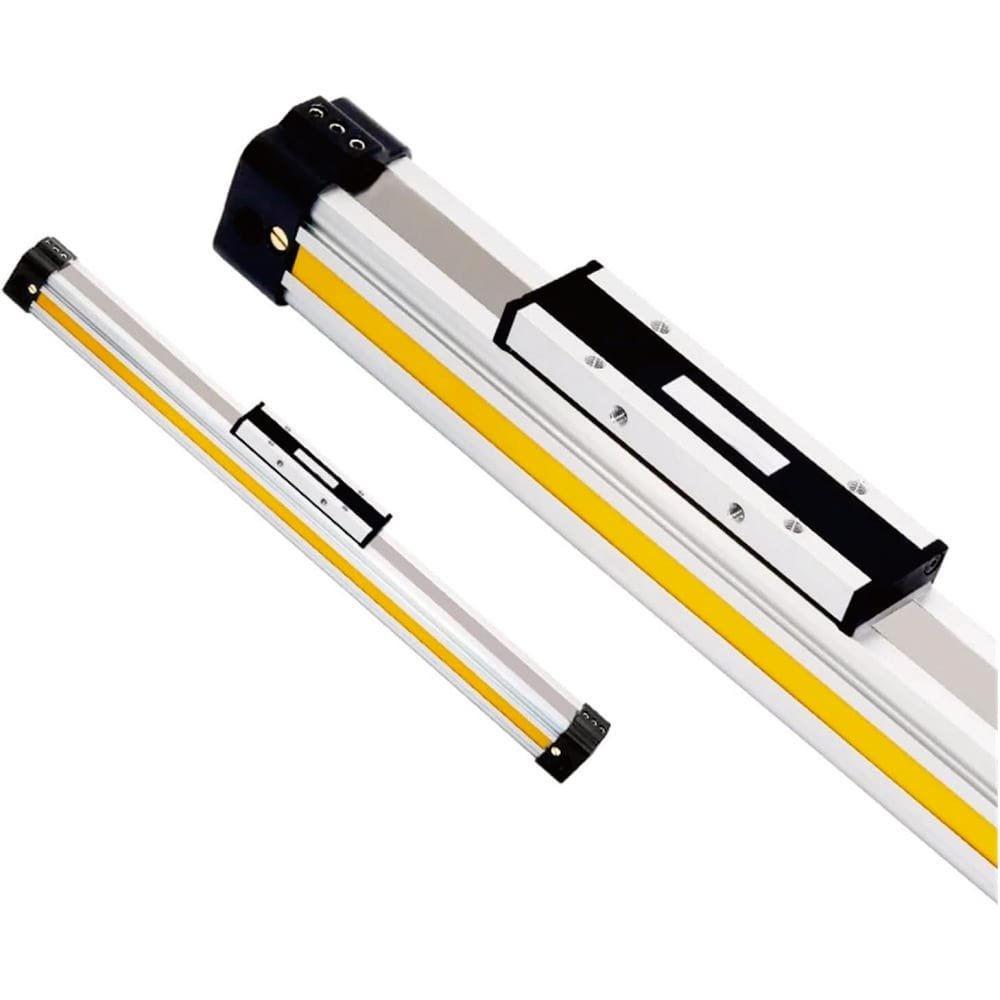
You can minimize hysteresis by selecting low-friction cylinder seals and precision guide systems (reducing mechanical hysteresis by 50-70%), using high-quality proportional valves with position feedback on the spool (cutting valve hysteresis in half), implementing proper air preparation with pressure stabilization (eliminating compressibility effects), and applying software compensation algorithms that account for directional differences—together achieving total system hysteresis below 2% of full scale. At Bepto, we’ve engineered our rodless cylinders specifically to minimize the friction-related hysteresis that dominates most systems.
Component-Level Solutions
Cylinder Design Optimization
The cylinder is often the largest contributor to hysteresis. Key design features that minimize friction-related hysteresis:
Low-friction seal materials: Our Bepto rodless cylinders use advanced polyurethane seals with molybdenum disulfide5 additives that reduce breakaway friction by 40% compared to standard NBR seals. Lower friction means less directional dependence.
Precision guide rails: Ground and hardened guide rails (0.02mm straightness tolerance) eliminate binding and uneven friction that creates hysteresis. Standard cylinders with 0.1mm guide tolerance exhibit 3-5x more friction-related hysteresis.
Optimized seal geometry: Our seals are designed with asymmetric lip geometry that equalizes friction in both directions, reducing directional hysteresis by up to 60%.
Rigid carriage design: Torsional rigidity prevents seal loading variations under asymmetric loads, maintaining consistent friction characteristics.
Valve Selection and Configuration
Not all proportional valves are created equal:
Closed-loop spool positioning: Valves with internal position feedback on the spool reduce valve hysteresis from 4-5% to under 2%. The investment pays off in improved system performance.
High-frequency dither: Some advanced valves apply a small, high-frequency oscillation to the spool that overcomes static friction, effectively eliminating stiction-related hysteresis.
Oversized valve capacity: Operating a valve at 40-60% of maximum flow reduces pressure drop and improves response, indirectly reducing hysteresis effects.
System Design Best Practices
Minimize air volume: Shorter hoses and smaller fittings reduce compressibility effects. Every meter of 6mm hose adds approximately 0.5% hysteresis.
Use pressure transducers, not regulators: For closed-loop force control, measure actual cylinder pressure with a transducer rather than relying on regulator settings.
Implement software compensation: Modern controllers can store hysteresis maps and apply directional compensation, effectively canceling 50-70% of residual hysteresis.
Stabilize supply pressure: A precision pressure regulator on the supply line eliminates pressure variation that appears as hysteresis in the control loop.
Performance Comparison
| System Configuration | Typical Hysteresis | Force Control Accuracy | Relative Cost |
|---|---|---|---|
| Standard cylinder + basic valve | 10-15% | ±10% | 1x (baseline) |
| Standard cylinder + quality valve | 6-9% | ±6% | 1.4x |
| Bepto rodless + basic valve | 4-6% | ±4% | 1.3x |
| Bepto rodless + quality valve | 2-3% | ±2% | 1.8x |
| Bepto rodless + premium valve + compensation | <2% | ±1% | 2.2x |
| Servo-electric actuator | <1% | ±0.5% | 5-7x |
The Bepto Advantage for Force Control
Our rodless cylinders are specifically engineered for proportional control applications:
Advanced Seal Technology
We’ve invested heavily in seal development, creating proprietary compounds that deliver:
- 40% lower breakaway friction
- 60% more consistent friction across temperature range (-10°C to +60°C)
- 3x longer life in dynamic applications (10M+ cycles)
Precision Manufacturing
Every Bepto rodless cylinder features:
- Guide rails ground to 0.02mm straightness
- Matched bearing sets for uniform loading
- Precision-bored cylinder tubes (H7 tolerance)
- Balanced carriage design for symmetric friction
Application Support
When you work with us, you get:
- Free hysteresis analysis of your current system
- Application-specific seal recommendations
- Valve sizing and selection assistance
- Software compensation algorithms (for compatible controllers)
- Documented performance data from factory testing
Practical Implementation Example
Here’s how we helped optimize a force control application:
Before (Standard System)
- Standard rodless cylinder with NBR seals
- Basic proportional valve (no feedback)
- 8% measured hysteresis
- ±8% force variation
- 3% scrap rate
After (Bepto Optimized System)
- Bepto rodless cylinder with low-friction seals
- Quality proportional valve with spool feedback
- Optimized air lines (reduced volume by 40%)
- Software compensation in PLC
- 1.8% measured hysteresis
- ±2% force variation
- 0.3% scrap rate
Investment: $1,200 additional cost
Payback: 2.3 months from scrap reduction alone
Additional benefits: Faster cycle time, reduced maintenance
Why Engineers Choose Bepto for Proportional Control
We understand that hysteresis isn’t just a technical curiosity—it’s a real problem that costs you money every day. 💡 Our rodless cylinders are designed from the ground up to minimize friction-related hysteresis, which typically accounts for 50-70% of total system hysteresis.
And here’s the best part: our cylinders cost 30% less than OEM equivalents while delivering superior performance. We ship in 3-5 days instead of 6-8 weeks, so you can test and validate quickly. Plus, our technical team (that includes me! 👋) provides free application engineering support to help you optimize your entire system—not just sell you a cylinder.
Conclusion
Understanding and minimizing hysteresis in proportional pressure control is essential for achieving the precise, repeatable force control that modern manufacturing demands—and the right cylinder design is your most powerful tool for reducing hysteresis at its largest source. 🚀
FAQs About Hysteresis in Proportional Pressure Control
What is an acceptable level of hysteresis for most industrial applications?
For general industrial force control applications, hysteresis below 5% of full scale is acceptable, while precision assembly operations typically require hysteresis below 2-3% to maintain quality standards. If your process can tolerate ±5% force variation, then 5% hysteresis is workable. However, remember that hysteresis compounds with other error sources (pressure variation, temperature effects, wear), so targeting 2-3% hysteresis provides a safety margin for long-term reliable operation.
Can I compensate for hysteresis with better control algorithms?
Software compensation can reduce the practical impact of hysteresis by 50-70%, but it cannot eliminate the underlying physical causes—and compensation becomes less effective as hysteresis increases beyond 8-10% of full scale. Modern PLCs and motion controllers can store hysteresis maps and apply directional correction, which works well for predictable, repeatable hysteresis. However, if your hysteresis varies with temperature, wear, or load conditions, software compensation becomes unreliable. The best approach is to minimize physical hysteresis first, then use software to handle the residual.
Why does my system perform differently in winter versus summer?
Temperature changes affect seal friction, air viscosity, and valve performance—typically increasing hysteresis by 30-50% over a 30°C temperature range, with the largest effect coming from seal friction changes. Standard NBR seals become stiffer and higher-friction at low temperatures, dramatically increasing hysteresis. Bepto’s advanced seal compounds maintain more consistent friction across temperature ranges, reducing this seasonal variation. If you’re experiencing temperature-related performance issues, upgrading to low-friction seals often provides a complete solution. 🌡️
How often should I measure hysteresis to detect component wear?
Measuring hysteresis quarterly during preventive maintenance allows you to detect seal wear, valve degradation, and mechanical looseness before they cause quality problems—a 50% increase in hysteresis typically indicates components approaching end-of-life. We recommend establishing a baseline hysteresis measurement when your system is new, then tracking changes over time. Gradual increases indicate normal wear; sudden changes suggest a specific failure (seal damage, valve contamination, loose fitting). Catching these early prevents unexpected downtime.
Why are Bepto rodless cylinders better for proportional control than standard cylinders?
Bepto rodless cylinders reduce friction-related hysteresis by 50-70% compared to standard cylinders through advanced low-friction seals, precision-ground guide rails, and optimized carriage design—all while costing 30% less than OEM alternatives and shipping in 3-5 days instead of 6-8 weeks. Since cylinder friction typically accounts for 50-70% of total system hysteresis, upgrading to Bepto cylinders delivers the single largest performance improvement you can make. We also provide factory hysteresis test data and free application engineering support to help you optimize your entire system. When you combine our cylinders with quality valves and proper system design, achieving sub-2% hysteresis becomes straightforward and affordable. 🎯
-
Understand the physics behind the lag between magnetic field strength and magnetization in solenoid coils. ↩
-
Learn about the specific friction phenomenon where the force required to initiate motion exceeds the force to maintain it. ↩
-
Explore the hardware and software systems used to measure and record real-time physical signals like pressure and voltage. ↩
-
Review the methods used to adjust Proportional-Integral-Derivative controllers for optimal system stability and response. ↩
-
Discover the properties of this solid lubricant additive used to reduce friction and wear in industrial seals. ↩