

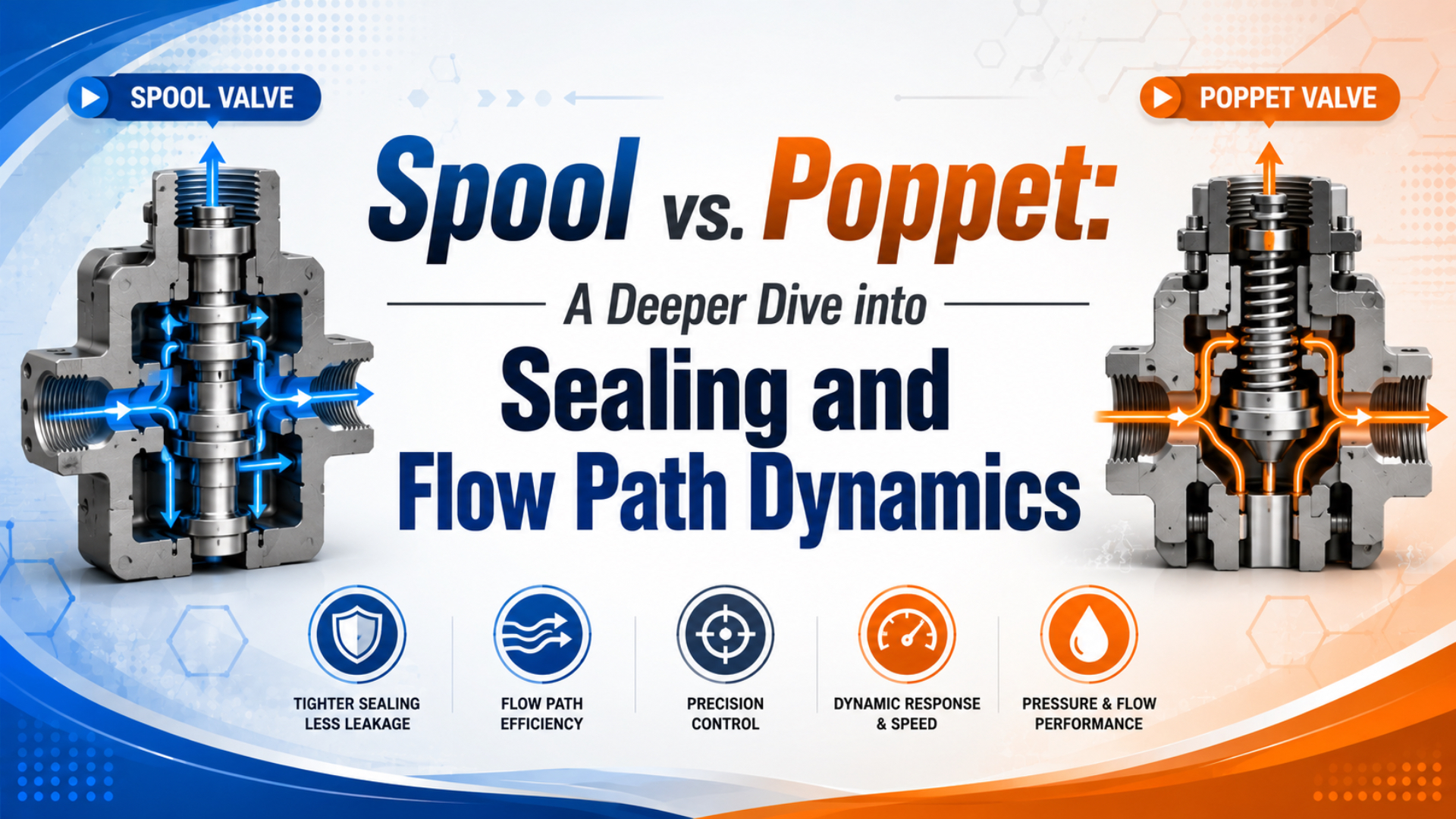
Spool and poppet identify the moving element inside a valve, not a guaranteed level of leakage, flow, speed, or contamination resistance. A spool slides through a bore to connect ports across metering edges. A poppet lifts from or returns to a seat, creating or closing an annular opening. Useful comparison starts one layer deeper: examine the sealing interface, effective opening area versus travel, pressure forces, crossover during motion, and published flow data for the exact model. Those five checks explain why two valves with the same port size and symbol can behave differently in the machine.
Geometry screens the candidates.
Test data makes the decision.
Key Takeaways
- Festo identifies spool and poppet as the two most common compressed-air valve technologies, with several seal variants inside the spool family.
- Architecture is not a performance guarantee.
- Compare stable and transitional flow paths.
- Use model-level leakage and ISO 6358 flow data with stated pressure, direction, medium, temperature, and test method.
What Actually Changes Between a Spool and a Poppet?
Spools meter across lands and ports; poppets meter around a seat. Festo identifies these as the two most common compressed-air valve technologies, then divides piston-spool valves into multiple sealing categories with different leakage, friction, pressure, and wear behavior (Festo, 2018).
A spool valve is a valve whose cylindrical moving element uses lands, grooves, and sealing regions to connect or block ports. The spool normally travels along the axis of its bore. The local air path may cross it nearly radially, turn through a body gallery, and then leave through another port. A poppet valve is a valve whose moving sealing element lifts from or returns to a seat. Its opening first appears as a narrow curtain around the seat perimeter, while downstream body passages determine where the air turns and how much area remains available.
Operator type is a separate classification. Either element can be direct acting or pilot operated. Parker’s pneumatic valve fundamentals describe direct solenoid and pilot-operated arrangements for spool or poppet mechanisms (Parker). The direct-acting and pilot-operated valve guide covers that distinction.
| Question | Spool architecture | Poppet architecture |
|---|---|---|
| Moving element | Cylindrical lands and grooves | Disc, cone, ball, or shaped sealing element |
| Primary motion | Axial sliding in a bore | Lift toward or away from a seat |
| Flow opening | Port window exposed by a metering edge | Curtain area around the seat |
| Multiport routing | Several paths can be switched by one spool | Several seats or poppets may be required |
| Sealing options | Metal clearance, moving soft seal, static cartridge seal | Metal or soft seat contact |
Names classify.
Data qualifies.
Use the existing spool-versus-poppet selection overview for application-level choices. This article stays at the geometry and transient-flow level so the two guides answer different questions.
Sealing Interface: Clearance, Sliding Seal, or Seat Contact
“Spool” alone does not specify the sealing mechanism or performance. Festo describes hard-sealed spools with an air gap of only a few micrometers, soft seals carried by the spool or housing, and cartridge seals retained in metal cages (Festo, 2018).
Hard-sealed spools use the bore or sleeve as both guide and sealing surface. Clearance permits motion without elastomer friction, but it also creates an internal bypass path. Thermal expansion, housing distortion, machining error, and wear change that clearance. The result is not a universal leakage rate; it is a geometry-sensitive characteristic that must be tested at specified pressure and temperature. Soft-sealed spools close paths with O-rings or molded seals. They can reduce internal leakage, yet the sliding interface introduces breakaway friction, wear at port edges, and sensitivity to seal swell or adhesion after a long dwell. Cartridge designs move the metal spool through retained sealing cages, changing both the wear interface and pressure capability.
Poppet contact develops pressure at a seat. A soft seat can conform to small surface errors, whereas a metal seat relies more heavily on geometry and finish. Neither should be described as permanently leak-free. Seat contact can fail because of particles; cuts or deformation; reverse pressure; insufficient closing force; material incompatibility.
Start selection with three questions: where is the sealing interface; does it slide during every cycle; what force keeps it closed against the stated pressure? Those questions expose wear and leakage mechanisms before a catalog adjective does.
In our experience, asking about the sealing interface before requesting a valve type improves supplier discussions. It prompts specific answers about clearance and seal location; seat material and pressure-assisted contact; permitted direction and reverse pressure; the actual leakage test instead of another category-level claim.
How Does Valve Travel Create an Effective Flow Area?
For machine selection, installed flow begins at the smallest effective opening rather than the threaded port. One Festo 5/2 poppet example uses three axial seals. Its piston-spool alternatives use different land and sleeve geometry plus moving-seal or cartridge-seal arrangements (Festo, 2018).
Near the start of opening, spool area grows with the total active metering-edge width and with travel beyond any positive overlap. At small poppet lift, the opening grows with seat perimeter and the gap normal to the seat. A useful first-order geometry model is:
Here, and are idealized opening areas; is element travel; is positive spool overlap; is total active metering-edge width; is poppet seat perimeter; is the angle between seat surface and motion axis. The approximation applies only near opening and does not replace tested flow data.
That is an area model, not a flow rating.
Real valves depart from it. Chamfers, rounded lands, multiple windows, vena contracta, seat shape, downstream turns, and adjacent passages affect discharge. We found the model most useful as a sensitivity map: once another restriction becomes smaller, additional element travel may add little installed flow.
Port size is a weak shortcut because the port-size and internal-orifice guide shows how a large connection can feed a smaller internal restriction.
Why Do Pressure Balance and Actuation Force Matter?
Pressure force depends on the unbalanced projected area, not on the words spool or poppet. In Festo’s pressure-dependent poppet example, the two effective diameters differ, so supply pressure produces an unbalanced force that requires a larger pilot stage (Festo, 2018).
A first-order relationship is:
Here, is the net pressure force in newtons, is the relevant pressure difference in pascals, and is the unbalanced projected area in square metres. Spring force, seal friction, inertia, flow force, and pilot pressure must be added to obtain the operator force required during motion. Balanced spool geometry can make the static pressure contribution small, but it does not remove friction or dynamic flow forces. A pressure-assisted poppet can use inlet pressure to improve closing contact, yet the same arrangement may restrict reverse flow or raise the opening force. Pressure-balanced poppets form another design class.
Balance changes the force budget.
Do not infer balance from the valve symbol. Ask for minimum operating pressure, maximum back pressure, permitted reverse pressure, external or internal pilot arrangement, and behavior during supply decay. Those fields reveal whether the valve can shift and reseat under the actual circuit state. Coil force and pilot architecture then contribute to command-to-flow response; the electromagnetic-drive guide explains that timing chain.
What Happens During Overlap and Crossover?
The steady-state symbol does not describe every connection made while the valve is moving. Festo documents a poppet arrangement in which ports 1, 2, 4 and the exhaust paths can communicate during transition, producing blow-by, leakage, and noise (Festo, 2018).
Spool timing depends on land overlap. Positive overlap means the closing edge blocks the old path before the opening edge exposes the new path. With negative overlap, both paths may communicate briefly. Zero or near-zero overlap can reduce the dead band but becomes more sensitive to tolerance, wear, and element position. Poppet crossover instead depends on the number of seats and their sequence. One seat can close before another opens, or the motions can overlap. A generic “poppet means closed crossover” claim is unsafe because multi-poppet geometry, operator compliance, and pressure forces determine the intermediate state.
Intermediate states can matter most.
Why does a millisecond-scale state matter? Temporary supply-to-exhaust flow can waste air and create noise, while an unintended work-port connection can alter motion or release vacuum and trapped pressure; the correct test records valve command, port pressures, and downstream motion on a shared time base.
In motion-control work, the acoustic click is not the state change. It marks mechanical activity somewhere in the operator. Pressure traces at the work ports provide stronger evidence that the intended flow path has actually formed. From our work on replacement reviews, a synchronized port-pressure trace usually resolves a crossover question more directly than sound or command timing alone. It shows three events: whether the old path closed; whether the new path opened; whether a brief supply-to-exhaust connection occurred.
Interpreting ISO 6358 Flow Data
ISO 6358-1 defines steady-state tests for pneumatic components with fixed or variable flow paths. A second amendment covering measurement uncertainty was published in April 2026. The standard provides a comparison framework rather than a rule that one architecture must outperform the other (ISO 6358-1; Amendment 2).
When selecting for compressed air, compare three fields: sonic conductance; critical pressure ratio; the supplier’s stated reference conditions. Cv or nominal flow remains useful only when its method and units are clear; never mix different media and directions or different reference pressures and standard-volume conventions.
| Data field | Selection question it answers | Common comparison error |
|---|---|---|
| Sonic conductance | How much choked-flow capacity does the tested path provide? | Comparing a supply path with another valve’s exhaust path |
| Critical pressure ratio | Where does the tested component transition between subsonic and choked behavior? | Treating as a universal constant |
| Cv or Kv | What standardized capacity did the supplier declare? | Ignoring gas conditions or converting without the stated method |
| Nominal flow | What catalog flow was reported at stated pressures? | Comparing values that use different pressure pairs |
| Effective area | What equivalent restriction did the test imply? | Treating it as the literal geometric opening |
Match the method before comparing numbers.
The sonic-conductance and critical-pressure-ratio guide explains the ISO 6358 variables. For Cv-based catalog comparisons, use the flow-coefficient guide. ISO 6358-3 then calculates system behavior from components and piping with known flow characteristics. Valve plus sub-base plus fittings plus tube and silencer form one flow chain; a high-capacity valve can still produce a slow actuator when another element becomes the dominant restriction (ISO 6358-3, 2014).
Why Do Category-Wide Leakage Claims Fail?
Leakage must be specified by state; pressure; direction; medium; temperature; acceptance method. Festo gives its cartridge-sealed spool and conventional poppet the same top qualitative rating for low leakage. That comparison disproves the shortcut that all spools leak more than all poppets (Festo, 2018).
Internal leakage is flow between supply, work, or exhaust passages while the valve remains externally sealed. External leakage escapes the pressure boundary. A product can perform well on one measure and poorly on the other, so both limits belong in the acceptance record. State matters as well: measure the de-energized state, every energized position, and any center position used by the circuit. If the valve is bidirectional, test both directions because a pressure-assisted seat can change contact force when inlet and outlet are reversed.
Leakage adjectives are not acceptance criteria.
Avoid “zero leakage” unless the supplier defines every test condition: detection limit and method; medium; pressure and temperature; duration. A defensible requirement states maximum internal leakage for each commanded state; external leakage at minimum and maximum pressure; normal and reverse direction; air quality and seal material; separate new-valve and service limits; instrument resolution and stabilization time. In a cylinder-holding circuit, remember that cylinder seals plus fittings and connected devices can also permit drift.
Contamination, Wear, and Stick-Slip
During service, ISO 8573-1 classifies compressed-air purity by three groups: particles, water and oil. Each can affect either architecture. Festo separately documents a self-cleaning effect at some poppet seats plus micrometre-scale clearance and sliding-seal concerns in spool variants (ISO 8573-1; Festo).
Particles can score a hard spool or cut a sliding seal. They can also wedge the element and change internal leakage. At a poppet, the same debris may be flushed away; it may instead become embedded in a soft seat or trapped across the contact line. “Self-cleaning” describes a possible flow effect, not permission to ignore filtration. Water can alter lubrication and promote corrosion or low-temperature problems. Oil compatibility depends on the elastomer plus lubricant chemistry and exposure. Follow the exact valve’s air-quality and lubrication requirements rather than assigning one cleanliness rule to every spool or poppet.
Clean air protects both designs.
Stick-slip is most relevant where a soft sliding seal alternates between static and dynamic friction, although seat adhesion can affect a poppet after dwell with a different failure signature. Before blaming the architecture, record cold-start and thermally stable response, minimum-pressure switching, leakage, and cycle variation; then obtain the rated-life conditions and failure criterion because seal speed, impact energy, pressure, temperature, contamination, pilot behavior, and mounting distortion all contribute.
A Geometry-First Selection Method
For function-first selection, Parker defines a two-way directional valve by two ports and two positions. Either can use a spool or poppet element, which separates circuit function from internal construction and keeps the selection sequence in the right order (Parker Pneumatic Valve Fundamentals).
Function comes first.
Start with the required stable states. Define the valve symbol, normal position, center condition, failure state, and permitted flow directions. Then document what must happen during transition: closed crossover, controlled overlap, permitted blow-by, or a maximum pressure disturbance.
| Dominant requirement | Evidence to compare |
|---|---|
| Low shutoff leakage | Sealing interface, closing force, flow direction, numerical leakage, and test method |
| Multiport routing | Every supply-to-work and work-to-exhaust passage, including center and transition states |
| Fast switching | Energizing and de-energizing time at relevant pressure, voltage, temperature, and load |
| High installed flow | ISO 6358 or compatible data for the correct direction plus the complete flow chain |
| Dirty or wet air | Corrected air-treatment condition and the exact valve’s stated purity limits |
Only then use architecture as a screening preference. A spool often packages several directional paths efficiently, while a poppet often provides a direct seat-based shutoff. Those tendencies narrow the candidate list; they do not replace model-level evidence. Some circuits benefit from both: a spool directional valve can route an actuator while a separate poppet performs low-leak isolation. This is not redundancy by default. Each element has a distinct job, and any safety function still requires an appropriate risk assessment and validated architecture.
Replacement and RFQ Checklist
ISO 6358-3 uses known component and piping characteristics to estimate complete-system flow, including subsonic and choked conditions. A replacement should therefore be checked as part of the manifold, tubing, fittings, and exhaust path rather than accepted because its thread and envelope match (ISO 6358-3, 2014).
Include these fields in a replacement review or RFQ:
- full valve symbol, ports, positions, and center state;
- spool or poppet element plus direct or pilot actuation;
- supply, work, exhaust, pilot, and reverse-flow limits;
- minimum, normal, and maximum absolute pressure;
- required flow for each supply and exhaust path;
- ISO 6358 values, Cv, Kv, or nominal-flow test conditions;
- internal and external leakage limits by commanded state;
- overlap, crossover, and blow-by requirements;
- energizing and de-energizing response definitions;
- air purity, lubrication policy, seal material, and temperature;
- voltage, power, connector, suppression, duty cycle, and ingress protection;
- mounting pattern, manifold restrictions, and permitted back pressure;
- expected state after loss and restoration of air or electrical power.
If crossover or leakage can cause hazardous motion, bench testing alone is insufficient. Verify the installed circuit under an approved procedure, with the hazard zone controlled and pressure traces captured at the relevant work ports.
Spool vs. Poppet FAQs
ISO 6358-1 has two published amendments as of 2026, including effective conductance and measurement uncertainty. That continuing test-method work reinforces the central selection rule: compare declared performance under compatible conditions instead of ranking entire valve architectures by one adjective (ISO 6358-1).
Does a poppet valve always leak less than a spool valve?
No. Seat contact can support low shutoff leakage, but contamination, damage, pressure direction, material, and closing force still matter. Hard-clearance spools have an inherent bypass path, while soft-sealed or cartridge-sealed spools form different leakage classes. Specify a numerical limit and test condition for the exact model.
Does a spool valve always have lower pressure drop?
No. Spool windows, galleries, manifolds, and exhaust paths can restrict flow; poppet seat area and downstream passages can do the same. Compare compatible ISO 6358, Cv, Kv, or stated nominal-flow data for the required direction, then include tubes, fittings, and silencers in the installed review.
Which design responds faster?
Neither architecture wins automatically. A short poppet stroke can reduce mechanical travel, while a balanced spool can reduce pressure force. Coil current, pilot volume, spring force, seal friction, pressure, temperature, and sensing definition also affect the result. Compare both energizing and de-energizing times under matched conditions.
Can a poppet replace a multiport spool valve?
Only if the replacement reproduces every required stable and transitional flow path. One spool can route several ports through its lands and grooves, whereas a poppet design may require multiple seats, so confirm the symbol, center condition, crossover, flow direction, pilot requirements, leakage, response, and failure state before replacement.
Which design handles contaminated air better?
Neither makes air treatment optional. Some poppet seats can shed loose particles, while hard debris can also damage the seat. Spool bores and sliding seals can score, jam, or wear. Use the valve manufacturer’s particle, water, oil, filtration, and lubrication requirements, then investigate the actual failure mode.
Architecture explains how a valve creates and closes flow paths. It does not certify the installed result. Select by sealing interface, metering geometry, pressure balance, crossover, and measured performance, then confirm the complete circuit under the conditions the machine will actually see.
Sources and technical references
- Festo, “Piston spool valves and poppet valves: A technical comparison of available solenoid valves”, 2018. Retrieved 2026-07-22.
- ISO 6358-1:2013, steady-state flow test methods for pneumatic components. Retrieved 2026-07-22.
- ISO 6358-1:2013/Amd 2:2026, evaluation of measurement uncertainty. Retrieved 2026-07-22.
- ISO 6358-3:2014, calculation of system flow-rate characteristics. Retrieved 2026-07-22.
- ISO 8573-1:2010, compressed-air contaminants and purity classes. Retrieved 2026-07-22.
- Parker Hannifin, “Pneumatic Valve Fundamentals”. Retrieved 2026-07-22.